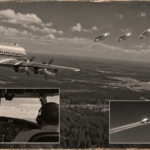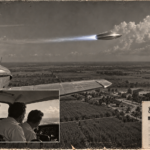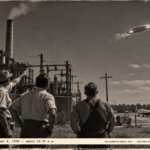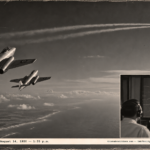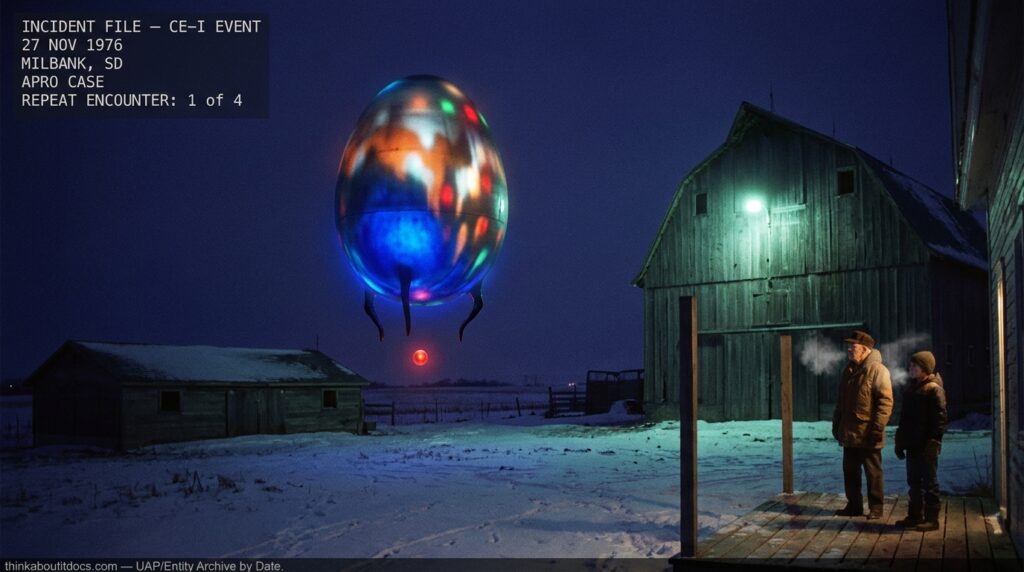
November 27, 1976 — A 30-foot egg-shaped craft hovers between the barn and hog house on the Foss family farm near Milbank, South Dakota, approximately 100 feet from witnesses Mike and Norman Foss. The object's multicolored lights melted into one another in a slow color-wheel pattern, and it emitted silent red spheres that exploded harmlessly. The craft returned three additional times.
THINK ABOUTIT UFO|UAP SIGHTING REPORT
1976: Repeat sightings in South Dakota
On the evening of November 27, 1976, police radio dispatcher Mike Foss drove home to his family’s farm south of Milbank, South Dakota, to find that the brilliant orange light he had been watching from the highway had followed him — and was now hovering between the barn and the hog house, barely a hundred feet from where he stood with his father, its thirty-foot egg-shaped body pulsing with melting multicolored lights and emitting silent red balls that exploded into nothing. The object would return three more times over the following weeks, and on one of those visits, the family dog was found dead — its body bearing marks consistent with severe thermal exposure.
Investigated by veteran APRO field researcher William M. Moore and documented in the APRO Bulletin, the Milbank repeat-encounter sequence stands as one of the most detailed rural close-encounter cases in the South Dakota archive — combining a credible law-enforcement-connected witness, physical interference with electronics, repeat visitation behavior, and tragic physiological effects on a domestic animal.
Date: November 27, 1976 (initial encounter; object returned on three subsequent occasions)
Sighting Time: Approximately 6:30 p.m. CST
Day/Night: Night
Location: Foss family farm, several miles south-southwest of Milbank, South Dakota
Urban or Rural: Rural — isolated farm
No. of Entity(‘s): None observed
Entity Type: Not Applicable
Entity Description: Not Applicable
Hynek Classification: CE-I (Close Encounter of the First Kind) — Object observed at approximately 100 feet distance, well within the 500-foot CE-I threshold. Reclassified from NL; see Researcher’s Notes.
Duration: 20 to 25 minutes (initial encounter)
No. of Object(s): 1
Description of Object(s): Egg-shaped craft, blue at its base, with melting multicolored lights (orange, white, blue, red, green) cycling across its body in a slow color-wheel fashion; two protruding legs or antennae; emitted silent red balls that exploded harmlessly
Shape of Object(s): Egg-shaped
Size of Object(s): Approximately 30 feet across (occupied half the 60-foot gap between the barn and hog house); witness initially estimated 40 feet
Color of Object(s): Blue at base; multicolored lights (orange, white, blue, red, green) melting into one another across the body; brilliantly orange at distance
Distance to Object(s): Approximately 100 feet (between the barn and hog house, observed from the farmhouse)
Height & Speed: Hovered above the hog house (approximately 15 feet high) but below the peak of the barn (35–40 feet); drifted slowly to the southwest during departure
Number of Witnesses: 3 (Mike Foss, Norman Foss, Mrs. Foss — though Mrs. Foss observed primarily from inside the house)
Special Features/Characteristics: Repeat visitation (object returned on three additional occasions after the initial encounter); electronic interference (television vertical roll during proximity); emission of silent “red balls” that detonated harmlessly; anomalous yard illumination during hover; possible photocell interference with mercury vapor yard light; family dog found dead with thermal-type injuries following a subsequent visit; object appeared to follow the witness home from the highway
Case Status: Unexplained
Source: William M. Moore, Field Investigator, APRO Bulletin, Vol. 25, No. 5 (November 1976)
Summary/Description: Police radio dispatcher Mike Foss observed a brilliantly orange light while driving south on Highway 77 from Milbank. After stopping to observe it hovering over a roadside field, Foss drove home to retrieve his parents. Upon arrival, the object had followed and was hovering between the barn and hog house at approximately 100 feet distance and 15–40 feet altitude. For 20–25 minutes, the three witnesses observed a 30-foot egg-shaped craft with multicolored lights, protruding appendages, and silent red-ball emissions. The object drifted slowly to the southwest and disappeared. It returned on three subsequent occasions. Television interference was noted during proximity, and the family dog was later found dead with thermal injuries.
Related Cases: 1956 Redfield, SD — Hewitt Encounter | 1977 South Dakota Missile Field Incident | 1953 Ellsworth AFB Radar-Visual Pursuit
Detailed Report
Mike Foss was a 27-year-old part-time police radio dispatcher for the Milbank Police Department. A physical disability had forced him away from a more demanding career path despite considerable talents in architectural design. Following a recent divorce, he had moved back in with his parents, Norman and Mrs. Foss, who occupied a farmhouse several miles south and slightly west of Milbank, South Dakota. Norman Foss was a retired 19-year veteran of the South Dakota Highway Patrol. The family had occupied the farmhouse since June 1976 — only five months before the encounters began.
On the clear, cold evening of November 27, 1976 — temperature near zero — Mike Foss left an auto body shop in Milbank at approximately 6:30 p.m. and began driving south on Highway 77 toward the farm. He noticed a brilliantly orange light to the west, which he initially dismissed as the moon but quickly rejected that identification. After turning west onto a gravel county road, he realized the light source was hovering over a field alongside the road. He stopped for a better look but did not leave the vehicle, and noted no effects on the car’s electrical system or engine. What he was observing was clearly not a helicopter. Frightened, he accelerated toward home approximately a mile and a half away.
Intending to retrieve his parents and return to the field to show them what he had seen, Foss began honking his horn as he approached the driveway. He ran inside, shouting for his mother and father to come quickly. When he returned outside with his father, the object he had left in the field behind him was now positioned between the barn and the hog house on the family property — approximately 100 feet from where they stood.
For the next 20 to 25 minutes, the three Foss family members watched the object. It was large and egg-shaped, blue at its base, with multicolored lights cycling across its body in a slow melting pattern — orange, white, blue, red, and green, transitioning into one another rather than blinking. Two protruding structures, described as legs or antennae, extended from the craft. The object occupied roughly half the 60-foot gap between the barn and hog house, making it approximately 30 feet across. It hovered above the hog house (about 15 feet tall) but below the barn’s peak (35–40 feet).
During the observation, the witnesses noted that the farmyard was illuminated far more brightly than could be explained by moonlight. The moon was in first quarter and positioned in a different part of the sky. The mercury vapor yard light near the barn, operated by an automatic photocell, was also on — raising the question of whether the object’s luminosity was affecting or overriding the photocell’s ambient-light sensor.
Just prior to Mike’s arrival, Norman Foss had been watching television inside. The set had begun rolling vertically — a malfunction the elder Foss associated with wind disturbing the roof antenna, though conditions were calm. The television returned to normal after the object departed.
The object drifted slowly to the southwest, diminishing in size and intensity until it disappeared. During its hover, Norman Foss could hear what he believed was heavy truck traffic on the main highway two miles east, and clearly heard and saw a jet aircraft passing overhead to the west. He noted no unusual sounds from the object itself.
Mrs. Foss, who remained inside, observed from the window and reported that the two men came back in to retrieve a pair of opera glasses (6×15) for closer examination. APRO field investigator William M. Moore documented the encounter in detail, including diagrams of the farm layout prepared by Mike Foss himself, leveraging Foss’s architectural drafting skills.
The object returned on three subsequent occasions, each time appearing near the farm. During one of these return visits, the family’s dog was found dead, its body displaying injuries described as consistent with severe thermal exposure. This detail, while unverifiable in the absence of veterinary examination records, adds a physical-effects dimension to what is otherwise a purely observational encounter.
Researcher’s Notes
The Milbank Egg — Rural South Dakota 1976 and the Anatomy of a Repeat-Encounter Sequence
- Classification Correction — CE-I, Not NL: The existing page classified this encounter as NL (Nocturnal Light), which is incorrect given the reported observation parameters. The object was positioned between the barn and hog house at approximately 100 feet from the witnesses — well within the 500-foot threshold for CE-I under Hynek’s original taxonomy. The witnesses described structural details including shape (egg-shaped), surface features (protruding appendages, color-cycling lights, blue base), and size estimated against known reference structures. This level of structural resolution at this proximity is definitionally a close encounter, not a distant nocturnal light. CE-I is the correct classification.
- Witness Credibility — Law Enforcement Connection: Mike Foss’s position as a police radio dispatcher, while not equivalent to a sworn officer, places him within the law-enforcement communication ecosystem. His father Norman Foss was a retired 19-year veteran of the South Dakota Highway Patrol — a career that demands observational reliability and resistance to confabulation. The family’s willingness to cooperate with an APRO field investigation, and Mike’s ability to produce detailed architectural-quality diagrams of the farm layout and object profile, elevates this case above the typical single-witness rural sighting. Neither witness had any apparent motive to fabricate, and the elder Foss’s career background makes him a particularly credible corroborating observer.
- Physical Effects — Electronic Interference and Animal Death: The television vertical-roll anomaly during the object’s proximity, while individually explainable by mundane causes, gains significance in the context of the overall encounter. Norman Foss attributed the rolling to wind he expected but did not actually observe — the evening was calm. If the interference was caused by the object’s presence, it implies electromagnetic emission within the frequency range affecting VHF television reception. The animal death reported during a subsequent visit, if accurately described, would upgrade the encounter to CE-II territory (close encounter with physical effects), though the absence of veterinary documentation prevents formal reclassification on that basis alone.
- Source Quality — APRO Field Investigation: William M. Moore’s investigation for the Aerial Phenomena Research Organization represents the standard of civilian UFO field work in the 1976–1977 period. Moore conducted on-site interviews, documented the farm layout, and published his findings in the APRO Bulletin with sufficient detail for independent assessment. The APRO Bulletin, while an advocacy publication, maintained higher editorial standards than many contemporaneous UFO periodicals, and Moore’s report includes the kind of environmental and contextual detail — temperature, moon phase, yard-light photocell behavior, television channel number — that characterizes thorough investigative work.
- Pattern Context — Repeat Visitation Behavior: The object’s return on three subsequent occasions is the most unusual dimension of this case. Repeat-encounter sequences in the UAP literature are relatively rare compared to single-event sightings, and when they occur they tend to cluster around specific geographic locations rather than following specific witnesses. The Foss farm’s short occupancy (five months) and the encounters’ clustering within a brief window suggest that the location itself — rather than the witnesses — may have been the attractor, if an attractor model applies at all. Whether the repeat visits represent genuine return behavior by the same object or a geographic coincidence involving multiple unrelated phenomena cannot be determined from the available evidence.
The Milbank encounter of November 1976 closes as a well-documented, multi-witness close encounter investigated by a credible field organization, involving a structured object at close range that demonstrated interactive behavior, electronic interference, and troubling physical effects on a domestic animal. The repeat-visitation dimension elevates it beyond a single-event sighting into something closer to a localized phenomenon — one that played out across multiple nights on a quiet South Dakota farm, witnessed by a family whose professional backgrounds lent unusual weight to their testimony.