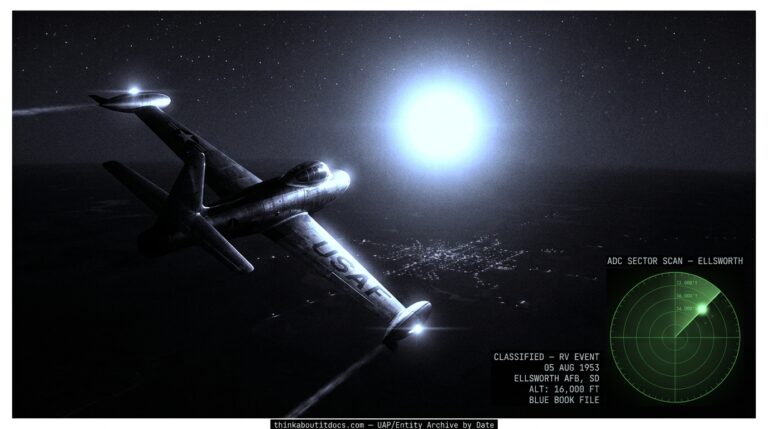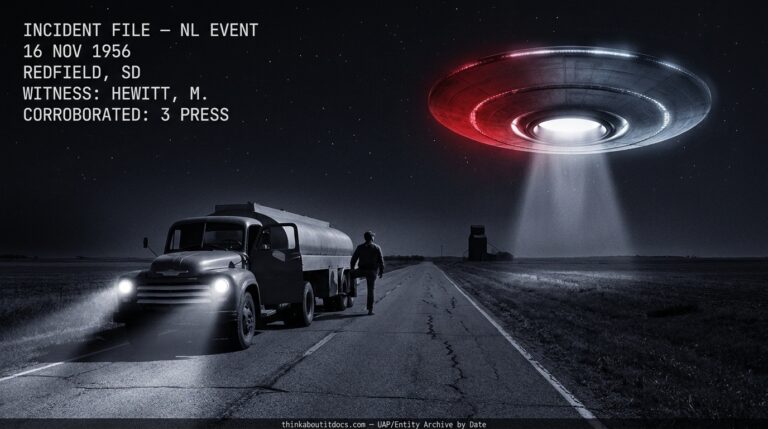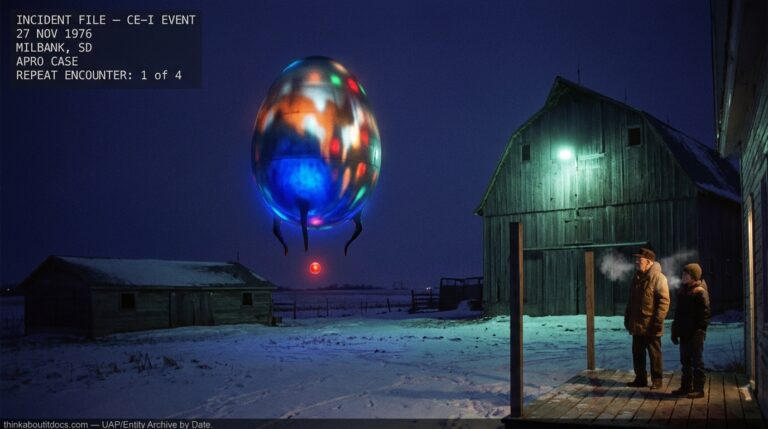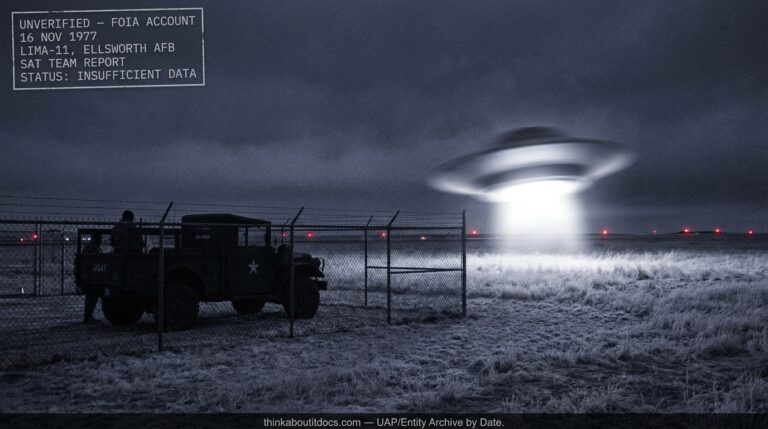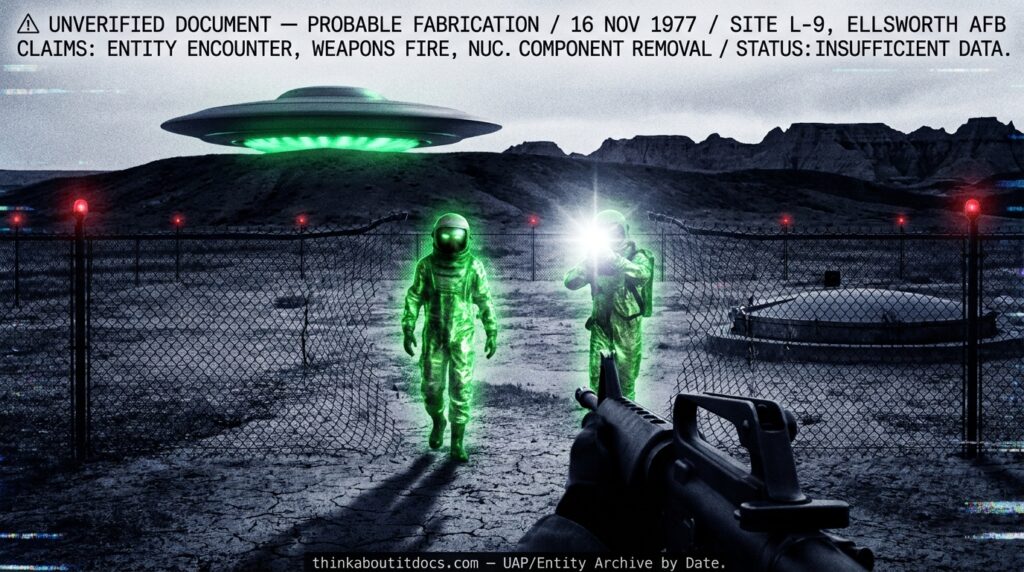
November 16, 1977 — A reconstruction of the unverified L-9 document's claims: two humanoid figures in glowing green metallic uniforms allegedly walked through the perimeter fence of a Minuteman missile site near Nisland, South Dakota, withstood M-16 fire, and departed in a saucer-shaped craft. The document's authenticity has never been confirmed; classified as probable fabrication.
THINK ABOUTIT UFO|UAP SIGHTING REPORT
1977: UFO Incident at USAF Missile Base
On the night of November 16, 1977, according to a document attributed to the Freedom of Information Act, two USAF security airmen at Minuteman missile site L-9 near Nisland, South Dakota, allegedly encountered two humanoid figures in glowing green metallic uniforms who walked through the site’s rear fence, withstood M-16 rifle fire — one shot in the back, one in the helmet — rose from the ground after falling, returned fire with a device that disintegrated one airman’s weapon and inflicted radiation burns on his hands, and then boarded a 20-foot saucer-shaped craft that climbed vertically and vanished over the eastern horizon. A site survey team reportedly measured radiation levels of 1.7 to 2.9 roentgens, and missile maintenance personnel allegedly discovered that the nuclear components had been removed from the warhead.
⚠ PROBLEMATIC SOURCE — PROBABLE FABRICATION:
This document has never been authenticated through verified FOIA channels. No FOIA release documentation, document control numbers, classification markings, or agency provenance have been independently confirmed. The claims — entity encounters, weapons fire with no effect, weapon disintegration, radiation exposure, and nuclear warhead component removal — represent extraordinary allegations that would have generated massive institutional response, yet no corroborating military records, medical records, security investigations, or Nuclear Weapons Incident (Broken Arrow/Bent Spear) reports have surfaced in the decades since. The document was disseminated through private research channels (Vanguard Sciences / Warren York), not through official declassification. Multiple UFO researchers have assessed this account as a probable fabrication or hoax document. It is preserved in this archive as a historical artifact of the case literature, not as a verified incident report. Readers should exercise extreme caution.
Date: November 16, 1977
Sighting Time: 20:59 hours (alarm activation); entity encounter and sighting occurred between approximately 21:32 and 22:30
Day/Night: Night
Location: Missile site L-9, approximately 7 miles southwest of Nisland, South Dakota (Ellsworth AFB missile field)
Urban or Rural: Military — USAF ICBM missile site, rural western South Dakota
No. of Entity(‘s): 2 (as claimed)
Entity Type: Humanoid (as claimed)
Entity Description: Figures described as wearing glowing green metallic uniforms with helmets and visors; capable of withstanding small-arms fire; carried a device that emitted a bright flash capable of disintegrating an M-16 rifle at range; recovered from being struck by bullets within approximately 15 seconds
Hynek Classification: CE-III (Close Encounter of the Third Kind) — Encounter with entity occupants, as claimed. Note: classification applied to the narrative as presented; the underlying account is unverified.
Duration: Approximately 30+ minutes (from SAT arrival through entity departure)
No. of Object(s): 1
Description of Object(s): Saucer-shaped craft emitting a glowing greenish light; entities entered through an unspecified access point
Shape of Object(s): Saucer
Size of Object(s): Approximately 20 feet in diameter and 20 feet thick
Color of Object(s): Glowing greenish light
Distance to Object(s): Object observed on the east side of a hill approximately 50 yards behind the missile site
Height & Speed: Climbed vertically from ground level and disappeared over the eastern horizon
Number of Witnesses: 2 (Airmen Jenkins and Raeke, as named in document)
Special Features/Characteristics: Alleged entity encounter at nuclear weapons site; entities reportedly impervious to M-16 fire; weapon disintegration via directed-energy device; radiation burns to witness; measured radiation contamination at site (1.7–2.9 roentgens); alleged removal of nuclear components from warhead; COVERED WAGON security upgrade; Backup Security Force deployment
Case Status: Insufficient Data — Probable fabrication. Document authenticity unverified. No corroborating records confirmed.
Source: Document attributed to FOIA release; disseminated through Vanguard Sciences / Warren York; no verified agency provenance
Summary/Description: Per the unverified document: At 20:59 hours, an O2 alarm activated at Minuteman site L-9 near Nisland, South Dakota. SAT members Jenkins and Raeke responded. Raeke observed a bright vertical light behind the rear fence line and, upon investigation, encountered a humanoid figure in a glowing green metallic uniform with helmet and visor. The figure refused to halt, aimed a device at Raeke that emitted an intense flash, disintegrating his M-16 and inflicting radiation burns on his hands. Jenkins subsequently observed two such figures walk through the rear fence. He fired two rounds, striking both — one in the back, one in the helmet. Both fell but rose approximately 15 seconds later and fired a similar device at Jenkins, who evaded. The entities entered a 20-foot saucer-shaped craft on the east side of the hill, which departed vertically. A site survey measured 1.7–2.9 roentgens radiation. Missile maintenance found nuclear components missing from the warhead.
Related Cases: 1977 Lima 11 Missile Field Incident (Same Date) | 1953 Ellsworth AFB Radar-Visual Pursuit
Detailed Report
The following narrative is reconstructed from a document attributed to a FOIA release concerning events at Ellsworth Air Force Base missile site L-9, approximately 7 miles southwest of Nisland, South Dakota. The document’s authenticity has not been independently verified. This report presents the claims as stated in the document, followed by analytical assessment.
At 20:59 hours on November 16, 1977, Airman First Class Phillips, assigned to Lima Security Control, reported an Outer Zone (O2) alarm activation at missile site L-9 to the Wing Security Control center. SAT (Security Alert Team) #1, consisting of A1C Jenkins and A1C Raeke, was dispatched with an estimated arrival time of 21:35 hours.
At 21:47 hours, A1C Phillips called WSC again to report that the situation at L-9 had been upgraded to COVERED WAGON — a security classification indicating a confirmed or suspected hostile intrusion at a nuclear weapons facility — at the request of Captain Larry D. Stokes, the Flight Security Officer. Security Option 11 was initiated, and two Backup Security Forces were formed.
According to the subsequent report compiled at 23:40 hours, Jenkins and Raeke arrived at site L-9 at 21:32 hours and dismounted to check the perimeter fence. Raeke observed a bright light shining vertically upward from behind the rear fence line, originating from a small hill approximately 50 yards to the rear of L-9. Jenkins remained at the vehicle while Raeke proceeded to investigate.
Upon reaching the crest of the hill, Raeke allegedly encountered an individual wearing a glowing green metallic uniform with a helmet and visor. Raeke challenged the individual, who refused to halt and continued walking toward the rear fence line. Raeke aimed his M-16 rifle and ordered the figure to stop. The intruder turned and aimed an object at Raeke that emitted a bright flash of intense light. This flash reportedly struck Raeke’s M-16, disintegrating the weapon and inflicting second- and third-degree burns on both hands. Raeke took cover and radioed Jenkins, who relayed a 10-13 distress call to Line Control.
Jenkins responded to Raeke’s position, carried him back to the SAT vehicle, then returned to the rear fence line to stand guard. Jenkins reportedly observed two figures in identical uniforms walk through the rear fence. He challenged them; they did not stop. Jenkins aimed and fired two rounds — one striking an intruder in the back, the other striking a helmet. Both figures fell to the ground. Approximately 15 seconds later, according to the account, the figures rose and one aimed a similar device at Jenkins, who took cover and evaded the flash. The two intruders then moved to the east side of the hill, where Jenkins observed them enter a saucer-shaped craft approximately 20 feet in diameter and 20 feet thick, emitting a greenish glow. The craft ascended vertically and disappeared over the eastern horizon.
Backup Security Force #1 arrived at 22:30 hours and established a security perimeter. A Site Survey Team arrived at 01:20 hours and measured radiation readings of 1.7 to 2.9 roentgens. Missile Maintenance personnel examined the missile and warhead and reportedly found the nuclear components missing. Colonel Speaker, Wing Commander, arrived and initiated an investigation. The document closes with a note that a follow-up report would be submitted by order of Colonel Speaker.
Supplementary information states that Raeke was treated at the base hospital for second- and third-degree radiation burns to both hands, and that his M-16 rifle could not be located at the site.
Researcher’s Notes
The L-9 Document — Ellsworth 1977 and the Anatomy of a Probable Fabrication
- Authenticity Assessment — Multiple Red Flags: This document exhibits numerous indicators of fabrication. First, the extraordinary nature of the claims — entity encounters, weapons fired at intruders who recover from bullet wounds, directed-energy weapon disintegrating an M-16, radiation contamination, and nuclear warhead component theft — would have triggered some of the most serious security and investigative protocols in the U.S. military arsenal, including Broken Arrow or Bent Spear reporting for the missing nuclear components. No such reports have ever surfaced. Second, the document was disseminated through private channels (Vanguard Sciences / Warren York) rather than through verified FOIA releases with traceable document control numbers. Third, no medical records for Raeke’s radiation burns, no criminal investigation reports for the weapons discharge, and no follow-up from the promised Colonel Speaker investigation have been produced. The complete absence of corroborating institutional documentation for what would have been one of the most serious security breaches in ICBM history is, by itself, near-decisive.
- Narrative Analysis — Too Perfect a Story: The document reads more like a screenplay treatment than a military incident report. Real security incident documentation tends to be bureaucratic, repetitive, and full of procedural notation; this account unfolds as a clean dramatic narrative with escalating tension, heroic action, and a tidy resolution. The specificity of certain details (the rifle is disintegrated, the burns are precisely categorized, the radiation readings are given to one decimal place) contrasts sharply with the absence of any verifiable institutional context. Real FOIA releases from this era typically include redaction marks, classification stamps, routing codes, and document numbers — none of which have been associated with this text.
- Same-Night Context — The Lima 11 Account: This incident shares its date (November 16, 1977) and installation (Ellsworth AFB missile field) with a separate, far more modest account from Lima 11 — a brief claim of a saucer-shaped object rising from near a missile site. The Lima 11 account, while also unverified, describes a plausible and restrained sighting consistent with the broader UAP-at-nuclear-facilities pattern. It is possible that a genuine anomalous event occurred that night at Ellsworth — perhaps something similar to the Lima 11 account — and that the L-9 document was constructed around that kernel, embellishing a real sighting into a dramatic entity encounter with extraordinary physical effects.
- Why This Case Persists in the Literature: Despite its near-certain fabrication, the L-9 document continues to circulate because it touches the most sensitive intersection in the UAP field: non-human intelligence and nuclear weapons. The broader pattern of UAP activity at ICBM sites is well-documented through legitimate channels — Malmstrom 1967, Minot 1968, and others supported by named witnesses and declassified records. The L-9 story leverages this legitimate pattern to lend credibility to an extraordinary claim. Its persistence serves as a cautionary example of how fabricated documents can embed themselves in the research literature by attaching to real, verified phenomena.
The L-9 document is preserved in this archive as a historical artifact — a case that has circulated in the UFO literature for decades and that researchers will encounter. It is not presented as a verified event. The claims it contains are extraordinary, the provenance is unverified, the corroborating institutional records are entirely absent, and the narrative structure more closely resembles fiction than military documentation. Classified as Insufficient Data with a Probable Fabrication assessment, it stands as a reminder that the integrity of the archive depends on the willingness to distinguish between the documented and the desired.