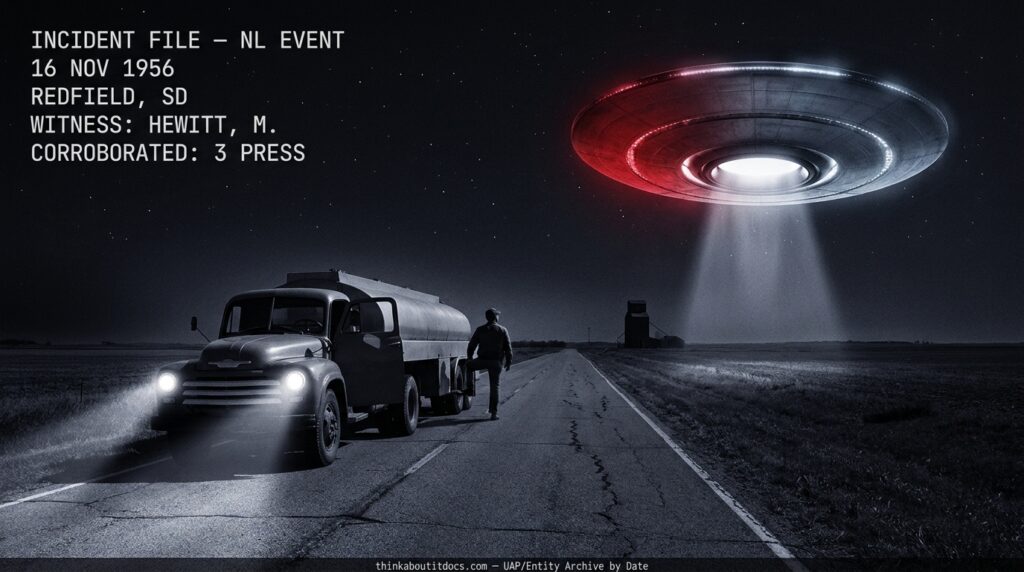
November 16, 1956 — Truck driver Marlen Hewitt stands beside his dairy tank truck near Redfield, South Dakota, as a massive color-changing disc hovers at half a mile. The object responded instantly to his headlights, turning cherry red and rocketing skyward. Three newspapermen independently observed the object from Ortonville, Minnesota.
THINK ABOUTIT UFO|UAP SIGHTING REPORT
1956: Driver Describes “Big Flying Saucer” Over South Dakota
At approximately 1:15 a.m. on November 16, 1956, truck driver Marlen Hewitt watched a massive, slate-gray metallic disc — estimated to cover an entire city block and standing roughly 12 feet thick — swoop down to within half a mile of his position on a deserted highway near Redfield, South Dakota, hover silently at 1,000 feet, and then react instantaneously to his truck’s headlights by turning a bright cherry red and rocketing upward into the clouds faster than anything he had ever seen move. The object had followed Hewitt for approximately 150 miles across five hours of driving, cycling through colors from blue-white to orange to red, gaining and losing thousands of feet of altitude in the span of an eye-blink, and demonstrating what can only be described as interactive awareness of the lone witness on the road below.
Hewitt’s account is corroborated by three independent newspapermen — Lem Kaercher of the Ortonville Independent and Don and Dick Olson of the Marshall Messenger — who observed the object at distance from Ortonville, Minnesota, transforming a solitary driver’s terrifying encounter into a multi-witness event with named press corroboration.
Date: November 16, 1956
Sighting Time: Approximately 1:15 a.m., continuing for approximately five hours
Day/Night: Night
Location: Near Redfield, South Dakota, extending along a route through Graceville, Ortonville (Minnesota), and Big Stone City, South Dakota
Urban or Rural: Rural — isolated prairie highways
No. of Entity(‘s): None observed
Entity Type: Not Applicable
Entity Description: Not Applicable
Hynek Classification: NL (Nocturnal Light) — Point or extended luminous source observed at night. Despite the witness’s detailed structural description at closest approach (half a mile, 1,000 feet altitude), the minimum observation distance exceeds the 500-foot CE-I threshold.
Duration: Approximately five hours (from initial sighting to final disappearance)
No. of Object(s): 1
Description of Object(s): Massive round disc, slate gray in color, appearing metallic; approximately 12 feet thick; an opening at the base roughly one-tenth the diameter of the craft emitted a brilliant light; a lighted outline encircled the edge, possibly windows or exhaust ports
Shape of Object(s): Round / Disc
Size of Object(s): Estimated as large as a square city block (witness’s comparison), approximately 12 feet in thickness
Color of Object(s): Slate gray (body); cycled through blue-white, orange, red, and bright cherry red; lighted outline around perimeter
Distance to Object(s): Closest approach approximately half a mile (lateral), 1,000 feet altitude
Height & Speed: Hovered at approximately 1,000 feet at closest approach; gained 3,000–4,000 feet of altitude instantaneously; departed upward into high clouds at extraordinary speed; demonstrated sustained pacing capability over 150 miles
Number of Witnesses: 4 (Marlen Hewitt, primary witness; three newspapermen at Ortonville — Lem Kaercher, Don Olson, Dick Olson)
Special Features/Characteristics: Color-cycling behavior; reactive response to witness’s headlights (turned cherry red and accelerated upon headlight activation); extreme instantaneous altitude changes; completely silent at all distances; paced the witness’s vehicle for approximately 150 miles over five hours; unaffected by wind direction
Case Status: Unexplained
Source: The Bismarck Tribune, November 16, 1956; NICAP archives; Michael Goodspeed compilation
Summary/Description: Truck driver Marlen Hewitt observed a massive, slate-gray metallic disc for approximately five hours while driving a dairy tank truck from Pelican Rapids, Minnesota, to Redfield, South Dakota. At closest approach, the object swooped to within half a mile at 1,000 feet altitude, revealing structural details including a round metallic body, a brilliantly lit underside opening, and a lighted perimeter. The craft cycled through multiple colors, responded immediately to the witness turning on his truck headlights by changing to cherry red and accelerating vertically, and paced the vehicle for 150 miles before disappearing. Three newspapermen independently observed the object at distance from Ortonville, Minnesota.
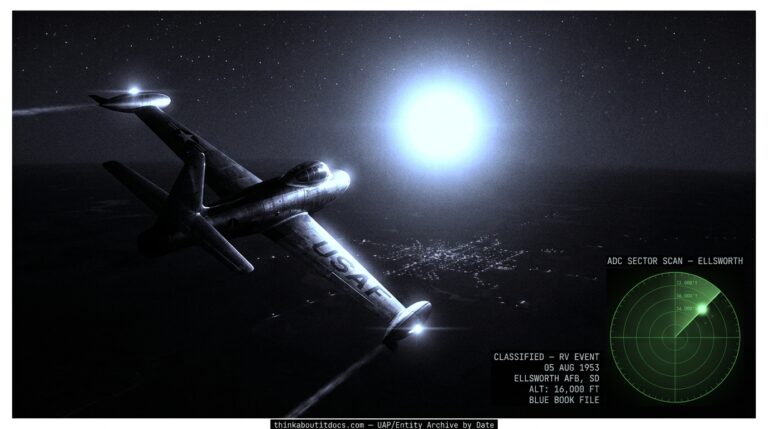
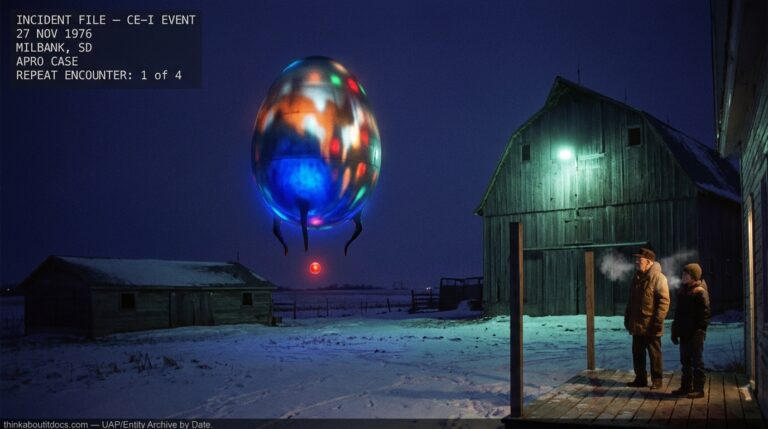
Related Cases: 1953 Ellsworth AFB Radar-Visual Pursuit | 1976 Milbank, SD — Repeat Egg-Shaped Craft Sightings
Detailed Report
Marlen Hewitt was a young driver employed by a dairy operation in Redfield, South Dakota. On the early morning of November 16, 1956, he was driving a tank truck from Pelican Rapids, Minnesota, back toward Redfield — a route that crossed the open prairie of eastern South Dakota and western Minnesota in the pre-dawn darkness. By his own statement, he had never held any stock in flying saucer stories prior to this night.
At approximately 1:15 a.m., Hewitt first noticed what he took to be an unusually bright star. As he continued driving toward Graceville, Minnesota, the light changed colors several times, and near Graceville it cycled through four distinct color transitions. Growing uncertain, Hewitt stopped his truck, killed the headlights, and stepped out to stretch his legs. As he rounded the back of the vehicle, the object swooped down to approximately half a mile east of his position, stopping at roughly 1,000 feet altitude.
At this distance, Hewitt could discern considerable structural detail. The object was round, slate gray, and appeared to be metallic. He estimated its footprint as equivalent to a square city block, with a thickness of roughly 12 feet. At the base of the craft, an opening approximately one-tenth the diameter of the object emitted a very brilliant light downward. Around the edge, a lighted outline was visible — Hewitt could not determine whether these were windows or some form of exhaust emission encircling the perimeter. The object tilted and maneuvered freely, gaining what he estimated at 3,000 to 4,000 feet of altitude instantaneously.
Hewitt described himself as terrified. He jumped back into the truck and turned on the headlights. The moment his lights activated, the object turned a bright cherry red and shot upward into the high cloud layer at a speed he described as faster than anything he had ever seen. It moved so quickly that the departure appeared nearly instantaneous.
As Hewitt drove toward Ortonville, Minnesota, he could still see the light within the clouds. At Ortonville, three newspapermen — Lem Kaercher of the Ortonville Independent and Don and Dick Olson of the Marshall Messenger — who were en route to a hunting trip, emerged from a restaurant and watched the object with him. Their independent observation from a separate vantage point provides the primary corroboration for the event.
After passing through Ortonville and reaching Big Stone City, South Dakota, the object dropped below the cloud layer again, still changing colors but now at a greater distance. Hewitt continued to observe it intermittently over the remainder of his route. The object finally disappeared approximately five hours after the initial sighting, during which time Hewitt had traveled roughly 150 miles. He noted that the object made no sound at any point, and moved into and against the wind with equal ease, suggesting it was completely independent of atmospheric conditions.
The account was reported the same day in The Bismarck Tribune and subsequently cataloged by NICAP.
Researcher’s Notes
The Hewitt Pursuit — Redfield 1956 and the Problem of Reactive Intelligence
- Classification Rationale — NL Despite Structural Detail: This case presents an interesting classification challenge. Hewitt’s description includes remarkable structural specifics — metallic surface, slate-gray coloration, dimensional estimates, underside opening, perimeter lighting — that would normally suggest a close-encounter classification. However, the closest approach distance was approximately half a mile at 1,000 feet altitude, well beyond the 500-foot threshold required for CE-I under Hynek’s original taxonomy. NL is therefore the technically correct classification, despite the unusually high level of physical detail reported. The structural description at this distance should be treated as the witness’s best assessment under conditions of high luminosity and emotional stress, not as precision measurement.
- Source Chain — Named Witnesses and Same-Day Press: The evidentiary strength of this case rests on two pillars: the named primary witness providing a detailed, internally consistent account, and the independent corroboration by three identified newspapermen. Lem Kaercher and the Olson brothers were not friends or associates of Hewitt — they were strangers on a hunting trip who independently observed the same object from Ortonville. The publication of the account in The Bismarck Tribune on the date of the sighting itself provides a contemporaneous record, eliminating the memory-drift issues that plague cases reported years or decades after the fact.
- Behavioral Analysis — Headlight-Reactive Response: The most analytically provocative element of this encounter is the object’s apparent reaction to Hewitt’s headlights. Upon activation of the truck’s lights, the object immediately changed to cherry red and accelerated vertically — a behavioral sequence that implies either situational awareness of the witness’s actions at half-mile range or coincidental timing. If the former, it represents a form of interactive intelligence: the object was not merely present in the sky but was monitoring the witness and responding to his behavior. Similar headlight- and flashlight-reactive behaviors have been reported in other cases across the archive, including the 1976 Milbank, South Dakota encounter where the object’s appearance coincided with the witness’s vehicle movements.
- Pattern Context — Great Plains Vehicle-Pacing Encounters: The Hewitt case fits squarely within a recognizable pattern of mid-century Great Plains encounters in which luminous objects pace vehicles — typically lone drivers on isolated rural highways at night — over extended distances. The five-hour, 150-mile pursuit is unusually prolonged but not unique; similar vehicle-pacing encounters have been reported from the Dakotas, Nebraska, Kansas, and Montana across the 1950s through 1970s. The common elements — isolated highways, single drivers, color-changing luminous objects, reactive behavior, and silent operation — suggest either a recurring phenomenon with consistent operational characteristics or a recurring perceptual/psychological archetype. The corroboration by the Ortonville newspapermen tips this particular case toward the former interpretation.
Marlen Hewitt’s 150-mile encounter on a cold November night in 1956 remains one of the most vivid and best-corroborated vehicle-pacing cases in the South Dakota archive. His description of a massive, color-cycling metallic disc that responded to his headlights and outperformed any known aircraft of the era — validated by three independent press witnesses — places this firmly among the unexplained nocturnal light events that defined the Great Plains wave of the mid-1950s. The case file closes where it opened: with an object that made no sound, ignored the wind, and vanished on its own terms.