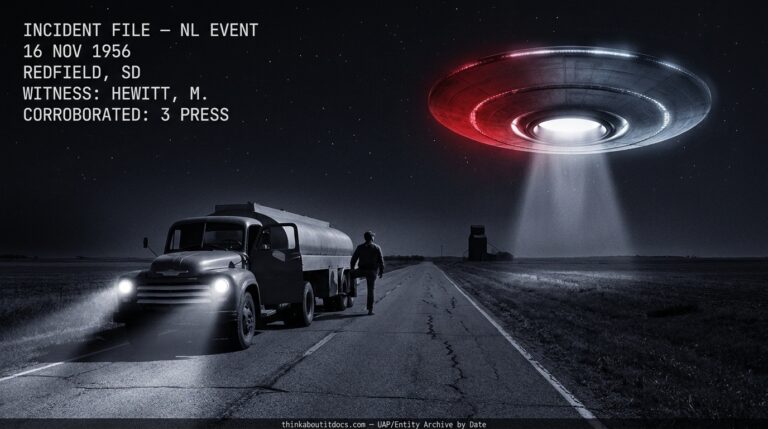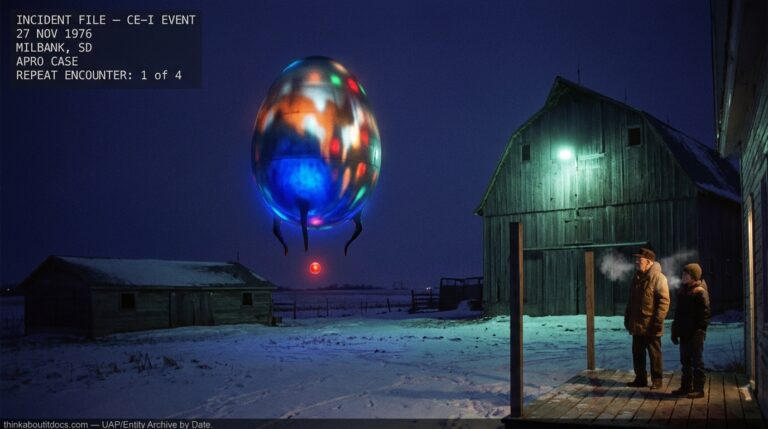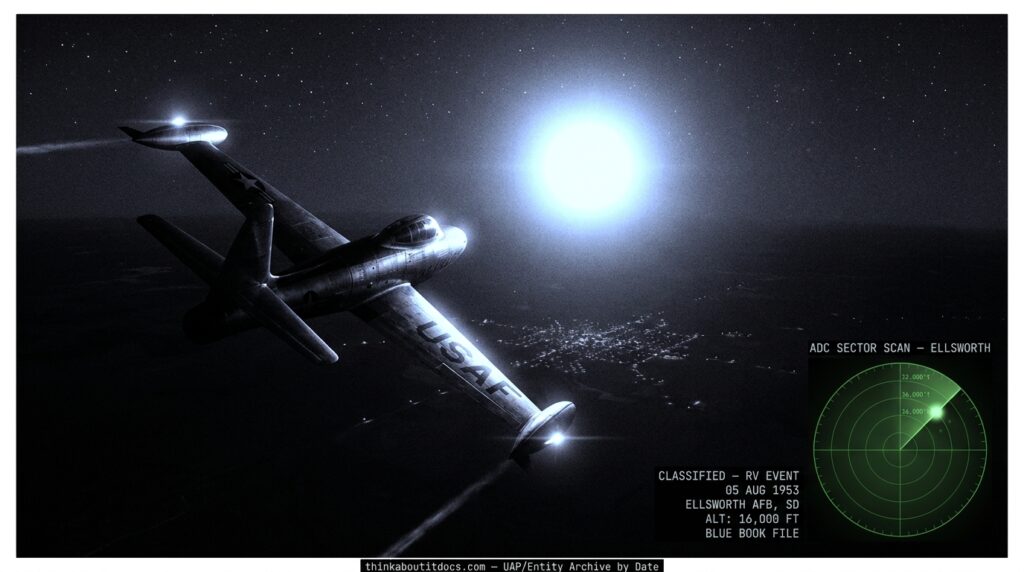
August 5, 1953 — An F-84 Thunderjet from Ellsworth Air Force Base pursues a brilliant bluish-white object across 120 miles of South Dakota prairie. The object maintained a consistent three-mile separation gap, outrunning military interceptors while being simultaneously tracked on ADC radar and observed by Ground Observer Corps spotters.
THINK ABOUTIT UFO|UAP SIGHTING REPORT
1953: Ellsworth Air Force Base UFO Incident
On the night of August 5, 1953, a bluish-white light of extraordinary brilliance appeared over the skies of western South Dakota — and for the next several hours, it made fools of the United States Air Force. Tracked simultaneously by Ground Observer Corps spotters, Air Defense Command radar at 16,000 feet, and two separate F-84 Thunderjet interceptors, the object executed a wide sweep around Rapid City at speed, maintained a consistent three-mile separation gap from pursuing aircraft as if governed by automatic proximity avoidance, and ultimately outran military jets across 120 miles of open prairie before disappearing over the horizon. The incident was deemed significant enough to generate a priority wire one step below a national attack warning — and to pull Captain Edward J. Ruppelt, head of Project Blue Book, out of bed and onto the first available flight to South Dakota.
This case stands as one of the most thoroughly documented radar-visual intercept events in the early Cold War UFO record, combining corroborated civilian observation, military radar tracking, and direct pilot pursuit into a single continuous encounter sequence that defied every conventional explanation available in 1953.
Date: August 5, 1953
Sighting Time: Shortly after dark, continuing for several hours
Day/Night: Night
Location: Ellsworth Air Force Base, Rapid City, South Dakota
Urban or Rural: Military installation / Rural
No. of Entity(‘s): None reported
Entity Type: Not Applicable
Entity Description: Not Applicable
Hynek Classification: RV (Radar-Visual) — Object detected on radar and simultaneously observed visually by multiple independent parties
Duration: Several hours (pursuit phase approximately 2+ hours; object tracked from initial sighting through departure over North Dakota)
No. of Object(s): 1
Description of Object(s): Extremely bright, large bluish-white light with no discernible internal structure; described as brilliant and distinct on both visual observation and radar return
Shape of Object(s): Not definitively determined — appeared as a luminous source visually; radar return was solid and well-defined
Size of Object(s): Large (described as significantly brighter and larger than any star or known aircraft light)
Color of Object(s): Bluish-white
Distance to Object(s): Closest approach approximately 3 miles (object maintained this separation distance from pursuing F-84 jets)
Height & Speed: Altitude 16,000 feet (confirmed by height-finding radar); speed sufficient to outrun F-84 Thunderjets at maximum pursuit velocity; object also climbed rapidly during chase
Number of Witnesses: Multiple — Ground Observer Corps spotter (Black Hawk, SD), ADC radar operators (minimum 3), two F-84 pilots, additional GOC spotters along the flight path extending to Fargo, North Dakota
Special Features/Characteristics: Radar confirmation (both sector scan and height-finding radar); simultaneous multi-party visual-radar correlation; apparent proximity-avoidance behavior (automatic 3-mile gap maintenance); reactive acceleration when interceptors closed distance; wide sweeping maneuver around Rapid City; object tracked across state lines into North Dakota
Case Status: Unexplained
Source: Captain Edward J. Ruppelt, The Report on Unidentified Flying Objects (1956); Project Blue Book files; NICAP archives
Summary/Description: Shortly after dark on the evening of August 5, 1953, the Air Defense Command radar station at Ellsworth AFB received a call from the local Ground Observer Corps filter center reporting an extremely bright light low on the horizon to the northeast, observed by a civilian spotter at Black Hawk, SD. Radar confirmed the target at 16,000 feet. Two F-84 jets were scrambled in sequence; each time an interceptor closed within approximately 3 miles, the object accelerated away, maintaining the gap. The object executed a wide sweep around Rapid City, then fled north with the F-84 in pursuit for 120 miles before the pilot was forced to return due to fuel limitations. Additional GOC spotters tracked the object as far as Fargo, North Dakota.
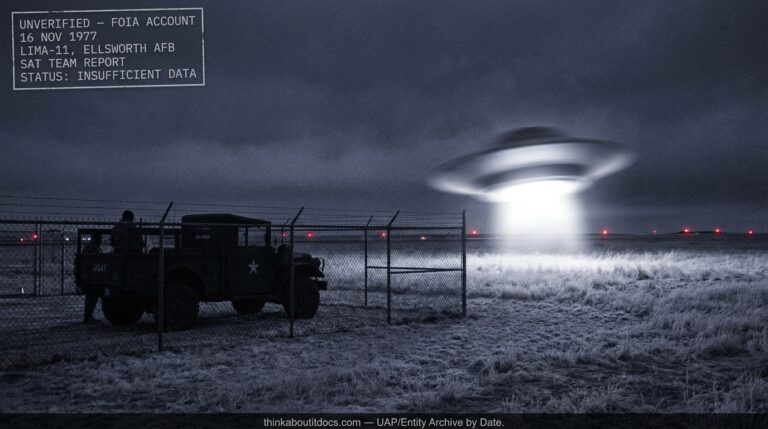
Related Cases: 1976 F.E. Warren AFB Minuteman III NL | 1977 South Dakota Missile Field Incident | 1956 Redfield, SD — Hewitt Encounter
Detailed Report
The Ellsworth Air Force Base radar-visual encounter of August 5, 1953, occupies a distinctive position in early Cold War UFO documentation because it was investigated personally by Captain Edward J. Ruppelt, then director of Project Blue Book — the U.S. Air Force’s official UFO investigation program. Ruppelt’s account, published in his 1956 book, provides an unusually granular reconstruction built from direct interviews with every principal witness conducted within days of the event.
The sequence began when the Ground Observer Corps filter center at Ellsworth relayed a report from a civilian spotter stationed at Black Hawk, approximately 10 miles west of the base. The spotter described an extremely bright light, low on the northeastern horizon. The duty controller at the ADC radar station — a warrant officer — redirected the sector scan to the northeast quadrant and immediately acquired a target at the reported position. The return was, in his words, “well defined, solid, and bright,” distinct from weather-related anomalies he was experienced in identifying. The height-finding radar operator independently confirmed the target at 16,000 feet.
The warrant officer established a direct phone link with the civilian spotter, and for several minutes the two compared notes on position and movement. Mid-conversation, the spotter excitedly reported the object was beginning to move southwest toward Rapid City. Simultaneously, the radar target began accelerating on the same heading. Two radar operators who ran outside confirmed visually that a large bluish-white light was indeed moving toward Rapid City. All three observation channels — civilian visual, military visual, and military radar — were now tracking the same object in real time.
The object executed a wide sweeping arc around Rapid City and returned to its original position. The warrant officer then vectored an F-84 Thunderjet already on combat air patrol west of the base onto an intercept course. The pilot acquired the light visually and turned to close. As he approached within approximately three miles, the object began moving — accelerating and climbing to the north. The pilot pursued, reporting that the light was growing brighter (indicating he was gaining), but the controller consistently confirmed that the actual separation distance was not decreasing. The object appeared to maintain an automatic three-mile buffer, accelerating proportionally whenever the jet closed the gap.
A master sergeant who witnessed the radar tracking told Ruppelt that in years of combat radar operations across both the European and Korean theaters, he had never been so completely awed by anything. The chase continued north for approximately 120 miles across increasingly desolate terrain before the pilot was forced to turn back due to fuel limitations. He later told Ruppelt he was privately relieved to have the excuse, given the isolation and the object’s demonstrated superiority.
A second F-84 was scrambled and also attempted intercept, with the same result — the object maintaining its standoff distance and ultimately departing at speeds the jets could not match. Ground Observer Corps spotters tracked the object’s passage across multiple reporting stations, with the final visual sighting reported from as far away as Fargo, North Dakota — some 300 miles from the original observation point.
The incident generated a priority wire classified one level below the code reserved for signaling that the United States was under attack. This classification triggered middle-of-the-night calls at both ATIC (Air Technical Intelligence Center) in Dayton and the Pentagon. Ruppelt used standing emergency orders to fly to Rapid City and conducted his investigation firsthand, interviewing the warrant officer, the radar operators, the pilots, and the civilian spotter.
It should be noted that Ruppelt’s published text contains an internal date discrepancy: the narrative header states August 5 while body text references “the night of the twelfth” and “the morning of August 11.” Standard cataloging, including Blue Book’s own files, records the event as August 5, 1953, and that date is used here.
Researcher’s Notes
The Ellsworth Pursuit — Rapid City 1953 and the Gold Standard of Radar-Visual Correlation
- Classification Correction — RV, Not DD: The existing page incorrectly classified this case as DD (Daylight Disc). The encounter occurred after dark, was tracked on military radar, and was visually confirmed by multiple parties simultaneously. The correct Hynek classification is RV (Radar-Visual), which denotes an object simultaneously detected on radar and observed visually by independent witnesses. RV cases occupy the highest evidentiary tier in Hynek’s taxonomy because they provide instrumental confirmation of visual observation, eliminating the most common categories of misidentification. The Ellsworth case is a textbook example.
- Source Authority — The Ruppelt Factor: This case carries exceptional source-chain weight because it was investigated personally by the director of Project Blue Book, not delegated to subordinate investigators or reported secondhand through military channels. Ruppelt conducted his own interviews within days, used emergency travel orders to reach the site, and published his account under his own name. His book is widely regarded by both proponents and skeptics as the most credible insider account of the early Blue Book era. The combination of Ruppelt’s direct involvement and the multiplicity of independent witness categories (civilian, military ground, military airborne, radar) makes this one of the best-sourced cases in the entire pre-1960 record.
- Behavioral Analysis — Proximity Avoidance: The most analytically significant feature of this encounter is the object’s apparent automatic proximity-avoidance behavior — maintaining a consistent three-mile gap from the pursuing F-84 regardless of the jet’s speed or approach vector. This behavioral pattern, described independently by both the pilot and the radar controller, suggests either an intelligent operator monitoring the pursuit or an automated standoff system. The three-mile figure remained constant across the entire 120-mile chase, implying that the object’s acceleration was not random but precisely calibrated. Similar proximity-maintenance behavior has been reported in later military intercept cases, including the 1976 Tehran incident and various carrier-group encounters described in the 2004 Nimitz timeline.
- Pattern Context — Cold War Nuclear Corridor: Ellsworth Air Force Base was a Strategic Air Command installation and one of the most important nuclear-capable bomber bases in the continental United States during the early 1950s. The appearance of an unidentified object demonstrating clear superiority over frontline interceptors directly over a SAC base — and the generation of a near-attack-level priority wire — underscores the national security dimension of these incidents. South Dakota would later host Minuteman ICBM fields, and the state’s UAP record includes multiple incidents involving direct proximity to nuclear weapons infrastructure, including the 1977 Ellsworth missile field encounters.
- Date Discrepancy in the Ruppelt Text: Researchers should note that Ruppelt’s published narrative contains conflicting internal dates. The chapter header and standard Blue Book cataloging assign August 5, 1953, but body passages reference “the night of the twelfth” and a phone call on “the morning of August 11.” This appears to be an editing artifact in the published text rather than evidence of two separate incidents. All major reference databases (NICAP, Blue Book archives, Ruppelt’s own case index) catalog this as a single event on August 5, 1953, and that date is used here.
The Ellsworth AFB radar-visual pursuit of 1953 remains one of the small number of cases from the early Blue Book era that resists conventional explanation under any reasonable standard of evidence. The combination of instrumental radar tracking, multi-party visual correlation, military pilot pursuit, and the object’s demonstrated flight performance — sustained speeds exceeding F-84 capability, reactive proximity avoidance, and transit across multiple state-level GOC reporting zones — places it firmly in the unexplained category. That it was investigated by the head of Blue Book himself, and that he considered it significant enough to feature prominently in his published account, speaks to the case’s enduring weight in the archive.