The Jerusalem chariots and Rome's burning shields — Classical Era high strangeness, 1 CE to 499 CE
Sighting by Date:
1 CE – 499 UFO|UAP & Entity Sightings Archive
The 1 CE – 499 CE archive covers the height and eventual fracture of the Classical Era, a period where high-strangeness accounts were recorded by some of the era’s most credentialed historians — Josephus, Tacitus, Cassius Dio, and later St. Augustine. This era is notable for recurring reports of aerial armies and burning shields documented across the Roman Empire and Imperial China, from the sword-shaped star and chariots in the clouds over Judea to the luminous cross reported by Constantine before the Battle of the Milvian Bridge.
The archive also documents a range of entity encounters across this period — a golden apparition interpreted as a flying Apsara in Han-dynasty China, a “star-god” named Yunghuo who spoke to a group of children before ascending into the sky, and a maiden clad in white said to have emerged from a pottery-shaped object at Via Campana, Italy. These accounts sit alongside sober astronomical prodigy records from Rome, Byzantium, and China — sworn eyewitness testimony, contested translations, and outright legend are all represented here, on the terms of their original sources.
Date: 34 CE
Location: China
Summary: A white, round object accompanied by ten small stars flew overhead. This could refer to a train of meteors, but the pattern is unusual if “accompanied” means the ten small stars were flying in formation with the main object.
Source: Edouard Biot, Catalogue des étoiles filantes et des autres météores observés en Chine pendant 24 siècles (Paris: Imprimerie Royale, 1846)
Date: 60 CE
Location: Scotland
Summary: A “ship” was seen speeding across the night sky.
Source: Not cited in original compilation
Date: 61 CE
Location: China
Summary: Han Emperor Mingti, who had heard of Buddhism, had a vision of a golden figure floating in a halo of light, interpreted as a flying Apsara (Buddhist angel). Sources vary on whether this was a dream or a waking apparition; Arthur Lillie describes it as “a golden man, a spirit named Foe,” while John Henry Gray calls it “a foreign god entering his palace.” The Emperor’s wise men, including Minister Fu Yi, interpreted the being as the Buddha. An envoy was subsequently sent to India, returning with sacred Buddhist texts, paintings, and Indian priests to explain Buddhist teachings to the Emperor.
Source: John Henry Gray, China, a History of the Laws, Manners and Customs of the People (Courier Dover, 2003), p. 106; Arthur Lillie, Buddhism in Christendom or Jesus the Essene (London: K. Paul, Trench, 1887), p. 188
Date: c. 65–66 CE
Location: Jerusalem
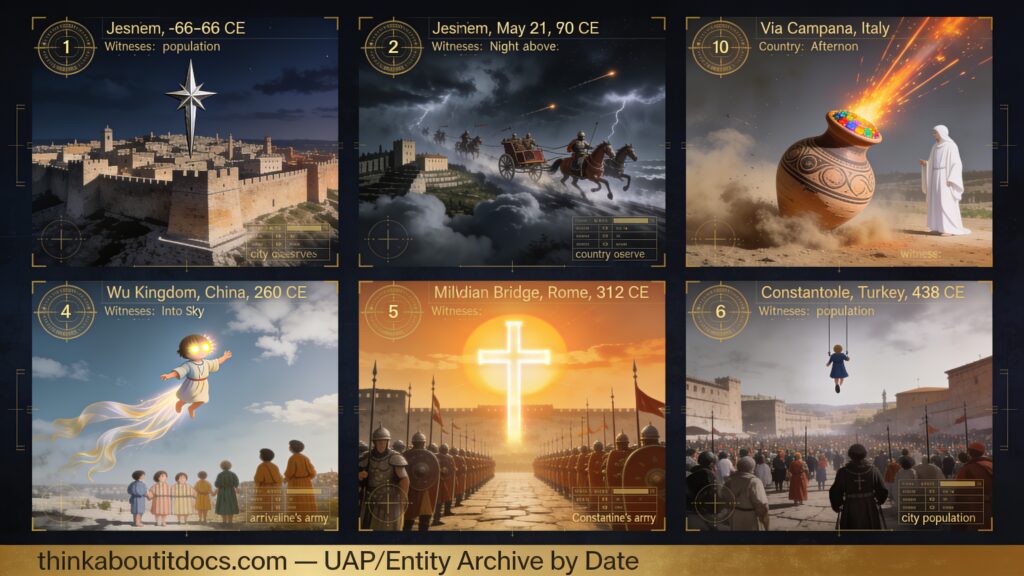
Summary: Among the omens Josephus records preceding the Jewish revolt and the destruction of the Temple, the first is described separately from the later chariots-in-the-clouds account: “There was a star resembling a sword, which stood over the city, and a comet, that continued a whole year.” Some historians identify this as the historically attested apparition of Halley’s Comet in 66 CE; scholarly opinion is divided on whether Josephus is describing one object or two distinct phenomena (a stationary sword-shaped star and a separately visible year-long comet).
Source: Josephus, The Jewish War, Book VI, Ch. 5, Sec. 3 (6.289)
Date: 70 CE, May 21
Location: Jerusalem
Summary: “On the 21st of May a demonic phantom of incredible size… for before sunset there appeared in the air over the whole country chariots and armed troops coursing through the clouds and surrounding the cities.”
Source: Josephus, The Jewish War, Book VI
Date: 75 CE (referring to the same 66–70 CE Josephus account, cited separately due to differing translation sources)
Location: Skies of Judea
Summary: Josephus described “chariots and troops of soldiers in their armor… running about among the clouds,” calling it “a miraculous phenomenon, passing belief.” He notes the account would likely be “deemed a fable were it not for the narratives of eyewitnesses” who had also seen it, adding that “armed battalions hurtling through the clouds” were witnessed over every city, accompanied by “great noise” and ground tremors. Roman historian Tacitus independently referenced the same event: “In the sky appeared a vision of armies in conflict, of glittering armor.”
Source: Josephus, The Jewish War; Tacitus, Histories
Date: 80 CE
Location: Caledon Wood, Scotland
Summary: “When the Roman emperor Agricola was in Scotland, wondrous flames were seen in the skies over Caledon Wood, all one winter night. Everywhere the air burned, and on many nights, when the weather was serene, a ship was seen in the air moving fast.”
Source: Conrad Lycosthenes (Wolfhart), medieval prodigy compiler
Date: 98 CE
Location: Rome
Summary: “At sunset, a burning shield passed over the sky at Rome. It came sparkling from the west and passed over to the east.”
Source: Conrad Lycosthenes (Wolfhart), medieval prodigy compiler
Date: 150 CE
Location: Via Campana, Italy
Summary: Note — single witness: the brother of Pope Pius I is the sole reported witness to this account. On a bright, sunny afternoon, an object described as “a beast” descended, shaped and colored like “a piece of pottery,” with a top of multiple colors that shot out “fiery rays.” The object landed, raising clouds of dust; when the dust cleared, “a maiden clad in white” was visible near the object. No further detail survives in the source record.
Source: Not cited in original compilation
Date: 187 CE
Location: Rome, Italy
Summary: “We read in Herodian that in the time of Commodus stars were seen all the day long, and that some stretched in length, hanging as it were in the midst of the air, which was a token of a cloud not kindled but driven together: for it seemed kindled in the night, but in the day when it was far off it vanished away.”
Source: Lycosthenes, Julii Obsequentis Prodigiorum Liber (Basel, 1552)
Date: 195 CE
Location: Corby New Town, UK
Summary: Close encounter with a craft and its occupants. One object, about a foot across, was observed by one female witness at a building.
Source: FSR Case Histories
Date: 195 CE
Location: Rome, Italy
Summary: Cassius Dio records three stars that “suddenly came to view surrounding the sun” while Julianus was offering sacrifices before the senate-house — interpreted afterward as portending the three rival commanders Severus, Niger, and Albinus, each then commanding three legions. The stars were distinct enough that soldiers repeatedly pointed them out to one another, declaring a dreadful fate would befall the emperor.
Source: Cassius Dio, Roman History, trans. Herbert Baldwin Foster (Troy, New York, 1905), vol. 9, p. 151
Date: 214 CE: Rome, Italy Sighting [Full case page — separate entry]
Date: 216 CE: Cannes, France Sighting [Full case page — separate entry]
Date: 235 CE
Location: Weinan, China
Summary: The army of Emperor Hou Chu saw a red object with pointed rays fly over them three times. Cataloged among “shooting stars and meteors,” though an ordinary meteor returning three times to fly over the same army stretches credulity.
Source: Edouard Biot, Catalogue des étoiles filantes et des autres météores observés en Chine pendant 24 siècles (Paris: Imprimerie Royale, 1846)
Date: 240 CE
Location: Che-chiang Province, China
Summary: Under Emperor Ta Ti of the Wu dynasty (228–251), a man named Wang Shuh gathering medicinal herbs on T’ien Tai Mountain saw a small blue boy, just over a foot tall, riding a red carp in a brook. The fish entered a cloud and gradually vanished. Later, from a mountaintop, Shuh watched wind and clouds gather above the sea before a sudden thunderstorm broke; he hid in a hollow tree in fright. When the sky cleared, the same blue boy and red carp reappeared and returned to the brook — identified in the source as a “Kiao,” a scaled dragon.
Source: Dr. M.W. De Visser, The Dragon in China and Japan (Amsterdam: Johannes Muller, 1913), pp. 80–81, quoting the Wuki
Date: 260 CE
Location: Wu Kingdom, China
Summary: During the reign of Sun Hsiu (258–263), border-garrison “hostage children” playing together were joined by an unrecognized child, under four feet tall, appearing six or seven years old. When asked who he was, he replied he had come because they seemed to be enjoying themselves. Light rays flashed from his eyes; frightened, the children asked about him further. He identified himself as “the star-god Yunghuo” (Mars), delivering a message that “the Three Lords will return to Ssu-ma,” then rose into the sky trailing what looked like flowing silk before vanishing.
Source: In Search of the Supernatural: The Written Record, trans. Kenneth J. DeWoskin and J.I. Crump (Stanford University Press, 1996), p. 110
Date: 312 CE
Location: Milvian Bridge, Rome, Italy
Summary: Constantine and his army reportedly beheld a luminous cross in the heavens. Constantine claimed to have been shown a cross on the sun as a sign from Christ that he would triumph over Maxentius at the Battle of the Milvian Bridge.
Source: Eusebius of Caesarea, Life of Constantine; Lactantius, On the Deaths of the Persecutors
Date: 314 CE
Location: China
Summary: The sun came down to the ground and three other suns rose together over the western horizon, then “flew together toward the east.”
Source: Shi Bo, La Chine et les Extraterrestres (Paris: Mercure de France, 1983), p. 47 — original primary source not located
Date: 334 CE
Location: Antioch, Turkey
Summary: “In Antioch a star appeared in the eastern part of the sky during the day, emitting much smoke as though from a furnace, from the third to the fifth hour.” The duration precludes a comet but exceeds what would be expected of a meteor.
Source: Theophanes, Chronographia, trans. C. Mango & R. Scott with G. Greatrex, The Chronicle of Theophanes Confessor (Oxford: Clarendon Press, 1997), p. 49
Date: 350 CE
Location: Emesa, Syria
Time: Midnight
Summary: Damascius, in The Life of Isidorus, relates that a sacred baetylus (meteorite) was kept by a man named Eusebius, who acquired it under strange circumstances: while roaming at midnight near the temple of Athena outside Emesa, he saw a globe of fire leap down accompanied by a great lion. The lion vanished; Eusebius found the object to be the baetylus, which told him — by his account — that it belonged to “Gennaios, the Noble One.” He carried it home that night, a distance he claimed exceeded 210 furlongs. The object is described as an exact globe, whitish in color, three handbreadths across.
Source: Arthur Bernard Cook, Zeus, A Study in Ancient Religion (Cambridge University Press, 1914), vol. 3, p. 888, quoting Damascius via the Byzantine scholar Photios
Date: May 7, 351 CE
Location: Jerusalem
Summary: Hermias Sozomen’s Ecclesiastical History records that at the time Cyril succeeded Maximus as head of the Jerusalem church, “the sign of the cross appeared in the heavens; its variance was not feeble and divergent like that of comets, but splendid and concentrated.” Its length was described as about fifteen stadia from Calvary to the Mount of Olives, with breadth in proportion. The phenomenon reportedly excited universal terror, was visible for several days, and was brighter than the sun.
Source: The Ecclesiastical History of Philostorgius, compiled by Photius, trans. Edward Walford (London: Henry G. Bohn, 1855), p. 49; date corroborated by the Byzantine text Chronicon Paschale
Date: 393 CE
Location: Rome, Italy
Summary: During the reign of Emperor Theodosius, a bright globe reportedly appeared at midnight, shining near Venus along the zodiac. A great number of other glowing orbs drew near the first, described as resembling a swarm of bees flying violently around a beekeeper, before all blended into a single flame that “bodied forth to the eye as a horrible two-edged sword,” with the original globe appearing as its pommel.
Source: Conrad Lycosthenes (Wolfhart)
Date: 396 CE
Location: Constantinople (Istanbul), Turkey
Summary: St. Augustine wrote that at nightfall a fiery cloud appeared from the east, small at first, then gradually enlarging as it approached the city until it hung terribly over the whole of it. The population fled to the church; when God had granted His word, the cloud diminished and disappeared. The people, freed from fear, later heard they must evacuate because the city would be destroyed the following Sabbath; the whole population left with the emperor, and the city was spared. Augustine asks: “Was this the anger of God, or rather His mercy?”
Source: Albert Barnes, Minor Prophets I (Michigan: Baker Books, 1985), p. 414. Augustine does not date the event; 16th-century historian Caesar Baronius assigned it to 396 CE by uncertain reasoning.
Date: 398 CE
Location: Byzantine Empire
Summary: “A thing like a burning globe, presenting a sword, shone brilliantly in the sky over the city. It seemed almost to touch the earth from the zenith. Such a thing was never recorded to have been seen before by man.”
Source: Not cited in original compilation
Date: 400 CE
Location: Egypt
Summary: An Egyptian monk identified as Pandorus wrote that from the creation of Adam down to Enoch — general Cosmic Year 1,282 — days were reckoned in neither months nor years, but the Egregori (“Watchers” or “angels”) descended to earth in the general Cosmic Year 1,000, conversed with humanity, and taught that the orbits of the two luminaries, marked by the twelve zodiac signs, are composed of 360 parts.
Source: Not fully cited in original compilation
Date: 418 CE
Location: Asia Minor
Summary: A solar eclipse was followed by a bright, cone-shaped meteor.
Source: Philostorgius, Ecclesiastical History (Epitome), Book XII, Ch. 8
Date: 438 CE
Location: Constantinople (Istanbul), Turkey
Summary: Following an earthquake that had destroyed much of Constantinople’s walls and towers, a new and stronger tremor struck as residents gathered outside the city in fear. Historian Nicephorus reports that amid the crowd, a child was suddenly lifted into the air by an unseen force until he passed from sight, then descended and told Patriarch Proclus, the Emperor, and the assembled crowd that he had attended a concert of angels hailing the Lord. Acacius, Bishop of Constantinople, stated the population of the city witnessed it directly. The event became the founding story for the Trisagion hymn of the Greek Church, still commemorated annually.
Source: 14th-century chronicler Nicephorus Callistus; corroborating letters from Acacius, Patriarch of Constantinople (d. 489), to Peter Fullo, and from Pope Felix III (483–492) to the same Peter Fullo. Versions agree on most details except the precise year and the child’s ultimate fate.
Date: 457 CE
Location: Brittany, France
Summary: Conrad Lycosthenes (Wolfhart), a professor at the University of Basel from 1539, recorded that in 457 over Brittany in northern France, “a blazing thing like a globe was seen in the sky. Its size was immense, and on its beams hung a ball of fire like a dragon, out of whose mouth proceeded two beams, one of which stretched beyond France, and the other reached toward Ireland, and ended in fire, like rays.”
Source: Not cited in original compilation
Date: 460 CE: Katsuragi Mountain, Japan Encounter [Full case page — separate entry]
Date: 497 CE (alternatively dated 473 CE by some scholars)
Location: Winchester, British Isles
Summary: An immense globe appeared in the sky at Winchester: “there appeared a star of wonderful magnitude and brightness, darting forth a ray, at the end of which was a globe of fire in the form of a dragon, out of whose mouth issued forth two rays; one of which seemed to stretch out itself beyond the extent of Gaul, the other towards the Irish sea, and ended in seven lesser rays.” Geoffrey of Monmouth dates the event to Ambrosius’s death; Roger of Wendover dates it to 497 CE.
Source: Geoffrey of Monmouth, Historia Regum Britanniae, Book VIII, Ch. 14; Lycosthenes, Julii Obsequentis Prodigiorum Liber (Basel, 1552)
RESEARCHER’S NOTES
The Jerusalem Chariots and Rome’s Burning Shields — 1 to 499 CE
- New entry added: the Josephus “sword star” comet (c. 65–66 CE), a documented omen distinct from — and preceding — the better-known chariots-in-the-clouds account, was missing from the prior version and has been added. Some historians identify it with the confirmed 66 CE apparition of Halley’s Comet.
- Duplicate accounts retained, not merged: the 70 CE and 75 CE entries describe the same underlying Josephus account of chariots in the clouds, drawn from different translation sources. Both are kept as separate entries per standing archive practice — the record preserves each citation rather than silently merging them.
- Single-witness case flagged: the 150 CE Via Campana account rests on a single reported witness (the brother of Pope Pius I) and is flagged accordingly rather than presented with the same weight as multiply-attested entries.
- OCR and transcription errors corrected: several quoted translations in the prior version contained garbled words from historical scanning (“am” for “Adam,” “ds” for “adds,” “he h” for “he had,” “spreing” for “spreading”). These have been corrected for readability without altering the substance of any quotation.
“Chariots and troops of soldiers in their armor were seen running about among the clouds… a miraculous phenomenon, passing belief.”
Josephus, The Jewish War, on the events of 70 CE