THINK ABOUTIT UFO|ENTITY SIGHTING REPORT
0214 CE: Rome, Italy Sighting
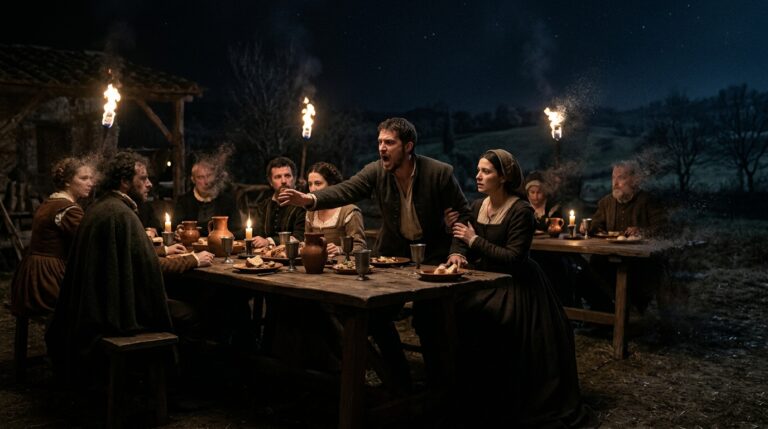
In the year 214 CE, over the ancient Roman town of Hadria in what is now northeastern Italy, witnesses looked up and saw something that defied every category available to them — a bridge made of fire stretching across the night sky, and standing beside it, the figure of a man dressed in white. The account survives in a single line recorded by French researcher Henry Durrant in 1970, drawn from Roman historical records. Brief as it is, it contains two of the most consistent elements in the ancient UAP record — a structured luminous aerial object and an associated humanoid entity — documented nearly two thousand years before the modern era gave them names.
Date: 214 CE
Sighting Time: Night
Day/Night: Night
Location: Hadria, Italy (near Rome)
Urban or Rural: Rural
Entity Type: Humanoid
Entity Description: figure of man wearing white clothing, observed adjacent to the aerial object
Hynek Classification: CE-III (Close Encounter III) Close observation with animate beings associated with the object.
Duration: Not recorded
No. of Object(s): 1
Size of Object(s): Large — described as visible across the night sky
Distance to Object(s): Aerial — observed in the night sky above Hadria
Shape of Object(s): Bridge — elongated, spanning structure
Description of Object(s): A fiery bridge observed in the night sky — a large luminous structure spanning the sky described as bridge-shaped and fiery in appearance
Color of Object(s): Fiery — luminous orange-red
Number of Witnesses: Not recorded — implied multiple
Special Features / Characteristics: Humanoid figure in white clothing observed in direct association with the aerial object — standing beside or adjacent to it; the bridge shape is among the most unusual object descriptions in the ancient UAP record
Case Status: Unexplained
Source: Henry Durrant, 1970; drawn from Roman historical records
Summary/Description:At Hadria, Italy in 214 CE, witnesses observed a fiery bridge-shaped object in the night sky with a humanoid figure dressed in white standing beside it. The case is documented by French researcher Henry Durrant in 1970 from Roman historical sources and represents one of the earliest recorded CE-III entity sightings in the Italian historical record — notable for both the unusual bridge morphology of the object and the consistent white-clad humanoid figure that appears across multiple ancient entity contact accounts.
Related Cases: 640 CE Faremoutiers-en-Brie France Entity Sighting | 815 CE Lyons France Magonia Sighting | Roman Era Aerial Phenomena Archive
DETAILED REPORT:
The Roman Empire in 214 CE was at its height under Emperor Caracalla. The town of Hadria — the ancient settlement that gave the Adriatic Sea its name — sat in the northeastern reaches of Roman Italy, a prosperous and well-documented settlement with deep roots in pre-Roman Italic culture.
It is here, in the night sky above Hadria, that witnesses recorded one of the most unusual object descriptions in the entire ancient UAP archive.
A bridge of fire.
Not a light. Not a disc. Not a sphere or a streak across the sky. A bridge — a structured, elongated, spanning shape made of fire, hanging in the night sky above the town. The description is recorded by French researcher Henry Durrant in 1970, drawn from Roman historical sources that have not survived in full. What Durrant preserved is a single precise sentence: at Hadria a fiery bridge was seen in the sky, and next to it the figure of a man wearing white clothing.
Two elements. One object. One entity.
The bridge morphology is rare in the ancient record but not unique. Elongated luminous objects spanning significant portions of the visible sky appear in other Roman-era accounts and in later medieval European sighting reports. What makes the Hadria case distinct is the presence of the humanoid figure — a man in white standing beside the object in apparent association with it.
The white-clad humanoid is one of the most consistent entity descriptions across the entire scope of the ThinkAboutIt archive. From the white-robed beings of Faremoutiers-en-Brie in 640 CE to the Men in White documented in modern contactee cases, the figure of a human-appearing being dressed in white associated with an aerial phenomenon appears with a regularity that demands attention. At Hadria in 214 CE, nearly eighteen centuries before the modern UFO era, that figure was already there.
The source limitation is real — a single researcher’s citation from records no longer directly accessible. But Durrant’s work in compiling Roman-era anomalous phenomena is considered a credible contribution to the pre-modern UAP record, and the specificity of the description — a bridge, fiery, a man in white — argues against invention. Vague embellishment produces vague accounts. Specific details survive because they were specific to begin with.
RESEARCHER’S NOTES: The Hadria Fiery Bridge — Rome’s White-Clad Entity and the Sky That Burned
- The Bridge Morphology: The bridge shape is one of the rarest and most analytically significant object descriptions in the ancient UAP record. Unlike spheres, discs, or streaks of light which can be attributed to natural phenomena, a structured bridge-shaped luminous object in the night sky has no conventional meteorological explanation. Its elongated, spanning form suggests a structured craft of considerable size observed at relatively close range.
- The White-Clad Humanoid Pattern: The figure of a man in white standing beside the aerial object connects directly to a pattern documented across centuries of entity contact reports. White-clad humanoids associated with luminous aerial objects appear in the 640 CE Faremoutiers case, in multiple Roman-era accounts, and in modern CE-III reports worldwide. At Hadria in 214 CE this pattern is already fully formed.
- Roman-Era Documentation Context: Roman historians and chroniclers maintained detailed records of aerial prodigies — unusual sky phenomena interpreted as omens. The survival of this account in Durrant’s 1970 compilation suggests it appeared in Roman prodigy lists or historical annals, giving it a level of institutional documentation unusual for ancient sighting reports.
- CE-III Classification Significance: The Hynek CE-III classification requires both an aerial object and an associated animate being observed in proximity. The Hadria case meets both criteria clearly — the fiery bridge and the man in white are described as co-located, adjacent, connected. This is not a separate sighting of an entity and an object — it is a single integrated encounter.
The Hadria sighting of 214 CE is eight words of ancient testimony that contain a complete CE-III encounter — a structured aerial object of unusual morphology and a white-clad humanoid figure standing beside it in the night sky over Roman Italy. The brevity of the surviving record is not a weakness. It is the signature of a genuine historical document — stripped of embellishment, reduced to what was actually seen. A bridge of fire. A man in white. Two thousand years later, we are still asking the same questions the people of Hadria asked that night.