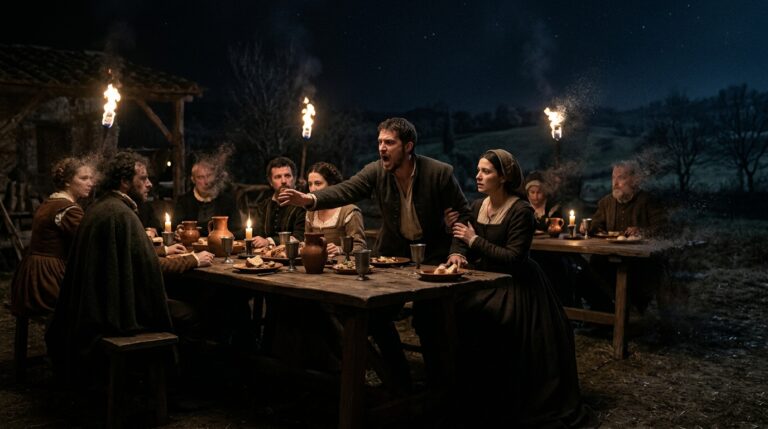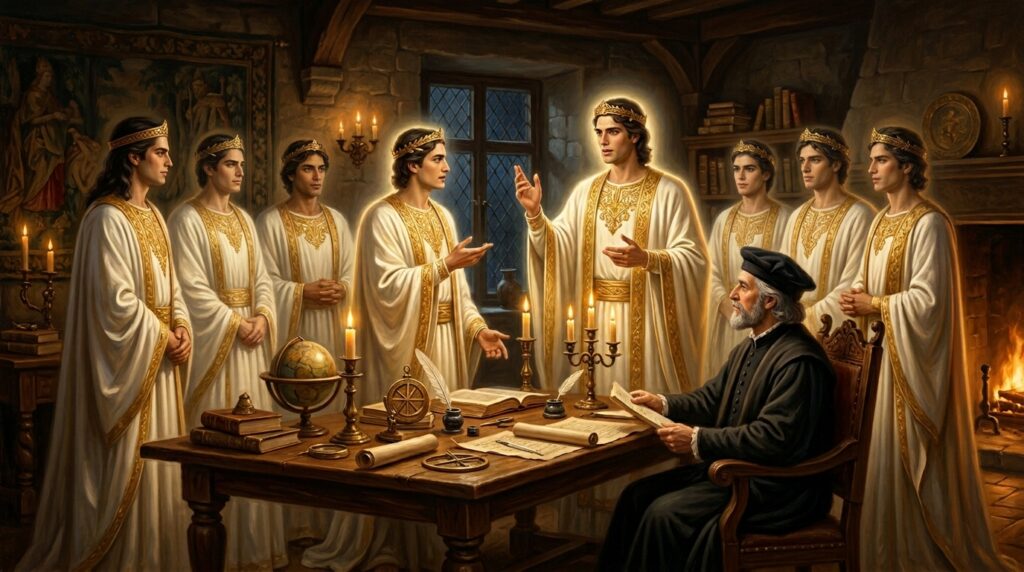
August 13, 1491 — Milan, Italy. Fazio Cardano, Renaissance philosopher and friend of Leonardo da Vinci, engaged in a three-hour philosophical debate with seven beings who identified themselves as men composed of air, denied the immortality of the individual soul, and disagreed among themselves on the nature of divine creation.
THINK ABOUTIT ENTITY ENCOUNTER REPORT
1491 CE: Fazio Cardano Sighting in Milan
On the evening of August 13, 1491, Fazio Cardano — mathematician, jurist, close friend of Leonardo da Vinci, and one of the most respected intellects in Milan — was resting in his home after a day’s work when seven beings appeared before him without warning. They were majestic in appearance, wore flowing robes and Greek tiaras, had black hair of unnatural beauty, and appeared to be between thirty and forty years old. What followed was not a terrifying visitation, not a blinding display of aerial power, not an abduction. It was a conversation. For more than three hours, Cardano and these seven beings discussed philosophy, the immortality of the soul, the nature of human existence, and the origin of the universe. When he asked who they were, they told him: men composed of air, subject to birth and death, whose lives might reach three hundred years. The encounter was later recorded by Cardano’s son, the famous polymath Gerolamo Cardano — and preserved by Jacques Vallée in Passport to Magonia as one of the most extraordinary CE-III cases in the pre-modern record.
Date: August 13 1491
Sighting Time: NA
Day/Night: evening
Location: Milan, Italy
Urban or Rural: Rural
No. of Entity(s): 7
Entity Type: Humanoid — described as majestic men
Entity Description: Seven tall humanoid beings wearing bright flowing robes and sandals with Greek tiaras on their heads. Black hair. Of unnatural beauty. Appeared to be 30 to 40 years of age. The tallest was the most philosophically active in the encounter.
Hynek Classification: CE-III (Close Encounter III) Close observation with animate beings associated with the object.
Duration: over three hours
Number of Witnesses: 1 — Fazio Cardano
Special Features/Characteristics: Prolonged philosophical dialogue between the witness and the entities; entities claimed to be composed of air and subject to birth and death with lifespans up to three hundred years; entities denied immortality of the individual soul; the tallest entity denied that God created the world from eternity while another stated God creates it from moment to moment — a theological and cosmological disagreement among the entities themselves; entities appeared and vanished without any described craft or entry mechanism
Case Status: Unexplained
Source: CUN Campania; Jacques Vallée, Passport to Magonia (1969)
Summary/Description: On the evening of August 13, 1491, Milanese philosopher and mathematician Fazio Cardano was resting at home when seven majestic humanoid beings in robes and Greek tiaras appeared before him. They engaged him in an extended philosophical discussion lasting over three hours covering the nature of the soul, life, death, and the origin of the universe. When asked who they were, they identified themselves as men composed of air, subject to birth and death, with lifespans potentially reaching three hundred years. They denied individual immortality, and among themselves disagreed on the nature of divine creation. Preserved by his son Gerolamo Cardano and documented by Jacques Vallée.
Related Cases: 1430 CE Jaen Spain Luminous Procession | 460 CE Katsuragi Mountain Japan Emperor Encounter | CE-III Entity Contact Archive

DETAILED REPORT:
The year is 1491. Milan is at the height of the Italian Renaissance. Leonardo da Vinci is painting in the city. Ludovico Sforza rules the duchy. The humanist tradition — the recovery of classical knowledge, the elevation of rational inquiry, the belief that careful observation and rigorous thought could unlock the secrets of the universe — is reshaping European civilization.
Fazio Cardano (1444–1524) is precisely the kind of man the Renaissance produced at its best. A jurist, mathematician, and philosopher of serious standing, he was well-known in Milan’s intellectual circles and counted Leonardo da Vinci among his close friends. He had expertise in perspective and geometry. He was, by every measure, an educated, rational, careful observer.
On the evening of August 13, 1491, he was resting at home after the day’s work.
Seven beings appeared.
They did not announce themselves. They did not arrive through a door or window. They simply materialized before him — seven men of majestic bearing, wearing bright flowing robes and sandals, with what appeared to be Greek tiaras on their heads. Their hair was black. Their beauty was described by Cardano as unnatural — beyond what human faces typically achieve. They appeared to be between thirty and forty years old, though what that appearance actually signified about their nature, the encounter would soon make ambiguous.
What happened next is what makes this case unique in the CE-III record of any era.
They talked.
For more than three hours, Fazio Cardano and these seven beings engaged in a sustained philosophical dialogue covering some of the deepest questions available to 15th century European thought: the nature of the human soul, the question of its immortality, the relationship between life and death, the transient nature of human existence on Earth, and the origin of the universe itself.
When Cardano asked who they were — the most natural question available to a Renaissance scholar confronted with beings he did not recognize — their answer was precise and extraordinary: they were men composed, as it were, of air. They were subject to birth and death, as humans are. But their lives were much longer than human lives and might reach three hundred years in duration.
Men of air. Not angels. Not demons. Not gods. Men — of a different composition and a much longer lifespan, but men nonetheless. The description anticipates by five centuries the language of modern entity classification more precisely than any theological or mythological framework available in 1491 Milan.
On the question of the soul’s immortality — a defining theological question of Cardano’s era — the entities’ answer was striking. They affirmed that nothing survives which is peculiar to the individual. The individual soul, as Renaissance humanism and Catholic theology conceived it, does not persist. Whatever continues after death is not the individual person.
Then the entities disagreed among themselves.
The tallest of the seven denied that God had made the world from eternity — that the universe had no beginning but existed always. The other argued the opposite position: that God creates the world from moment to moment, continuously, and that should the divine creative act cease for an instant the world would instantly perish. This was not a rehearsed theological position delivered in unison. It was a genuine disagreement, argued between beings who had different views on the nature of divine creation — conducted in front of a human witness who was qualified by training and intellect to understand and record what he heard.
After more than three hours the beings departed — as they had arrived, without mechanical aid or conventional exit.
Fazio Cardano told his son. His son, Gerolamo Cardano — who would become one of the most famous mathematicians and physicians of the 16th century, the inventor of the combination lock, a pioneer of probability theory — recorded his father’s account. Jacques Vallée found it and documented it in Passport to Magonia as one of the most significant pre-modern CE-III encounters in the record.
RESEARCHER’S NOTES: The Cardano Encounter — Seven Men of Air and the Longest Philosophical Debate in CE-III History
- Witness Credibility: Fazio Cardano was one of the most intellectually qualified witnesses in the entire pre-modern entity encounter record. A trained mathematician, jurist, and philosopher, close friend of Leonardo da Vinci, with expertise in perspective and the empirical observation of phenomena — he was precisely the witness most capable of accurately recording what he experienced and least likely to embellish it with supernatural interpretation. His account is notably free of the religious overlay common to 15th century encounter reports.
- The Air Composition Claim: The entities’ self-identification as men composed of air and subject to birth and death with three-hundred-year lifespans is one of the most analytically specific entity self-descriptions in the pre-modern archive. It does not claim divinity, supernatural power, or celestial origin. It describes a biological existence — longer than human, made of different material, but fundamentally mortal — that anticipates modern discussions of non-human biology with remarkable precision.
- Theological Disagreement as Evidential Detail: The internal disagreement between the entities on the question of divine creation is the most analytically significant detail in the entire account. Fabricated encounter reports do not typically include the beings disagreeing with each other on cosmological questions. The disagreement is the hallmark of genuine observed behavior — these were not performing a prepared message but engaging in authentic intellectual discourse with their own internal differences of opinion.
- The Preservation Chain: Fazio Cardano → Gerolamo Cardano → CUN Campania → Jacques Vallée represents one of the most traceable preservation chains in the pre-modern CE-III record. Each link is a documented, credentialed individual — not an anonymous chronicler but named scholars whose other works survive and can be verified. The Cardano family’s intellectual reputation gives this account a documentary credibility matched by very few entity encounter cases of any era.
The 1491 Milan encounter is the Renaissance in its most extraordinary form — a philosopher who spent his days discussing the nature of reality with Leonardo da Vinci spending an evening discussing it with seven beings who claimed to be made of air. Fazio Cardano did not interpret what he experienced through the theological framework his century provided. He recorded it as an observer. The beings who appeared to him were not angels performing miracles. They were entities with opinions, disagreements, lifespans, and a cosmology of their own — who chose to spend three hours of it in conversation with a Milanese mathematician in 1491. Gerolamo Cardano preserved his father’s account. Jacques Vallée recovered it. The archive holds it. Whatever those seven men of air were, they were worth talking to — and Fazio Cardano was exactly the right person to talk to them.