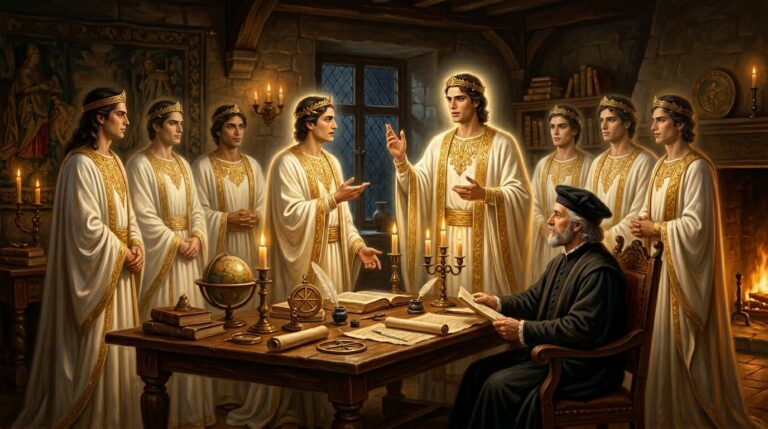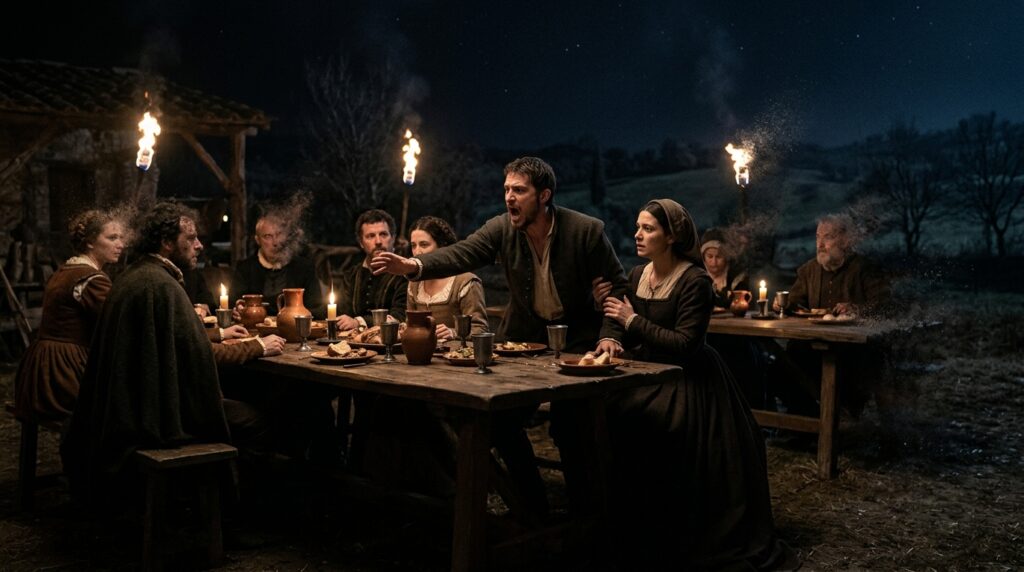
1526 CE — Rome, Italy. A man transported 100 miles from Rome to near Benevento in a single night. The entity gathering's banquet table had no salt. When he reached for it and said "Thank God" — everything vanished. He woke naked in a field at dawn. Documented by Italian Inquisitor Paulus Grillandus in the Tractatus de Hereticis et Sortilegiis.
THINK ABOUTIT ABDUCTION REPORT
1526: Rome, Italy Abduction
In 1526 in Rome, Italy, a man followed his wife’s instructions and did not say the name of God. He agreed to this condition because she had told him it was necessary — they were going somewhere together, transported through the night by two he-goats, and the word would cause problems. He kept his agreement through the gathering, through the dancing, through the banquet. Then he reached for the salt. It was a reflex — the ordinary human desire for salt at a meal — and when he felt it in his hand he said, reflexively, “Thank God, the salt has come.” Everything disappeared. The people, the tables, the food, the gathering — all of it vanished instantly and he was alone in a dark field. At dawn he discovered he was near Benevento — 100 miles from Rome. He had been transported back not to his home but to open countryside, naked, in the cold, with nothing but the night’s disorientation and the journey home ahead of him. The case was documented by Italian Inquisitor Paulus Grillandus in his Tractatus de Hereticis et Sortilegiis — a work whose influence on the demonological literature of the 16th century rivaled the Malleus Maleficarum itself.
Date: 1526 CE
Sighting Time: Not recorded — night
Day/Night: Night
Location: Rome, Italy — transported to near Benevento, approximately 100 miles distant
Urban or Rural: Urban origin — rural arrival
No. of Entity(s): Multiple — wife, many famous persons at the gathering, entities described as demons
Entity Type: Non-human entities — described within 16th century framework as demons; the gathering included human participants and apparent non-human presiding figures
Entity Description: Entities associated with the gathering not individually described beyond the demonological classification; the transport mechanism involved two he-goats; the gathering included dancing, a banquet, and a ceremony; the entities or organizers of the gathering specifically excluded salt from the table — consistent across pre-modern entity encounter accounts of the fairy and demon contact tradition
Hynek Classification: CE-IV — Close Encounter of the Fourth Kind; physical abduction of the witness with transport to a distant location
Duration: All night — the witness was absent from Rome from the previous night until dawn when he found himself near Benevento
Number of Witnesses: Multiple — the wife, the gathered attendees; the man himself; shepherds near Benevento who confirmed his location at dawn
Special Features/Characteristics: Physical displacement confirmed — witness woke 100 miles from point of departure with no conventional explanation for the transit; salt absent from the gathering table — consistent with the pan-European pre-modern entity encounter tradition of salt avoidance by non-human beings; abrupt termination of the experience triggered by invoking a divine name — consistent with the broader pattern of encounter termination by religious invocation; the wife’s prior knowledge of the prohibition suggests repeated prior participation; multiple famous persons present — suggesting the gathering was a recurring event with established participants; wife subsequently confessed and was executed; the document was preserved in official Inquisition records
Case Status: Unexplained
Source: Paulus Grillandus, Tractatus de Hereticis et Sortilegiis (1526); Malleus Maleficarum, Part I, Question I, trans. Montague Summers (London: Bracken Books, 1996)
Summary/Description: In 1526 CE in Rome, a man observed his wife leave the house at night and demanded to accompany her the following time. They were transported by two he-goats to a gathering attended by many famous persons involving dancing, a banquet, and a ceremony. The wife warned him not to invoke God’s name. When he reached for salt at the banquet and said “Thank God,” the entire gathering instantly vanished. He found himself naked in a field near Benevento — 100 miles from Rome. He returned home begging for food and clothing, reported his wife to the Inquisition, and she was burned at the stake after confessing. Documented by Italian Inquisitor Paulus Grillandus.
Related Cases: 1586 CE Grangemuir Scotland Alison Pearson — Good Neighbors | 1656 CE Cardiganshire Wales Little People Feast | European Entity Gathering Archive
DETAILED REPORT:
The year is 1526. Rome has just survived the catastrophic Sack of Rome by the forces of Holy Roman Emperor Charles V — one of the most traumatic events in Renaissance history. The Papal States are in turmoil. The Inquisition is active. And somewhere in the city, a man has begun to notice that his wife leaves the house at night and will not say where she goes.
When he confronts her and presses hard enough, she tells him the truth. She goes to a gathering. She is taken there.
He demands to go with her.
She agrees — on one condition. He must not say the name of God while they are there. Whatever happens, whatever he sees, however strange or difficult it becomes, he cannot invoke that name. He agrees.
They are transported by two he-goats.
This method of transport — animal-mediated physical relocation — is one of the distinctive features of the European witch-gathering tradition that modern researchers recognize as a consistent element of pre-modern entity encounter accounts reframed through the available theological vocabulary of their era. The he-goats are the 1526 equivalent of what other pre-modern accounts describe as being lifted, carried, or transported by other means to a location that cannot be reached by conventional travel.
They arrive at the gathering.
The account preserves several precise details. Many famous people are present — people the man recognizes. This is not an anonymous congregation of strangers. It is people from his world, his society, his Rome, present at a gathering they have evidently been attending for some time. A ceremony takes place in which everyone declares their devotion to the Devil. There is dancing. There is a banquet.
And at the banquet, there is no salt.
This detail — salt absent from the table of an entity gathering — is one of the most consistent features in the entire European pre-modern record of non-human gatherings, witch sabbaths, fairy feasts, and entity encounters. Salt in European folk tradition has purifying and protective qualities associated with warding off evil spirits. Entities — whether classified as demons, fairies, angels, or other non-human intelligences — consistently avoid it across hundreds of documented accounts. Its absence from the banquet table in 1526 Rome is not a detail the Italian Inquisitor invented. It was reported to him by the witness and it fit a pattern he recognized from his extensive documentation of similar cases across the region.
The man reaches for the salt.
He has it in his hand. The instinctive human response to having obtained a desired item at a meal is to express satisfaction — and he says, automatically, “Thank God, the salt has come.”
Everything disappears.
The people, the tables, the food, the gathering, his wife — all of it vanishes in an instant. He is alone. He is naked. He is in a dark field in cold night air. At dawn he meets shepherds who tell him he is near Benevento.
He is 100 miles from Rome.
The physical displacement is the most analytically significant element of the case. This is not a man who had a strange dream and woke in his own bed. This is a man who was physically relocated 100 miles from his starting point in a single night with no conventional explanation for the transit. The shepherds who found him were real. The begging journey home was real — it took long enough that he arrived in Rome starving and exhausted. The distance was real.
He reported his wife to the Inquisition.
She confessed. She was burned at the stake.
Paulus Grillandus — whose Tractatus de Hereticis et Sortilegiis was one of the most influential documents in 16th century demonological literature — documented this case as part of his systematic study of what he classified as demonic transport. His work drew a clear distinction between two competing theories of what was happening in these cases: the skeptical position that the experiences were mental illusions produced in the minds of participants, and the true believer position that the transport and gatherings were physically real. Grillandus was aware that this distinction had life-and-death consequences for the people he was investigating — because if the transport was illusory, the participants were mentally deluded; if it was real, they were willing participants in demonic activity. He documented the 1526 case precisely because the physical evidence — a man 100 miles from home with no way to have gotten there — argued for the second position.
RESEARCHER’S NOTES: The 1526 Rome Abduction — Salt, Displacement, and the Inquisitor Who Documented It
- The 100-Mile Displacement as Physical Evidence: The witness waking 100 miles from his point of departure — confirmed by shepherds who found him naked in a field at dawn near Benevento — is the most analytically significant element of this case. Physical displacement of this magnitude cannot be explained as dream, hallucination, or mental illusion. The witness was physically elsewhere and had to physically return. This is the same category of evidence that makes the 1572 Hans Buchmann Romerswil abduction and the 1593 Gil Pérez Manila teleportation significant — a human body transported to a location it cannot have reached by known means.
- The Salt Avoidance Pattern: The absence of salt from the gathering table is one of the most consistently documented features of pre-modern entity encounters involving food and gathering in the European record. It appears in fairy feast accounts, witch sabbath documentation, and entity contact reports across centuries and geography. It is not a detail that 16th century witnesses were coached to provide — it is a detail that witnesses reported independently across different investigators, different regions, and different centuries. The salt avoidance pattern in the 1526 Rome account connects this case to a very long line of consistent encounter documentation.
- Encounter Termination by Divine Name: The instant termination of the gathering when the witness invoked God’s name is consistent with the documented pattern of abrupt encounter termination triggered by religious invocation across the pre-modern European entity encounter record. Whether this represents a genuine vulnerability of the entities or non-human presences to specific sounds or concepts, or a more complex mechanism, the pattern is documented consistently enough across independent accounts to constitute a recognizable feature of this category of encounter.
- Inquisitorial Documentation as Source: Paulus Grillandus was one of the most experienced and systematic investigators of anomalous entity encounters in 16th century Europe. His role as an Inquisitor gave him access to testimony under conditions that compelled disclosure — witnesses in Inquisition proceedings faced severe consequences for false testimony in either direction. His documentation of the 1526 case was produced under conditions that, by the legal standards of the era, were designed to extract truth rather than fabrication.
The man who went to a gathering in 1526 Rome followed one simple rule — do not say the name of God — and kept it until a reflex at a salt dish ended the entire experience in an instant. He woke 100 miles away, naked in a cold field, and walked home begging. When he got there he reported his wife to the Inquisition and she was burned. Paulus Grillandus wrote it down. The salt was absent from the table because it always is. The transport was real because a man was 100 miles from home with no explanation. The 16th century called it a witch’s sabbath and the Devil’s work. The archive calls it CE-IV and notes the displacement, the salt, the termination trigger, and the documented physical evidence. The vocabulary changes. The pattern does not.