August 7, 1806 CE — Chimney Rock, Rutherford County, North Carolina. A very numerous crowd of brilliant white humanoid beings of every size rose from the south face of Chimney Rock and moved in organized formations to collect at its top for approximately one hour. Six witnesses including a reluctant skeptic who saw nothing on first look confirmed the event. Published in the Raleigh Register September 1806 and reprinted 1883.
THINK ABOUTIT ALIEN ENCOUNTER REPORT
1806: Chimney Rock, Rutherford, North Carolina Alien Encounter
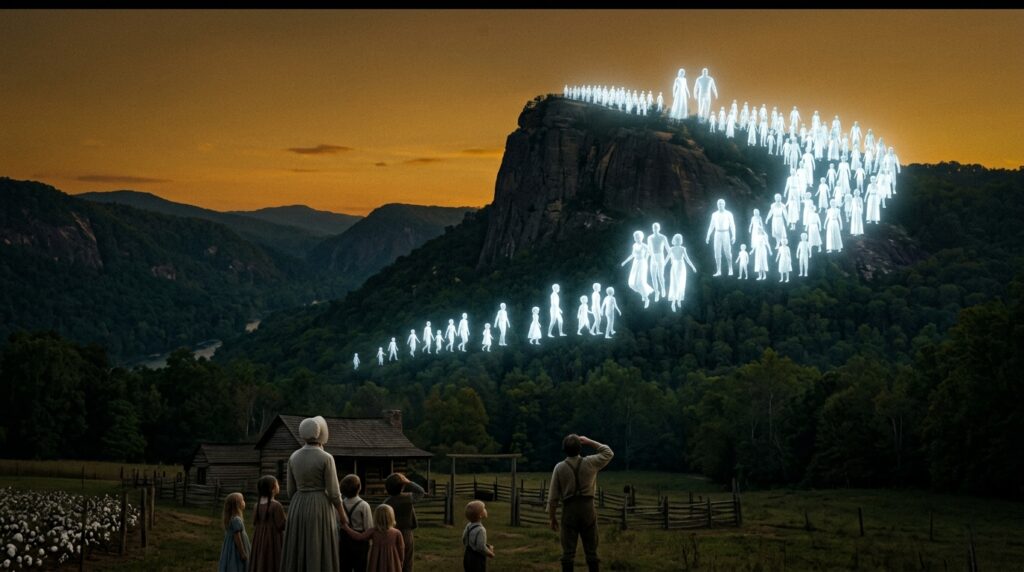
At six o’clock in the evening of August 7, 1806, near the Chimney Rock mountain in Rutherford County, North Carolina, an eight-year-old girl named Elizabeth Reaves was in the cotton field ten poles from her family’s house when she noticed a man on the mountain. Her eleven-year-old brother Morgan was skeptical — until he walked to where she was standing, looked up, and shouted that he saw a thousand or ten thousand things flying in the air. His sister Polly and a woman of the household ran out. Their mother, the widow Patsey Reaves, walked eight poles toward the mountain and looked. What she saw she described precisely: a very numerous crowd of beings resembling the human species, of every size from the tallest men down to the least infants, more small than full grown, all clad with brilliant white raiment of no describable form. They appeared to rise off the mountain south of the Chimney Rock and move northward in organized throngs, collecting around the top of the rock. Three rose together — two, then a third behind them at about two feet distance — moving with great agility toward the crowd. Then three more rose from the same place in the same order and direction. The sighting continued for about an hour. Mrs. Reaves sent for a neighbor, Mr. Robert Siercy — who came reluctantly, expecting to see nothing extraordinary. He took a first look at the mountain and saw nothing. He took a second look and said he saw more glittering white appearances of human kind than he had ever seen at any general view. The two largest beings moved before the others at about twenty yards distance — and then they vanished, leaving on the witnesses a solemn and pleasing impression on the mind, accompanied by a diminution of body strength.
Date: August 7, 1806
Sighting Time: 18:00 — approximately one hour duration
Day/Night: Evening
Location: Chimney Rock, Rutherford County, North Carolina, USA — near the Appalachian Mountain
Urban or Rural: Rural — farm and mountain terrain
No. of Entity(s): Many — a very numerous crowd; described as thousands; of every size from tall adults to least infants
Entity Type: Humanoid — beings resembling the human species; brilliant white garments; no discernible individual body members or sex distinction; organized flight behavior
Entity Description: A very numerous crowd of beings resembling the human species. Unable to discern particular members of the human body or distinction of sexes. Every size from the tallest men down to the least infants — more small than full grown. All clad with brilliant white raiment of no describable garment form. Rose off the mountain south of Chimney Rock and moved northward collecting at the top of the rock. Three rose together in paired formation — two together then one about two feet behind — moving with great agility. Three more rose from the same place in the same order. Several others followed. Two of the largest beings moved before the others at approximately twenty yards. All eventually vanished, leaving a solemn and pleasing impression on the mind accompanied by diminution of body strength.
Hynek Classification: CE-III — Close Encounter of the Third Kind; direct close observation of multiple animate humanoid beings in organized aerial movement by multiple witnesses over an extended period
Duration: Approximately one hour
No. of Object(s): None — no craft; the beings themselves were the aerial phenomenon
Color of Object(s): Brilliant white — the raiment of the beings; glittering white — Mr. Siercy’s description
Distance to Object(s): Mountain distance — approximately six furlongs from the dwelling house to Chimney Mountain; the beings were visible rising from the mountain and collecting at its top
Height & Speed: Mountain altitude — rising from the south face; moving northward to the top of Chimney Rock; three moved with great agility toward the crowd
Number of Witnesses: Multiple — Elizabeth Reaves (8), Morgan Reaves (11), Polly Reaves (4), an unnamed woman of the household, Patsey Reaves (widow mother), and Mr. Robert Siercy who arrived reluctantly as a skeptic
Special Features / Characteristics: Multigenerational family witness chain beginning with a child’s unprompted observation; the child-first observation pattern is analytically significant — Elizabeth was not primed by an adult’s alarm; Morgan’s initial skepticism followed by confirmation; Mr. Robert Siercy as a reluctant skeptic whose independent confirmation is the most analytically valuable witness element — he came expecting to see nothing and saw glittering white appearances of human kind beyond anything at any general view; the diminution of body strength after the vanishing is a documented physical aftermath consistent with the Oz Factor physiological effects; the solemn and pleasing impression is the specific emotional aftermath — not terror but a profound mixed quality consistent with documented CE-III aftermath reports; published in the Raleigh Register September 1806 — formally reported to editor J. Gates within weeks of the event; reprinted in the Statesville North Carolina Landmark June 15, 1883; organized formation flight — the three-plus-one formation of rising beings, the semicircular course noted by Siercy, the twenty-yard lead of the two largest beings before vanishing all describe organized behavioral formations rather than random aerial movement; Chimney Rock in Rutherford County is a distinctive geological landmark — a 315-foot monolithic column of syenite rising from the Broad River Gorge — making the location precisely identifiable
Case Status: Unexplained
Source: Raleigh Register and State Gazette, September 1806; reprinted in Statesville (North Carolina) Landmark, June 15, 1883; report formally made August 7, 1806 to editor J. Gates
Summary/Description: On August 7, 1806, at 6 PM near Chimney Rock, Rutherford County, North Carolina, an eight-year-old girl’s observation of a figure on the mountain led to a family-wide and community witness event involving multiple family members and a reluctant skeptic neighbor who all observed a very numerous crowd of brilliant white humanoid beings of all sizes rising from the mountain and moving in organized formations to collect at Chimney Rock’s top before vanishing. Duration approximately one hour. Formally reported to the editor of the Raleigh Register September 1806. Published again in 1883.
Related Cases: 1744 CE Knott Scotland Aerial Troops | 1624 CE Bierstedt Germany Men and Chariots from Clouds | Early American CE-III Archive
DETAILED REPORT:
August 7, 1806. Rutherford County, North Carolina. The Appalachian Mountains rise to the west and south of a farming community where the Reaves family — a widow, Patsey Reaves, and her children — work cotton fields in the long summer evenings. Chimney Rock, the distinctive 315-foot monolithic column of syenite granite that gives the community its name, stands approximately six furlongs from their dwelling house. In 1806, Chimney Rock is not yet a tourist destination — it will not become a public attraction until the 1820s. In 1806 it is simply a dramatic geological feature on the western skyline, familiar to everyone in the valley.
Elizabeth Reaves is eight years old. She is in the cotton field, approximately ten poles from the house, at six o’clock in the evening. She sees a man on the mountain.
She tells her eleven-year-old brother Morgan.
Morgan is skeptical. This is an analytically significant detail — an eleven-year-old boy’s initial dismissal of his younger sister’s observation is the natural response of a more experienced observer to a less experienced one. He did not believe her. She insisted. He walked to where she was standing.
He looked up.
He shouted that he saw a thousand or ten thousand things flying in the air.
The instant conversion of the skeptical older sibling to an overwhelmed witness is one of the most analytically credible transitions in the Chimney Rock account. Morgan came to the spot ready to be unimpressed. What he saw converted him from dismissal to awe in the same moment.
His sister Polly — four years old — and a woman of the household heard his shout and ran out. They called their mother.
Patsey Reaves, the widow who heads the household, walked approximately eight poles toward the mountain. She looked at Chimney Rock with the unhurried attention of a woman who did not feel sensible alarm or fright — the account specifically notes this — and she described what she saw with the precision of someone whose instinct in an overwhelming situation was to observe and record rather than to flee.
A very numerous crowd of beings resembling the human species.
She could not discern particular members of the human body — individual limbs, features — from her distance. She could not distinguish sexes. What she could see was the general human form in brilliant white, multiplied enormously across the face and top of Chimney Rock. Every size from the tallest men down to the least infants. More small than full grown. All in brilliant white raiment of no describable garment form.
They were rising from the mountain’s south face at approximately the height of the rock — not from the ground, not from the valley, but from the mountain itself — and moving northward to collect at the top of Chimney Rock. Organized movement. Directional. Purposeful.
Three rose in formation: two together, then one about two feet behind, all three moving with great agility toward the crowd already at the top. Then three more from the same place in the same order and direction. Then several others. The formation behavior — consistent paired and tripled rising patterns from the same origin point, moving in the same direction at the same altitude — argues for organized aerial activity rather than random aerial appearance.
Patsey Reaves sent for Mr. Robert Siercy.
Siercy is the account’s most analytically valuable witness. He was reluctant to come — he expected to see nothing extraordinary. This is a skeptic arriving under social pressure. He looked at the mountain on arrival. He saw nothing strange. Then he took a second look.
He said he saw more glittering white appearances of human kind than he had ever seen of men at any general view.
A skeptic who came expecting nothing, saw nothing on first look, and then on second look saw glittering white human-appearing forms in numbers beyond any crowd he had ever witnessed — this is the Chimney Rock account’s gold standard witness. His corroboration is not the corroboration of an already-alarmed community member swept up in collective excitement. It is the corroboration of a man who had to look twice before he saw it, and who then described what he saw in terms that exceeded his most extravagant prior experience of human crowds.
Siercy noted the variety of sizes — entities of different heights moving in throngs. He observed that they moved in a semicircular course between him and the rock. The two largest beings moved before the others at approximately twenty yards distance. And then they vanished.
The aftermath Siercy described is one of the most unusual physical and emotional aftermath reports in the early American CE-III record: a solemn and pleasing impression on the mind, accompanied by a diminution of body strength. Not terror, not exhilaration, not the straightforward shock of an anomalous encounter. Something more complex and more specific — solemn and pleasing simultaneously, while physical strength decreased.
The formal report was made to J. Gates, editor of the Raleigh Register and State Gazette, and was published the following September 1806. It was reprinted in the Statesville North Carolina Landmark on June 15, 1883 — preserving the account across 77 years in two independent publication events.
RESEARCHER’S NOTES:
Chimney Rock 1806 — The Child-First Pattern, the Reluctant Skeptic, and Diminution of Body Strength
- The Child-First Observation Pattern: Elizabeth’s unprompted observation of a figure on the mountain before any adult had seen anything is one of the most analytically significant structural features of the Chimney Rock account. Children are less likely than adults to apply conventional suppressive frameworks to anomalous observations — they report what they see without the social filter that causes adults to hesitate before making an extraordinary claim. The fact that the entire community encounter began with an eight-year-old’s observation that a skeptical eleven-year-old initially dismissed is consistent with a genuine anomalous event developing from the most unprimed possible witness.
- The Reluctant Skeptic as Gold Standard: Robert Siercy’s witness account is the most analytically significant in the Chimney Rock case because he arrived as a skeptic under social pressure, performed an initial negative observation, and only then saw the phenomenon on a second look. His subsequent description — glittering white human appearances in numbers beyond any general view — cannot be attributed to social contagion or group excitement. He came to disprove and ended up confirming. This is the strongest possible CE-III witness configuration.
- Diminution of Body Strength as Physical Evidence: The physical aftermath described by Siercy — a diminution of body strength accompanying the solemn and pleasing impression — is consistent with the documented physiological effects of CE-III exposure across the modern research record. Witnesses who have been in close proximity to anomalous aerial entities frequently report subsequent fatigue, muscle weakness, and a specific altered emotional state. Siercy’s description of this aftermath predates the modern research vocabulary for CE-III physiological effects by 160 years and matches it precisely.
- Newspaper Publication Chain: The formal report to the Raleigh Register in 1806 and the 1883 Statesville Landmark reprint establish a two-publication documentation chain spanning 77 years. Both publications treated the account as a genuine community event worthy of preservation. The 1883 reprint — nearly eight decades after the original — suggests the Chimney Rock 1806 event maintained its local significance long enough to merit re-publication in the post-Civil War era.
An eight-year-old girl saw a man on a mountain in North Carolina on August 7, 1806, and by the time an hour was over, a skeptic who had come expecting nothing was reporting glittering white forms in numbers beyond any crowd he had ever seen, moving in semicircular courses above Chimney Rock before vanishing and leaving him with diminished body strength and a solemn and pleasing impression he apparently could not shake. The widow Reaves described it to the editor of the Raleigh Register. He published it. The Statesville Landmark reprinted it 77 years later. The archive holds it now — the child’s observation, the brother’s conversion, the mother’s precise description, the reluctant neighbor’s two looks and what the second look showed him, and the physical aftermath that neither terror nor excitement explains. Whatever rose from the south face of Chimney Rock and collected in organized formation at its top on that August evening was seen by a family, confirmed by a skeptic, published by a newspaper, and preserved for two centuries. The mountain is still there. The record is still in the archive.