THINK ABOUTIT UFO|ENCOUNTER SIGHTING REPORT
1624: Bierstedt, Anhalt, Germany
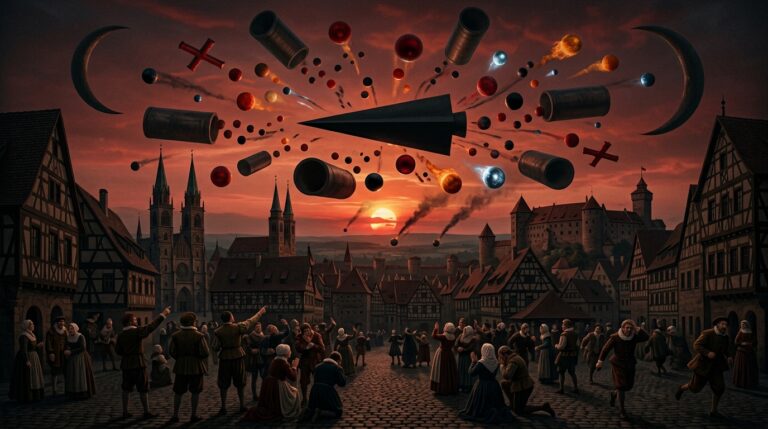
Between six and eight o’clock on the evening of May 12, 1624, the sky over Bierstedt in the Duchy of Anhalt, Germany, opened without thunder and without warning. From within thick banks of clouds, the witnesses below watched as a multitude of men and golden chariots descended through the cloud layer and moved across the horizon in a structured procession that lasted exactly two hours. The figures moved with what the accounts describe as a structured grace — organized, deliberate, following a formation that defied every natural explanation available to a city in the middle of the Thirty Years’ War. Some citizens fell to their knees in prayer, believing the Day of Judgment had arrived. Others stood frozen, unable to look away from the gleaming figures that occupied the sky above their city for the full duration before vanishing back into the clouds. It was 1624. Germany was in the fourth year of the most destructive war in European history to that point. The sky over Bierstedt chose that moment to show the city something that no one in it had a name for.
Date: May 12, 1624
Sighting Time: 18:00 to 20:00
Day/Night: Evening — dusk into night
Location: Bierstedt, Duchy of Anhalt, Germany
Urban or Rural: Urban — city population witnessed the event
No. of Entity(s): Multiple — a multitude of men
Entity Type: Humanoid — described as men; gleaming, organized figures
Entity Description: A multitude of human-appearing figures described as men, organized in a structured procession with golden chariots. Described as gleaming. Moving with structured grace across the horizon in an organized formation. Emerged from within cloud banks and returned to them after two hours.
Hynek Classification: CE-III — Close Encounter of the Third Kind; close observation of multiple animate beings associated with aerial vehicles; the beings were clearly visible, individually distinguishable, and organized in deliberate formation. The existing CE-I classification on the page understates the encounter given the detailed entity description.
Duration: 2 hours exactly — from 18:00 to 20:00
No. of Object(s): Multiple — golden chariots accompanying the multitude of men
Description of Object(s): Golden chariots — vehicle-type objects accompanying the humanoid figures, described as golden in appearance, part of the organized aerial procession
Shape of Object(s): Chariot — vehicle morphology
Size of Object(s): Not recorded — visible from ground level across the city
Color of Object(s): Golden — chariots described as golden; figures described as gleaming
Distance to Object(s): Aerial — visible from city streets below
Height & Speed: Cloud level — emerged from cloud banks; moved across the horizon at procession pace; returned to clouds after two hours
Number of Witnesses: Multiple — entire city population; some fell to knees, others stood frozen
Special Features / Characteristics: Silent emergence — the sky parted without thunder; organized formation — the procession moved with structured grace rather than random movement; two-hour sustained duration — long enough for the entire city to observe and react; return into clouds — the procession vanished back into the cloud layer it had emerged from; Thirty Years’ War context — Bierstedt was in the path of the most destructive European war of the era at the time of the sighting; connects directly to the long tradition of aerial army and chariot processions documented across European history from 1100 CE through the mid-17th century
Case Status: Unexplained
Source: Chris Aubeck, Return to Magonia
Summary/Description: On the evening of May 12, 1624, between 6 and 8 PM, a multitude of gleaming humanoid figures and golden chariots emerged silently from cloud banks over Bierstedt, Anhalt, Germany, and moved in a structured organized procession across the horizon for two full hours before returning to the clouds. The entire city witnessed the event — some falling to their knees in prayer, others frozen in place. Documented by Chris Aubeck in Return to Magonia.
Related Cases: 1100 CE Germany Aerial Armies over Crusading Europe | 1571 CE Lepanto Italy Aerial Army | 1608 CE France 12,000 Blue-Armored Warriors from Clouds | European Aerial Army Archive
DETAILED REPORT:
The year is 1624. The Thirty Years’ War began in Bohemia six years ago and has spread across the German-speaking lands with a devastation that would ultimately kill between a quarter and a third of the population of what is now Germany. The Duchy of Anhalt — in central Germany, between the Elbe and Saale rivers — is directly in the path of the conflict. Lutheran and Catholic armies have been moving through these territories. Communities have been watching the horizon for signs of approaching forces for years. The people of Bierstedt know what an army looks like. They know what soldiers on the march look like, what wagons and chariots look like, what organized military formations moving across open terrain look like.
What appeared over their city on the evening of May 12, 1624 was not a German army.
At six o’clock in the evening, the sky over Bierstedt changed without any warning sound. No thunder. No lightning. The clouds — thick banks of cloud — opened or parted, and from within them something emerged.
A multitude of men. And golden chariots.
The account preserved by Chris Aubeck describes the figures as gleaming — a quality of light or reflectivity that distinguished them from anything the witnesses had seen in the four years of war they had been surviving. They moved with what witnesses described as structured grace — not the chaotic movement of a battle, not the random dispersal of fleeing people, but an organized procession with internal order and deliberate direction. They drifted across the horizon in a formation.
The city’s response was immediate and divided in exactly the way genuine mass anomalous observation divides a community. Some citizens fell to their knees in prayer — their interpretive framework for gleaming figures descending from parted clouds in organized formation was the Day of Judgment, the end of days, the moment they had been told to expect since childhood. Others could not process the event through any framework at all. They stood frozen. Unable to move. Unable to look away from the gleaming figures above them.
For two full hours the procession continued.
Then, as silently as it had emerged, it returned to the clouds. The formations dissolved back into the cloud layer from which they had appeared, and the sky over Bierstedt returned to its ordinary configuration.
The timing of the Bierstedt event within the broader pattern of aerial procession sightings documented in the ThinkAboutIt archive is worth noting. The aerial army tradition — organized human-appearing figures and military vehicles observed in the sky — runs continuously from the 1100 CE German crusade accounts through the 1571 Lepanto aerial army, the 1608 France 12,000 blue-armored warriors from clouds, and the 1624 Bierstedt procession. Each century produces multiple documented accounts of the same phenomenon across different European geographies — organized humanoid figures in aerial formations, associated with military vehicles, observed at altitude and duration long enough for community-wide observation and reaction.
Bierstedt in 1624 is that tradition in its Thirty Years’ War context — a city already living in the reality of military catastrophe watching something in the sky that matched the form of an army but operated in a dimension that no army available to the Holy Roman Empire could reach.
RESEARCHER’S NOTES:
The Bierstedt Procession — Structured Formation, Thirty Years’ War Context, and the Aerial Army Tradition
- Upgrade from CE-I to CE-III: The existing classification of this case as CE-I understates its analytical significance. CE-I designates proximity of an object within 500 feet without animate beings. The Bierstedt account explicitly describes a multitude of men — individual humanoid figures — organized in procession with vehicles. This is CE-III by definition: close observation of animate beings associated with aerial objects. The reclassification matters because it connects this case correctly to the aerial army and entity procession tradition in the archive rather than treating it as a simple light or object sighting.
- The Thirty Years’ War Context: Bierstedt’s location in the Duchy of Anhalt placed it directly in the theater of the Thirty Years’ War in 1624. The witnesses were people with direct personal experience of military formations, armed soldiers, and military vehicles. Their capacity to distinguish between an ordinary army on the horizon and what appeared over their city was not naive — these were people who had been watching real armies for years. Their reaction — falling to their knees and standing frozen rather than fleeing or preparing defenses — reflects their recognition that what was above them was categorically different from any army they had actually encountered.
- The Aerial Chariot Morphology: The golden chariots accompanying the humanoid figures in the Bierstedt procession connect this case directly to the Ezekiel chariot tradition, the Vedic Vimana accounts, and the broader aerial vehicle-as-chariot morphology documented across cultures and millennia. The chariot is the most ancient and cross-culturally consistent vehicle form applied to aerial objects in the pre-modern record — appearing in Mesopotamian, Hebrew, Indian, Greek, Celtic, and European sources across thousands of years. Its appearance in a 1624 German account during the most destructive war of the era places the morphology in its most militarily resonant possible context.
- The Two-Hour Duration: The two-hour duration of the Bierstedt procession is one of its most analytically significant features. Extended sustained aerial phenomena of this length are not atmospheric illusions, optical effects, or misidentified natural phenomena. Two hours is long enough for an entire city to observe, react, discuss, and form a consensus account — which is precisely what produced the record that reached Chris Aubeck four centuries later. The duration argues strongly for a genuine physical phenomenon with the organizational capacity to maintain a structured procession over a populated area for a sustained period.
The sky over Bierstedt opened silently at six o’clock on May 12, 1624, and showed the city a procession of gleaming men and golden chariots for two hours while Germany burned around them. The people who fell to their knees thought it was the end of the world. The people who stood frozen thought nothing — they simply could not look away. After two hours the procession returned to the clouds and the sky became ordinary again. Chris Aubeck found it in Return to Magonia. The archive holds it now — one entry in the long and consistent record of organized humanoid figures and aerial vehicles observed over European territories in moments of maximum human crisis. Whatever moves through the sky in formations of men and chariots during wars has been doing so across this continent for at least five hundred years. Bierstedt in 1624 is one of its clearer documented appearances.