THINK ABOUTIT ENTITY SIGHTING REPORT
1594: Freiburg, Germany Apparition of Jesus
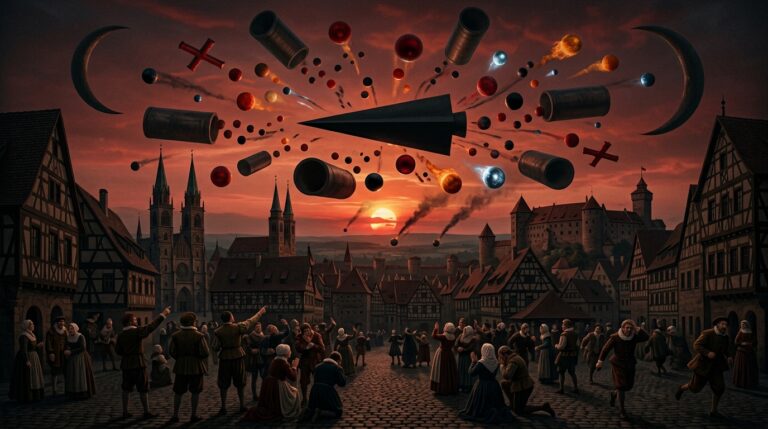
In 1594 in Germany, two separate communities witnessed two separate sky apparitions in the same year — and both of them interpreted what they saw through the only available framework for something that had no other explanation. Over Freiburg in the Black Forest region, the people saw a luminous figure sitting on a rainbow, which they described as the form of Jesus Christ announcing the Last Judgment. Over Saxony, the same year, an entirely different community witnessed something equally unclassifiable: a dead man laid out on a funeral bier, carried through the sky by many figures in black bearing trumpets. Two events. Two locations. Two communities in the same country in the same year watching figures in the sky that they had no natural vocabulary for and reaching for the only vocabulary available — the end of time. Germany in 1594 was twelve years past the end of the Nuremberg aerial battle and thirty-three years before the beginning of the Thirty Years’ War. The sky over the German-speaking lands in the late 16th century was busy, and the communities beneath it were watching.
Date: 1594 CE
Sighting Time: Not recorded
Day/Night: Day — classified as DD (Daylight)
Location: Freiburg im Breisgau, Baden-Württemberg, Germany (first event); Saxony, Germany (second event)
Urban or Rural: Not recorded
No. of Entity(s): First event: 1 — luminous figure on a rainbow. Second event: multiple — a dead man on a bier carried by many black-robed figures bearing trumpets
Entity Type: Humanoid — aerial figures of distinctive appearance and apparent purpose
Entity Description: First event: A luminous humanoid figure seated on a rainbow over Freiburg, interpreted by local witnesses as the form of Jesus Christ as if announcing the Last Judgment. Second event: A dead man laid out on a funeral bier carried through the sky over Saxony by many figures dressed in black who carried trumpets. The procession character of the second event — organized, purposeful, directional — distinguishes it from simple aerial light phenomena.
Hynek Classification: CE-III — Close Encounter of the Third Kind; close observation of animate beings or entity-forms of defined appearance at aerial altitude. The Freiburg event is reclassified from the existing DD designation — DD designates objects, not luminous humanoid figures seated on rainbows.
Duration: Not recorded
No. of Object(s): First event: 1 — the rainbow as the physical structure on which the figure appeared. Second event: 1 — the bier or aerial vehicle carrying the procession Description of Object(s): First event: A rainbow serving as the apparent platform or support for the luminous figure. Second event: A funeral bier visible in the sky carrying a recumbent human figure Shape of Object(s): First event: Rainbow arc. Second event: Bier — rectangular funeral platform Size of Object(s): Not recorded — aerial scale
Color of Object(s): First event: Luminous — figure on rainbow; multiple colors of the rainbow itself. Second event: Black — the figures carrying the bier
Distance to Object(s): Aerial — visible from ground level to multiple witnesses
Height & Speed: Aerial — both events observed in the sky; second event described as a procession suggesting movement through the sky
Number of Witnesses: Multiple — community-level observations in both Freiburg and Saxony; individual counts not recorded
Special Features / Characteristics: Two independent events in different German locations in the same year 1594 — not the same phenomenon; different morphologies, different locations, same year and same interpretive context; the rainbow-figure over Freiburg connects to the broader German tradition of luminous figures on atmospheric phenomena documented across the 16th century; the Saxony sky procession with trumpeters and a bier connects directly to the 1608 Prague faceless army, the 1624 Bierstedt aerial procession, and the broader European sky procession tradition; both events framed by witnesses in apocalyptic terms — Last Judgment, death procession — consistent with the psychological climate of late 16th century Protestant Germany; the trumpet-bearing figures are one of the most specific musical detail descriptions in the pre-modern sky procession record
Case Status: Unexplained
Source: T. Peter Park, The Anomalist No. 10
Summary/Description: In 1594, two independent communities in Germany witnessed separate aerial phenomena. Over Freiburg, witnesses observed a luminous figure seated on a rainbow interpreted as Christ announcing the Last Judgment. Over Saxony the same year, witnesses observed a sky procession carrying a dead man on a bier, attended by many figures in black carrying trumpets. Both events were documented by T. Peter Park in The Anomalist No. 10 as part of the broader pattern of late 16th century German aerial entity encounters.
Related Cases: 1561 CE Nuremberg Germany Aerial Battle | 1624 CE Bierstedt Germany Men and Chariots from Clouds | 1587 CE Turnac France Aerial Battle | German Sky Procession Archive
DETAILED REPORT:
The year is 1594. Germany is in the middle of the long, uneasy peace between the Reformation’s upheaval and the Thirty Years’ War that will begin in 1618. The Protestant Reformation has shattered the religious unity of the German-speaking world, theological conflict permeates daily life, and apocalyptic anxiety — the expectation of divine judgment arriving at any moment — is the dominant psychological climate of an entire generation of German Christians.
It is in this context that the sky over Freiburg presents its first 1594 anomaly.
A figure seated on a rainbow. Luminous, defined, humanoid — positioned on the arc of a rainbow in a way that has no meteorological explanation and no precedent in the atmospheric optics of the period. The witnesses who saw it reached for the most powerful available image in their theological vocabulary: Christ enthroned on a rainbow, as depicted in countless Last Judgment altarpieces across the Catholic and Protestant churches of Germany. As if to announce the Last Judgment.
This interpretive leap — from anomalous luminous figure on a rainbow to the specific imagery of the Last Judgment — tells us something important about what the witnesses actually saw. They were not seeing a light effect they could dismiss. They were seeing a figure. Defined enough, structured enough, human enough in form to be compared specifically to the iconographic tradition of Christ in glory. What sat on that rainbow over Freiburg in 1594 was not a smear of light. It was something that looked like a person sitting on an atmospheric arc — and the community beneath it, reaching for whatever explanation their world provided, reached for the end of everything.
The second event is three hundred miles to the northeast, in Saxony.
This one is not a single figure. It is a procession.
A dead man — a human figure arranged as a corpse on a bier — moves through the sky over Saxony, carried by many figures dressed in black. They carry trumpets. This is not a random assembly of aerial lights. It is an organized, purposeful aerial procession with specific assigned roles: bearers carrying a bier, attendants in black, trumpeters. The funeral procession was a highly ritualized social institution in 16th century German culture — every element of it carried specific meaning about the identity and status of the deceased and the nature of the mourning. Whatever the Saxony witnesses saw carried every element of a formal funeral procession through the sky above their heads.
The trumpet detail is analytically specific. Trumpets in a funeral procession served a specific ceremonial function — they announced the procession, marked the status of the dead, and signaled to the community to stop and acknowledge the passing. Whatever carried trumpets through the Saxony sky in 1594 was either imitating this ceremonial function or operating according to its own purposes that happened to include trumpet-bearing attendants.
T. Peter Park preserved both events in The Anomalist No. 10 as part of his documentation of the broader pattern of German late 16th century aerial entity encounters. The two events — Freiburg and Saxony — are not the same phenomenon. They have different morphologies, different locations, and different witness communities. What they share is the year, the country, and the interpretive context of a culture primed for apocalyptic imagery by thirty years of Reformation trauma.
Both the Freiburg rainbow figure and the Saxony sky procession with its bier and trumpeters fit within the broader European sky procession tradition documented from the 1100 CE German aerial armies through the 1608 Prague faceless army and the 1624 Bierstedt men and chariots from clouds. The form varies. The phenomenon of organized humanoid figures moving through the sky in structured formations over populated European communities does not.
RESEARCHER’S NOTES:
The 1594 Freiburg and Saxony Apparitions — Rainbow Figure, Funeral Procession, and the Apocalyptic Sky
- The Rainbow as Platform vs. Atmospheric Effect: The Freiburg apparition of a figure seated on a rainbow raises a specific analytical question: was the rainbow a naturally occurring atmospheric arc on which a luminous figure coincidentally appeared, or was the rainbow itself part of the appearance — generated, structured, or used as a visible platform by the entity or phenomenon responsible for it? The distinction matters because natural rainbows do not carry seated figures. If the rainbow was natural and the figure appeared on it, the case involves an entity using an atmospheric structure as a visible backdrop. If both were generated together, the case involves a more complex phenomenon capable of producing both optical and physical elements simultaneously.
- The Funeral Procession Morphology: The Saxony sky procession — bier, dead figure, black-robed bearers, trumpeters — is the most elaborately detailed sky procession account in the 1590s German record. The specificity of the funeral morphology suggests either a deliberate mimicry of a culturally recognizable ceremony for communicative purposes, or a genuine procession of non-human entities whose own ceremonial or functional activity happened to resemble a human funeral. Both possibilities are analytically significant. A phenomenon that chooses to present itself in the specific morphology of a funeral procession to a community in the grip of apocalyptic anxiety is either communicating something about death and endings, or it is conducting its own business in a form the observers could not help but interpret as the darkest available symbol.
- Same Year, Different Phenomena: The 1594 Freiburg and Saxony cases are documented together because they occurred in the same year and country, but they are analytically independent — different morphologies, different locations, different witness communities. Their co-occurrence in 1594 may be coincidental. Or it may reflect a pattern of increased aerial entity activity across the German-speaking lands in the late 1590s that the archive documents in multiple entries across this period.
- The Anomalist Documentation: T. Peter Park’s documentation in The Anomalist places both events within the analytical tradition of serious historical UAP and entity encounter research rather than theological or folkloric scholarship. His inclusion of both events in the same entry establishes their comparative relationship — they belong to the same category of phenomenon even if they are not the same event.
Over Freiburg in 1594, something sat on a rainbow and looked like the figure witnesses had been praying in front of for their entire lives. Over Saxony in the same year, something carried a dead man through the sky on a bier attended by black-robed trumpeters. Two communities. Two different phenomena. One year. Germany in 1594 was watching its sky with the specific intensity of a culture that believed judgment was always imminent and signs were always significant. What it saw in that year gave both communities exactly the images their theology had prepared them to find most terrifying — and the archive holds both accounts without being able to explain either one. Whatever sat on the Freiburg rainbow was not the Last Judgment. Whatever carried a bier through the Saxony sky with trumpeters in attendance had its own purposes. The witnesses named what they saw with the only names available to them. The archive holds what the sky showed them.