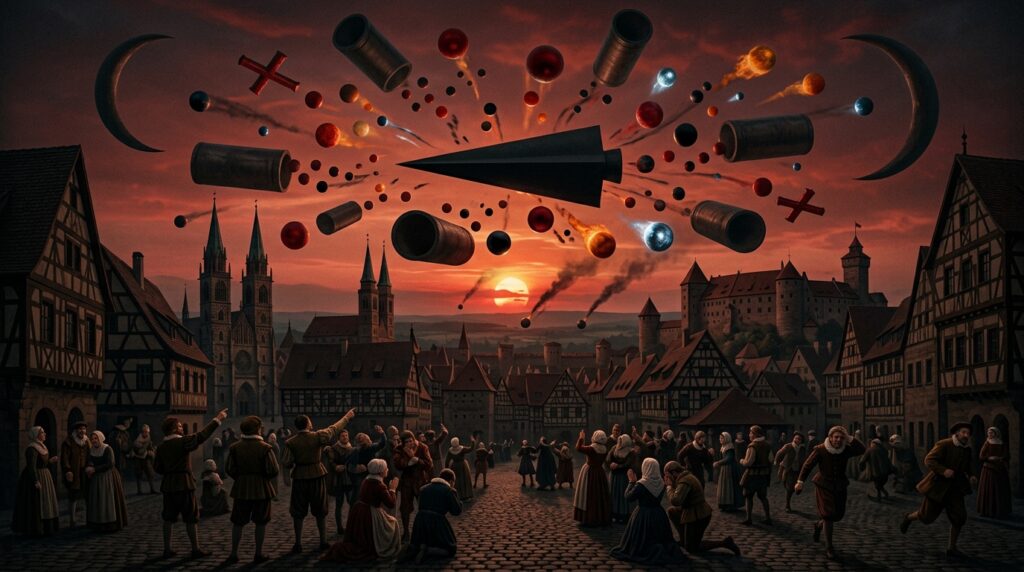
April 14, 1561 CE — Nuremberg, Germany. Between 4 and 5 AM hundreds of spheres, cylinders, blood-red crosses, crescents, and a massive black spear engaged in aerial combat above one of the Holy Roman Empire's greatest cities for over an hour before falling to earth in clouds of smoke. Documented by Hans Glaser in a broadsheet archived at the Zentralbibliothek Zürich — one of the most famous mass UAP events in recorded history.
THINK ABOUTIT UFO SIGHTING REPORT
1561: UFO ‘battle’ over Nuremberg, Germany
At daybreak on April 14, 1561, between four and five o’clock in the morning, the citizens of Nuremberg — one of the most prosperous and culturally significant cities of the Holy Roman Empire — looked up and saw something that would terrify them for the rest of their lives. Two blood-red semi-circular arcs appeared at the center of the sun. From the sun itself emerged cylindrical shapes — tubes resembling cannon barrels — from which dozens of spheres poured out and began moving erratically across the sky. Crosses the color of blood appeared among the spheres. Blue-white, red, black, and orange globes darted in formations of threes and fours and larger groupings. Crescents appeared in the sky alongside the spheres and cylinders. For more than an hour, these objects appeared to engage in combat with each other — fighting vehemently, as Hans Glaser wrote — until the exhausted combatants began to fall toward the earth beyond the city walls in clouds of smoke. Then a massive black spear-shaped object appeared, pointing westward, as if supervising or concluding the engagement. The people of Nuremberg who watched this from their streets, their fields, and their city gates were many — men and women, within the city and outside it, in sufficient numbers to constitute a city-wide mass sighting. Hans Glaser, letter-painter and printer of Nuremberg, published a broadsheet within weeks of the event with a woodcut illustration that has become one of the most recognized images in the history of UAP documentation. That broadsheet has been archived for four centuries at the Zentralbibliothek Zürich. It is still there.
Date: April 14, 1561
Sighting Time: Between 04:00 and 05:00 — daybreak
Day/Night: Dawn
Location: Nuremberg, Free Imperial City, Holy Roman Empire, Germany — within the city, before its gates, and in the surrounding countryside
Urban or Rural: Both — city-wide sighting extending into the rural surroundings
Hynek Classification: DD — Daylight Disc; multiple objects of defined shape observed in daylight conditions; the combat behavior, formation flying, and organized departure into the earth beyond the city walls elevates this well beyond conventional DD classification
Duration: Over one hour — from first appearance through the aerial engagement to the fall of objects beyond the city walls
No. of Object(s): Hundreds — exact count not given; the broadsheet describes cylindrical objects, spheres in groups of three and four, crosses, two large crescents, and a large black spear-shaped object
Description of Object(s): Two blood-red semi-circular arcs at the sun’s center. Cylindrical tube-shaped objects resembling cannon barrels from which multiple spheres emerged and darted. Spheres in groups of three, four, and larger formations — black, red, orange, and blue-white in color. Blood-red crosses among the spheres. Two large lunar crescents. A massive black spear-shaped object pointing westward appearing at the climax of the engagement. Multiple objects falling to earth beyond the city walls in clouds of smoke at the encounter’s conclusion.
Shape of Object(s): Multiple — cylinders/tubes; spheres; crosses; crescents; large spear/triangular form
Size of Object(s): Varied — spheres described as approximately three in length — small to large; the black spear-shaped object was massive
Color of Object(s): Blood-red; black; orange; blue-white — multiple distinct colors documented
Distance to Object(s): Aerial — appeared in and around the sun at dawn; close enough for witnesses to distinguish shape, color, formation, and apparent combat behavior in detail
Height & Speed: Solar altitude — appearing from and around the sun at dawn; objects moved erratically and at high speed; combat formations visible from the ground
Number of Witnesses: Many — men and women within the city of Nuremberg, before its gates, and in the surrounding countryside; a city-wide and regional mass observation
Special Features / Characteristics: Emergence from cylinders — spheres poured from tube-shaped objects suggesting carrier/deployment relationship; combat behavior explicitly documented — objects fought vehemently until exhausted; formation flying — groups of three, four, and larger formations; multiple distinct object morphologies operating simultaneously; terminal crash landing of multiple objects beyond the city walls in smoke; massive black spear-shaped object appearing at the climax suggesting a command or command-termination presence; the entire event occurred in the context of the rising sun at dawn suggesting either the sun as a backdrop for illumination or association with solar position; documented within weeks in a broadsheet by a named professional publisher with a woodcut illustration; broadsheet archived at Zentralbibliothek Zürich; Carl Jung referenced it in his 1958 study of UFO symbolism; Jacques Vallée examined and commented on it; Nuremberg was experiencing severe economic depression at the time following the Reformation — the city’s social context produced intense apocalyptic anxiety
Case Status: Unexplained — atmospheric optical phenomenon proposed by skeptics; not confirmed
Source: Hans Glaser broadsheet (April 1561), archived at Zentralbibliothek Zürich, Wickiana Collection; Nuremberg Gazette; Carl Jung, Flying Saucers: A Modern Myth of Things Seen in the Skies (1958)
Summary/Description: At dawn on April 14, 1561, the citizens of Nuremberg witnessed a mass aerial event lasting over an hour in which hundreds of objects — cylinders, spheres, crosses, crescents, and a massive black spear — appeared in and around the sun, engaged in apparent aerial combat, formed into flight groupings, and eventually fell toward the earth beyond the city walls in clouds of smoke. Documented within weeks by Hans Glaser in a broadsheet with woodcut illustration now archived at the Zentralbibliothek Zürich — one of the most famous and most analyzed mass UAP events in the pre-modern historical record.
Related Cases: July 1566 CE Basel Switzerland Black Sphere Aerial Battle | 1550 CE Saxony Germany Aerial Army with Cross | 1555 CE Buendia Spain Cross Object | Nuremberg-Basel Renaissance Aerial Combat Archive
DETAILED REPORT:
April 14, 1561. Nuremberg is one of the great cities of the Holy Roman Empire — a Free Imperial City of enormous wealth, culture, and prestige that had suffered a catastrophic reversal of fortune following the Reformation. Once a safe haven for nobility and merchants at the crossroads of European trade routes, Nuremberg in 1561 is a city in depression — its trade routes severed, its citizens taxed heavily to pay for military conflicts they had declined to support, its population increasingly gripped by apocalyptic anxiety rooted in financial hardship and religious upheaval.
Into this context, at four o’clock in the morning on April 14th, the sky opened its account.
Hans Glaser — letter-painter and printer of Nuremberg, a professional publisher whose craft was the production and sale of broadsheets to a literate public — was among those who witnessed or immediately learned the full details of what occurred. His account, published within weeks of the event and illustrated with a woodcut that has become one of the most recognized images in the history of UAP documentation, begins with the sun.
Two blood-red semi-circular arcs appeared at the center of the sun — just like the moon in its last quarter, Glaser writes. These arcs were the opening formation. Then, from the sun itself, the cylinders began to emerge.
Tube-shaped objects — Glaser describes them as resembling cannon barrels, the most powerful projectile-delivery technology available to a 16th century German printer seeking a structural analogy — floated in the air around the sun. From these tubes, spheres poured out. Dozens of them. Black, red, orange, and blue-white — a specific chromatic variety that witnesses preserved with precision. The spheres moved erratically. They grouped into formations of three, four, and larger clusters. Blood-red crosses appeared among them.
Then they began to fight.
The word Glaser uses — vehemently — is not metaphorical. He is describing what the witnesses described to him: objects in active, vigorous, sustained combat with one another. Not random movement. Not simultaneous drift. Combat — objects attacking other objects, engaging, retreating, engaging again — for more than an hour above the rooftops of Nuremberg while men and women in the streets, the fields outside the gates, and the surrounding countryside watched.
Two large crescents appeared in the sky alongside the fighting objects. More spheres emerged from the cylindrical forms. The engagement continued.
Then, at the climax, the black spear appeared.
Massive. Black. Spear-shaped — or triangular, depending on which account is consulted. Pointing westward. It appeared in the sky as the combat reached its most intense phase and the combatants began to fall. The exhausted objects — the word exhausted is Glaser’s, suggesting either a genuine depletion of some resource or capability in the combatants, or the only word available to describe objects behaving as if depleted — descended toward the earth beyond the city walls. They fell in clouds of smoke. An enormous crash was heard across the city as the encounter ended.
Hans Glaser published his broadsheet. He included a woodcut — now one of the most reproduced images in pre-modern UAP documentation — depicting the sky filled with the spheres, the cylinders from which they emerged, the blood-red crosses, the crescents, and the black spear at the bottom of the composition, pointing westward over a stylized Nuremberg skyline. He concluded his text with a statement that has been cited by researchers and skeptics alike for over four centuries — that whatever such signs mean, God alone knows.
The broadsheet, measuring 26.2 by 38 centimeters, is preserved in the Zentralbibliothek Zürich in Switzerland. Carl Jung referenced it in his 1958 study of UFO symbolism. Jacques Vallée examined it and expressed skepticism about its literal interpretation. Ulrich Magin questioned the broadsheet’s function as objective reporting. The debate about what Nuremberg witnessed on April 14, 1561 has continued without resolution for 464 years.
What is not in dispute is that the broadsheet exists, that it was published within weeks of the claimed event by a named professional publisher, and that its woodcut illustration depicts specific objects of specific shapes, colors, and behavioral characteristics that no atmospheric optical phenomenon — sun dogs, parhelia, halos — fully accounts for. Sun dogs are stationary. They do not emerge from cylinders. They do not fall to earth in smoke. They do not require a massive black spear to appear at their climax.
RESEARCHER’S NOTES:
The Nuremberg Aerial Battle — Carrier Deployment, Combat Behavior, and the Black Spear
- Carrier/Deployment Relationship: The emergence of spheres from cylindrical objects is the most technically significant structural detail in the Nuremberg account. The cylinders are not simply present alongside the spheres — the spheres emerge from them and then operate independently. This is a carrier/deployment relationship — a larger craft deploying smaller craft from its interior — that is one of the most consistently documented features of modern UAP encounters and one that has no conventional atmospheric optical explanation. Sun dogs do not deploy spheres. Cylinders from which multiple objects emerge and then engage in independent combat behavior are craft.
- Combat Behavior as Classification Evidence: The documented behavior of the objects — vehement fighting until exhausted, formation groupings of three and four, falling to earth in smoke — constitutes behavioral evidence that cannot be attributed to atmospheric optics. Atmospheric phenomena do not fight. They do not form tactical groupings. They do not exhaust. They do not crash outside a city in smoke. The behavioral description in the Glaser broadsheet describes coordinated autonomous objects, not light refraction.
- The Black Spear’s Analytical Significance: The appearance of the massive black spear-shaped object at the climax of the engagement — after the combat and before the crash landing of the exhausted objects — is one of the most analytically distinctive features of the 1561 Nuremberg event. Its timing, position, and scale relative to the other objects suggest either a command-and-control function, a concluding signal, or a third-party observation of the engagement. Whatever its function, it is specifically separate from the combatant objects — they fight, it appears, they fall, it remains. It is the last object described before the encounter concludes.
- The Basel Parallel: The July 1566 black sphere aerial battle over Basel — documented in a second broadsheet by Samuel Apiarius and Samuel Coccius five years later and 200 miles to the southwest — describes a virtually identical event. Black spheres in combat. Objects falling. A major city’s population as witnesses. A broadsheet published within the event’s immediate aftermath. The structural similarity between the Nuremberg 1561 and Basel 1566 events — same phenomenon, same documentation method, same geographic cultural context — argues for a genuine recurring phenomenon rather than independent fabrications or atmospheric misinterpretations.
Hans Glaser published a broadsheet in April 1561 and it is still in the Zürich library. Whatever the people of Nuremberg watched between four and five in the morning on April 14th of that year — the cylinders from which spheres emerged, the blood-red crosses among the fighting globes, the crescents in the sky, the hour-long combat, the exhausted objects falling beyond the walls in smoke, the massive black spear pointing westward at the end — was real enough to send a professional printer to his press within weeks of the event to produce a permanent illustrated record of it. Whatever such signs mean, Hans Glaser wrote, God alone knows. Four hundred and sixty-four years later the archive holds his broadsheet, his woodcut, and his honest admission that the most careful observer in Nuremberg in 1561 could not explain what his city had witnessed. The spheres emerged from the cylinders. They fought. They fell. The black spear appeared. And then it was over.