THINK ABOUTIT ENTITY SIGHTING REPORT
1125 CE: Railbach, Freienstein, Germany Burning Man?
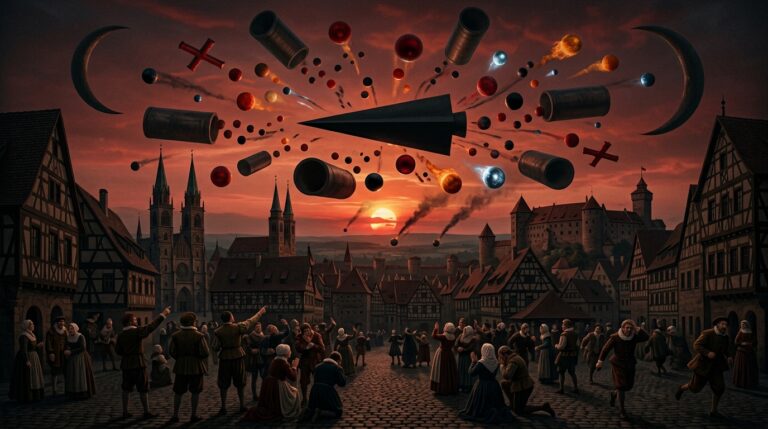
Shortly before midnight on a night in 1125 CE, multiple witnesses in the hills near Railbach and Freienstein in Germany watched something that defied every category available to them. A figure ran across the hillside — the shape of a man, but burning. Not a man on fire. A man of fire. It spat flames from its nose and mouth. Witnesses reported they could plainly see its ribs — burning, visible through whatever passed for its body. Named witness Georg Miltenberger was among those who watched it wander the mountainous area for what the account describes as quite some time. Nine centuries later nothing in the natural world or the medieval supernatural tradition adequately explains what those witnesses saw running across those hills.
Date: 1125
Sighting Time: 2300 to midnight
Day/Night: Night
Location: Railbach, Freienstein, Germany
Urban or Rural: Rural — mountainous hillside terrain
No. of Entity(s): 1
Entity Type: Bizarre non-human entity
Entity Description: Described as a burning man or man of fire — humanoid in form, running across the hills, spitting fire from its nose and mouth, with burning ribs plainly visible through its body; remained wandering the mountainous area for an extended period
Hynek Classification: CE-III (Close Encounter III) Close observation with animate beings associated with the object.
Duration: Extended — the entity wandered the mountainous area for quite some time after initial observation
Special Features / Characteristics: Internal luminosity — burning ribs visible through the body; fire emission from facial orifices; sustained ground-level movement over extended time; entity showed no distress despite apparent combustion — behaved as though the fire was its natural state rather than an injury
Case Status: Unexplained
Number of Witnesses: The account mentions many witnesses, including an individual named Georg Miltenberger.
Source: Michel Bougard, Inforespace # 23, And Jean Ferguson “Humanoids”
Summary / Description: Near Railbach and Freienstein, Germany in 1125 CE, multiple witnesses including Georg Miltenberger observed a bizarre humanoid entity running across the hills between 11pm and midnight. Described as a burning man or man of fire, the entity spat fire from its nose and mouth and had burning ribs plainly visible through its body. It remained wandering the mountainous area for an extended period. The case is one of the most physically unusual non-human entity descriptions in the medieval European record.
Related Cases: 214 CE Hadria Italy Fiery Bridge and White-Clad Entity | 1092 CE Polotsk Belarus Invisible Horsemen | Medieval European Entity Contact Archive
DETAILED REPORT:
The hills near Railbach and Freienstein in 12th-century Germany were not wilderness in any uninhabited sense. This was a populated rural landscape of medieval Germany in the early Hohenstaufen era — farms, villages, roads, people moving through the landscape at all hours. When multiple witnesses report seeing something extraordinary in this terrain, they are reporting from a context of daily familiarity with what that landscape normally looked like at night.
What they saw on this night was not normal.
Between 11 o’clock at night and midnight, a figure appeared on the hillside. It was running. It was shaped like a man. And it was on fire — not burning in the way a human being catches fire, but constitutionally burning, as though fire was the substance it was made of rather than something happening to it.
The witnesses described it as a burning man. A man of fire. The description that emerged from multiple observers is specific and consistent: the entity spat fire from its nose and from its mouth as it ran. And several witnesses reported something even more remarkable — they could plainly see its ribs. Not the surface of a body. The interior structure — burning ribs, visible through whatever served as the entity’s outer form, glowing from within.
This is internal luminosity. The entity was not reflecting firelight from an external source. It was generating light from inside itself, sufficiently intense that its skeletal structure was visible to human observers at close enough range to make out the detail.
Georg Miltenberger is named in the account as a specific witness — one of many, according to the source text. The naming of a witness in a medieval account is significant. It is the chronicler’s way of signaling that this is not general folklore but a report attached to a specific, identifiable individual who could be questioned about what he saw.
The entity did not pass through the area and disappear. It remained. It wandered the mountainous terrain for what the account describes as quite some time — a sustained ground-level presence of a burning humanoid figure in the hills outside two German villages for an extended period around midnight in 1125 CE.
Michel Bougard’s documentation of this case in Inforespace and Jean Ferguson’s inclusion of it in his study of humanoid encounters preserves it in the modern research record. The entity description has no conventional explanation — medieval or modern. A human being on fire does not run through hills spitting flames and displaying visible burning ribs. A torch or lantern does not run. A meteor does not wander. Whatever Georg Miltenberger and the other witnesses of Railbach and Freienstein saw that night was none of those things.
RESEARCHER’S NOTES: The Railbach Burning Man — Internal Luminosity, Named Witnesses, and Nine Centuries of No Explanation
- Internal Luminosity and Visible Skeletal Structure: The detail of burning ribs visible through the entity’s body is one of the most analytically unusual features in the entire medieval entity record. Internal luminosity — light generated from within a being’s body rather than reflected from an external source — appears in other non-human entity accounts across multiple eras and cultures but is rarely described with the anatomical specificity recorded at Railbach. Whatever the entity was made of, it was translucent or semi-transparent and self-illuminating.
- Named Witness: The inclusion of Georg Miltenberger as a named witness elevates this account above anonymous folklore. Medieval chroniclers named witnesses when they wanted to signal specific, attributable testimony — a standard of documentation that carries weight across nine centuries. Miltenberger’s name is preserved because he was a real person who reported a real observation.
- Sustained Ground-Level Presence: Unlike most aerial phenomena accounts where objects pass through quickly, the Railbach entity remained in the area for an extended period — wandering the mountainous terrain rather than departing. This sustained, purposeful movement through a specific geographic area suggests intentional behavior rather than a random atmospheric event or a brief encounter.
- Fire Emission from Facial Orifices: The specific detail of fire being spat from the entity’s nose and mouth — rather than simply being surrounded by flames — suggests an active, directional emission of energy from within the being. This type of directed energy output from a non-human entity, described in the vocabulary available to 12th-century German witnesses, is consistent with accounts of plasma-generating or energy-radiating non-human intelligences documented in the broader research literature.
The Burning Man of Railbach is preserved in the medieval research record through two independent researchers — Bougard and Ferguson — drawing on 12th-century German sources that documented a named witness, a specific time window, and one of the most physically unusual non-human entity descriptions in the European historical archive. A humanoid figure of fire with visible burning ribs, spitting flames, running the hills of Germany for an extended time around midnight in 1125 CE. No medieval framework adequately explains it. No modern one does either. Georg Miltenberger saw it. The archive holds his testimony. The question of what he saw remains open.