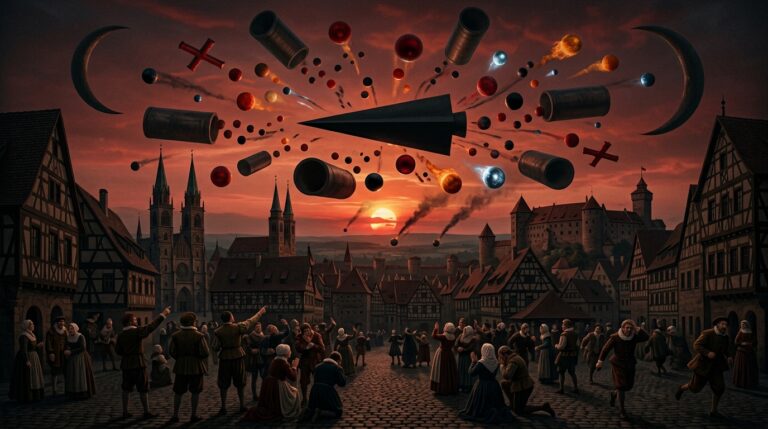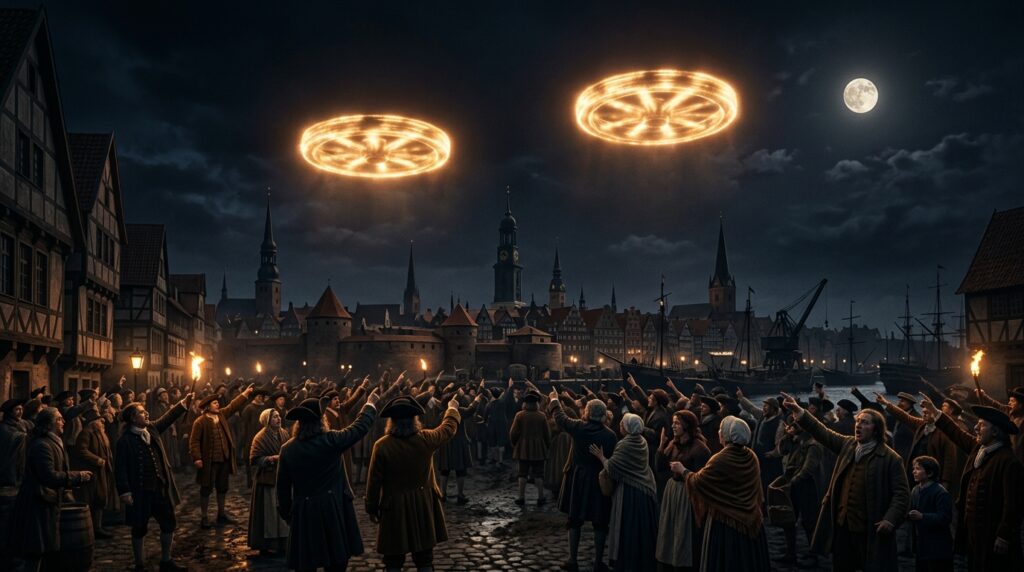
November 4, 1697 CE — Hamburg, Germany. Two glowing wheel-shaped objects appeared in the night sky over one of northern Europe's most important trading cities, witnessed by a crowd of Hamburg citizens and documented in a surviving period illustration showing both wheels alongside the moon and the witnessing crowd below. One of the few pre-modern UAP mass sightings with surviving period iconographic evidence.
THINK ABOUTIT UFO|UAP SIGHTING REPORT
1697: UFOs over Hamburg, Germany
On the night of November 4, 1697, the citizens of Hamburg, Germany looked up and saw two glowing wheels in the sky. Not lights. Not undefined luminosities. Wheels — a specific geometric form with all the connotations that word carries in the European aerial phenomena record, where the wheel has been one of the most consistently documented shapes since the fiery rotating wheels of Ezekiel’s vision, through the burning revolving wheels of Leicester in 1387, to these two glowing examples over the great Hanseatic port city at the close of the 17th century. The event was significant enough to be depicted in a period artwork that has survived to the present day — showing both glowing wheels in the night sky above Hamburg, the moon visible in the same frame for comparison of apparent size, and a crowd of citizens on the ground below with their arms raised, pointing upward. The crowd detail is analytically significant: these were not isolated witnesses in the countryside. These were Hamburg citizens — residents of one of the busiest and most cosmopolitan trading cities in northern Europe — pointing at something in the night sky above their streets. The 1697 Hamburg glowing wheels are a mass sighting with surviving period iconographic evidence, in the archive’s German aerial phenomena record that runs without interruption from the 1100 CE crusade accounts to the 20th century.
Date: November 4, 1697
Sighting Time: Night — exact time not recorded
Day/Night: Night
Location: Hamburg, Germany
Urban or Rural: Urban — Hamburg was one of the most important trading cities in northern Europe
No. of Entity(s): None observed
Entity Type: N/A
Entity Description: N/A
Hynek Classification: NL — Nocturnal Light; two luminous objects of defined shape observed at night. The existing DD classification is incorrect — DD designates daylight disc sightings; this was a night event. NL with wheel morphology is the correct classification.
Duration: Not recorded
No. of Object(s): 2
Description of Object(s): Two glowing wheel-shaped objects observed in the night sky over Hamburg. The period illustration preserves both objects simultaneously — they were observed together rather than in sequence. The moon is visible in the same illustration, providing an apparent size comparison that suggests the objects were either very large or very low in altitude relative to the moon.
Shape of Object(s): Wheel — specifically described as glowing wheels; circular with implied rotational or radiating structure
Size of Object(s): Potentially very large — the moon is visible in the same period illustration and if taken as a size reference the wheels appeared comparably large in apparent diameter, suggesting either enormous physical size or very low altitude
Color of Object(s): Glowing — luminous; specific color not recorded beyond luminosity
Distance to Object(s): Aerial — above the city; altitude not precisely recorded
Height & Speed: Aerial — hovering or moving above Hamburg; no speed data recorded
Number of Witnesses: Mass sighting — a crowd of citizens depicted in the period artwork pointing upward
Special Features / Characteristics: Period artwork survives — a contemporary illustration of the event has been preserved showing both glowing wheels, the moon, and the witnessing crowd; this makes the Hamburg 1697 case one of a small number of pre-modern UAP events with surviving period iconographic evidence alongside the 1561 Nuremberg Hans Glaser broadsheet, the 1566 Basel Samuel Coccius broadsheet, and the 1665 Stralsund Erasmus Francisci engraving; wheel morphology — connects this case to the long tradition of wheel-shaped aerial objects in the European record from Ezekiel onward through the 1387 Leicester burning rotating wheels, the 1604 Kyoto Japan whirling red wheel, and the broader global fiery wheel tradition; mass urban sighting in one of Europe’s busiest ports; the Hynek classification on the page (DD) requires correction to NL
Case Status: Unexplained
Source: UFOs at Close Sight and others; period illustration preserved
Summary/Description: On the night of November 4, 1697, two glowing wheel-shaped objects were observed in the sky over Hamburg, Germany in a mass sighting depicted in a surviving period illustration showing both objects, the moon for apparent size comparison, and a crowd of Hamburg citizens with raised arms pointing upward. One of a small number of pre-modern UAP events with surviving period iconographic evidence.
Related Cases: 1387 CE Leicester England Burning Rotating Wheels | 1561 CE Nuremberg Germany Aerial Battle | 1606 CE Kyoto Japan Whirling Red Wheel | European Wheel-Shaped UAP Archive
DETAILED REPORT:
November 4, 1697. Hamburg is at the height of its Baroque era prosperity — one of the great ports of the Hanseatic tradition, a city of merchants, shipbuilders, bankers, and craftsmen whose streets were busy with the commerce of northern Europe. It was not a quiet frontier settlement where isolated rural witnesses might be dismissed. It was one of the most cosmopolitan urban environments in 17th century Germany.
On this November night, something appeared over the city.
Two glowing wheels.
The description is precise in its geometry. Not two lights, not two luminous masses — wheels. The wheel shape in aerial phenomena documentation carries a specific visual meaning: circular, with either a spoke-like internal structure, a rotating appearance, or an edge-defined ring form that the witnesses could identify as wheel-like rather than simply round. The fiery rotating wheels documented over Leicester and Northamptonshire in 1387 were described with the same specific vocabulary. The whirling red wheel that hovered over Nijo Castle in Kyoto in 1606 uses the same geometric form. The wheel is one of the oldest and most consistently documented aerial object morphologies in the global UAP record — appearing in Ezekiel’s vision, in the medieval chronicle tradition, and in the pre-modern accounts from multiple cultures that had no contact with each other.
The two Hamburg wheels were seen simultaneously, not in sequence — the period illustration shows both together in the sky above the city at the same time.
The period illustration is the most analytically significant feature of the Hamburg 1697 case. It preserves several details that the sparse written record does not: the two wheels are shown at apparent similar altitude, both luminous, with the moon visible in the same frame. If the moon is taken as an apparent size reference — as the page’s editorial note suggests — the wheels’ apparent diameter approaches or matches the moon’s, implying either extremely large physical size or very low altitude for objects of more modest size. The crowd of Hamburg citizens below is shown with arms raised and pointing upward — the universal body language of mass aerial observation in which multiple people simultaneously direct others’ attention to the same phenomenon in the sky.
The wheel morphology’s connection to the broader pre-modern aerial phenomena record is one of the most analytically significant aspects of the Hamburg case. The Babylonian and Hebrew traditions describe the merkabah — the divine chariot — in terms of wheels within wheels. The 1387 Leicester chronicles document burning revolving wheels over English counties. The 1561 Nuremberg broadsheet describes spheres and cylinders. The 1566 Basel account describes spheres. Hamburg in 1697 returns to the wheel — specifically, to two glowing wheels over a major northern European city on a November night at the close of the 17th century.
The case is straightforwardly documented: two objects, specific geometric form, mass urban witness base, surviving period illustration. It requires no interpretive elaboration beyond those elements. What appeared over Hamburg on November 4, 1697 was seen by enough people to generate a period illustration that has survived three centuries. The wheels were there. The crowd pointed. The archive holds the picture.
Also worth noting: the existing Hynek classification on the page is DD — Daylight Disc. This is incorrect. DD designates metallic or whitish objects seen in the day. The Hamburg 1697 sighting was at night. The correct classification is NL — Nocturnal Light — with the specific morphological notation of wheel shape.
RESEARCHER’S NOTES:
The Hamburg Glowing Wheels — Wheel Morphology, Period Illustration, and a Mass Urban Sighting
- Wheel Morphology Continuity: The 1697 Hamburg glowing wheels connect to one of the oldest and most geographically consistent morphological categories in the UAP record. Wheel-shaped aerial objects appear from ancient Mesopotamian and Hebrew texts through medieval European chronicles through the modern era with a consistency that no single cultural tradition can account for. The Hamburg wheels are the German late-17th century entry in this tradition — urban, multiple, witnessed by a crowd, and documented in surviving period art.
- Period Illustration as Iconographic Evidence: The Hamburg 1697 illustration is one of a small and analytically valuable set of pre-modern UAP events with surviving period artwork. The 1561 Nuremberg Hans Glaser broadsheet, the 1566 Basel Samuel Coccius broadsheet, the 1665 Stralsund engravings, and the Hamburg 1697 illustration constitute a documented artistic record of aerial phenomena in the German cultural zone across 136 years. Each was produced close in time to the events it depicts, by witnesses or artists working from witness accounts, in a printing and visual culture that valued accuracy over embellishment.
- Mass Urban Witness Base: The crowd of Hamburg citizens depicted pointing upward in the period illustration establishes this as an urban mass sighting — the highest-credibility witness configuration available for a pre-modern event. Individual rural witnesses can be dismissed. A crowd of Hamburg citizens cannot. The city’s commercial and cosmopolitan character means the witnesses included the full range of educated and experienced urban observers — merchants, sailors, craftsmen, and clergy — with no shared motive for fabrication.
- Hynek Reclassification Required: The existing DD classification requires correction to NL. DD — Daylight Disc — specifically designates metallic or whitish objects observed in daylight. The Hamburg 1697 event was at night. NL — Nocturnal Light — is the correct classification for a luminous object observed at night regardless of its shape. The reclassification is analytically important because it connects the case correctly to the nocturnal luminous wheel tradition rather than the daylight disc tradition.
Two glowing wheels appeared over Hamburg on November 4, 1697, and the citizens of one of northern Europe’s busiest ports raised their arms and pointed at them. Someone made a picture. The picture survived. The archive holds the event as a mass urban nocturnal sighting of two wheel-shaped luminous objects — corrected from DD to NL, connected to the oldest documented aerial object morphology in the European record, and illustrated by period artwork that shows the moon in the same frame as a size reference and a crowd below who knew what pointing fingers meant. Hamburg in 1697 was not the first German city to watch something wheel-shaped in its sky. It was not the last. The archive records it in the sequence it belongs to — the long tradition of glowing wheels over the German-speaking lands that runs from the medieval chronicle record through the 17th century and beyond.
 There was a UFO sighting over Hamburg, Germany on November 4, 1697, depicted in this artwork. The objects were described as being “two glowing wheels”.
(Note: if the round object on the far right is the moon, the UFOs were either very low or very large. Notice also the many people pointing — this was likely a famous event.)