Fire from the sky through the century of death — 14th-century high strangeness, 1300 to 1399 CE
Sighting by Date:
1300 – 1399 UFO|UAP & Entity Sightings Archive
Leicester’s Burning Wheels, the Dečani Fresco & the Black Death Claim Fact-Checked
The 14th century CE was the most catastrophic century in European history — the Black Death killed roughly a third to a half of Europe’s population between 1347 and 1351, the Hundred Years’ War began, the Mongol Empire fragmented, and the medieval world order began its long collapse. It was also, by the documentary record, an unusually active period for anomalous aerial phenomena. A week-long pulsating circular object over Tver, Russia opened the century. Fiery rotating wheels and barrel-shaped objects haunted the English counties of Leicester and Northampton for entire winters. The 1300–1399 archive documents dozens of incidents across Russia, England, France, Italy, Japan, China, Serbia, Spain, and Sicily.
This page also carries a claim that requires a clear caveat rather than silent repetition: several sources here — most notably fringe writer William Bramley’s The Gods of Eden and Gianfranco degli Esposti’s compilation of Italian plague-era records — describe cigar-shaped aerial objects dispersing mist shortly before local Black Death outbreaks, and interpret the timing as causal. The actual cause of the Black Death is not in scientific dispute: it was the bacterium Yersinia pestis, spread primarily by fleas carried on black rats along trade routes, confirmed by both historical epidemiology and modern ancient-DNA studies of plague-era burial sites. The aerial-mist accounts below are preserved as documented period claims — they are not evidence of, or an explanation for, the plague’s actual cause, and this archive does not endorse the causal reading some of its cited sources assert.
Date: 1303
Location: Erfurt, Germany
Time: Not recorded
Summary: German chroniclers recorded a large luminous object moving slowly across the night sky over Erfurt, observed by multiple witnesses and recorded as a prodigious aerial sign distinct from any known astronomical phenomenon.
Source: Erfurt Chronicle, referenced in Jacques Vallée, Passport to Magonia, supplementary records
Date: December 1317
Location: Tver, Russia
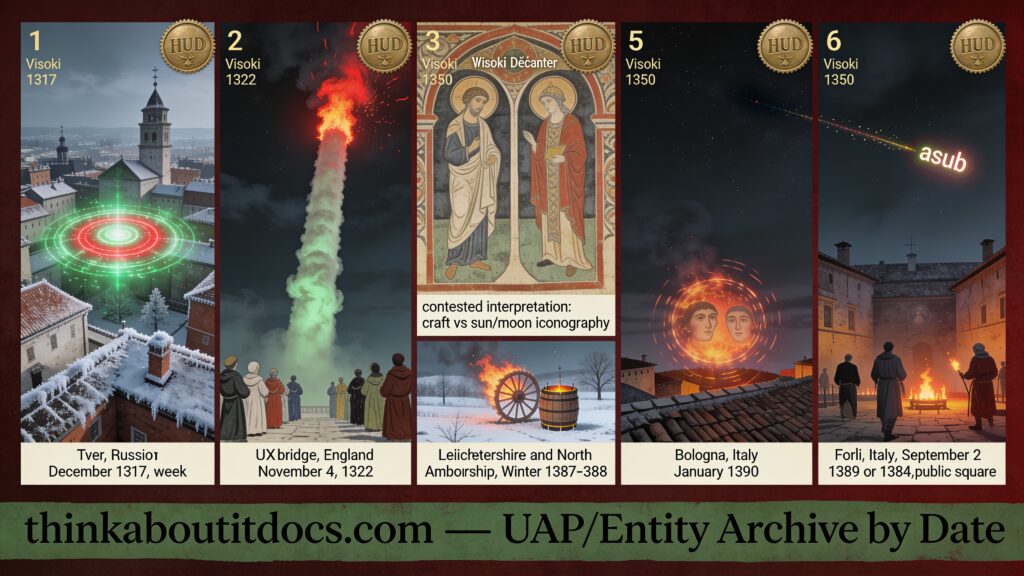
Summary: A bright green circular object, pulsating red at its center and producing three rays (two eastward, one westward), reportedly hung over Tver for over a week before moving north and out of sight.
Source: Not cited in original compilation
Date: 1319
Location: Russia (no exact location given)
Summary: At night, witnesses reported “fiery pillars” extending from the ground to the sky; others saw a “heavenly arc,” and still others described horse-like flying entities equipped with “lanterns.”
Source: Philip Mantle and Paul Stonehill, UFO-USSR
Date: 1320
Location: Durham, England
Summary: After the Abbot of Durham was buried, a strange light reportedly descended from the sky and moved about over his grave.
Source: Robert de Graystanes, Historia Dunelmensis, in Historiae Dunelmensis Scriptores Tres (London/Edinburgh: Publications of the Surtees Society, 1839)
Date: 1322
Location: Bury St. Edmunds, England
Time: Not recorded
Summary: A luminous cross appeared in the sky above Bury St. Edmunds, observed by the monastic community and recorded as an extraordinary aerial sign.
Source: Suffolk monastic chronicles, referenced in C.E. Britton, A Meteorological Chronology to A.D. 1450
Date: November 4, 1322
Location: Uxbridge, England
Summary: “In the first hour of the night there was seen in the sky over Uxbridge a pillar of fire the size of a small boat, pallid, and livid in color.” Rising from the south and crossing the sky slowly northward, a red flame burst from its front with beams of light. Many witnesses reported what appeared to be collisions, with sounds of a fearful combat heard at a distance.
Source: Flores Historiarum, attributed to Robert of Reading, Rerum Britannicarum Medii Aevi Scriptores 95, vol. 3, pp. 210–211
Date: 1330
Location: Beaune, France
Summary: A tapestry depicting the life of the Virgin Mary at Notre-Dame de Beaune, Burgundy, has been cited in ufological literature as containing disc-shaped objects in its background sky. As with much medieval religious art of this kind, the identification is contested — such shapes are also commonly interpreted as stylized suns, stars, or halos consistent with period artistic convention.
Source: Not cited in original compilation
Date: 1338
Location: Chantilly, France
Summary: An illuminated manuscript held at the Musée Condé in Chantilly, associated with Jacques Legrand’s writings, contains an image depicting a ball-shaped aerial object among its illustrations.
Source: Musée Condé, Chantilly
Date: January 1, 1339
Location: Silesia
Note — poor source translation: the surviving text is a garbled machine translation from French. Retained pending a better source.
Summary: A fall of fine, filamentous material resembling cotton felt (“angel hair”) was reported over Silesia; microscopic examination reportedly found the substance primarily composed of coniferous plant material, though it is unclear whether this meant pollen or plant fiber.
Source: Edinburgh Review 87:197
Date: 1344: Feldkirch, Austria Sighting [Full case page — separate entry]
Date: 1347–1350
Location: Florence, Italy
Note — causal claim not endorsed: this entry’s source attributes the Black Death to the described aerial objects. The bacterium Yersinia pestis, spread by fleas on rats, is the scientifically established cause of the plague; this account is preserved as a documented period-adjacent claim, not as evidence toward that cause.
Summary: Writer Gianfranco degli Esposti describes reports from the plague period of “strange cigar-shaped objects slowly crossing the sky, sometimes at low altitude, dispersing in their passage a disturbing mist,” with local epidemic outbreaks reportedly following soon after. A separate account describes a mass of vapor over Florence originating from the north, and reports from the East of animal carcasses falling from the sky, their decomposition blamed for befouling the air. The plague killed an estimated 60,000 in Florence alone.
Source: Gianfranco degli Esposti, “Travi di Fuoco e Segni Divini: Paura nei Cieli del Medioevo”; Lycosthenes, Prodigiorum ac Ostentorum Chronicon (Basel, 1557)
Date: Before 1348
Location: Between Cathay and Persia
Note — causal claim not endorsed: see the note above; this account is likewise preserved as a documented period claim rather than an explanation of the plague’s actual cause.
Summary: A chronicle-derived account describes a “vast fire” reportedly falling like snow between Cathay and Persia, burning mountains, plains, and people, with vast smoke rising; those who witnessed it were said to die within half an hour, as were those who saw the dead.
Source: Philip Ziegler, The Black Death (Faber Finds, 1998), citing multiple medieval chronicle sources
Date: July 18, 1349
Location: Japan
Summary: Two shining objects appeared from the southeast and northwest, appearing to maneuver acrobatically and emitting flashes during what was described as a clash between them.
Source: Morihiro Saito, Nihon Tenmon Shiryō, Ch. 8
Date: 1350
Location: Visoki Dečani Monastery, Kosovo
Summary: A 14th-century fresco at Visoki Dečani depicts two figures within two flying objects, one apparently pursuing the other, with onlooking figures shown reacting with apparent alarm. Ufologist analysis by Diego Cuoghi and others has proposed this is a conventional Byzantine anthropomorphic representation of the sun and moon — a well-documented artistic motif in Orthodox iconography of this era — rather than a depiction of craft.
Source: Diego Cuoghi analysis; fresco held at Visoki Dečani Monastery
Date: December 1352
Location: Northern England
Summary: A powerful beam of light was reportedly seen scanning the sky in the north of England.
Source: Michel Bougard, La Chronique des OVNI (Delarge, 1977), p. 71
Date: February 5, 1355
Location: Suzhou (Pingjiang), Jiangsu Province, China
Summary: A loud noise in the sky preceded the appearance of a large black cloud filled with flames and lights, described as “loaded with troops,” associated with physical destruction on the ground.
Source: Shi Bo, La Chine et les Extraterrestres (Paris: Mercure de France, 1983), p. 30, citing writer Tao Zongyi
Date: Summer 1355
Location: Leicester, England
Summary: Henry Knighton’s Chronicon records a red banner and another appearing in the sky, observed at Leicester and in many parts of England, sometimes appearing to approach as if to collide, until the red banner was finally described as defeating the blue and both dashed to the ground in view of onlookers.
Source: Michel Bougard, La Chronique des OVNI (Delarge, 1977), pp. 71–72
Date: March 16, 1356
Location: China
Note — poor source translation: fragmentary translation, retained pending improvement.
Summary: A Yuan Dynasty record describes an unusual atmospheric or luminous event over two days in March 1356, including reports of fog, mist, and unusual noise from a city.
Source: Yuan Dynasty chronicle records
Date: December 18, 1358
Location: China
Note — poor source translation: fragmentary translation, retained pending improvement.
Summary: A record references an astronomical or atmospheric observation associated with the planet Venus (Taibai) in December 1358.
Source: Yuan Dynasty astronomical records
Date: Summer 1360
Location: England and France
Summary: “In flat and deserted places in England and France… there suddenly appeared two towers, from which two armies went out, one of which was crowned with a warlike sign, and the other was clothed in black.” The account describes the “warriors” defeating the black-clad force twice before both towers and armies vanished.
Source: Chronicon Angliae (1328–1388), attributed to Thomas Walsingham (d. 1422); C.E. Britton, A Meteorological Chronology to A.D. 1450 (London: HMSO, 1937), p. 144
Date: 1361
Location: Yamaguchi Prefecture, Western Japan
Summary: A flying object described as “shaped like a drum, about twenty feet in diameter” reportedly emerged from the inland sea off western Japan.
Source: Not cited in original compilation
Date: June 1364
Location: China
Note — poor source translation: fragmentary translation, retained pending improvement.
Summary: Two Yuan Dynasty records describe a bright starry-night phenomenon in southern Henan, described as bright as day, and a separate observation of a triple-star formation with unusual atmospheric gas effects.
Source: Yuan Dynasty chronicle records
Date: Between 1368 and 1399
Location: Along the Yellow River, China
Summary: During the Hongwu era of the Ming Dynasty, commander Qiu Jingsi’s troops, stationed along the Yellow River, reportedly witnessed a huge glowing object fall into the river one afternoon, jetting flames and raising waves at the water’s edge; several soldiers were wounded.
Source: Shi Bo, La Chine et les Extraterrestres (Paris: Mercure de France, 1983), p. 41
Date: July 1370
Location: China
Note — poor source translation: fragmentary translation, retained pending improvement.
Summary: A Ming Dynasty record from the Hongwu era describes bright star-like objects moving slowly from the north-northeast before scattering into fragments.
Source: Ming Dynasty chronicle records, Hongwu era
Date: February 1382
Location: Paris, France
Summary: Before the Maillotins uprising, a fiery, flashing globe was reportedly seen for eight days “roaming from door to door above the city of Paris,” with no accompanying wind, lightning, or thunder — the weather otherwise remaining serene throughout.
Source: Chronique du Religieux de Saint-Denys Contenant le Règne de Charles VI de 1380 à 1422, Tome II (Paris, 1840)
Date: 1384
Location: Caravaca, Spain
Summary: While the Caravaca cross (see the 1232 entry in this archive’s sister page for the 13th century) was transported from Caravaca to Lorca, two lights reportedly accompanied the procession, disappearing only once the cross reached its destination — one of several legendary accounts associated with the relic’s history.
Source: Clara Tahoces, “Caravaca, ¡Qué Cruz!” Más Allá 127 (September 1999)
Date: July 15, 1385
Location: London and Dover, England
Summary: After sunset, a fire in the shape of a head appeared in the southern sky, stretching northward before dividing into three parts and flying “like a bird of the woods in flight,” eventually rejoining as one before vanishing.
Source: C.E. Britton, A Meteorological Chronology to A.D. 1450 (London: HMSO, 1937), p. 149; noted by John Malvern, a monk of Worcester who continued the Polychronicon
Date: September 1385
Location: China
Note — poor source translation: fragmentary translation, retained pending improvement.
Summary: A Ming Dynasty record from the Hongwu era describes multiple astronomical observations in September 1385, including references to guest stars and unusual planetary conjunctions.
Source: Ming Dynasty chronicle records, Hongwu era
Date: February 1387
Location: China
Note — poor source translation: fragmentary translation, retained pending improvement.
Summary: A Ming Dynasty record describes a cluster of five stars and a separate triple-star observation in February 1387.
Source: Ming Dynasty chronicle records, Hongwu era
Date: October 1387 (possibly November — see source note; related to the 1388 entry below — see Researcher’s Notes)
Location: Leicester and Northamptonshire, England
Time: 6:00 a.m. (initial sighting time cited; phenomenon reportedly recurred through the winter)
Summary: “A certain appearance in the likeness of a fire was seen in many parts of the kingdom of England, now in one form, now in another… some appeared in the form of a burning revolving wheel, others again in the form of a round barrel of flame emitting fire from above, yet others in the shape of a long fiery beam,” recurring through much of the winter, especially in Leicestershire and Northamptonshire.
Source: Henry Knighton, Chronicon (d. 1396); C.E. Britton, A Meteorological Chronology to A.D. 1450 (London: HMSO, 1937), p. 150
Date: November–December 1388 (probable duplicate or closely related record of the 1387 entry above — see Researcher’s Notes)
Location: Leicester and Northampton, England
Time: Extended, throughout winter
Summary: Henry Knighton’s Continuation of the Chronicle of Leicester describes “a fire in the sky, like a wheel spinning and on fire, or a circular barrel of flame, emitting fire from above, and other forms of long burning rays,” observed through much of the winter across Leicestershire and Northamptonshire — matching the 1387 entry’s description almost word for word.
Source: Henry Knighton, Continuation of the Chronicle of Leicester
Date: January 8, 1388 or 1389
Location: Ragusa, Sicily, Italy
Time: 11:00 p.m.
Summary: Several very bright objects passed over, aligned above the convent of the Friars Minor of Ragusa.
Source: Henry Durrant, The Black Book of UFOs (Laffont, 1970), p. 59
Date: April 1389
Location: Leicester, England
Time: Not recorded
Summary: Henry Knighton’s chronicle reports that in April 1389, a flying dragon “was seen in several places” in Leicester.
Source: “UFO Files,” ed. Marshall Cavendish (Paris, 1998), Special issue, p. 5
Date: September 2, 1389 (probable duplicate of the September 2, 1394 entry below — see Researcher’s Notes)
Location: Forlì, Italy
Time: 2:00 p.m. (initial report); the main event described occurred at the second hour of the night
Summary: Many “asub” (a period term for celestial objects) and shooting stars were reported in early September. On the 2nd, at the second hour of the night, witnesses in the public square of Forlì saw a large asub cross the sky slowly over the span of “two Pater Nosters,” emitting a smell of burning wood, then remaining motionless before gradually dispersing into a vapor cloud that took serpentine shapes.
Source: Michel Bougard, La Chronique des OVNI (Delarge, 1977), p. 72
Date: January 1390
Location: Bologna, Italy
Time: Not recorded
Summary: A “ball of fire” reportedly rotated over the rooftops of Bologna, with the faces of “devils” said to be visible inside it, apparently trying to see out.
Source: Il Domani di Bologna 21 (October 2006): 10
Date: January 26, 1390
Location: Messina, Sicily, Italy
Summary: Historian Antonino Mongitore records a light seen falling from the sky above a cross atop the Monastery of St. Salvatore’s dome, visible for roughly half an hour before ascending back into the sky — a duration inconsistent with a meteor.
Source: Antonino Mongitore, Della Sicilia Ricercata nelle Cose più Memorabili (Palermo, 1742)
Date: September 2, 1394 (probable duplicate of the September 2, 1389 entry above — see Researcher’s Notes)
Location: Forlì, Italy
Summary: At the second hour of the night, men in Forlì’s main square reportedly saw an enormous “asub” fly over very slowly, lasting “the time of two Paternosters,” leaving a smell of burning wood, remaining motionless for a time before evaporating into a cloud — matching the 1389 Forlì entry above in nearly every detail.
Source: F. Guarini, I Terremoti di Forlì (Croppi, Forlì, 1880), p. 142
Date: Winter 1394 (probable duplicate/compiled retelling of the 1387–1388 Leicester/Northants entries above — see Researcher’s Notes)
Location: England (general)
Summary: “A certain thing appeared in the likeness of fire in many parts of England every night,” reportedly following solitary travelers and stopping when they stopped. Witnesses described it variously as a burning turning wheel, a flaming barrel, or a long burning lance — descriptions matching the 1387/1388 Leicester and Northamptonshire accounts closely enough to suggest Holinshed’s later compilation drew directly on Knighton’s earlier chronicle.
Source: Raphael Holinshed, Chronicles of England, Scotland and Ireland (London: J. Johnson, 1808), vol. II, p. 829
Date: 1395
Location: Languedoc, France
Summary: Jean Juvénal des Ursins records that a large star and five small stars were seen fighting in the sky over Languedoc for roughly half an hour, accompanied by cries and the sound of armor and combat, followed by the appearance of a copper-colored, spear-wielding figure who struck the large star with fire. The event was later read as an omen preceding a battle in Hungary.
Source: Jean Juvénal des Ursins, Histoire de Charles VI, Roy de France, in Michaud and Poujoulat, eds., Nouvelle Collection des Mémoires pour Servir à l’Histoire de France, Tome II (1836)
RESEARCHER’S NOTES
Fire from the Sky and the Century of Death — 1300 to 1399
- Black Death causal claim reframed: the hook and several entries previously presented cigar-shaped aerial objects as a documented cause of the Black Death, echoing William Bramley’s fringe thesis. The plague’s cause is not scientifically in dispute — Yersinia pestis, spread by fleas on rats — and this page now states that plainly. The period accounts are retained as documented claims, not as evidence toward causation.
- Probable duplicates flagged: the September 2, 1389 and September 2, 1394 Forlì “asub” entries share identical date, time, duration, sensory detail, and behavior — almost certainly the same underlying event cited from two different secondary compilations with a transcription date error in one. Both are retained, cross-referenced.
- Related entry cluster flagged: the October 1387, November–December 1388, and Winter 1394 entries all describe the same burning-wheel/flaming-barrel/fiery-lance phenomenon over Leicestershire and Northamptonshire in near-identical language. The 1394 Holinshed account almost certainly compiles from Knighton’s earlier chronicle rather than documenting an independent recurrence. All three are retained per standing practice, now cross-referenced to one another.
- Fragmentary Chinese translations flagged: several entries (1356, 1358, 1364, 1370, 1385, 1387) rest on garbled translations retained for completeness pending better source material.
- Contested visual evidence noted: both the Beaune tapestry and the Visoki Dečani fresco are presented alongside the mainstream art-historical alternative explanation (solar/lunar iconography, halo and star conventions) rather than as settled ancient-astronaut evidence.
The 14th century record spans genuine geographic and cultural breadth — Russian fiery pillars, English burning wheels, Chinese fireballs entering rivers, and Italian “asub” sightings — recorded by chroniclers who took the phenomenon seriously enough to preserve it alongside their accounts of famine, war, and plague. The archive holds that record honestly, including where its own sources overreach.
“A certain appearance in the likeness of a fire was seen in many parts of the kingdom of England… some appeared in the form of a burning revolving wheel, others again in the form of a round barrel of flame emitting fire from above.”
Henry Knighton, Chronicon, on the Leicester and Northamptonshire sightings, 1387–1388