August 18, 1783 CE — Windsor Castle, England. Four witnesses including Royal Academy co-founders Thomas and Paul Sandby observed a pale blue luminous sphere emerge beneath an oblong cloud, halt, increase in luminosity, move east, change direction, and disappear southeast while illuminating everything on the ground. Published in the Philosophical Transactions of the Royal Society 1784. Documented in the surviving Sandby aquatint.
THINK ABOUTIT UFO|UAP SIGHTING REPORT
1783: Luminous UFO seen from Windsor Castle
At 9:45 PM on August 18, 1783, four witnesses stood on the terrace of Windsor Castle and watched a sequence of aerial events that Thomas Sandby — a founder of the Royal Academy of Arts and one of the most visually trained observers in Georgian England — considered significant enough to document in a detailed watercolor that his brother Paul then rendered into an aquatint. The sequence began with an oblong cloud moving parallel to the horizon over the Home Counties of England. Beneath that cloud a luminous object appeared and became spherical — brilliantly lit. The sphere halted. In its halted state it appeared pale blue. Then its luminosity increased. Then it moved east. Then it changed direction. Then it moved parallel to the horizon. Then it disappeared to the southeast. Throughout all of this the light it gave out was prodigious — it lit up everything on the ground. The account was published the following year in the Philosophical Transactions of the Royal Society — the most prestigious scientific journal in Britain — in 1784. The aquatint Thomas Sandby created from Paul’s watercolor shows King George III or members of the nobility on the Windsor Castle terrace watching the event in progress. It still exists. The 1783 Windsor Castle observation is the most institutionally credentialed 18th century British UAP event in the archive — witnessed by the founders of the Royal Academy, published in the Royal Society’s journal, illustrated in a surviving period artwork, and documented with a behavioral sequence that no known natural aerial phenomenon fully accounts for.
Date: August 18, 1783
Sighting Time: 21:45
Day/Night: Night
Location: Windsor Castle terrace, Berkshire, England
Urban or Rural: Urban — royal palace terrace
No. of Entity(s): None observed
Entity Type: N/A
Entity Description: N/A
Hynek Classification: NL — Nocturnal Light; extended luminous source observed at night; the specific behavioral sequence — appearing beneath a cloud, becoming spherical, halting, pale blue coloration, luminosity increase, eastward departure, direction change, southeastward disappearance — goes well beyond conventional NL and approaches CE-II given the ground illumination effects
Duration: Not precisely recorded — sufficient for the full behavioral sequence including halt, direction change, and final southeastward departure
No. of Object(s): 1 — plus an associated oblong cloud
Description of Object(s): An oblong cloud moving more or less parallel to the horizon. Beneath this cloud appeared a luminous object that became spherical and brilliantly lit. The sphere halted. Its initial color was pale blue. Its luminosity then increased significantly. It moved east. It changed direction. It moved parallel to the horizon. It disappeared to the southeast. The light it gave out was prodigious and illuminated everything on the ground.
Shape of Object(s): Initially oblong within the cloud; became spherical when it emerged as a distinct luminous object
Size of Object(s): Not recorded — large enough to illuminate everything on the ground with prodigious light
Color of Object(s): Pale blue — initial color when halted; luminosity increased thereafter
Distance to Object(s): Aerial — visible from Windsor Castle terrace across the Home Counties; close enough to illuminate the ground below
Height & Speed: Aerial — parallel to horizon initially; direction changes documented; no speed estimate preserved
Number of Witnesses: 4 — including Thomas Sandby, founder of the Royal Academy; his brother Paul Sandby, watercolorist and also Royal Academy founder; and at least two others — possibly including King George III
Special Features / Characteristics: Thomas Sandby as primary illustrating witness — co-founder of the Royal Academy of Arts in 1768, the most visually trained professional observer in 18th century Britain; Paul Sandby as secondary illustrating witness — watercolorist whose documentation of the event produced the surviving aquatint; published in Philosophical Transactions of the Royal Society 1784 — the most prestigious scientific journal in Britain; the surviving aquatint illustration — produced by Thomas Sandby from Paul’s watercolor — is one of the few surviving period illustrations of a specific UAP event from the 18th century; the behavioral sequence — cloud, spherical emergence, halt, pale blue, luminosity increase, eastward departure, direction change, southeastward disappearance — is a specific multi-stage behavioral document not attributable to any single natural phenomenon; the ground illumination — everything on the ground lit up — is a physical effect consistent with an extremely powerful near-ground aerial light source; the conventional bolide/meteor explanation proposed by the Science & Society Picture Library does not account for the halt, the direction change, or the sustained behavioral sequence; the same night saw observations across multiple locations in England of what may be the same or related object
Case Status: Unexplained — meteor/bolide proposed but behavioral sequence inconsistent; published in Philosophical Transactions 1784
Source: Philosophical Transactions of the Royal Society (1784); Thomas Sandby aquatint; UFOs at Close Sight; Tiberius Cavallo’s account
Summary/Description: On August 18, 1783, at 9:45 PM, four witnesses including Royal Academy co-founders Thomas and Paul Sandby observed from Windsor Castle terrace an oblong cloud beneath which a brilliant luminous sphere appeared, halted, appeared pale blue, increased in luminosity, moved east, changed direction, moved parallel to the horizon, and disappeared southeast while illuminating everything on the ground. Published in Philosophical Transactions of the Royal Society 1784 and documented in the surviving Sandby aquatint.
Related Cases: 1676 CE Montanari Halley Vast Body | 1686 CE Leipzig Gottfried Kirch Hovering Object | English Royal Society UAP Archive
DETAILED REPORT:
August 18, 1783. Windsor Castle is the primary residence of King George III — the most powerful monarch in the world’s most powerful empire. The castle’s terrace overlooks the Thames valley and the Home Counties of England in every direction. At 9:45 in the evening, four witnesses are on the terrace.
Among them are Thomas Sandby and his brother Paul Sandby.
Thomas Sandby is not merely a skilled artist. He is a co-founder of the Royal Academy of Arts — one of the two figures most responsible for establishing Britain’s primary institution for the visual arts in 1768. His professional life has been devoted to training his eye to observe and record with precision what the visual world presents. Paul Sandby is a watercolorist of similar standing and training. Both brothers are professionally equipped to observe, document, and communicate visual phenomena with an accuracy that most witnesses cannot match.
At 9:45 PM they see an oblong cloud.
It is moving more or less parallel to the horizon — not dramatically, not meteorically, but steadily and at a horizon-parallel orientation that suggests deliberate directional movement rather than atmospheric drift. Beneath this oblong cloud, a luminous object appears. It develops — becomes spherical, brilliantly lit. The sphere is now distinct from the cloud. It has emerged from beneath the oblong cloud as its own defined luminous form.
It halts.
A sphere of prodigious light, halted in the sky above the Home Counties of England, visible from Windsor Castle terrace at 9:45 PM. In its halted state it appears pale blue. The specific color designation — pale blue rather than white, yellow, red, or orange — is a specific observational commitment by witnesses trained to name colors with professional precision.
Then its luminosity increases.
The object grows brighter while stationary. Then it moves — east, away from its halted position. Then it changes direction. Then it moves parallel to the horizon — a controlled lateral movement, not a continued eastward trajectory and not a ballistic descent. Then it disappears to the southeast.
Throughout the entire sequence — from oblong cloud to spherical emergence to halt to blue to brightness increase to eastward departure to direction change to southeastward disappearance — the light it gives out is prodigious. It illuminated everything on the ground.
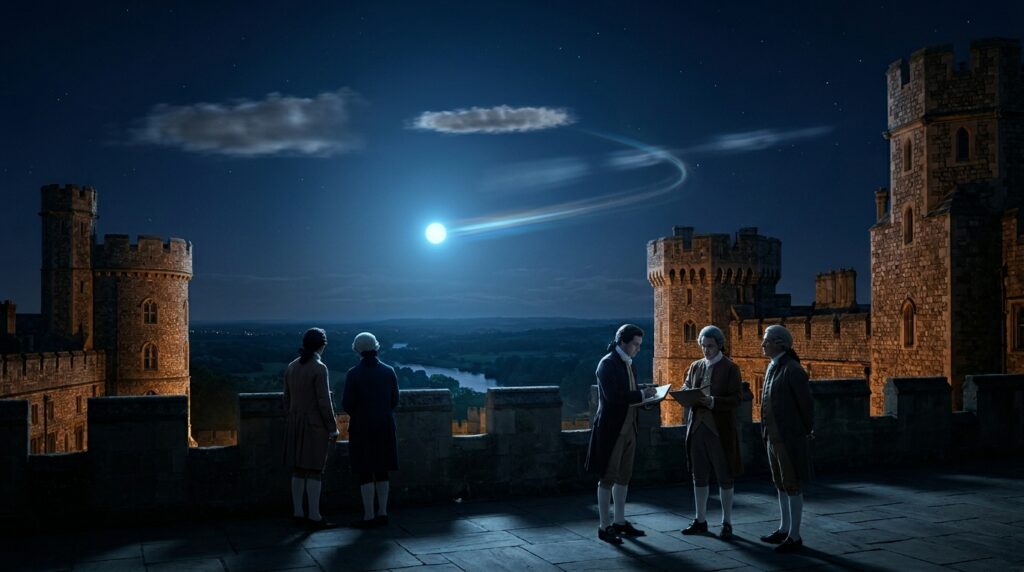
Thomas Sandby documented the event in a detailed watercolor. Paul Sandby’s rendering was made into an aquatint — an engraving technique that produces fine tonal gradations appropriate for representing atmospheric light effects — that shows the Windsor Castle terrace with figures observing the event. The figures may include King George III. The aquatint survives.
The account was published in the Philosophical Transactions of the Royal Society in 1784 — the year after the event. The Philosophical Transactions was founded in 1665 and is the oldest continuously published scientific journal in the world. Publication in the Transactions in 1784 represents the formal entry of the August 18, 1783 Windsor Castle event into the permanent scientific record of the Enlightenment era.
The conventional explanation offered by the Science & Society Picture Library — that the event was a bolide, a very bright meteor — accounts for some elements of the account. A bolide can be brilliantly luminous. A bolide can illuminate the ground. A bolide can appear to change shape as it burns and breaks apart. What a bolide cannot do is halt. A bolide cannot increase in luminosity while stationary. A bolide cannot change direction in a controlled lateral movement parallel to the horizon. The behavioral sequence preserved in the Philosophical Transactions is too specific and too behaviorally complex to be collapsed into a bolide explanation that the witnesses themselves — who saw it and documented it — did not offer.
Additional accounts of the same or related event that night came from other locations across England, including the naturalist Tiberius Cavallo who observed it and published his own account — separately — in the Philosophical Transactions of the same year.
RESEARCHER’S NOTES:
The Windsor Castle Observation — Royal Academy Witnesses, Behavioral Sequence, and the Philosophical Transactions
- The Sandby Brothers as Gold Standard Witnesses: Thomas and Paul Sandby are among the most visually trained professional observers in 18th century Britain. Co-founders of the Royal Academy, trained watercolorists, professionals whose entire careers depend on accurate visual observation and precise documentation — their simultaneous observation of the same event provides a corroborating witness configuration of exceptional quality. When both Sandbys document the same behavioral sequence in an aquatint and a watercolor published in the Royal Society’s journal, the evidential weight is extraordinary.
- The Behavioral Sequence as Analytical Evidence: The specific documented behavioral sequence — oblong cloud, spherical emergence, halt, pale blue coloration, luminosity increase, eastward departure, direction change, parallel horizon movement, southeastward disappearance — is too complex and too specifically documented to attribute to any single natural aerial phenomenon. Each element individually has potential natural explanations. The complete sequence in the specific order documented does not.
- The Surviving Aquatint: The Thomas Sandby aquatint — produced from Paul’s watercolor, showing the Windsor Castle terrace and the event in progress — is one of the few surviving period illustrations of a specific UAP event from the 18th century. The Stralsund 1665 Erasmus Francisci engraving, the Nuremberg 1561 Hans Glaser broadsheet, and the Windsor Castle 1783 Sandby aquatint are the three most important surviving period illustrations in the European UAP archive. The Windsor Castle aquatint is the only one of the three produced by professional visual artists from direct personal observation.
- Philosophical Transactions Publication: The 1784 Royal Society Philosophical Transactions publication gives this event the same institutional endorsement that makes the Robozero 1663 account and the Montanari 1676 account analytically significant — publication in the most prestigious scientific journal of the era by the most prestigious scientific institution, in the year immediately following the event. The Royal Society did not publish accounts carelessly. Their decision to include the Windsor Castle 1783 observation in the Transactions reflects their assessment that the witnesses and the account were credible enough for permanent scientific record.
Four witnesses on the Windsor Castle terrace watched an oblong cloud produce a pale blue sphere that halted and grew brighter and moved east and changed direction and moved parallel to the horizon and disappeared southeast while lighting everything on the ground with prodigious light on the evening of August 18, 1783. Two of them were founders of the Royal Academy. One of them made a watercolor. His brother made it into an aquatint. The Philosophical Transactions of the Royal Society published the account in 1784. The aquatint still exists. The Transactions entry still exists. The conventional bolide explanation does not account for the halt or the direction change. The archive holds what the Royal Society preserved — the oblong cloud, the brilliant sphere, the pale blue, the prodigious light, the behavioral sequence, and the Royal Academy founders who watched it from the most famous castle in England and documented it with professional precision because they were exactly the kind of people who document things precisely.

This illustration depicts a sighting that occurred at 9.45pm on the evening of August 18, 1783 when four witnesses on the terrace of Windsor Castle observed a luminous object in the skies of the Home Counties of England. The illustration has been done following the indications of Thomas Sandby, a founder of the Royal Academy, and his brother Paul, both of whom witnessed the event.
The sighting was recorded the following year in the Philosophical Transactions of the Royal Society (1784), who relates what witnesses observed:
“An oblong cloud moving more or less parallel to the horizon. Under this cloud could be seen a luminous object which soon became spherical, brilliantly lit, which came to a halt; this strange sphere seemed at first to be pale blue in colour but then its luminosity increased and soon it set off again towards the East. Then the object changed direction and moved parallel to the horizon before disappearing to the South-East; the light it gave out was prodigious; it lit us everything on the ground.”
Note: According the Science & Society Picture Library (UK), the illustration depicts ‘the meteor of 18 August, 1783.’ The following is the caption for this illustration from their website:
Print showing members of the nobility (King George III?) observing a very bright shooting star called a bolide from the terraces of the royal palace of Windsor Castle. Titled ‘The meteor of August 18, 1783…’, the aquatint was produced by Thomas Sandby after a watercolour by Paul Sandby. The dazzlingly bright meteor was seen widely in surrounding areas of England and disintegrated into several parts.