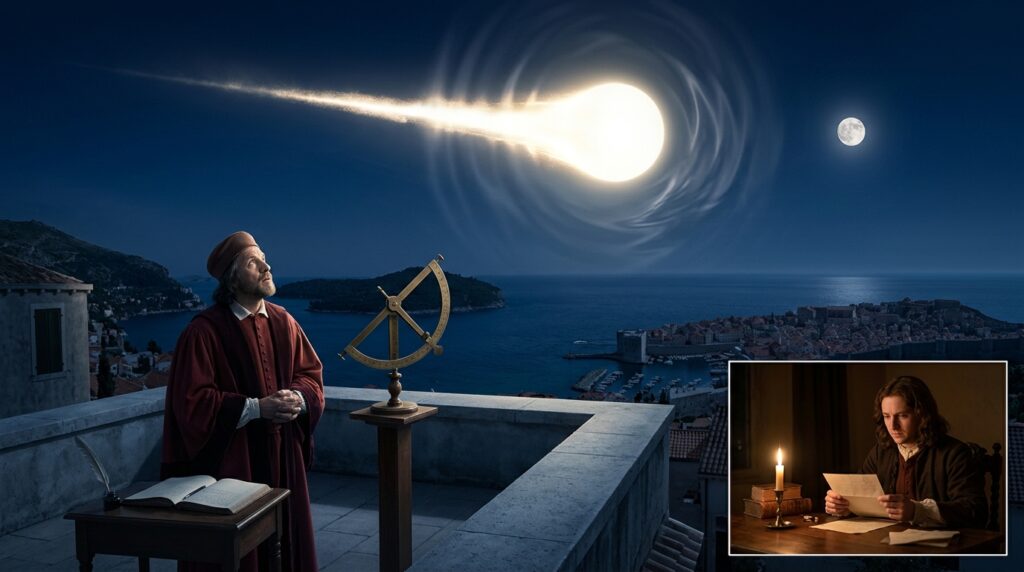
March 1676 CE — Italian peninsula and Adriatic Sea. Italian astronomer Geminiano Montanari observed a vast body apparently bigger than the moon cross from Dalmatia over all of Italy at 40 miles altitude at an estimated 9,600 mph, hissing over land and making a cart-over-stones sound over the sea. He reported it to Edmond Halley who stated it was the hardest thing to account for he had ever met — the first scientifically calculated UAP speed estimate in history.
THINK ABOUTIT UFO|UAP SIGHTING REPORT
1676: Geminiano Montanari’s Vast Body — Reported to Edmond Halley
In March 1676, Italian astronomer and polymath Geminiano Montanari — a man of expertise spanning geophysics, biology, mathematics, ballistics, meteorology, and astronomy — watched something cross the sky from the Adriatic coast of Dalmatia all the way across Italy and out over the Mediterranean to Corsica. It appeared one and three-quarter hours after sunset. It hissed as it passed over Ronzare. It made a sound like the rattling of a great cart over stones as it crossed the sea from Livorno to Corsica. Montanari estimated its altitude at approximately 40 miles above the earth. He estimated its size as apparently bigger than the moon — a vast body crossing an enormous geographic distance in a matter of minutes at an altitude that placed it well above any known atmospheric phenomenon. He calculated from its angular speed across that distance that it was travelling at approximately 160 miles per minute — 9,600 miles per hour. He reported this account to Edmond Halley, who became the second Astronomer Royal of Britain, the man who calculated the orbit of the comet that bears his name, and one of the most capable scientific minds of the 17th century. Halley’s response to Montanari’s account was precise and honest: “I find it one of the hardest things to account for that I have ever yet met.” That assessment — from one of the greatest scientists of the Enlightenment era — has not been surpassed in the three and a half centuries since Montanari watched something vast and fast and impossibly loud cross the night sky of 17th century Italy.
Date: March 1676 — one and three-quarter hours after sunset
Sighting Time: Evening — approximately 19:45 local time
Day/Night: Night
Location: Adriatic coast from Dalmatia — crossing all of Italy — to the sea between Livorno and Corsica; observed from multiple ground positions across the Italian peninsula
Urban or Rural: Multiple — rural and urban locations across the Italian peninsula
No. of Entity(s): None observed
Entity Type: N/A
Entity Description: N/A
Hynek Classification: NL — Nocturnal Light; point or extended luminous source observed at night; the extreme altitude, continental travel distance, acoustic phenomena, and calculated hypersonic speed place this well beyond conventional NL classification
Duration: Several minutes — sufficient to travel from Dalmatia across all of Italy to Corsica; total trajectory distance approximately 1,000 miles
No. of Object(s): 1
Description of Object(s): A vast luminous body apparently bigger than the moon. Crossed from the Adriatic coast over all of Italy at approximately 40 miles altitude, hissing as it passed over Ronzare, then crossing the sea from Livorno to Corsica with a sound like the rattling of a great cart over stones. Montanari calculated its speed at approximately 160 miles per minute — 9,600 miles per hour.
Shape of Object(s): Not recorded — apparent disc or spherical based on moon comparison; described as a vast body
Size of Object(s): Apparently bigger than the moon in apparent diameter — at 40 miles altitude this represents an extraordinary physical size
Color of Object(s): Luminous — sufficient to be clearly visible one and three-quarter hours after sunset
Distance to Object(s): Approximately 40 miles above the earth’s surface — Montanari’s altitude estimate
Height & Speed: 40 miles altitude; approximately 9,600 mph — 160 miles per minute; Montanari calculated this from timing its passage across known geographic distances
Number of Witnesses: Multiple — observed across the entire Italian peninsula; Montanari was the primary scientific witness and calculator
Special Features / Characteristics: Continental trajectory — traveled from Dalmatia across all of Italy to Corsica; double acoustic signature — hissing over Ronzare, cart-over-stones sound over the sea; apparent size larger than the moon at 40-mile altitude; calculated hypersonic speed of 9,600 mph from timing observations — the first scientifically calculated UAP speed estimate in the historical record; Halley’s response preserved as one of the most honest assessments of an unexplained aerial phenomenon by a major scientific figure in history; this is correctly attributed to Geminiano Montanari reporting to Halley — not Halley’s personal observation; Halley’s own personal observations occurred in May 1677 and March 1716; the page title requires correction from Edmund Halley to Geminiano Montanari/Edmond Halley
Case Status: Unexplained — Halley’s own assessment: the hardest thing to account for he had ever met
Source: Geminiano Montanari report to Edmond Halley; compiled in Black Vault A List of UFO Sightings by Astronomers (2000)
Summary/Description: In March 1676, Italian astronomer Geminiano Montanari observed a vast luminous body apparently larger than the moon cross from the Adriatic coast of Dalmatia over all of Italy at 40 miles altitude, hissing as it passed, making a cart-over-stones sound over the sea, and reaching Corsica. He calculated its speed at approximately 9,600 mph — the first scientifically calculated UAP speed estimate in history. He reported the account to Edmond Halley, who stated it was the hardest thing to account for he had ever met. The page title incorrectly attributes the sighting to Halley; the 1676 account belongs to Montanari.
Related Cases: March 19, 1719 CE Oxford England — Edmond Halley Submits to Royal Society | March 1716 CE Edmond Halley Personal Sighting | May 1677 CE Southern England Halley Personal Sighting | Astronomer UAP Witness Archive
DETAILED REPORT:
March 1676. One and three-quarter hours after sunset. The sky over the Adriatic coast of Dalmatia — the eastern shore of the sea that separates the Italian peninsula from the Balkans — is clear enough for a trained astronomer to observe and time a celestial phenomenon with the precision of a man whose career has been devoted to measuring the sky.
Geminiano Montanari was exactly that man. Born in 1633, he held chairs at the University of Bologna and the University of Padua, conducted pioneering work in telescopic astronomy, studied meteorites before the field existed, investigated variable stars before the term was coined, and contributed to ballistics, applied mathematics, and geophysics. He was one of the most thoroughly equipped scientific observers in 17th century Europe.
What he saw crossing the Italian sky in March 1676 was none of those things.
It appeared over the Adriatic from the direction of Dalmatia — coming in from the east, crossing the coast, and moving westward over the Italian peninsula. It was at approximately 40 miles altitude — well above any atmospheric phenomenon, in the transitional zone between the mesosphere and the thermosphere. At that altitude it appeared, in Montanari’s assessment, apparently bigger than the moon. A vast body — his exact words — covering an angular diameter at 40 miles of altitude that required a physical size of extraordinary proportions.
It was not silent.
As it passed over Ronzare it hissed. The hissing is the acoustic signature of an object moving through the upper atmosphere at speed — a specific sound produced by the interaction of a large fast-moving body with the thin air at high altitude. Montanari’s documentation of this sound is analytically significant: at 40 miles altitude, any sound reaching the ground requires a source of enormous acoustic power, since atmospheric density at that height attenuates sound radically. Whatever was making that sound above Ronzare was generating it at a level audible on the surface through 40 miles of increasingly dense atmosphere.
Then it crossed the sea from Livorno to Corsica.
Over the water the acoustic signature changed: it made a noise like the rattling of a great cart over stones. A different sound from the hiss over land — possibly reflecting the interaction of the object’s emissions with the water surface below it, or a change in the object’s own energy output over the sea crossing. Malorie’s Adventures
Montanari timed its passage. He knew the geographic distances involved — the width of Italy, the crossing to Corsica, the total trajectory from Dalmatia to the western Mediterranean. He applied the calculation available to any trained astronomer of the period: angular velocity times distance equals linear speed. He computed that it travelled 160 miles a minute — approximately 9,600 miles per hour. This is the first scientifically calculated speed estimate for an unidentified aerial object in the historical record. A trained mathematician, working from timing observations across a continental trajectory, producing a specific quantitative result that was beyond any human technology of 1676 by a factor of approximately thirty. Sporcle
Montanari reported this account to Edmond Halley.
Halley was at this point the Savilian Professor of Geometry at Oxford and one of the most capable mathematical minds in Europe — the man who would predict the return of the comet that now bears his name, who would later become the second Astronomer Royal of Britain, who would submit his own 1719 aerial observation to the Philosophical Transactions of the Royal Society with the precision of an instrument reading.
Halley commented: “I find it one of the hardest things to account for that I have ever yet met.” Sporcle
This statement — precise, honest, and unqualified — is the most analytically significant scientific assessment of an unexplained aerial phenomenon in the 17th century record. Halley did not offer an explanation. He did not suggest a category. He acknowledged that the most capable scientific mind he knew had reported something that defied every explanatory category available to the most capable scientific minds of the Enlightenment. He called it the hardest thing to account for. That is exactly what it was.
RESEARCHER’S NOTES:
Montanari’s 1676 Account — The First Calculated UAP Speed, Dual Acoustic Signatures, and Halley’s Honest Assessment
- The First Scientifically Calculated UAP Speed: Geminiano Montanari’s calculation of 9,600 mph from timing observations across a continental trajectory is the earliest known scientifically derived speed estimate for an unidentified aerial object in the historical record. The calculation methodology — timing angular velocity across known geographic distances — is the same method used by modern radar operators and optical tracking systems. The result — approximately Mach 12.5 — is consistent with modern documented UAP performance characteristics. A 17th century astronomer calculated hypersonic speed 270 years before the term existed.
- Dual Acoustic Signatures as Physical Evidence: The two distinct sounds — hissing over Ronzare on land, cart-over-stones rattling over the sea from Livorno to Corsica — constitute one of the most detailed acoustic descriptions of an aerial phenomenon in the pre-modern record. The distinction between the two sounds suggests either that the object’s acoustic emission varied depending on its operational state during the transit, or that the different substrates below the object — land versus water — produced different reflected or refracted acoustic signatures. Either way, the dual acoustic documentation is physically specific evidence arguing for a genuine physical source rather than visual misidentification.
- Halley’s Assessment as Scientific Benchmark: Edmond Halley’s statement that the Montanari account was the hardest thing to account for he had ever met is analytically significant precisely because of who said it. Halley was one of the most capable scientific minds of his generation — a man comfortable with mathematical complexity, physical reasoning, and astronomical observation at the highest level. His explicit acknowledgment that the account exceeded his explanatory capacity is the 17th century scientific establishment’s most honest engagement with an unexplained aerial phenomenon.
Geminiano Montanari watched a vast body apparently bigger than the moon cross from Dalmatia over all of Italy at 40 miles altitude in March 1676, hissing over the land and rattling like a cart over stones across the sea, and calculated from his timing that it was moving at 9,600 miles per hour. He told Edmond Halley. Halley said it was the hardest thing to account for he had ever met. The archive holds both the account and the assessment. Whatever crossed the Italian sky in March 1676 was faster than anything the Enlightenment knew how to build by a factor of thirty, louder than any known object at 40 miles of altitude, and larger in apparent diameter than the full moon. Two of the finest scientific minds of the 17th century looked at the same data and reached the same conclusion: they could not explain it. Three and a half centuries later the archive cannot either.