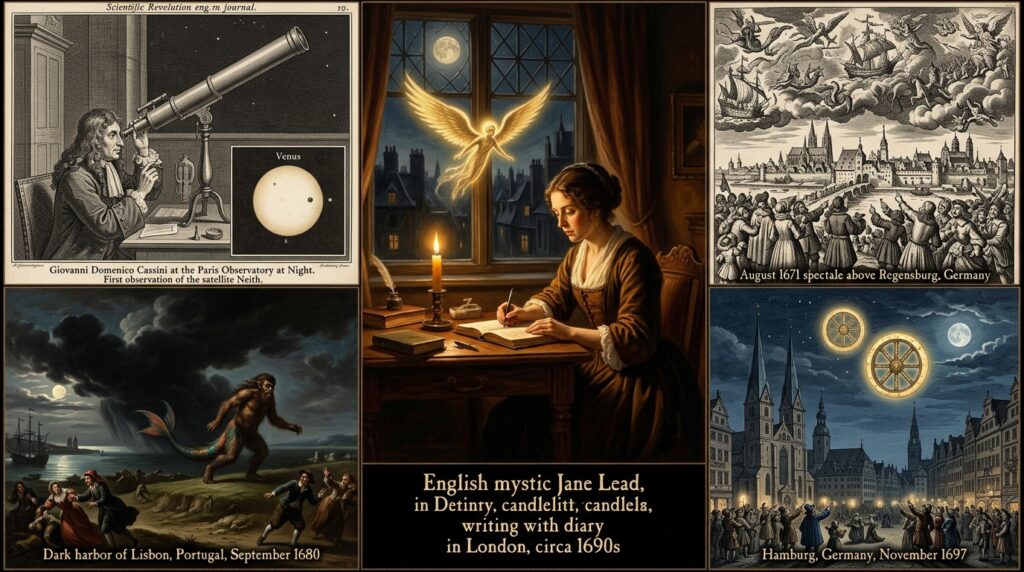
1670–1699 CE — The Scientific Revolution's greatest minds documented the phenomenon in the same publications as their astronomical discoveries. Cassini saw the Venus satellite Neith at Paris Observatory. Gottfried Kirch watched a hovering object bright enough to read by at Leipzig. Geminiano Montanari calculated 9,600 mph and reported to Halley who called it the hardest thing he'd ever had to account for. And Jane Lead kept the pre-modern era's closest equivalent to a modern CE-IV abduction case file.
Sighting by Date:
1670 – 1699 UFO|UAP & Entity Sightings Archive
The final thirty years of the 17th century CE were the age of the Scientific Revolution’s consolidation — Newton published his Principia Mathematica in 1687, Cassini mapped Saturn’s rings, Halley calculated comet orbits, and the Royal Society was establishing the institutional framework of modern science. It was also a period of extraordinary personal entity contact documentation, sustained aerial phenomena observation by credentialed astronomers, and the earliest systematic personal UFO diary in the historical record. Jane Lead — British Christian mystic, theologian, and founder of the Philadelphian Society — kept a meticulous forty-year record of entity contacts, transport experiences, bedroom visitations, and aerial craft observations that reads in every structural detail like a modern CE-IV abduction and contact case file. She described transport experiences she explicitly called neither angelic nor demonic, using the term Magia for the beings involved. She described a gold-winged ship that descended and departed. She described bedroom visitors who were silent, who pricked her skin with a sharp needle, who surrounded her in trance states. She did all of this in print, in London, before 1700, in a four-volume theological work that has been in continuous scholarly circulation ever since.
The 1670–1699 archive is also notable for its astronomical credibility layer — Giovanni Domenico Cassini at the Paris Observatory making the first documented observation of what would later be named the Venus satellite Neith, Gottfried Kirch in Leipzig watching an object half the apparent size of the moon hover for fifteen minutes at 30 miles altitude bright enough to read by, Geminiano Montanari calculating the speed of a vast body crossing Italy at 9,600 mph and reporting it to Edmond Halley, and Edmond Halley himself making his first personal UAP observation. The 1670–1699 window is the intersection of the Scientific Revolution’s greatest minds with the phenomenon they could not explain — producing the most credentialed astronomical UAP record of the pre-modern era alongside the most personally detailed entity contact diary in European history. Whatever was operating over the late 17th century world was being watched by its best observers. They recorded it. The archive holds what they wrote.
Date: April 1670
Location: countryside near London, England
Summary: An English woman named Jane Lead has her first contact with a bright cloud with a brilliant woman inside. Jane Lead was a British Christian mystic who lived from 1623 to 1704. Information about her early life is sparse but her family is known to have hailed from Norfolk. Born as Jane Ward in 1623, she married William Lead (or Leade) at the age of 21, and had four daughters by him. According to her own writings, during a dance at a Christmas party, when she was 15 years old, Lead heard a miraculous disembodied voice. It said “Cease from this, I have another dance to lead thee in, for this is vanity.” She interpreted this as a sign that she should devote her life to a spiritual cause, and in later life this decision led her into the study of theology, philosophy and alchemy. In April 1670, as Lead reflected about the nature of Wisdom, There came upon me an overshadowing bright Cloud, and in the midst of it the Figure of a Woman, most richly adorned with transparent Gold, her hair hanging down and her Face as the terrible Crystal for brightness, but her Countenance was sweet and mild. At which sight I was somewhat amazed… From this moment on, Jane Lead’s life would be full of visions. Years later she would write about actual sightings that she had and several abductions by a group of beings who, by her own admission, were neither angels nor demons. (As noted by Jesse Glass in an article on Jane Lead’s mystic experiences, she often uses the term ‘Magia’ when referring to them). She calls her abduction experiences Transports throughout her diaries.
Source: Works of Jane Lead, especially her book A Fountain of Gardens. “Printed and Sold by J. Bradford, near Crowder’s Wall,” London 1696. Four Volumes. The original edition is very rare but most of Jane Lead’s works can be found faithfully reproduced in on-line archives.
Date: August 18, 1671
Location: Regensburg, Germany
Summary: Signs in the sky: An engraving shows an amazed crowd staring at ships in the sky, various mythical animals and armies arrayed for battle. This engraving is cut from a book, The Relationis historicae semestralis vernalis continuatio (1672 edition) by Jacobus Francus and Sigismundus Latomus.
Source: Wunderzeichen, zu Regenspurg gesehen am 18. Augusti 1671. [Goethe Universitatsbibliothek Frankfurt-am-Main, Einblattdr. G.Fr. 12], engraving cut from Francus, Jacobus & Latomus, Sigismundus. Relationis historicae semestralis vernalis continuatio (1672). University of Frankfurt, Collection of Gustav Freytag (Einblattdr. G.Fr. 12).
Date: January 25, 1672
Location: Paris Observatory, France
Summary: The great astronomer and planetary observer Giovanni Domenico Cassini, who was director of Paris Observatory at the time, recorded the presence of an object that seemed to be a satellite of Venus. He would not announce this discovery until he saw the object again, in 1686. This supposed satellite was later named “Neith.”
Source: “The Problematical Satellite of Venus,” in The Observatory 1 (1884): 222-226.
Date: February 8, 1672
Location: off Cherbourg, France
Summary: Captain Isaac Guiton reports that a “star” came down; it split into two “ships”, while a third one appeared later. The original reads: “An hour past midday, by the calmest weather in the world, appeared to us a star over our heads, about fifteen feet long. From there it went and fell to the north, leaving some smoke that formed into two ships, each with two lights and the mizzen and their large sails folded, both sailing into the south. The one on the north side was larger than the southernmost one. And as they sailed thus, they separated by about four feet, and another ship formed in the middle, seemingly bigger than the others, all black, and turning its bow to the north without any sails, yet equipped with its masts and ropes, as if resting at anchor. This seemed to us to take over half an hour. After which, they vanished to the south without leaving any trace…”
Source: Cited by Michel Bougard in La chronique des OVNI {1977), 96.
Date: November 8 or 16, 1672
Location: Tokyo, Japan
Summary: An object resembling a lantern flew away to the east.
Source: Takao Ikeda, UFOs over Japan
Date: 1674
Location: Japan
Summary: A dark, elongated cloud flies “like an arrow,” on a N to SE trajectory. By definition, meteors are luminous, often described as “fiery.” The description given here, of a dark object, seems to exclude the meteoritic explanation.
Source: Brothers Magazine , 1
Date: 1676: Edmund Halley sees UFO – has been corrected
Date: March 1676
Location: Dalmatia (Adriatic coast) — crossing all of Italy — Livorno to Corsica, Mediterranean Sea
Time: One and three-quarter hours after sunset — approximately 19:45 local time
Summary: Italian astronomer Geminiano Montanari observed a vast luminous body apparently larger than the full moon cross from the Adriatic coast of Dalmatia over the entire Italian peninsula at an estimated altitude of 40 miles, hissing as it passed over Ronzare, then crossing the sea from Livorno to Corsica with a sound like the rattling of a great cart over stones. Montanari calculated from timing observations across the continental trajectory that the object was travelling at approximately 160 miles per minute — 9,600 miles per hour — the first scientifically calculated speed estimate for an unidentified aerial object in the historical record. He reported the account to Edmond Halley, later the second Astronomer Royal of Britain, who assessed it as the hardest thing to account for he had ever met. [Full Report]
Source: Geminiano Montanari report to Edmond Halley; compiled in A List of UFO Sightings by Astronomers, The Black Vault (2000); UFO Evidence case 492
Date: May 23, 1676
Location: London, England
Summary: In a diary entry, spiritual writer Jane Lead describes a visit from three mysterious figures. “I saw one as in a Figure of a sprightly Youth, presenting himself near my Bedside, which amazed me, and I was afraid to take knowledge of him, who made out to me, as if he would draw my Aspect to him, but I could not find any Power for Speech with him. This disappearing, another in taller Stature, and more Manly Countenance, drew upon me, seeming to desire Familiarity with me; and then I looked when this Appearance would have spoke, but it was passive, and silent, only pleasant in its Countenance, who on a sudden withdrew. Then again was a presentation of a Person in a middle Stature, comely, sweet, and amiable for attraction; yet I being bounded in my Spirit, was hindered: otherwise I could have run with my Spirit into him.” While this apparition could be interpreted as an effect of schizophrenia this report 167 would be seen as classic “bedroom visitation” by aliens in the context of today’s abduction literature.
Source: The Works of Jane Lead, op. cit.
Date: July 16, 1676
Location: London, England
Summary: Spiritual writer Jane Lead witnessed an object in the sky that she took to be “the eye of God.” She wrote “This Morning…there appeared to me an Azure blue Firmament, so Oriental as nothing of this, in this Visible Orb could parallel with it. Out of the midst thereof was a most wonderful Eye, which I saw Sparkling, as with Flaming Streams from it. Which I am not able to Figure out, after that manner, in which it did present it self unto me. But according to this Form it was, as much as I am able to give an account of it, it was thus, or after this manner. There was a Flaming Eye in the midst of a Circle, and round about it a Rainbow with all variety of Colours, and beyond the Rainbow in the Firmament, innumerable Stars all attending this Flaming Eye.” Jane’s style is as difficult and archaic as that of any 17th century mystic, but what she seems to be describing is a luminous or fiery (“sparkling…flaming”) lenticular (“eyes shaped”) object that flew over London on a sunny day (“the blue firmament”). The object emitted rays or jets (“flaming streams”) and seemed to move within a wider rainbow colored circle, perhaps accompanied by smaller objects which looked like stars. Her drawing shows an oval or eye-like thing emitting five shafts of flame or light, enclosed by a thick circle surrounded by stars. The circle’s interior is labeled “The Globe of Light,” suggesting something more substantial than a mere ‘ring’ or ‘rainbow.’
Source: The Works of Jane Lead, op. cit.
Date: September 20, 1676
Location: Uffington Fields, England
Summary: A fiery ‘meteor’ in the shape of a dart moved with a wavy vibrating motion. At 7 P.M., according to Morton, an “unusual meteor” was seen by residents of Northamptonshire. Mr. Gibbon of Peterborough said that “The stem at a distance appear’d about a foot and half in length and with a narrow stream of light as if were a String of Cord affix’d to it. It had a waved or vibrated motion Its duration about a minute.” Mr. Gibbon allegedly first saw this apparition at the zenith as it made its way toward Uffington Fields.
Source: John Morton, The Natural History of Northamptonshire; with some account of the antiquities (London, 1712), 348
Date: March 22, 1677
Location: London, England
Summary: Spiritual writer Jane Lead wrote that during the night she had been “cast as into a magical Sleep, where I saw my self carried into a Wilderness.” There she found herself in a peaceful, natural environment. Before she could enjoy these circumstances, however, a being that she had seen before and two other female entities “did make a kind of Assault upon me; but one of the Females was more fierce, and did give my outward Skin a prick, as with a sharp Needle. Upon which I called for Angelical aid to succour me, or else too hard they would be. Whereupon I was parted from them, and saw them in that place no more…” Lead writes that after this vision, before waking up in bed, she was told that she needn’t worry, that it would not happen to her again.
Source: The Works of Jane Lead, op. cit.
Date: May 1677
Location: Southern England
Time: Night
Summary: Edmond Halley’s first personal UAP observation — a great light observed over all of southern England, bright enough to be widely reported. This is Halley’s own personal sighting distinct from the 1676 Montanari account he received.
Source: Edmond Halley personal records; referenced in Philosophical Transactions correspondence
Date: December 30, 1677
Location: at sea West of Granada, Spain
Summary: Pierre Boutard, an officer aboard the ship La Maligne notes in the logbook that “on Thursday the thirtieth day of December 1677 in the morning about 4 hours, we have seen a star in the direction of northwest lA west, ending southeast lA east, but carrying (such) a great light that all on board thought there was widespread fire, but it was accompanied by over 200 rays carrying such a light, that we believed we were all lost. We dropped anchor about 9 or 10 in the morning in the small bay of Grenada.”
Source: Michel Bougard, La chronique des OVNI( 1977), 97.
Date: February 9, 1678
Location: London, England
Summary: Mystic Jane Lead recorded “A Transport” — an out-of-body encounter with a golden, four-winged ship visible only to her, while companion figures beside her stated they could not see it. [Full report]
Source: Jane Lead, The Works of Jane Lead / A Fountain of Gardens (1696)
Date: September 17, 1680
Location: Fields near Lisbon, Portugal
Time: 11:30 a.m.
Summary: A huge hair-covered creature with a multi-colored tail emerged from a descending black cloud and outran and circled its pursuers, appearing to switch positions within seconds, before a deadly storm struck the region. [Full report]
Source: Chris Aubeck, Return to Magonia, quoting Don Julio Alberto de la Hinojosa
Date: November 17, 1684
Location: Saint Aubin, Brittany, France
Time: 10 A.M.
Summary: About 10 A.M. a priest from Lannion saw “a flame in the shape of a teardrop, as big as one’s hand, coming down from the sky. Its motion was extremely slow, for it took no less than seven to eight minutes to reach the horizon. It seemed a bit bluer. Its tail threw off sparks, and it was on the opposite side from the sun.”
Source: Histoire de l’Academie Royale des Sciences (1684), 419.
Date: 1686
Location: England
Time: Not recorded
Summary: Multiple luminous objects were reported in England in 1686 and documented in contemporary pamphlet literature — part of the broader pattern of English aerial phenomena documentation continuing through the Restoration era.
Source: Referenced in Harold T. Wilkins, Flying Saucers on the Attack
Date: July 9, 1686
Location: Leipzig, Germany
Time: 1:20 a.m.
Summary: Astronomer Gottfried Kirch recorded a brilliant object, half the apparent size of the moon, hovering for fifteen minutes and bright enough to read by — its altitude calculated at over thirty miles via cross-location observation. [Full report]
Source: Gottfried Kirch, Ephemerides (1688)
Date: August 28, 1686
Location: Paris Observatory, France
Summary: A second observation by Cassini of the supposed satellite of Venus, which would later be named “Neith.” Venus was a morning “star” at the time, with heliocentric longitude 59° and elongation 38°. The object was estimated to be 1/2 the diameter of Venus and it showed the same phase as Venus. Cassini then revealed his two sightings.
Source: “The Problematical Satellite of Venus,” in The Observatory 7 (1884): 222-226.
Date: June 1688
Location: Yunnan Province, China
Summary: A large yellow “umbrella-like” object rose from the ridge and came down again, with many lights: “In the year 27 under the reign of emperor Kangxi of the Qing dynasty, my brother in-law Bixilin went to his home in the mountains, 20 kilometers from the city of Kunmin. While staying there, he saw every day at noon, when the weather was clear, a large yellow cover like an umbrella that rose slowly above a ridge. This object threw such brilliant lights that he dared not look at it directly. It rose and got lost into the clouds. A little while later it would come down, always slowly, going up and down in the same way. At nightfall, the flying object lost its yellow color and turned paler and blurry. It disappeared completely when the sky was dark.”
Source: Shi Bo, La Chine et les Extraterrestres, op.cit., 36.
Date: December 20, 1689
Location: England, exact location unknown
Summary: About 4:45 A.M., a fiery object shaped like a half-moon changed into a bright sword and “ran westward.” .
Source: “Diary of Jacob Bee of Durham,” reprinted in Six North Country Diaries, vol. CXVIII, J.C. Hodgson, ed. (Durham: Surtees Society, 1910).
Date: May 6,1692
Location: Edo (Tokyo), Japan
Summary: In broad daylight, three luminous objects like the sun, moon and a star appeared, sparkling “in an unearthly way.”
Source: Inforespace 25.
Date: Summer 1692
Location: Cape Ann, Massachusetts
Summary: Ebenezer Babson and a colonial garrison had repeated encounters over two weeks with unidentified strangers who survived direct gunfire and vanished from spots they were seen falling in, before disappearing entirely. [Full report]
Source: Jerome Clark, Unexplained!
Date: 1693
Location: Poland
Time: Morning
Summary: A noble and God-fearing man praying in his garden observed a man flying past without wings. Two witnesses. [Full report]
Source: Jan Kazimierz Haur, agriculture handbook (1693)
Date: 1693
Location: Hamburg, Germany
Summary: A very luminous, round “machine” with a sphere at its center, crossing the sky.
Source: Researcher Winkler (in a catalogue published by the Fund for UFO Research) cites Peter Kolosimo.
Date: Sept. 1693
Location: Bowden Parva, Northampton, England
Summary: “The top of it was in Form of the letter W: And had a Lift or String of Light appendant to the lower Part of the W, about a Yard and Half in Length. It continued some time, and was seen by several round the country.”
Source: John Morton, Natural History, op. cit.
Date: December 1693
Location: Egryn, Merionethshire, Wales
Summary: A “fiery exhalation” came from the sea and set fire to the hay with “a blue weak flame.” The fire, though easily extinguished, “did not the least harm to any of the men who interposed their endeavour to save the hay, though they ventured (perceiving it different from common fire) not only close to it, but sometimes into it.”
Source: The oldest report comes from a letter dated January 20th, 1694 by a certain Maurice Jones to the author of the additions to Cambden ‘s Brittania. The letter was published in The Philosophical Transactions, vol. XVIII (1694), pp. 49-50, along with a chronology and names of witnesses of the events.
Date: 1694
Location: Montgomeryshire, Wales
Summary: “A fiery exhalation a furlong broad rose from the sea burning straw, hay, and barns. Grass was tainted, killing cattle, and skin of witnesses was affected — one of the earliest documented cases of physical physiological effects from a fiery aerial phenomenon on human witnesses.
Source: Not recorded in original entry
Date: 1694
Location: America
Summary: The “Woman of the Wilderness” sect was a group of German Pietists with Rosicrucian leanings who settled in one of the early communes on the American continent. On June 24th, St. John’s Day, on the one year anniversary of their arrival in America, a luminous “angel” descended before the group, which validated their belief that an eschatological period of judgement was coming soon. Scholars believe that this Utopian commune, like the many others being founded in the 18th century, may have influenced much of the early ideology of the American settlers. They are known to have written one of the first volumes of music in America.
Source: Not recorded in original entry
Date: July 23 1694
Location: London, England
Summary: Jane Lead describes something she calls an “enclosed Principle” surrounded by a fiery circle: Within it there appeared bright Beryl Bodies walking up and down, and with them did appear as in a Looking glass, like as a round Globe, the Personal Glory of our Mighty King, who moved as they moved. The Ground they went upon, was paved as with Sparkling Stones, with Veins of Gold, which cast forth a mighty Lustre.
Source: The Works of Jane Lead, op. cit.
Date: November 25, 1696
Location: Tobolsk, Russia
Time: 2 P.M.
Summary: An object split into four luminous parts, the center being dark, with a human form inside. The report reads: “On Sunday, at 2 P.M., there appeared in Tobolsk a sign in the sun: it split into four parts, as it were, and the rays from the sun were light, but in the middle it was dark. And among these parts one could see in the darkness something like a man with extended arms.”
Source: Cherepanov, Aerial Fears of Tobolsk in Olden Days – from the Siberian Olden Days (Tobolsk, 1882), op. cit.
Date: November 28, 1696
Location: Tobolsk, Russia
Time: 5 A.M.
Summary: 28th – At 5 A.M. “there was a sign in the east: from a dark cloud there was suspended something like an iron-clamp with a great fire that shone brightly and descended down to the very earth.”
Source: Cherepanov, Aerial Fears of Tobolsk in Olden Days – from the Siberian Olden Days (Tobolsk, 1882), op. cit.
Date: November 4, 1697
Location: Hamburg, Germany
Time: Night
Summary: Two glowing wheel-shaped objects appeared in the night sky over Hamburg in a mass sighting documented in a surviving period illustration showing both wheels, the moon for apparent size comparison, and a crowd of Hamburg citizens pointing upward. [Full report]
Source: UFOs at Close Sight and others; period illustration preserved
Date: May 30, 1698
Location: Dinant, Namur, Belgium
Time: 2 A.M.
Summary: A mysterious explosion was reported. One object was observed by a male witness in rocky terrain.
Source: SOBEPS
Date: 1699
Location: St. Didier, Vaucluse, near Avignon, France
Summary: A priest saw a large light and three globes coming from the sky and merging together: “As I arrived near the oratory I saw the sky open, a great light appeared and soon I observed three globes of fire. The middle one was higher than the other two. I thought, ‘here are the lights I have been told about.’ Immediately I fell to my knees and thanked God for such a great marvel. At the same time, two more lights appeared, but a bit higher than the place where the chapel is located (…) The two globes merged with the middle one and vanished.”
Source: L ‘histoire du diocese d’Avignon by Abbot Granget, cited by Michel Bougard, La chronique des OVNI (1977), 99-100.
EXECUTIVE SUMMARY:
The Scientific Revolution Meets the Phenomenon — Jane Lead’s Diaries, Cassini’s Venus Satellite, and the Late 17th Century Archive
The 1670–1699 CE archive is the period in which the UAP and entity contact record intersects most directly with the founding institutions of modern science. The Paris Observatory under Cassini produced the first documented astronomical observation of the Venus satellite Neith in 1672 and confirmed it in 1686. Gottfried Kirch in Leipzig documented a hovering object half the moon’s apparent size at 30 miles altitude for fifteen minutes bright enough to read by. Geminiano Montanari calculated the speed of a vast body crossing Italy at 9,600 mph and Edmond Halley called it the hardest thing he had ever had to account for. These are not anonymous witnesses or rural peasants — these are the founding generation of modern astronomy, working at the institutions that defined the Scientific Revolution, recording anomalous aerial phenomena in the same publications where they recorded planetary observations and comet orbits. The phenomenon did not become more explicable because Newton had just explained gravity. It remained exactly what it had always been — and the best minds of the Enlightenment recorded it with the same honesty as every generation before them.
The other defining feature of the 1670–1699 archive is Jane Lead’s four-volume systematic record of entity contact and transport experiences spanning four decades from 1670 to her death in 1704. Lead’s diaries are the pre-modern era’s closest equivalent to a modern CE-IV abduction case file — organized, detailed, internally consistent, and explicit in their distinction between the beings involved and conventional theological categories. She used the term Magia. She described needle-prick physical contact. She described bedroom visitations by silent male figures. She described a gold-winged ship that descended and ascended. She used the word Transport for her abduction experiences — a precise terminological choice that maps directly onto the modern abduction research vocabulary. The Lisbon 1680 hairy creature from a black cloud — circling its stunned witnesses at superhuman speed with a multi-colored tail — closes the archive’s entity contact record for the decade with one of the most physically dynamic non-human entity appearances in the pre-modern Portuguese record. The late 17th century was watching, writing, and preserving. The archive holds what it produced.
“In the form of a large Ship, with four golden Wings… it came down with the greatest swiftness as is imaginable… when I came up to it, then it did as suddenly go up again, withdrawing out of sight, unto the high Orb from whence it came.”
Jane Lead, A Transport, diary entry February 9, 1678, London, England