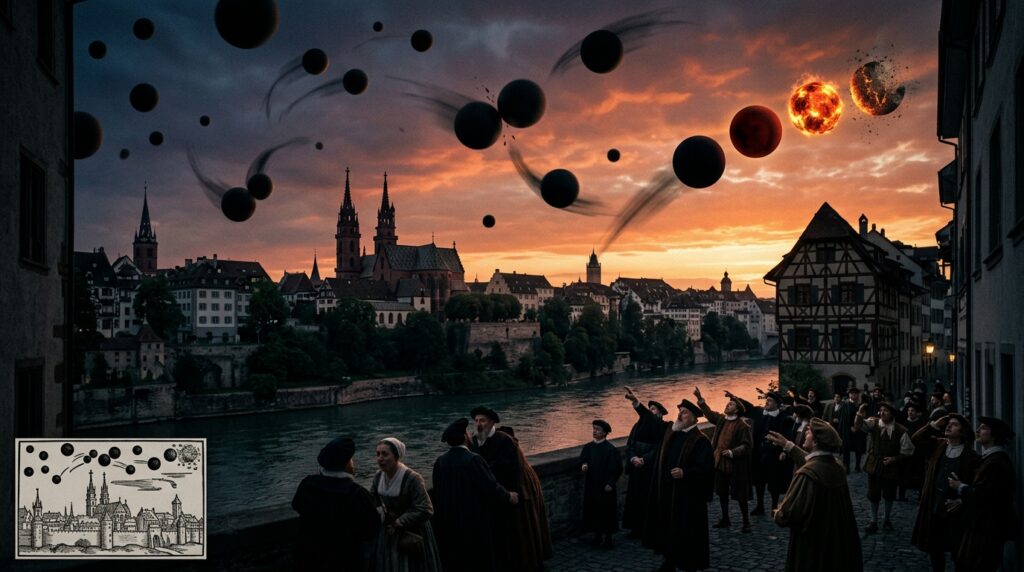
August 7, 1566 CE — Basel, Switzerland. At sunrise, many large black spheres appeared over Basel moving toward the sun at high speed, making half-turns and colliding for several hours before turning red, then fiery, and dying out. Documented the same day by Samuel Coccius in the Basel city gazette — the companion event to the April 14, 1561 Nuremberg aerial battle 200 miles away. Both documents preserved in the Wickiana Collection at the Zurich Central Library.
THINK ABOUTIT UFO SIGHTING REPORT
1566: UFO sighting over Basel, Switzerland
At dawn on August 7, 1566, the citizens of Basel, Switzerland looked up and watched a battle. Many large black spheres appeared in the sky at sunrise, moving at high speed toward the sun. They made half-turns. They collided with each other — banging one against the others. Then something changed: a great number of them became red, and then fiery, and then one by one they were consumed and died out. Samuel Coccius — a student of crowned writings and liberal arts who was among the witnesses and who served as a chronicler for the Basel city gazette — wrote down what he and his fellow citizens had seen. His account was published the same day. An accompanying woodcut illustration — now preserved in the Wickiana Collection at the Zurich Central Library alongside the Nuremberg 1561 broadsheet — shows Basel’s medieval skyline beneath a sky crowded with dark spheres. Five years after Nuremberg witnessed hundreds of objects emerge from cylinders and fight for over an hour above its rooftops, Basel witnessed hundreds of black spheres conduct their own aerial battle two hundred miles to the southwest. The two events — same class of phenomenon, same class of documentation, same geographic cultural zone, same documentary archive — are the two most famous aerial combat events in the pre-modern European record. And they are separated by exactly five years and two hundred miles.
Date: August 7, 1566
Sighting Time: Dawn — at the time when the sun rose
Day/Night: Dawn
Location: Basel, Switzerland
Urban or Rural: Urban — city of Basel, observed by many citizens
Hynek Classification: DD — Daylight Disc; multiple objects of defined spherical shape observed in dawn conditions over a populated city; combat behavior, directional movement toward the sun, and terminal phase change from black to red to fiery elevates this beyond conventional DD classification
Duration: Several hours — many citizens of Basel saw the spheres involved in aerial battle for several hours
No. of Object(s): Many — described as many large black balls; exact count not given
Description of Object(s): Many large black spheres moving at high speed toward the sun, making half-turns, colliding with each other. A great number subsequently became red and then igneous before being consumed and dying out — a specific terminal phase change from black to red to fiery to extinguished
Shape of Object(s): Spheres — specifically described as balls
Size of Object(s): Large — described as many large black balls
Color of Object(s): Black initially; transitioning to red, then fiery/igneous, then extinguished
Distance to Object(s): Aerial — appeared at sunrise altitude over the city; close enough for witnesses to observe combat details, directional movement, and color changes
Height & Speed: High speed — moved at high speed toward the sun; made half-turns; combat maneuvers with collisions
Number of Witnesses: Many — frightened citizens of Basel; community-wide observation over several hours
Special Features / Characteristics: Movement toward the sun — the spheres’ direction of movement was specifically toward the sun rather than random; half-turn maneuvers — controlled directional changes inconsistent with ballistic or atmospheric movement; combat behavior — banging one against the others describing deliberate collision or engagement; terminal phase sequence — black to red to igneous to consumed and died out; a specific documented terminal sequence not attributable to any natural aerial phenomenon; the woodcut illustration by Samuel Coccius preserved in the Wickiana Collection at the Zurich Central Library alongside the Nuremberg broadsheet; Samuel Coccius identified by name as the chronicler — a student of crowned writings and liberal arts, educated and literate; Basel was one of the most important Renaissance publishing cities in Europe — home to Erasmus, center of humanist scholarship, city of the most literate population in Switzerland; the Wickiana Collection curator Johann Jakob Wick systematically collected broadsheets of aerial phenomena from across the German-speaking world in this period — the Basel and Nuremberg documents are part of his systematic archive
Case Status: Unexplained
Source: Samuel Coccius, Basel city gazette, August 7, 1566; Wickiana Collection, Zurich Central Library
Summary/Description: At dawn on August 7, 1566, many citizens of Basel, Switzerland observed many large black spheres moving at high speed toward the sun, conducting half-turns, colliding with each other in apparent combat for several hours. A great number subsequently became red, then fiery, and were consumed and died out. Documented on the same day by Samuel Coccius in the Basel city gazette with an accompanying woodcut illustration now preserved in the Wickiana Collection at the Zurich Central Library — one of the two most famous aerial combat events in the pre-modern European record alongside the April 14, 1561 Nuremberg aerial battle.
Related Cases: April 14, 1561 CE Nuremberg Germany Aerial Battle | 1557 CE Basel Switzerland Army in Sky | 1577 CE Basel Switzerland Black Spheres | Nuremberg-Basel Renaissance Aerial Combat Archive
DETAILED REPORT:
August 7, 1566. Basel is one of the great cities of Renaissance Europe — home to the University of Basel founded in 1460, to Erasmus who spent the final years of his life here, to the printing houses that made Basel the publishing capital of the German-speaking world. The city sits on the Rhine at the point where Switzerland, Germany, and France converge. Its population in 1566 is one of the most educated and literate in Europe. When Samuel Coccius writes about what happened at dawn on August 7th, he is writing for readers who will evaluate his account with critical intelligence.
At sunrise — at the precise moment when the sun broke over the eastern horizon of Basel — the black spheres appeared.
Not one or two. Many large black balls. They were moving at high speed from the moment of their appearance. Their direction was specific and deliberate: toward the sun. Not drifting. Not random. Toward the sun — a directional movement that had purpose and consistency across the entire formation.
Then they made half-turns.
A half-turn is a 180-degree change of direction. Atmospheric particles do not make half-turns. Ballistic objects do not make half-turns. A half-turn is a controlled maneuver executed by something capable of reversing its direction at speed. The Basel spheres made them repeatedly.
Then they collided.
Banging one against the others. The combat behavior of the Nuremberg 1561 event — objects fighting vehemently with each other — reappears here in its most physically direct form: objects actively colliding with each other in the sky above Basel while frightened citizens watched below. Several hours of this. Not a brief appearance and departure. A sustained aerial engagement over a populated city for several hours at dawn while the population of one of Europe’s most educated cities stood in the streets and watched.
Then the terminal phase began.
A great number of them became red.
The color change is specific and sequential: black to red. Not all of them — a great number of them. The ones that became red then became fiery — igneous, burning. And then each of those was consumed and died out. Not disappeared, not flew away — consumed. The terminal sequence is: black, red, igneous, consumed, extinguished. It is a specific documented progression that has no atmospheric or astronomical explanation and that Samuel Coccius — a man trained in letters and liberal arts, writing for an educated readership — chose to record with precision because precision was what he was trained to apply.
Samuel Coccius published his account the same day. The Basel city gazette in which it appeared was part of the most sophisticated print culture in Europe — Basel’s publishing houses had been producing works of humanist scholarship for a century. His account was accompanied by a woodcut illustration showing Basel’s distinctive medieval silhouette beneath a sky filled with dark spheres.
That woodcut — along with the Nuremberg 1561 Hans Glaser broadsheet — was collected by Johann Jakob Wick, a Zurich pastor who spent decades systematically collecting printed and illustrated records of aerial phenomena from across the German-speaking world. Wick’s collection — the Wickiana — is now preserved at the Zurich Central Library. It is one of the earliest systematic archives of UAP documentation in the world. Both the Basel 1566 and Nuremberg 1561 documents are in it. They have been there since the 16th century.
The analytical relationship between Basel 1566 and Nuremberg 1561 is one of the most significant structural features of the pre-modern UAP record. Two cities two hundred miles apart. Five years between the events. Same class of phenomenon — black spheres in aerial combat. Same class of documentation — a named educated witness, a city gazette, a woodcut illustration, a professional archive. Same geographic cultural zone — the Rhine corridor of the Holy Roman Empire. Whatever operated over Nuremberg in April 1561 and over Basel in August 1566 was operating in the same region with the same methodology and generating the same class of documentation from the same class of educated civic witnesses.
RESEARCHER’S NOTES:
The Basel Black Spheres — Terminal Phase, The Wickiana Archive, and the Nuremberg Connection
- The Terminal Phase as Physical Evidence: The documented sequential color change from black to red to fiery to consumed and extinguished is the most analytically significant physical detail in the Basel account. This terminal sequence is not the behavior of atmospheric light phenomena — sun dogs and parhelia do not become red, then fiery, then consumed. It is consistent with objects undergoing energetic terminal events — structural failure under extreme conditions, energy depletion, or controlled shutdown — that produce a visible light sequence before the object ceases to exist as a visible entity. The specificity of the sequence argues for genuine physical objects undergoing genuine terminal processes.
- Samuel Coccius as Ideal Witness: A student of crowned writings and liberal arts writing for the Basel city gazette in 1566 is among the most credible possible witnesses in the pre-modern record. He was trained to observe and record accurately. He was writing for an educated, critical readership that would hold him accountable for inaccuracy. He published the same day. He included an illustrative woodcut. This is not a peasant’s frightened oral tradition — it is a professional chronicle produced by an educated man for an educated audience in the most literate publishing city in Europe.
- The Wickiana Archive Context: Johann Jakob Wick’s systematic collection of aerial phenomena broadsheets — of which the Basel 1566 document is a key entry — represents the earliest known systematic UAP archive in European history. Wick was not collecting folklore. He was collecting printed, published, illustrated accounts of anomalous aerial events from across the German-speaking world — applying the humanist scholarly principle of systematic collection to a phenomenon that his contemporaries could not explain. The Wickiana Collection at the Zurich Central Library is, in effect, the world’s first UAP archive. The Basel 1566 woodcut has been in it since the year it was made.
- The Nuremberg-Basel Pattern: The structural similarity between the April 1561 Nuremberg event and the August 1566 Basel event — same phenomenon, same documentation method, same geographic zone, same archive — is one of the most analytically significant patterns in the pre-modern European UAP record. These are not independent isolated accounts. They are two data points in a series of aerial combat events documented across the Rhine corridor in the mid-16th century, all following the same pattern of organized aerial object formations, combat behavior, and terminal phases. The series suggests a recurring operational presence rather than random anomalous events.
Samuel Coccius was standing in Basel at sunrise on August 7, 1566 and he watched many large black spheres move toward the sun, make half-turns, bang into each other for several hours, turn red, turn fiery, and die out. He wrote it down the same day. His account and its woodcut have been in the Zurich Central Library since the 16th century. The Nuremberg 1561 broadsheet is in the same collection. Two hundred miles. Five years. The same phenomenon. The same documentation. Whatever conducted aerial combat over Nuremberg in April 1561 and over Basel in August 1566 was working the Rhine corridor of the Holy Roman Empire with the consistency of something that had reasons to be there. The archive holds both events. The pattern between them is the most documented bilateral UAP operational series in the pre-modern record. And it ended — as everything in Basel ended — with a careful man writing down exactly what he saw.