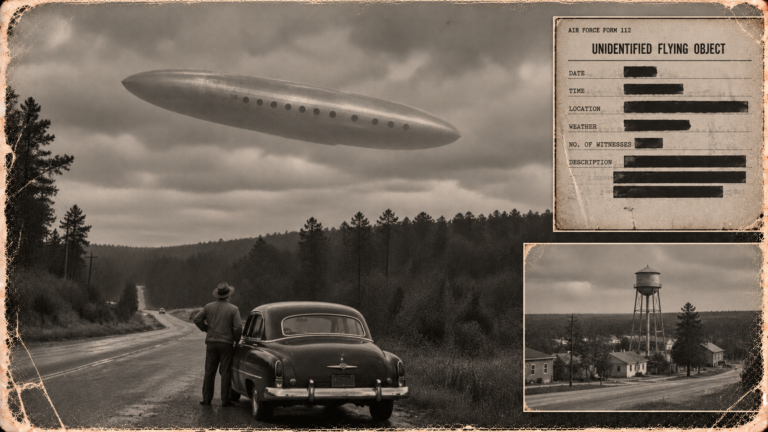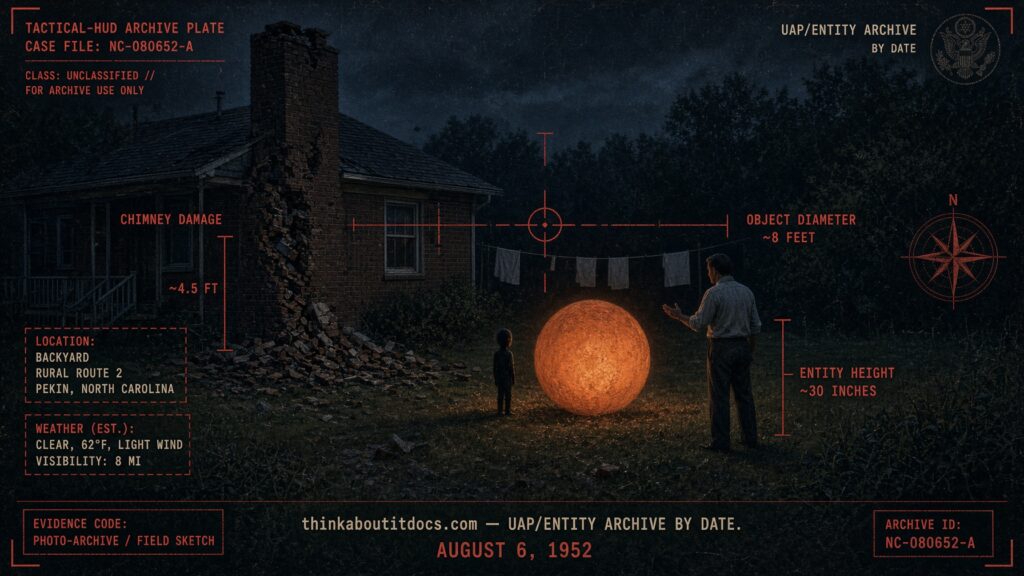
West Lumberton, North Carolina, August 6, 1952 — James Allen approaches the object in his backyard.
THINK ABOUTIT
UFO|UAP & ENTITY ENCOUNTER REPORT
1952: West Lumberton, North Carolina — The James Allen Encounter
James Allen watched an orange ball come out of the night sky, clip his chimney, and drop into his own backyard — and when he walked up close enough to ask if anyone was hurt, a 30-inch little man answered him only by vanishing in a whiff of air and a whistling shriek.
Date: August 6, 1952
Sighting Time: 2100 (9:00 p.m.)
Day/Night: Night
Location: West Lumberton, North Carolina. An independent source records a very similar case under “Lamberton, North Carolina” — a real, distinct place name for a small community adjoining Lumberton in Robeson County — which may represent the same event under a variant place name, or a genuinely separate but strikingly similar case; this archive has not resolved which.
Urban or Rural: Rural
No. of Entity(‘s): 1
Entity Type: Small humanoid
Entity Description: Approximately 30 inches tall, standing beside the object after its lights went out; no further physical description recorded
Hynek Classification: CE-III (Close Encounter of the Third Kind) — close observation with an animate being associated with the object
Duration: Not recorded
No. of Object(s): 1
Size of Object(s): 8 ft long, 6 ft high
Distance to Object(s): 10 ft (the distance to which the witness approached before the lights went out and the entity became visible)
Shape of Object(s): Ball-shaped
Color of Object(s): Orange
Number of Witnesses: 1 (Mr. James Allen)
Special Features/Characteristics: The object struck the witness’s chimney, knocking part of it in, before falling into his backyard. As Allen approached to within about 10 feet, its lights went out and he saw a small, 30-inch humanoid standing beside it. When he asked if it was hurt, the being — and the object — vanished “in a whiff,” followed by a loud whistling noise like rushing air.
Case Status: Insufficient Data — a single witness account with a possible physical trace (chimney damage) that is described but not documented with photographs or an independent inspection in the surviving record
Source: Contemporary newspaper source (specific publication not recorded)
Summary/Description: On the night of August 6, 1952, at about 9:00 p.m., Mr. James Allen of West Lumberton, North Carolina saw an orange ball come through the air, strike his chimney and knock part of it in, then fall into his backyard. The object measured roughly 8 feet long and 6 feet high. Allen walked to within about 10 feet of it; as he approached, its lights went out and he saw a small humanoid, about 30 inches tall, standing beside it. When he asked if it was hurt, both the being and the object vanished “in a whiff,” followed by a loud noise like whistling air, and then were gone.
Related Cases: Possibly the same event as, or a closely similar case to, one recorded independently under “Lamberton, North Carolina,” describing a saucer-shaped craft (roughly 3 by 2 meters) landing after striking a chimney, with a similarly small entity (approximately 70 cm, or about 27.5 inches) emerging and being asked if it was hurt, then departing with a whistling sound. This archive has not confirmed whether these are the same incident under two place-name variants or two separate but strikingly similar cases.
Detailed Report
The West Lumberton case survives as a compact but vivid account, carrying a level of physical incident — actual chimney damage from the object’s impact — that’s rarer in this archive’s 1952 record than simple aerial sightings. James Allen’s own description, preserved as a direct quote (“When I asked if it was hurt, it went away in a whiff; then it made a loud noise, like air whistling, and was gone”), gives the case an immediacy that secondhand paraphrase often loses.
An independently sourced account describing an almost identical event — a small craft striking a chimney, a small humanoid emerging, the witness asking if it was hurt, and a whistling departure — appears under the place name “Lamberton, North Carolina,” a real, distinct community near Lumberton in Robeson County. Whether this represents the same underlying event recorded under two different place names by two different chains of sources, or two genuinely separate but closely parallel incidents, has not been established. The entity height differs slightly between the two accounts (30 inches versus roughly 27.5 inches), which is within the range of ordinary estimation variance either way.
No photograph of the damaged chimney, no measurement or inspection report, and no second witness are recorded in the surviving sourcing. The case rests on Allen’s own account as preserved by an unspecified contemporary newspaper.
RESEARCHER’S NOTES
West Lumberton, North Carolina — 1952 and a Possible Duplicate Case
- An unresolved naming/duplication question: The near-identical “Lamberton, North Carolina” account is close enough in specific detail (chimney strike, small entity, “was it hurt,” whistling departure) that this is either the same case under a variant place name or a genuinely remarkable coincidence — this archive flags the question rather than assuming either answer.
- A described but undocumented physical trace: Chimney damage is a checkable claim in principle, but no photograph, inspection, or independent confirmation of the damage survives in the sourcing located for this case.
- A direct, specific witness quote: Allen’s own words carry a plainness — asking if the being was hurt, rather than reacting with fear or hostility — that reads as a genuine, unrehearsed human response rather than a stylized narrative beat.
- Single witness, no second observer: As with many of this archive’s best-quoted 1952 cases, this one still rests entirely on one person’s account.
Seven decades later, whether Lamberton and West Lumberton turn out to be the same story wearing two different names or two separate nights that happened to rhyme, James Allen’s own question — asking a stranger from nowhere if he was hurt — is the detail that has kept this small case remembered at all.
“When I asked if it was hurt, it went away in a whiff; then it made a loud noise, like air whistling, and was gone.”
— James Allen, West Lumberton, North Carolina, August 6, 1952