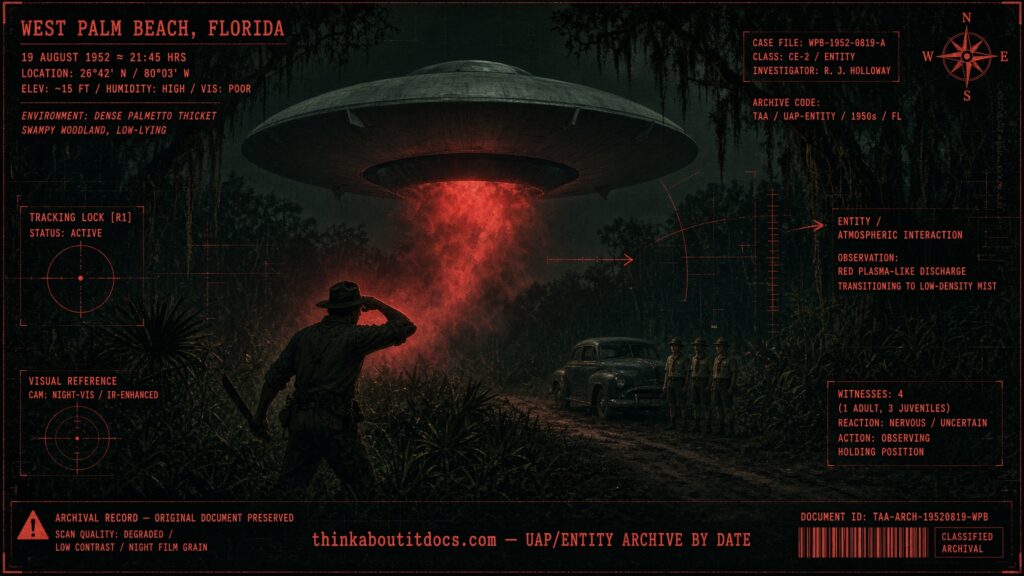
Military Trail, near West Palm Beach, Florida, August 19, 1952 — the scene Sonny Desvergers described to Project Blue Book investigators.
THINK ABOUTIT
UFO|UAP & ENTITY ENCOUNTER REPORT
1952: The Sonny Desvergers “Scoutmaster Case” — West Palm Beach, Florida
Scoutmaster Sonny Desvergers walked into a stand of Florida palmettos to check on a downed plane and staggered back out an hour later, waving a machete and babbling, his cap punched through with tiny burn holes and the hair on his arms singed away — a scene so convincing that Project Blue Book’s own chief investigator, Capt. Edward Ruppelt, initially believed him completely, before later reversing course and branding the case, in his own words, “the best hoax in UFO history.”
What makes the West Palm Beach case endure isn’t just the fireball or the burns — it’s that neither the true believers nor the skeptics ever got a clean win. Ruppelt’s team hauled grass and soil samples back to Dayton, Ohio, where agronomists found the root structure charred through despite intact topsoil; three named Boy Scouts backed the scoutmaster’s account under separate questioning; and a deputy sheriff on the scene called it the most genuine terror he’d witnessed in nineteen years of law enforcement. Set against all of that: a scoutmaster with a less-than-honorable Marine discharge, a stolen car in his past, a press agent hired almost immediately, and a story sold to a national tabloid within the year. Seven decades later, the Air Force still has never proven it a hoax — it just stopped believing it.
Date: August 19, 1952
Sighting Time: 2145 (approximately 9:45 p.m.; some secondary accounts give a start time closer to 9:30 p.m.)
Day/Night: Night
Location: Along Military Trail, roughly 10 miles inland from West Palm Beach, Florida
Urban or Rural: Rural
No. of Entity(‘s): 3
Entity Type: Humanoid — this detail appeared only in Desvergers’ later retellings of the case, not in his initial report to police or his first Air Force interview, a distinction this archive flags explicitly rather than treating the entities as part of the original account.
Entity Description: Wore grayish clothing; Desvergers described a sweaty odor associated with them
Hynek Classification: CE-III (Close Encounter of the Third Kind) — close observation with animate beings associated with the object
Duration: Not precisely recorded; Desvergers left his car to investigate and returned roughly an hour later
No. of Object(s): 1
Size of Object(s): Described as huge
Distance to Object(s): Not precisely recorded; close enough that Desvergers described directly seeing a dark body overhead and, in later retellings, boarding the object’s rim
Shape of Object(s): A smooth disc, somewhat concave on the underside, with vanes around the edge and a dome in the middle
Color of Object(s): Gray
Number of Witnesses: 4 — Desvergers directly, plus three Boy Scouts (Charles Stevens, David Rowan, and Robert Ruffing) who remained near the car and were separately interviewed by Ruppelt’s team
Special Features/Characteristics: Desvergers reported oppressive heat and humidity, a pungent smell, and a feeling of being watched just before seeing the disc overhead; a red fireball drifted toward him, expanded into a red mist, and enveloped him, causing him to lose consciousness. On recovery, he ran for the road and encountered a deputy sheriff summoned by the boys, who had independently seen the red fire strike him. His arms, face, and cap showed burns, his hair was singed, and grass at the site showed scorched roots despite intact topsoil. In later, more elaborate retellings, Desvergers additionally claimed he had briefly boarded the object’s rim and fought with three humanoids in grayish, sweaty-smelling clothing — a detail absent from his earliest accounts.
Case Status: Disputed. Capt. Edward Ruppelt, heading Project Blue Book’s investigation, initially found Desvergers highly credible: his account stayed consistent and unrehearsed across repeated interviews, the three Boy Scouts corroborated key details independently, an Air Force surgeon documented genuine burns and singed hair, and laboratory analysis in Dayton, Ohio confirmed the grass roots at the site were charred despite the soil itself remaining undisturbed. Ruppelt’s suspicion shifted only after a deputy encouraged him to look into Desvergers’ background, revealing a less-than-honorable Marine discharge for going AWOL and car theft, a later conviction and seven-year probation sentence for passing bad checks, and Desvergers’ rapid hiring of a press agent and sale of his story to American Weekly within the year. Ruppelt ultimately wrote the case off as a hoax, later calling it “the best hoax in UFO history” in his 1956 book — but the Air Force was never able to conclusively prove fabrication, and the physical evidence (the charred root samples in particular) has never been fully explained by either side.
Source: Project Blue Book files; Capt. Edward J. Ruppelt, “The Report on Unidentified Flying Objects” (1956); contemporary Palm Beach County Sheriff’s Office records
Summary/Description: On the night of August 19, 1952, hardware-store clerk and Boy Scout leader Sonny Desvergers was driving three scouts home along Military Trail near West Palm Beach, Florida when he spotted a bright, fuzzy light in the palmetto brush off the road. Thinking it might be a downed aircraft, he stopped, left the boys with the car, and went to investigate on foot. In a clearing, the air turned oppressively hot and humid; he smelled a pungent odor and felt watched. Looking up, he saw a dark shape overhead — a huge, smooth, concave-bottomed gray disc with edge vanes and a central dome, revealed when he shone his flashlight on it. A red fireball then drifted toward him, expanding into a mist that enveloped him and knocked him unconscious. He came to, ran for the road, and was met by a deputy sheriff the boys had summoned — the deputy had independently seen the red fire strike Desvergers from a distance. Back at the sheriff’s office, his arms, face, and cap showed burns and his hair was singed; grass sampled at the site later tested with charred roots despite undisturbed soil. Project Blue Book chief Edward Ruppelt personally investigated, initially finding Desvergers credible, but reversed his assessment after learning of the scoutmaster’s checkered personal history and quick moves to monetize the story — ultimately labeling it a hoax, though never definitively proving one.
Related Cases: Not Applicable
Detailed Report
Few cases in this archive’s 1952 record carry as much documented back-and-forth as West Palm Beach. The initial investigative picture, as Ruppelt himself later wrote it up, was surprisingly strong: Desvergers held up under repeated, separated interviews without his story shifting or sounding rehearsed; three Boy Scouts, questioned on their own weeks later at a regular troop meeting, corroborated the core sequence of events; an Air Force surgeon documented physical burns and singed hair consistent with a genuine flash-heat exposure rather than self-inflicted injury; and soil samples flown back to Dayton showed charred plant roots with the surrounding soil itself untouched — a detail that, on its face, is difficult to fake with an ordinary flame source. A deputy sheriff with nineteen years on the job called Desvergers’ terror the most convincing he’d ever witnessed.
What turned the case is not new physical evidence but background investigation. A deputy suggested Ruppelt’s team dig into who Desvergers actually was, and what they found undercut the witness rather than the physics: an other-than-honorable discharge from the Marine Corps for going AWOL and stealing a car, a documented reputation for tall tales, and — emerging later — a felony conviction for passing bad checks that brought seven years’ probation. Alongside this, Desvergers moved unusually fast to control and monetize the story, hiring a press agent almost immediately and selling an account to the tabloid American Weekly within roughly a year, all while publicly insisting to Ruppelt that he wanted to keep details secret “for the good of humanity.” That combination — a witness with documented dishonesty in unrelated matters, paired with rapid commercial exploitation of the story — is what shifted Ruppelt’s judgment, not any new finding that discredited the physical evidence itself.
The entity detail is worth separating out specifically. Desvergers’ earliest accounts to police and in his first Air Force interview describe only the disc, the fireball, and the red mist — no humanoids. The claim of boarding the craft and fighting three grayish, sweaty-smelling beings appears only in later, more elaborate retellings, a progression consistent with either a genuinely traumatic memory resurfacing in pieces, or a story growing in the telling — this archive does not resolve which.
RESEARCHER’S NOTES
The Sonny Desvergers “Scoutmaster Case” — West Palm Beach, 1952, and a Hoax That Was Never Proven
- Physical evidence Ruppelt himself couldn’t explain away: The charred-root, undisturbed-soil finding from the Dayton lab analysis is the single hardest piece of evidence in the case, and it survived Ruppelt’s own reversal — his “hoax” conclusion rests on witness credibility, not on debunking the physical trace.
- Credibility judgments and physical evidence pulled in different directions: This is a rare case where the investigator’s assessment of the man and the investigator’s assessment of the evidence diverged, and Ruppelt’s own writing makes clear he never fully reconciled the two — he “wrote off” the case rather than explained it.
- The entity claim arrived late and should be weighed accordingly: Because the humanoid encounter surfaces only in later retellings, not the original police and Air Force statements, this archive treats it as a separate, lower-confidence layer of the account rather than folding it into the core, earlier-documented sequence.
- Character evidence is not the same as debunking: Desvergers’ military discharge, theft, and fraud conviction speak to his general honesty, but none of them constitute a demonstrated method by which he could have staged burns, singed his own hair, charred grass roots without disturbing soil, and fooled a deputy sheriff from a distance — a gap in the hoax case worth naming directly.
- Institutional weight cuts both ways: Ruppelt’s own “best hoax in UFO history” line has become the case’s defining legacy quote, repeated far more often than his earlier, more measured assessment that Desvergers “remembered details very well” and didn’t respond like someone reciting a script.
More than seventy years on, the West Palm Beach case sits exactly where Ruppelt left it: officially written off, never officially solved, with a set of charred grass roots that nobody — not the true believers, not the Air Force, not history itself — has ever fully accounted for.
“We wrote off the incident as a hoax. The best hoax in UFO history.”
— Capt. Edward J. Ruppelt, “The Report on Unidentified Flying Objects,” 1956