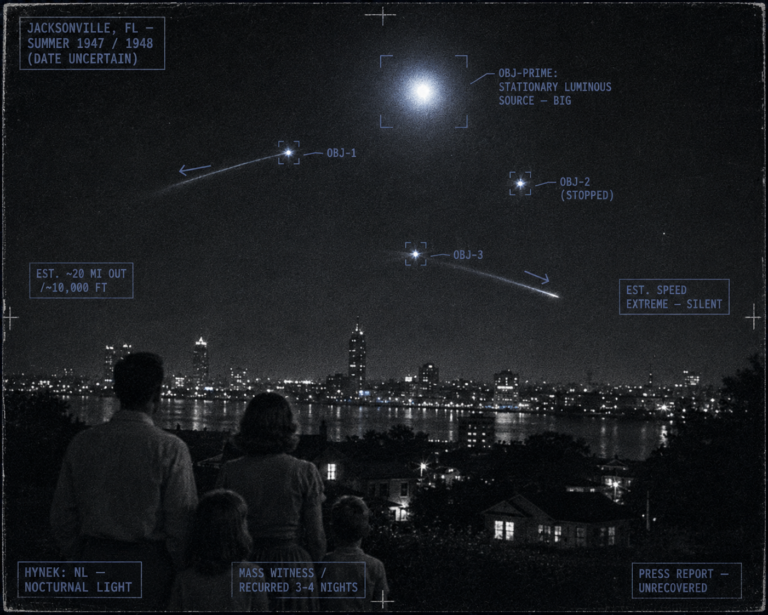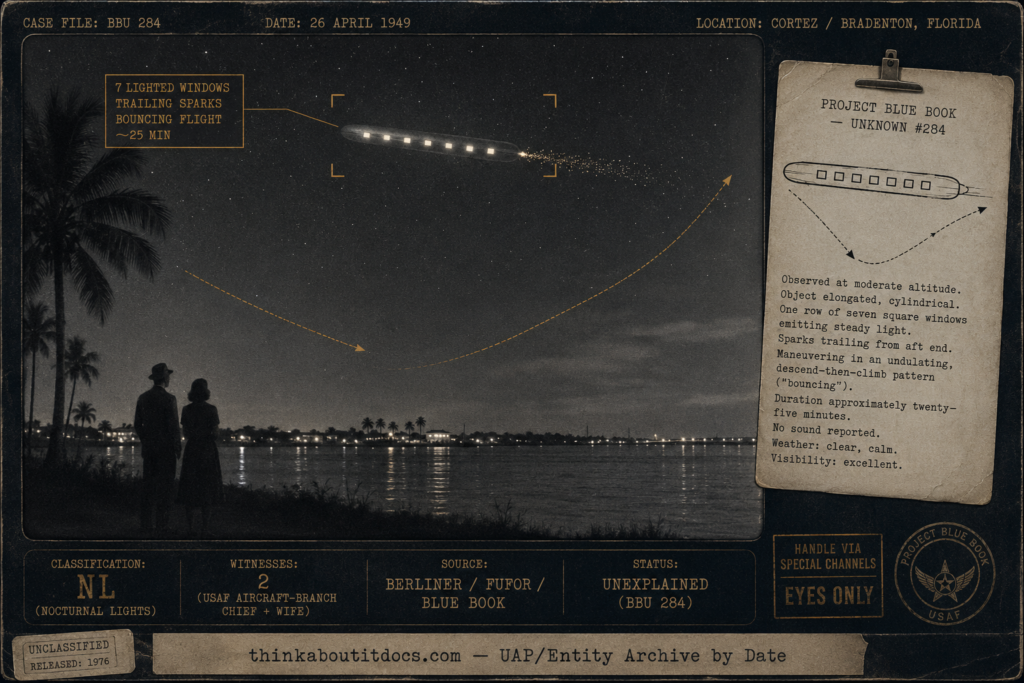
The Cortez-Bradenton object, Florida Gulf coast, January 27, 1949 — a windowed, spark-trailing cigar watched for 25 minutes by an Eglin AFB aircraft-branch chief and his wife; classified NL, status Unexplained (Blue Book Unknown #284).
THINK ABOUTIT UFO | UAP SIGHTING REPORT
1949: The Cortez-Bradenton, Florida Sighting — Blue Book Unknown #284
Late on the night of January 27, 1949, an Air Force captain whose job was knowing what flew stood with his wife on Florida’s lower Gulf coast and watched something he could not name. For twenty-five minutes a luminous, cigar-shaped object as long as two Pullman cars hung and moved in the night sky near Cortez and Bradenton, a single row of seven glowing square windows burning along its flank and sparks trailing from it as it descended, climbed, and rode an anomalous bouncing arc through the dark at around four hundred miles an hour. The witness was not a curious civilian. Captain Sames — also recorded as Sannes — was the Acting Chief of the Aircraft Branch at Eglin Air Force Base, an officer whose professional responsibility was the evaluation of aircraft. When the report reached Project Blue Book, the Air Force’s own analysts could not explain it. It was filed as Unknown number 284, one of the small residue of cases that survived every attempt at identification.
The Cortez-Bradenton sighting belongs to a coherent late-1940s thread of anomalous elongated objects bearing rows of luminous “windows” — a motif shared with the Chiles-Whitted encounter of July 1948 and the later Clyde Tombaugh sighting of August 1949. What distinguishes it is not the strangeness of the description but the caliber of the person who made it.
Date: January 27, 1949
Sighting Time: 10:20 p.m.
Day/Night: Night
Location: Near Cortez and Bradenton, Gulf coast of Florida
Urban or Rural: Rural / coastal (the Cortez fishing village and Bradenton area, lower Florida Gulf coast)
No. of Entity(‘s): Not Applicable
Entity Type: Not Applicable
Entity Description: Not Applicable — nocturnal-light observation; no occupants reported
Hynek Classification: NL (Nocturnal Lights)
Duration: Approximately 25 minutes
No. of Object(s): 1
Description of Object(s): A luminous, cigar- or cucumber-shaped object roughly the length of two Pullman cars, carrying a single row of seven lighted square windows and throwing off sparks. It descended, then climbed, moving with a distinctive bouncing or undulating motion.
Shape/Size/Color: Elongated cigar / cylindrical (“cucumber-like”); brightly luminous; seven windows lit; trailing sparks; estimated length on the order of 160 feet
Distance to Object(s): Not established with precision; initial altitude approximately 8,000 feet
Height & Speed: Approximately 8,000 feet initially; descended then climbed with a bouncing motion; estimated 400-500 mph
Number of Witnesses: 2 — Capt. Sames (also recorded as Sannes), USAF, Acting Chief of the Aircraft Branch, Eglin Air Force Base, and his wife
Special Features/Characteristics: Seven lighted square windows along the body; trailing sparks; anomalous descend-climb “bouncing” flight profile; 25-minute duration; principal witness was a serving Air Force aircraft-branch chief; carried as Project Blue Book Unknown #284
Case Status: Unexplained — Project Blue Book Unknown #284
Source: Don Berliner, Project Blue Book Unknowns list (BBU #284); FUFOR Index; Sparks, Comprehensive Catalog of BB Unknowns
Summary/Description: At 10:20 p.m. on January 27, 1949, Capt. Sames, USAF — Acting Chief of the Aircraft Branch at Eglin AFB — and his wife observed a cigar-shaped object near Cortez and Bradenton on Florida’s Gulf coast. Estimated as long as two Pullman cars, it displayed seven lighted square windows and threw off sparks, first appearing at approximately 8,000 feet. Over roughly 25 minutes it descended then climbed with a distinctive bouncing motion, traveling at an estimated 400-500 mph. The Air Force investigated and could not identify the object; it entered the Project Blue Book record as Unknown #284.
Related Cases: 1948 — Chiles-Whitted encounter, Alabama (cigar-shaped object with lighted square windows; Blue Book Unknown); 1949 — Clyde Tombaugh sighting, Las Cruces, New Mexico (geometric formation of window-like rectangles); 1947-1948 — Jacksonville, Florida bright-light reports (regional context)
Detailed Report
The Cortez-Bradenton case is short on documentary detail but unusually strong on the variable that matters most for a nocturnal-light report: the competence of the witness. The man who watched the object for 25 minutes was not a casual observer but the serving Acting Chief of the Aircraft Branch at Eglin Field, an officer whose professional responsibility was the identification and evaluation of aircraft. When such a witness watches something for nearly half an hour and cannot reconcile it with anything he knows to fly, that judgment carries real evidentiary force.
The observation began at 10:20 p.m. on January 27, with the object first noted at roughly 8,000 feet near the Gulf-coast communities of Cortez and Bradenton, well south of the captain’s home station in the Florida Panhandle. He and his wife described an elongated, cigar- or cucumber-shaped body, brightly luminous, about as long as two Pullman railroad cars — a large object by any reckoning. Along its flank ran a single row of seven lighted square windows, and it shed sparks as it moved. Nothing in that description matches the night signature of a 1949 aircraft, which would show standard navigation and cabin lighting, not a row of seven glowing squares and a trail of sparks.
The motion was as anomalous as the appearance. Rather than holding a steady course, the object descended, then climbed, riding a distinctive bouncing or undulating path through the sky at a speed the captain put at around 400 to 500 mph. A meteor or fireball — which the sparks might otherwise suggest — is eliminated by the duration and the flight behavior: meteors are gone in seconds and never climb or bounce, let alone persist for 25 minutes. A 1949 aircraft is ruled out by the windows, the sparks, and the maneuvering — and ultimately by the Air Force’s own inability to identify it. A balloon cannot make 400 mph or execute a climb after a descent.
The case entered the official record through the Air Force’s investigation and emerged as a genuine Unknown — number 284 in the Project Blue Book catalog later compiled and published by Don Berliner, with the entry preserved in the Fund for UFO Research index and in Brad Sparks’ Comprehensive Catalog of BB Unknowns. That status is significant: Blue Book and its Battelle-assisted analysts worked hard to explain reports away, succeeding with the large majority. The small residue they could not resolve represents the cases that resisted every conventional candidate. Cortez-Bradenton is one of them.
The case’s limitation is breadth of corroboration. There were two witnesses, husband and wife, with no radar track, no photograph, and no independent second party on record. It rests entirely on a single sustained observation by a credible pair. But the description is specific and internally consistent across the 25-minute watch, the witness is exceptionally qualified, and the official disposition is Unknown — a combination that places it among the more solid nocturnal-light cases of the immediate post-1947 period.
RESEARCHER’S NOTES
The Cortez-Bradenton Object — A Windowed Cigar on the Florida Gulf Coast, 1949
- Classification. This is an NL (Nocturnal Lights) case: a luminous object observed at night, its structure inferred from a row of lit windows rather than resolved in daylight detail. Even though the witnesses discerned a cigar shape and counted seven windows, the observation remains fundamentally one of lights in the night sky at distance and altitude, with no close approach and no landing — the textbook definition of the category. There is no basis for a Daylight Disc or close-encounter designation.
- Source chain and the time correction. The case comes through Blue Book Unknown #284 as compiled by Don Berliner (FUFOR Index) and as catalogued by Brad Sparks. Both Berliner’s compilation and Sparks’ Comprehensive Catalog give the sighting time as 10:20 p.m. — the time used here. The live page on this site had previously carried 2320 hours (11:20 p.m.), which is an error; that figure has been corrected in this rebuild to match the primary compiled record.
- Pattern context. This report belongs to an important 1948-1949 sub-type: elongated, cigar- or rocket-shaped objects carrying rows of lighted square windows. Its direct ancestor is the Chiles-Whitted encounter of July 24, 1948, in which two Eastern Air Lines pilots over Alabama described a wingless cigar with a double row of glowing square windows and a trailing flame — also a Blue Book Unknown, and directly compared by Air Force analysts to the Cortez-Bradenton description. The later Clyde Tombaugh sighting of August 1949 adds a third independent instance of the “rectangular window” motif, seen this time by the discoverer of Pluto. Across these cases, credible witnesses reported the same unusual detail independently — lighted geometric “windows” on an elongated body — which is part of what makes the type difficult to dismiss.
- Physical and evidentiary weight. On the strength side: an exceptionally qualified primary witness, a corroborating second witness, a long 25-minute observation, a specific and consistent description, anomalous flight behavior that eliminates every ordinary candidate, and an official Blue Book Unknown disposition. On the limiting side: no radar track, no photograph, only two witnesses with a marital relationship. The honest evaluation is Unexplained — the same assessment the Air Force itself reached — anchored less by volume of evidence than by the quality of the observer and the complete failure of every conventional explanation.
- Witness name variant. Berliner’s list records the primary witness as “Capt. Sames”; other sources give “Sannes.” Both variants refer to the same individual, the same rank, and the same post (Acting Chief of the Aircraft Branch, Eglin AFB). The discrepancy is a transcription inconsistency in the compiled record, not a genuine dispute about identity.
The Cortez-Bradenton sighting is a compact but resilient case. An Air Force aircraft-branch chief and his wife watched a windowed, spark-trailing cigar maneuver over the Florida Gulf coast for 25 minutes, and neither the captain nor the Air Force that investigated him could say what it was. It joins the lighted-window cigar reports of Chiles-Whitted and the Tombaugh formation as part of a coherent late-1940s thread, and it carries the rare designation of an official Blue Book Unknown. It belongs in the record exactly as the Air Force left it — unexplained, and made the more notable by the expertise of the man who could not explain it.
“…a cigar-shaped object as long as 2 Pullman cars, with 7 lighted square windows and throwing sparks, descend then climb with a bouncing motion at about 400 mph.”
Project Blue Book Unknown #284 — compiled summary of the January 27, 1949 Cortez-Bradenton, Florida report by Capt. Sames, USAF, Acting Chief of the Aircraft Branch, Eglin AFB.