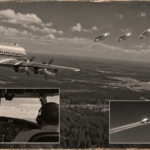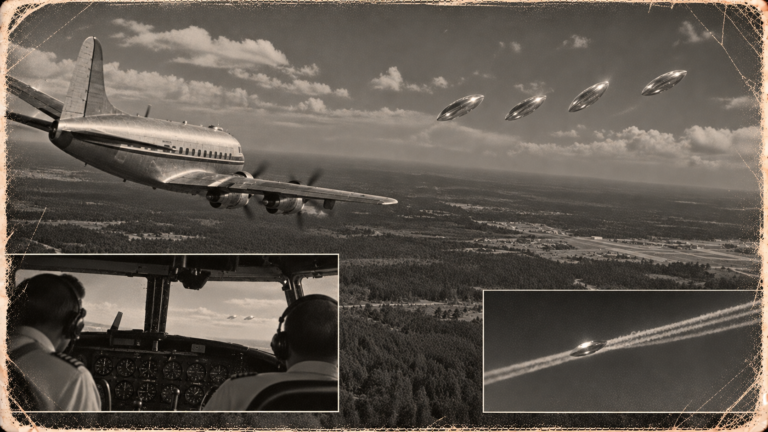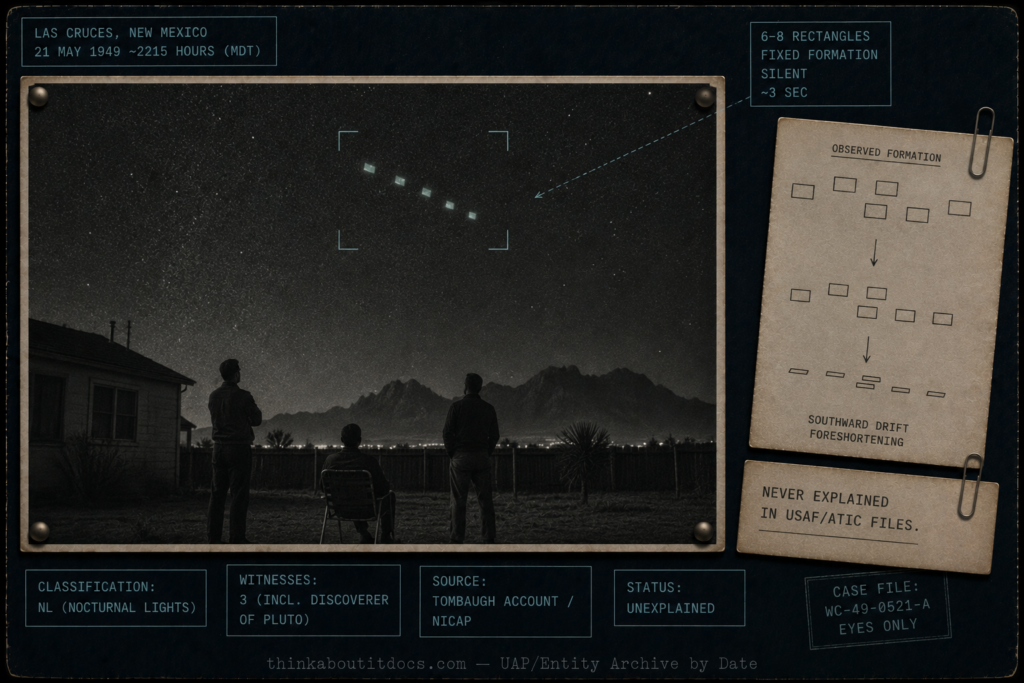
The Tombaugh sighting, Las Cruces, New Mexico, August 20, 1949 — Pluto's discoverer and two family witnesses watched a formation of green window-like lights cross the sky; classified NL, status Unexplained.
THINK ABOUTIT UFO | UAP SIGHTING REPORT
1949: The Clyde Tombaugh Sighting — Las Cruces, New Mexico
Of all the people who have ever reported a UFO, few were better equipped to know what they were looking at than Clyde Tombaugh. The man had discovered Pluto in 1930 by spotting a speck of moving light on photographic plates, and he had spent uncounted nights teaching his eye to separate the genuine from the artifact. So when, around eleven o’clock on the night of August 20, 1949, he glanced up from his Las Cruces backyard into a clear desert sky and saw a tight, geometric cluster of six to eight faint bluish-green rectangles of light — window-like, holding formation — drift from near the zenith down toward the southern horizon, his reaction is worth weighing. He was, by his own admission, petrified with astonishment. His wife and her mother, sitting with him, saw it too. Tombaugh ruled out the planets, the meteors, the aircraft, and the atmospheric tricks he knew so well, and the Air Force never managed to explain it either.
Date: August 20, 1949
Sighting Time: Approximately 11:00 p.m.
Day/Night: Night (clear, transparent desert sky)
Location: Backyard of the Tombaugh home, Las Cruces, New Mexico
Urban or Rural: Urban / residential
No. of Entity(‘s): None reported
Entity Type: Not applicable
Entity Description: Not applicable — nocturnal-light observation, no occupants
Hynek Classification: NL (Nocturnal Lights)
Duration: About 3 seconds (Tombaugh); roughly 1½ seconds for his wife
No. of Object(s): One geometric group of six to eight luminous rectangles, in fixed formation
Description of Object(s): A geometrically arranged cluster of six to eight faint bluish-green (yellowish-green) rectangles of light, window-like in appearance, holding a constant formation as the group moved. Tombaugh later compared the pattern to the “Lubbock Lights.” As the group descended it foreshortened, its formation tightening and its light dulling, until it faded from view about 35 degrees above the horizon.
Shape: Rectangular lights (“window-like”) in a geometric array
Size: Formation spanned roughly one degree of sky at first sighting
Color: Bluish-green / yellowish-green
Distance: Not established
Height & Speed: High; moved from near the zenith toward the south-southeast, fading at ~35° elevation; no sound
No. of Witnesses: 3 — Clyde W. Tombaugh; his wife, Patricia; and his mother-in-law
Special Features/Characteristics: The witness was the discoverer of Pluto and an elite observational astronomer who explicitly excluded planets, meteors, aircraft, atmospheric optics, and terrestrial reflection; silent; the formation held its geometry while foreshortening on descent; never explained in official USAF/ATIC files
Case Status: Unexplained
Source: Clyde Tombaugh’s own written account (submitted 1957) and his 1956 public statement; NICAP case files; discussed throughout the standard UFO literature. The sighting was never explained in official USAF/ATIC records
Summary/Description: About 11:00 p.m. on August 20, 1949, astronomer Clyde Tombaugh — discoverer of Pluto — was admiring the night sky from his backyard in Las Cruces, New Mexico, with his wife and mother-in-law, when he saw a geometrically arranged group of six to eight faint bluish-green rectangular, window-like lights near the zenith. The formation moved southward, foreshortening and dimming as it descended, and faded about 35 degrees above the horizon. The whole event lasted only a few seconds and was silent. Tombaugh, an observer uniquely qualified to identify conventional astronomical and atmospheric phenomena, said he doubted any terrestrial reflection could account for it and described himself as astonished. He separately reported having seen three of the New Mexico “green fireballs” of the same era. The case was never resolved in Air Force files.
Related Cases: 1951 — Lubbock Lights, Texas (formation of lights; Tombaugh’s own comparison) | 1948–1951 — the New Mexico “green fireballs” (LaPaz investigations; Tombaugh reported seeing three) | 1949 — Rogue River, Oregon (technically trained NACA witnesses, daylight disc)
Full Report
The weight of this case rests almost entirely on the witness, and the witness is exceptional. Clyde Tombaugh had found a planet by detecting a faint point of light shifting against a field of stars — the discipline of telling the real from the spurious was his life’s work. He knew Venus, he knew meteors, he knew how aircraft lights and temperature inversions and reflections behave. That is the lens through which his report must be read.
By his own account, written up in 1957, he was standing in his Las Cruces backyard about eleven o’clock on an August night in 1949, looking toward the zenith and enjoying an unusually transparent sky, when he suddenly saw a geometric group of faint bluish-green rectangles of light. They were arranged in a fixed pattern that reminded him, in retrospect, of the formation later famous as the Lubbock Lights. The cluster moved across the sky toward the south; as it descended, the individual rectangles foreshortened, the formation drew tighter — it had spanned about a degree at first — and the light dimmed, fading out roughly 35 degrees above the horizon. The whole passage took only a few seconds. His wife, Patricia, caught it for perhaps a second and a half; her mother saw it as well. There was no sound.
Tombaugh’s interpretation was careful and bounded. He did not claim a spacecraft; he claimed that he could not account for what he saw by any ordinary phenomenon, and that he doubted a terrestrial reflection could explain it. Years later, in a 1956 statement, he summarized his position across all his anomalous sightings: he had seen objects that defied the explanations a professional astronomer would normally reach for, and he thought it unscientific for his colleagues to refuse even to entertain the possibility of an extraterrestrial origin. Coming from a man of his standing, that was a notably measured but pointed remark.
His other reported observations round out the picture of an open but disciplined observer. Tombaugh said he had also seen three of the mysterious “green fireballs” that appeared over New Mexico from late 1948 onward — the same phenomenon then under serious study by Dr. Lincoln LaPaz of the University of New Mexico — and he considered them unusual even by the standards of ordinary fireballs. He had, more controversially, once speculated that a bright flash he observed on Mars in 1941 might have been an explosion, a notion he raised in 1949 with the White Sands naval missile director, Commander Robert McLaughlin; that idea is best filed as the speculation it was rather than as observation. What it illustrates is a scientist genuinely willing to follow anomalies, which makes his restraint about the 1949 lights all the more telling.
The official record is brief and revealing in its silence. When Dr. J. Allen Hynek, then a scientific consultant to Project Blue Book, quietly surveyed fellow astronomers about UFO sightings at a 1952 convention, Tombaugh was among those who confided that they had seen something — as was LaPaz. Tombaugh even offered the Air Force the use of his telescopes to photograph UFOs if he were alerted in time. Yet the Las Cruces sighting itself was never given a conventional explanation in USAF or ATIC files. It simply remained on the books, unresolved, attached to one of the most respected names in twentieth-century astronomy.
RESEARCHER’S NOTES
The Tombaugh Lights — New Mexico 1949 and the Expert Witness
- Classification. This is a clean NL (Nocturnal Lights): luminous sources observed at night, structureless beyond their rectangular appearance and geometric arrangement, with no occupants and no instrumented detection. The “window-like” quality and the fixed formation are descriptive detail within the category, not grounds for a different one. There is no basis for a Daylight Disc or close-encounter label.
- Source chain. The provenance is the witness himself, in his own careful words, corroborated by two family members and recorded in his 1957 written account and 1956 public statement, with the case carried in NICAP files and the broader literature. Crucially, the value here is not documentary volume but witness quality: the primary source is a world-class observational astronomer describing what he saw, with explicit reasoning about what it was not. The page’s reliance on a tertiary summary undersells a case whose strength is the observer.
- Pattern context. The sighting sits at the center of the late-1940s New Mexico anomaly cluster — the green fireballs, the White Sands missile-range reports, the LaPaz investigations — a period and place where some of the most scientifically credentialed UFO observations on record were made. Tombaugh’s own comparison to the Lubbock Lights ties his formation to the era’s recurring “group of lights in formation” motif, even though the Lubbock case itself drew a much-debated conventional explanation. The Tombaugh report is part of the small but significant subset of astronomer and scientist sightings that resist the usual dismissals.
- Physical / evidentiary weight. Moderate to high, and unusual in its character. There is no photograph, no radar, and the event lasted only seconds — ordinarily reasons for caution. But the single most important variable in evaluating a nocturnal-light report is the competence of the observer, and on that axis this case is close to unmatched: the witness was the person who discovered Pluto by distinguishing genuine motion from optical artifact, supported by two corroborating witnesses, and he affirmatively excluded the conventional explanations from his own deep expertise. The Air Force never explained it. The honest disposition is Unexplained, carried less by quantity of evidence than by the exceptional authority of the man reporting it.
The Tombaugh sighting is, in a sense, a test of how much witness credibility should count. Strip away the famous name and it is a few seconds of silent green lights in formation — slender evidence. Restore the name, and it becomes one of the hardest early reports to wave aside, because the observer had spent his career doing precisely the thing skeptics would demand: separating the real from the illusory in the night sky, and he could not explain what he saw. He did not overclaim, his family saw it too, and the Air Force left it unresolved. It belongs in the chronological record as a brief but formidable Unexplained nocturnal-light case — anchored by the judgment of the man who found the ninth planet.