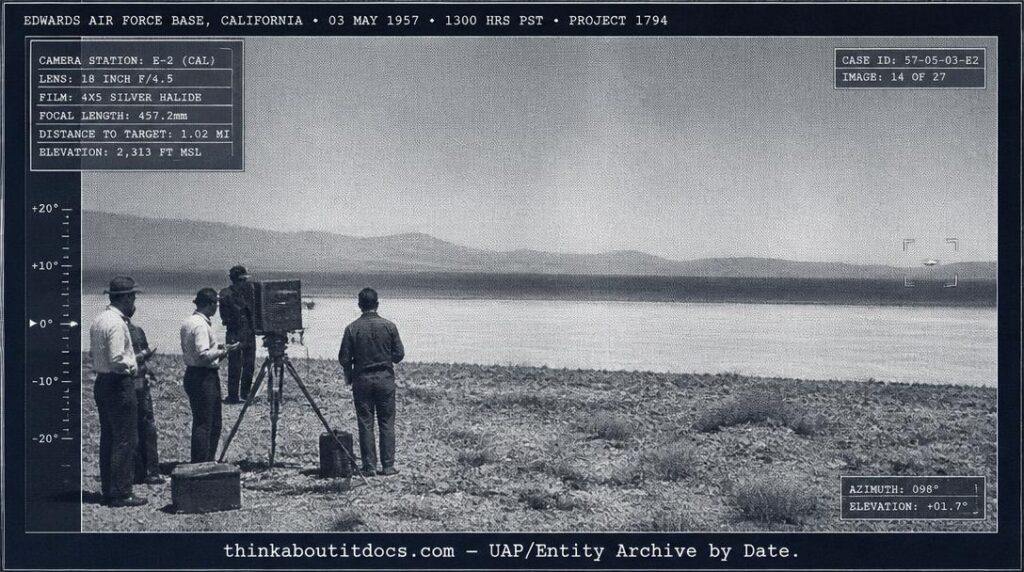
Archival-style rendering of the 1957 Edwards Air Force Base incident later described by astronaut Gordon Cooper, shown here consistent with the known distant calibration-camera equipment rather than the more dramatic close-range retelling.
THINK ABOUTIT UFO LANDING REPORT
1957: Astronaut Gordon Cooper Witnesses UFO Landing at Edwards AFB
In later interviews, Mercury astronaut Gordon Cooper described a saucer landing on the dry lake bed at Edwards Air Force Base in 1957, filmed up close by a professional camera crew who got within 20 to 30 yards of a shiny, 30-foot silver disc before it took off. It’s one of the most quoted UFO stories ever told by an astronaut. The verifiable version is considerably smaller: a single automated tracking camera photographed something unidentified from roughly a mile away during a routine precision-landing calibration test, Cooper forwarded the undeveloped film to Washington per standard procedure, and the film was never seen again. Cooper himself did not personally witness the object — only the developed photographs afterward — and even his own later account shifted in the retelling.
Editor’s Note: This site maintains a separate companion analysis, Gordon Cooper and UFOs — Sorting an Astronaut’s Claims by the Evidence, which tiers all of Cooper’s public UFO statements by evidentiary strength. That page rates this Edwards AFB story as the “medium claim”: intriguing but unconfirmed, with no film ever surfacing and Cooper’s own telling varying over time. This page focuses in depth on this specific 1957 incident; readers wanting the fuller picture of Cooper’s UFO claims, including his strongest (1951 Germany) and weakest (Bob Lazar endorsement, contactee associations) statements, should consult that companion page.
Date: May 3, 1957 (this site’s legacy field data listed only “1957”; the specific date is established in later research and corrected here)
Sighting Time: Undocumented
Day/Night: Day (daylight test operations)
Location: Dry lake bed, Edwards Air Force Base, California
Urban or Rural: Rural (desert military installation)
No. of Entity(s): Not Applicable
Entity Type: Not Applicable
Entity Description: Not Applicable
Hynek Classification: CE-II — Close Encounter of the Second Kind, per the claimed physical presence and landing gear traces; this classification rests entirely on Cooper’s secondhand retelling of photographic evidence rather than direct witness testimony, since Cooper did not personally observe the object and no independently examined photograph or film has ever been produced
Duration: Undocumented
No. of Object(s): 1
Description of the Object(s): Described in Cooper’s most detailed and most quoted retelling as a classic shiny silver saucer, smooth-surfaced, approximately 30 feet across, extending three landing-gear legs before touching down on the dry lake bed; contemporaneous technical accounts note the actual imaging equipment involved was a cinetheodolite or Askania-type calibration camera, a 35mm system shooting roughly one frame per second from a distance of about a mile, not a close-range professional film crew
Shape of Object(s): Saucer, shiny silver and smooth
Size of Object(s): Approximately 30 feet across (per Cooper’s retelling; not independently measured)
Distance to Object(s): Cooper’s later, most dramatic retelling claims a camera crew approached to within 20 to 30 yards; technical accounts of the actual test equipment in use describe a fixed tracking camera roughly a mile from the lake bed, a significant discrepancy between the two versions
Color of Object(s): Shiny silver
Number of Witnesses: Disputed. Cooper’s retelling describes a “camera crew,” later identified in other research as personnel named Bittick and Gettys; Cooper’s own role was limited to reviewing the developed film afterward, not direct observation
Special Features/Characteristics: Cooper stated he followed standard procedure and forwarded the undeveloped film to Washington after being instructed to do so by a superior officer; he claimed the developed footage, when briefly returned to him, matched the crew’s description exactly; when Project Blue Book was later established, Cooper says he mentioned the film, but it was never located; Cooper separately stated a belief that Blue Book itself was “strictly a cover-up.” Contradicting the dramatic retelling, Jack Acuff, then director of NICAP, stated in 1976 that Cooper had described the incident to him as consistent with a weather balloon, and Edwards AFB’s own contemporaneous public information office reportedly offered a mundane explanation (described elsewhere as involving high-altitude wind-borne debris) at the time.
Case Status: Insufficient Data — an intriguing but uncorroborated secondhand account, with no surviving film, a witness who did not personally observe the object, a substantial gap between the dramatic and the technical versions of the story, and evidence the witness himself offered a mundane explanation for it at least once
Source: Gordon Cooper, in later published interviews (this page’s quoted material is most commonly attributed in circulation to a version credited to journalist John Cooke); UFO Evidence archive; RationalWiki’s assessment of contemporaneous Edwards AFB technical records and Jack Acuff’s 1976 NICAP statement
Summary/Description: Astronaut Gordon Cooper, in later interviews, described a 1957 incident at Edwards Air Force Base in which a camera crew filming a precision-landing installation test spotted and filmed a shiny silver saucer landing on a dry lake bed, approaching to within 20 to 30 yards before it took off. Cooper said he forwarded the film to Washington per standard procedure and never saw it again. Independent research indicates the actual imaging equipment was a distant automated tracking camera rather than a close-range professional crew, and NICAP’s own director reported in 1976 that Cooper had at one point described the object as consistent with a weather balloon. No film has ever surfaced, and Cooper’s own account of the incident varied over the decades.
Related Cases: Gordon Cooper and UFOs — Sorting an Astronaut’s Claims by the Evidence (companion tiered analysis of all Cooper’s public UFO statements) | 1957: Gordon Cooper & UFOs: An Astronaut Speaks Out
Full Report
In 1957, Cooper was one of an elite band of test pilots at Edwards Air Force Base in California, in charge of several advanced projects, including the installation of a precision landing system. In his most frequently quoted retelling, he described the incident this way:
“I had a camera crew filming the installation when they spotted a saucer. They filmed it as it flew overhead, then hovered, extended three legs as landing gear, and slowly came down to land on a dry lake bed! These guys were all pro cameramen, so the picture quality was very good. The camera crew managed to get within 20 or 30 yards of it, filming all the time. It was a classic saucer, shiny silver and smooth, about 30 feet across. It was pretty clear it was an alien craft. As they approached closer it took off.”
Cooper said that when his camera crew handed over the film, he followed standard procedure and contacted Washington to report the object, and that “all heck broke loose.” According to Cooper, a high-ranking officer instructed him to place the developed film in a pouch and send it to Washington once processed, without specifying that Cooper himself should not view it first — which Cooper says he did anyway, finding the footage consistent with what the crew had reported. When the Air Force later established Project Blue Book to collate UFO evidence, Cooper says he raised the film, but it was never located; he offered his own view that “Blue Book was strictly a cover-up anyway.”
This dramatic version, however, sits in tension with two independent threads of evidence. First, technical accounts of Edwards AFB’s precision-landing test program from the period describe the imaging equipment as a cinetheodolite or Askania-type calibration camera — a 35mm system exposing roughly one frame per second, operated at a fixed position approximately a mile from the target area for engineering measurement purposes, not a mobile professional crew capable of approaching a landed object to within 20 or 30 yards. Second, Jack Acuff, director of NICAP, stated in 1976 that Cooper had personally described the object to him in terms consistent with a weather balloon, a version sharply at odds with the “clearly an alien craft” framing of Cooper’s later, more widely circulated retelling. Edwards AFB’s contemporaneous public information office is separately reported to have offered its own mundane explanation for the sighting at the time.
Cooper’s broader public statements on UFOs, including a 1978 written statement to the United Nations expressing his belief that some UFOs were extraterrestrial craft, are documented and consistent over many decades. His strongest personal claim, a 1951 multi-pilot sighting over Germany while flying F-86s, is treated separately and rated far more credible in this archive’s companion Cooper analysis. The Edwards AFB story, by contrast, is one Cooper did not personally witness firsthand and whose specific details, including the proximity of the camera crew and the certainty of its alien origin, appear to have grown more dramatic in Cooper’s later retellings relative to the more modest technical record and his own reported 1976 characterization of it.
RESEARCHER’S NOTES
The Edwards AFB Film — 1957 and the Growth of a Secondhand Story
- Cooper was not a firsthand witness. By his own account, Cooper did not see the object himself; he reviewed developed photographs after the fact and relayed what a camera crew reportedly told him. Every version of this story, however dramatically told in later interviews, is secondhand at its evidentiary core.
- The proximity claim conflicts with the known equipment. Cooper’s most quoted version has a professional crew approaching to within 20 to 30 yards. Contemporaneous technical descriptions of Edwards’ precision-landing test camera equipment describe a fixed, distant tracking camera roughly a mile away, built for engineering calibration rather than close-range documentary filming. These two descriptions cannot both be accurate as stated, and the discrepancy is a significant, checkable problem with the story’s most dramatic version.
- The witness’s own account shifted, including toward a mundane explanation. NICAP director Jack Acuff’s 1976 statement that Cooper described the object to him as consistent with a weather balloon is a direct, sourced contradiction of the “clearly an alien craft” framing that dominates Cooper’s later, more widely circulated retellings. A witness’s account changing meaningfully over time, including at one point toward a conventional explanation, is a material fact for evaluating the story’s reliability, not an incidental detail to smooth over.
- No film has ever surfaced, in any version. Every telling of this story, dramatic or modest, agrees on one point: whatever was recorded was sent to Washington and never seen again. Absent the film, absent independent witnesses willing to go on record, and absent a resolvable conflict between the dramatic and technical descriptions of the equipment involved, the case cannot rise above Insufficient Data no matter how credible Cooper’s broader reputation as an astronaut may be.
- Read this case alongside, not instead of, the fuller Cooper analysis. This site’s companion page on Cooper’s full body of UFO statements is essential context: it is precisely because Cooper’s 1951 Germany sighting is well-attested and multi-witness that his other, weaker claims deserve careful separate treatment rather than borrowed credibility. This Edwards AFB story belongs in that “intriguing but unconfirmed” middle tier, not alongside his strongest claim.
What can be established here is modest: an automated calibration camera at a military test range recorded something unidentified from roughly a mile away in 1957, the film was forwarded through official channels and never seen again, and the astronaut who told the story afterward gave at least two substantially different versions of it over the following decades, one dramatic and confident, another reportedly closer to a weather balloon. The gap between those two versions is the case, as much as the object itself.
“It was a classic saucer, shiny silver and smooth, about 30 feet across. It was pretty clear it was an alien craft.”
— Gordon Cooper, in his most widely circulated retelling of the 1957 Edwards AFB incident