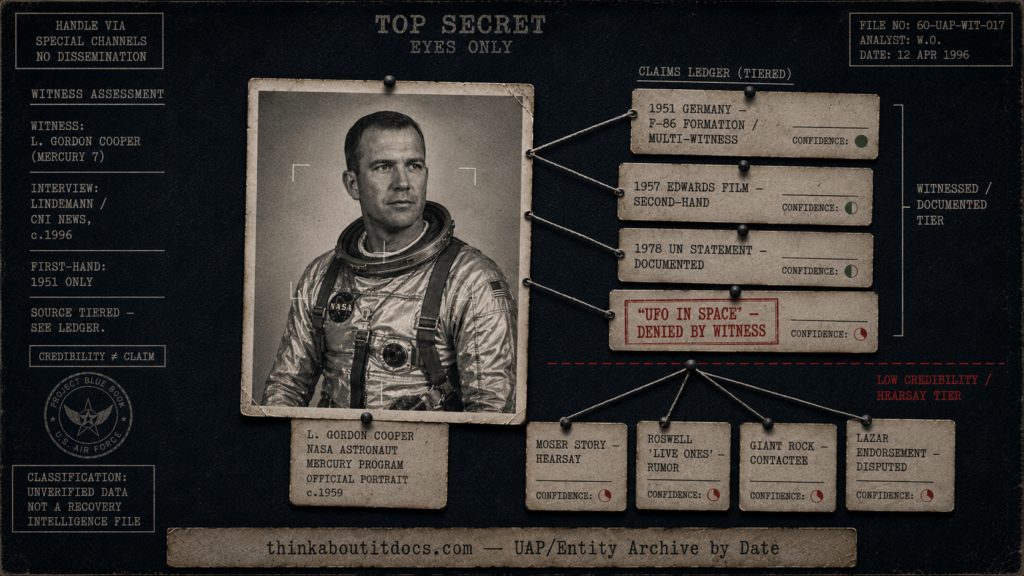
The Cooper file, tiered: a serious 1951 multi-pilot sighting at the top, hearsay and contactee lore at the bottom, and — in red — the in-space UFO myth he personally denied. Credibility of the witness is not credibility of every claim.
THINK ABOUTIT UFO|UAP SIGHTINGS ARTICLE
Gordon Cooper and UFOs — Sorting an Astronaut’s Claims by the Evidence
Gordon Cooper is the witness the UFO field most wants on its side — a Mercury Seven original, holder of an American orbital record, a “right stuff” aviator with nothing left to prove — and that is exactly why his case has to be read carefully rather than swallowed whole. Cooper believed, sincerely and for fifty years, that some UFOs were alien craft, and he said so to the United Nations. But the headline “an astronaut says aliens are here” flattens a man whose statements ranged from a genuinely serious multi-pilot sighting he witnessed himself to third-hand tales he simply passed along — and it buries the most newsworthy thing he ever said on the subject: that the famous story of an astronaut seeing a UFO in space, his own supposed Mercury sighting included, never happened. Sorting Cooper’s claims by what he actually saw versus what he was merely told is the whole task here.
The man, and why his word carried weight. Leroy Gordon Cooper Jr. (1927–2004) flew Mercury 9 in 1963 and Gemini 5 in 1965, was in line to command later missions before program cancellations and, by his own account, friction with NASA over his outspokenness intervened. He was not a fringe personality; he was an accomplished, technically literate test pilot. That credibility is real and it matters — but it attaches to Cooper the observer, not automatically to every story Cooper repeated.
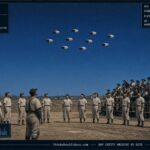
The strong claim — Germany, 1951. This is the core, and it is serious. Flying F-86s with the 86th Fighter-Bomber Wing over West Germany, Cooper and other pilots reported watching groups of metallic, saucer-shaped craft in formation at altitudes and speeds beyond their own aircraft, recurring over two or three days. He described disciplined formation flying and was certain, with his fellow pilots, that they were not looking at human technology. They reported it; the explanation relayed back was, absurdly, “high flying seed pods.” Cooper told this account consistently for half a century, including in his 1978 UN statement and his 2000 memoir. It is multi-witness, daylight, military, and internally stable — by far his best-supported claim, even though, like most such cases, it was never independently documented at the time and rests ultimately on the pilots’ testimony.
The on-record position — the UN, 1978. Cooper put his belief in writing to the United Nations during its 1978 UFO discussions, stating plainly that he believed unexplained craft were visiting from more advanced civilizations and urging a coordinated scientific program to study them. This is documented and authentic; it is the formal version of the conviction he held the rest of his life.
The myth he personally debunked — UFOs in space. Here is the detail the sensational framing obscures. Despite a persistent legend that Cooper saw a glowing UFO during his 1963 Mercury flight, Cooper repeatedly and emphatically denied it. Asked directly whether he ever saw anything otherworldly in orbit or near the Moon, his answer was no — nothing in space, nothing on the Moon, and as far as he knew, nothing seen by the other astronauts either. An honest archive entry should foreground this, because it is the rare instance of a believer-witness knocking down a story that flattered his own side.
The medium claim — Edwards AFB film, 1957. Often cited alongside the above (and covered separately in the archive), this is the account that on May 3, 1957, a camera crew setting up a precision-landing cinetheodolite on a dry lake bed at Edwards filmed a saucer; Cooper said he viewed the resulting photographs, forwarded them to the Pentagon, and never saw them again. It is intriguing but weaker than 1951: Cooper did not witness the object himself, only the imagery, and details of his telling shifted over the years. No film has ever surfaced.
The weak tier — hearsay, rumor, and contactee circles. The remainder of Cooper’s UFO statements, including much of the 1996 interview this page reproduced, belongs in a clearly separate and lower category, and conflating it with the 1951 sighting is precisely the error the archive exists to prevent:
- The “Moser” story — a tale that a rocket-scientist friend at White Sands in the mid-1950s secretly ferried library books to a human-looking alien who took five years to acclimate to Earth and then quietly became a businessman — is pure third-hand hearsay. Cooper never met the alleged visitor; he was repeating a deceased friend’s account, unverifiable in every particular. In form it is a classic 1950s contactee narrative.
- Roswell “live ones.” Cooper expressed a belief that bodies, even living occupants, had been recovered (not at Roswell but “better” sites). This was opinion and rumor, not first-hand knowledge.
- The Giant Rock rendezvous. Cooper described nearly attending a planned contact event around 1972–73 in the Mojave that fell through. Giant Rock was the site of George Van Tassel’s contactee conventions, and Cooper’s own memoir places associated figures in this orbit — notably Dan Fry, a documented 1950s contactee who claimed a 1950 ride aboard a saucer, and a business partner who claimed to receive telepathic transmissions from extraterrestrials. These are CONTACTEE associations and should be flagged as such.
- The Bob Lazar endorsement. Cooper allowed that Lazar’s story of reverse-engineering saucers at a secret Nevada base was “quite possibly” true. Lazar’s claims are unverified and widely disputed, including unresolved questions about his claimed academic credentials; Cooper’s endorsement adds belief, not evidence.
- The Holloman AFB landing rumor. Cooper thought it “perhaps” true. It remains an unverified rumor.
The synthesis. Cooper was a sincere and serious man, and his 1951 sighting deserves to be treated as a genuine, well-attested military UFO report. But sincerity and a distinguished résumé do not transfer evidential weight from a man’s own observations to the stories he repeats on others’ authority. The single most important thing this page can do is refuse to let “Mercury astronaut” lend the Moser tale or the Lazar endorsement the same standing as the thing Cooper actually saw over Germany — and to keep faith with Cooper’s own honesty by recording that, on the question of UFOs in space, he told the truth and said no.
Claims Ledger
1951 — Germany, F-86 formation sighting Source: Cooper, first-hand; UN statement (1978); memoir Leap of Faith (2000) Status: Best-supported claim — multiple military witnesses, daylight, recurring; never independently documented at the time
1957 — Edwards AFB saucer film Source: Cooper, second-hand (viewed photos only); crew named as Bittick and Gettys Status: Intriguing but unconfirmed; no film extant; Cooper’s account varied over time
1978 — UN letter/statement Source: Cooper, documented public record Status: Authentic statement of belief (not itself a sighting)
“UFO in space” during Mercury flight Source: Persistent media legend Status: FALSE — explicitly and repeatedly denied by Cooper himself
“Moser” acclimated-alien-businessman story Source: Cooper relaying a deceased friend’s account (third-hand) Status: Unverifiable hearsay; contactee-genre narrative
Roswell “live ones” / recovered bodies Source: Cooper, opinion/rumor (not first-hand) Status: Unverified
Giant Rock contactee rendezvous (c. 1972–73) Source: Cooper; memoir (associated with Dan Fry, a documented contactee, and a telepathic-contact claimant) Status: CONTACTEE association; event reportedly canceled; no encounter occurred
Bob Lazar / Area 51 reverse-engineering Source: Cooper endorsing Lazar’s claims Status: Lazar’s claims unverified and widely disputed; endorsement only
Holloman AFB landing Source: Cooper, “perhaps” true Status: Unverified rumor
Researcher’s Notes
The Right Stuff and the Wrong Tier — Gordon Cooper and the Credibility-Transfer Problem
- Witness credibility is not claim credibility: Cooper’s standing as a Mercury Seven astronaut is genuine and earns his first-hand observations a serious hearing — but credibility attaches to the observer, not to the category “things this observer said.” The page’s central analytical job is to separate what Cooper witnessed (1951 Germany) from what he merely relayed (Moser, Roswell “live ones,” Lazar). Collapsing those into a single “astronaut confirms aliens” headline is exactly the move that turns a credible witness into a vector for uncorroborated lore.
- The in-space denial belongs at the top, not buried: The most under-reported fact in the Cooper file is that he debunked the very myth most often attached to his name — the astronaut-sees-UFO-in-orbit story. He said he saw nothing in space or on the Moon. Foregrounding this is both accurate and a credibility marker for Cooper himself: he declined to claim the sensational thing that would have served his own beliefs.
- Contactee flags and discredited endorsements: Cooper’s later associations run through the contactee world — Giant Rock (George Van Tassel’s convention site) and, per his memoir, the contactee Dan Fry and a telepathic-contact claimant. These warrant the same CONTACTEE flag the archive applies to Adamski- and Menger-type material. Likewise, his endorsement of Bob Lazar should be recorded with the standing caveat that Lazar’s claims are unverified and widely disputed. Belief expressed by a credible person is still belief, not corroboration.
The record’s honest final position is that Gordon Cooper was a credible man who made one credible claim and a number of far weaker ones, and that telling them apart honors him better than lumping them together does. His 1951 formation sighting over Germany is a real, multi-witness military report worth its place in the record. His UN statement is an authentic declaration of belief. His flat denial of any in-space sighting is, if anything, the most trustworthy thing he said, precisely because it cost his own side a favorite story. The rest — the acclimating-alien businessman, the recovered “live ones,” the Giant Rock contactee circle, the Lazar endorsement — is hearsay, rumor, and contactee lore that a Mercury astronaut’s name cannot upgrade into evidence. The archive keeps Cooper, with respect, exactly as he was: a serious witness to one thing and a sincere repeater of many others, with the line between the two drawn clearly enough that no reader leaves believing an astronaut confirmed what he only ever passed along.