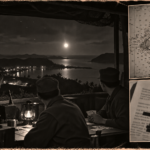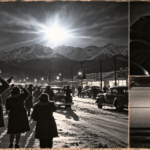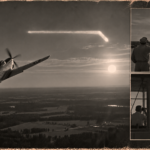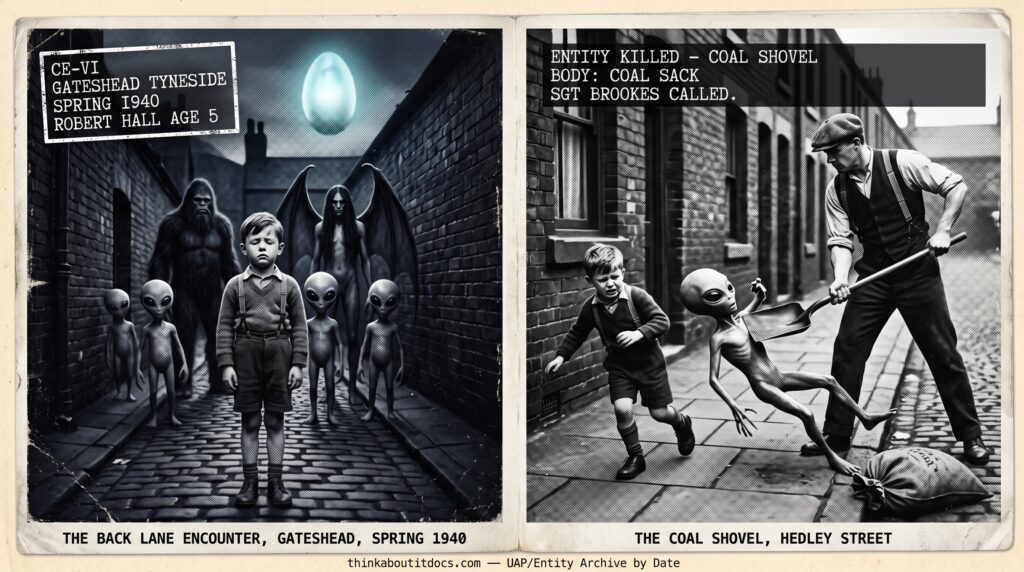
Gateshead, Tyneside, England, Spring 1940 — five-year-old Robert Hall is examined by multiple entities in a back lane, blood taken from the back of his neck. Next day: MIB visit with a warning. Days later: a grey alien grabs him off the street. Uncle Ernie kills it with a coal shovel. Sergeant Brookes is called. The Army takes the body to a local church. Robert told this story for 70 years. Investigated by Richard Hall, richplanet.net (2008) — street names and Sgt Brookes confirmed. Source: Gavin Havery, The Northern Echo, June 24, 2011. Case Status: Insufficient Data. thinkaboutitdocs.com.
THINK ABOUTIT UFO | UAP | ENTITY ENCOUNTER REPORT
1940: The Alien Killed With a Coal Shovel
On a sunny spring morning in 1940, five-year-old Robert Hall was playing in the maze of red-brick Tyneside terraces near Saltwell Road in Gateshead when he decided to head home to Hedley Street. He had already seen something whizzing about in the sky earlier that day, but thought nothing of it — soldiers were marching south along the road toward Low Fell, and the world was at war. What was waiting for him in the back lane was something else entirely. Robert later described a group of beings of radically different appearances: three built like men but ranging from two to four feet tall, one resembling Bigfoot, another with long flowing hair and a coat partially covering a skeletal frame with bat wings. They spoke to him in perfect unaccented English, told him they wanted to examine him, and when he shut his eyes in terror they took what he described as blood from the back of his neck and applied a jelly to the puncture. He was allowed to leave after twenty minutes. The next day, two men in black suits came to the house and told him that if he said anything, he would disappear. A few days after that, a grey alien with a large head and big eyes grabbed him off the street. His Uncle Ernie saw what was happening and bashed its head in with a coal shovel. The body was put in a coal sack. Robert was sent to find Sergeant Brookes. The Army came and took the body to a church. Robert Hall, then 76 years old, told this story to The Northern Echo in 2011 — the same story he had been telling all his life.
Date: Spring 1940
Sighting Time: Late morning — after playing with friends, heading home
Day/Night: Day — described as a sunny spring day
Location: Saltwell Road / Hedley Street back lane, Gateshead, Tyne and Wear, England
Urban or Rural: Urban — wartime working-class Tyneside terrace housing, near railway tracks
No. of Entity(‘s): Multiple (at least 6 distinct beings across two incidents)
Entity Type: Grey (primary); mixed entity types (initial back-lane encounter)
Entity Description: Initial encounter — group of beings of widely different appearances: three built like men, ranging from 2 to 4 feet tall; one resembling Bigfoot; one with long flowing hair and coat partially covering a skeletal body with bat wings. All spoke perfect unaccented English. Carried a short white hand-held device capable of subduing or immobilizing. Second incident (attempted abduction) — a grey alien fitting the standard description: large head, big eyes, grey skin.
Hynek Classification: CE-VI — Close Encounter of the Sixth Kind (death of an entity associated with a UAP/entity encounter, as documented in this case by the coal shovel killing). Note: CE-VI is a post-Hynek classification extension; the standard Hynek scale ends at CE-IV. The CE-VI designation is retained as used on the page for consistency but should be noted as an extended-scale classification.
Duration: Approximately 20 minutes (initial encounter); brief (attempted abduction)
No. of Object(s): 1
Description of the Object(s): “A big egg-shaped thing surrounded by bright light.” No further structural detail recorded.
Shape of Object(s): Egg-shaped
Size of Object(s): Not recorded
Color of Object(s): Bright light surrounding the craft
Distance to Object(s): In the back lane — close proximity
Height & Speed: Seen whizzing about in the sky earlier in the day; on the ground or very low in the back lane during the encounter
Number of Witnesses: Robert Hall (age 5, primary witness); other children present during initial encounter (fled, some injured on barbed wire at the railway fence); Uncle Ernie (witnessed and intervened in the second incident); Sergeant Brookes (called to the scene)
Special Features/Characteristics: Perfect unaccented English spoken by entities; blood extraction from back of neck; jelly applied to puncture site; triangular marks on Robert’s left cheek persisting until age 12–13; MIB visit the following day with explicit warning; second incident days later — attempted abduction of Robert; entity killed with coal shovel by Uncle Ernie; body placed in coal sack; Army retrieval to a church; Richard Hall (richplanet.net) conducted three-month investigation in 2008, verified street and shop names, confirmed existence of Sgt Brookes in the area at the time
Case Status: Insufficient Data
Source: Gavin Havery, The Northern Echo, June 24, 2011; Richard Hall, richplanet.net / The Rich Planet Starship (Sky channel 201)
Summary/Description: Five-year-old Robert Hall encountered multiple entities of varied appearance in a Gateshead back lane in spring 1940 while soldiers marched past on Saltwell Road. The beings — some man-sized but 2–4 feet tall, one Bigfoot-like, one with bat wings — spoke perfect English, examined him, extracted what appeared to be blood from his neck, and applied jelly to the site. A second incident days later involved a grey alien attempting to grab him from the street; his Uncle Ernie intervened with a coal shovel. The body was collected by the Army and taken to a church. MIB visited the family the following day. Triangular marks appeared on Robert’s cheek and persisted for several years. Source: Robert Hall’s 70-year consistent testimony, investigated by Richard Hall (richplanet.net, 2008), reported by The Northern Echo (2011).
Related Cases: 1938 Sydney Australia CE-IV black-clad figures at bedside | 1939 Karelia Finland angel entities | 1941 Cape Girardeau Missouri crash retrieval | 1947 Roswell Army retrieval parallel
Detailed Report
The Gateshead case of spring 1940 is one of the most structurally unusual pre-modern entity encounters in the British record. It is sourced to a 2011 newspaper account of a 76-year-old man’s testimony, investigated by a regional paranormal broadcaster, and it contains elements — extreme entity variety, MIB follow-up, Army retrieval, physical marks — that have no parallel in the pre-modern British archive and are more characteristic of the post-1947 American literature. These facts require honest assessment alongside the case’s equally notable credibility indicators.
Robert Hall’s testimony has three properties that distinguish it from fabricated or attention-seeking accounts. First, consistency: he has told the same story from childhood, enduring decades of mockery from teachers, peers, and family. The Northern Echo’s description of his telling — earnest, sincere, specific, with the anger of a man who spent his life being disbelieved — is consistent with genuine experience. Second, specificity: the street names, the back lane geography, the barbed wire at the railway fence, Sergeant Brookes’s existence and area assignment — all verified by Richard Hall’s 2008 three-month investigation. These are not generalized narrative details. They are precise geographic and institutional anchors in a specific wartime Tyneside landscape. Third, the wartime context: soldiers marching south toward Low Fell, the awareness of the war with Germany — these are authentic contextual details for Gateshead in spring 1940 that a five-year-old would register and retain.
The entity description is the case’s most analytically challenging element. A group of beings that includes man-sized 2–4 foot humanoids, a Bigfoot-type entity, and a skeletal bat-winged figure represents a degree of entity type variety without parallel in the pre-modern record. The standard explanation — that a child’s terrified perception of a group of entities produced a fragmented and partially confabulated description — is plausible. The alternative — that the 1940 phenomenon genuinely deployed beings of wildly different physical types in the same location simultaneously — is consistent with a handful of other multi-entity-type cases in the archive but requires more credible sourcing than a single 70-year-old recollection to establish. The grey alien of the second incident is structurally consistent with the post-war grey literature but predates it by seven years.
The coal shovel death is the case’s most extraordinary element and the one that generated the CE-VI classification. If an entity was killed with a coal shovel, collected in a coal sack, and handed to Sergeant Brookes who then called the Army who transported it to a church — that is the earliest documented entity retrieval event in the British record. Richard Hall of richplanet.net, a regional UAP broadcaster, confirmed that Sgt Brookes was a real officer working the area at the time. The Army retrieval to a church has not been independently documented. The body is not known to have been subsequently recorded in any British military archive. The story rests entirely on Robert Hall’s testimony and on the secondary confirmation of verifiable peripheral details.
The source — a regional newspaper feature article by a named journalist, published 71 years after the event — is not a field research publication. It is the record of a single witness’s account, filtered through a journalist and a paranormal broadcaster. The case is retained as Insufficient Data: the testimony is consistent, the witness is credible in manner and longevity of account, and the verifiable details check out. What cannot be established from available sources is whether the entities, the coal shovel death, the MIB visit, or the Army retrieval occurred as described.
RESEARCHER’S NOTES
The Coal Sack on Hedley Street — Gateshead 1940 and the Pre-Modern British Entity Record
- Source Chain Assessment: The Northern Echo is a legitimate regional British newspaper. Gavin Havery is a named staff journalist. The article is dated June 24, 2011, and reports Robert Hall’s testimony as an elderly witness in a television documentary context. Richard Hall’s three-month investigation (2008) is a secondary corroboration layer — he is a named researcher who verified peripheral details but is not a BUFORA, MUFON, or NICAP-tier organization. The case carries the source weight of a regional newspaper feature with three months of background investigation, not a field-research database entry.
- The MIB Element: The Men in Black visit the following day — two men in black suits threatening Robert’s family with disappearance if he spoke — is a standard MIB trope that does not appear in the British UAP record until the post-war period and is heavily associated with American contactee and abduction literature from the 1950s onward. Its presence in a 1940 Gateshead case is either an authentic early occurrence of institutional suppression behavior or a retrospective contamination of the account by the post-war MIB mythology. Given Robert’s lifelong consistency in telling the story, this cannot be resolved.
- The Entity Variety Problem: The simultaneous presence of man-shaped 2–4 foot beings, a Bigfoot-type, and a bat-winged skeletal figure in the same back lane is unprecedented in the pre-modern British record. Three possibilities: the entities were genuinely of mixed type; a terrified five-year-old’s perception fragmented into multiple categories; or the account incorporated later cultural additions (Bigfoot entered British popular culture in the 1960s–70s) during decades of retelling. The bat-winged skeletal figure has pre-modern parallels in the 1938 Provincetown Cape Cod entity cluster (Citro) and the 1909 New Jersey Devil revival. The Bigfoot element is the most temporally suspicious — it was not a common British cultural reference in 1940.
- The Coal Shovel as Physical Intervention: The case’s most historically significant element — Uncle Ernie’s coal shovel killing of the grey alien — is also its most unverifiable. If accurate, it documents a physical confrontation resulting in an entity death and subsequent Army retrieval in spring 1940, seven years before Roswell and four years before the earliest documented post-war British entity encounter. The church where the Army supposedly deposited the body has not been identified. No British military or ecclesiastical archive has produced a corroborating record. The coal sack is the archive’s most tantalizing loose end.
Robert Hall told the same story from the age of five until he was 76, through decades of schoolyard mockery and adult dismissal, and he told it to The Northern Echo with the specificity of a man who was there: the barbed wire on the railway fence cutting the other children, the jelly on the back of his neck, Uncle Ernie’s coal shovel, the body going into the coal sack, Sergeant Brookes coming, the Army taking it to a church. Richard Hall checked the street names, found Sergeant Brookes in the records. The Northern Echo printed it on June 24, 2011. The body — if there was a body — has been in some British institutional custody for eighty-four years. Robert’s triangular marks were gone by the time he was thirteen. Case Status: Insufficient Data. He said he would take it to his grave, and he probably did.