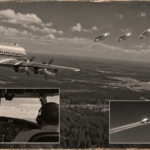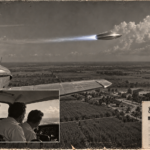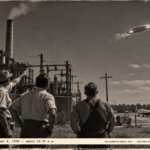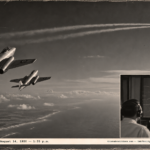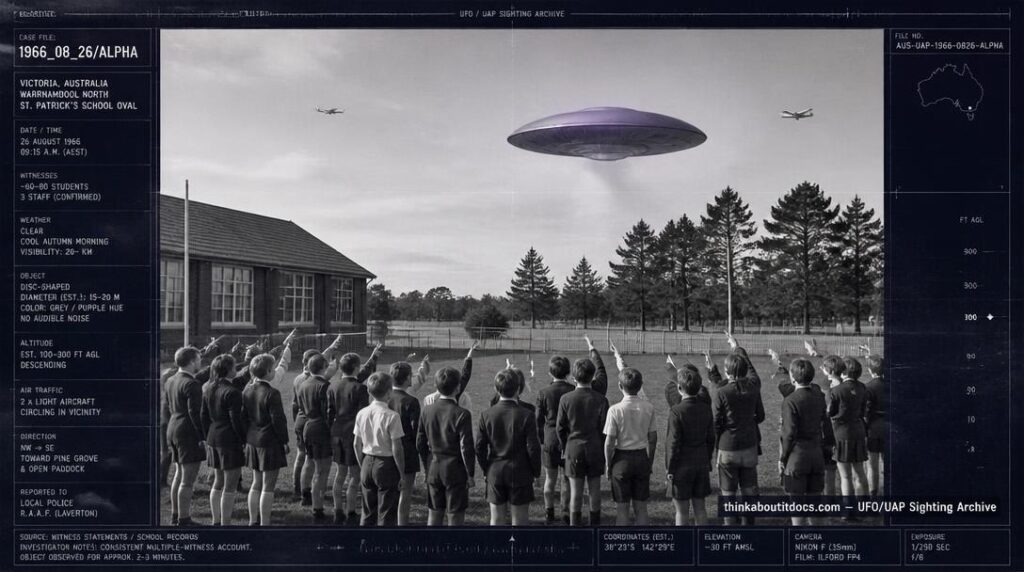
More than 200 students and teachers at Westall High School and Westall State School witnessed a saucer-shaped object descend into a nearby paddock, April 6, 1966.
THINK ABOUTIT ENCOUNTER REPORT
The 1966 Westall UFO Encounter: Australia’s Largest Mass UFO Sighting
Just before 11 a.m. on April 6, 1966, more than 200 students and teachers at two adjoining Melbourne schools watched a grey, saucer-shaped object descend into a nearby paddock, then climb away at speed pursued by five unidentified light aircraft. It remains the largest mass UFO sighting in Australian history — and one of the few where witnesses have consistently described being visited afterward by officials who told them not to talk about what they saw.
Date: April 6, 1966
Sighting Time: Approximately 11:00 a.m.
Day/Night: Day
Location: Westall High School and Westall State School, Clayton South, Melbourne, Victoria, Australia; object
descended into a paddock at The Grange (now a nature reserve)
Urban or Rural: Suburban school grounds and adjoining open paddock
No. of Entity(‘s): None documented
Entity Type: None documented
Entity Description: None documented
Hynek Classification: CE-II (Close Encounter II) — upgraded from the source material’s original DD. Witnesses reported the object descending out of sight into the paddock, consistent with a landing or very low hover, followed by one to three circular ground patches found at the site afterward — a documented physical trace, which is the defining feature of CE-II rather than a simple daylight disc sighting
Duration: Approximately 20 minutes
No. of Object(s): One primary object is described in the main site record; some individual witness accounts over the decades have described additional objects or the pursuing aircraft in varying numbers, but the core, most consistent account centers on a single primary object
Description of the Object(s): A grey, saucer-shaped object with a slight purple hue, roughly twice the size of a family car; science teacher Andrew Greenwood separately described it in contemporary press coverage as a silvery-green disc — a witness-description variation typical of large mass sightings rather than a contradiction in the core account
Shape of Object(s): Saucer-shaped
Size of Object(s): Approximately twice the size of a family car
Color of Object(s): Grey with a slight purple hue (alternatively described by one witness as silvery-green)
Distance to Object(s): Not documented in numeric terms; object was close enough to be watched crossing directly over the school and descending into an adjoining paddock
Number of Witnesses: More than 200, including students and staff at both Westall High School and the adjoining Westall State School
Special Features/Characteristics: The object was reportedly pursued by five unidentified light aircraft as it climbed away; one to three circular patches were found in the paddock grass after the object departed; uniformed personnel, believed by witnesses to be police and military, were reported attending the site afterward, taking measurements, and reportedly burning or turning over the affected ground; multiple witnesses, including teacher Andrew Greenwood, have described being visited afterward by officials who instructed them not to discuss the event, with Greenwood specifically reporting he was threatened under the Official Secrets Act and warned he would be discredited through rumors of alcoholism if he spoke out; some students reported being disciplined for discussing the incident; contemporary press coverage was inconsistent, with the broadsheet Age running a small story and the tabloid Sun News-Pictorial, which would ordinarily be expected to cover such a story, running none
Case Status: Unexplained — extensively investigated over more than five years by researcher Shane Ryan, who located and interviewed more than 110 witnesses; no official military or government record of the incident or any response to it has ever been located; the leading proposed explanation (a stray high-altitude balloon) has been directly disputed by individuals involved in the balloon program it is attributed to, and by wind-pattern analysis inconsistent with a balloon reaching the site from its claimed launch point
Source: The Dandenong Journal, April 14 and April 21, 1966; The Age, April 7, 1966; Shane Ryan and Rosie Jones, “Westall ’66: A Suburban UFO Mystery” (documentary, 2011); ongoing research by Shane Ryan
Summary/Description: More than 200 students and teachers at Westall High School and Westall State School in Clayton South, Melbourne watched a grey, saucer-shaped object descend into a nearby paddock and remain for roughly 20 minutes before climbing away at speed, pursued by five unidentified aircraft. Witnesses reported ground traces at the site and described being visited and warned into silence by officials afterward. It remains the largest and most extensively documented mass UFO sighting in Australian history.
Related Cases: None documented on this site — occurred four days after the widely discussed 1966 Balwyn UFO photograph, taken in a nearby Melbourne suburb by a witness who was a member of the same UFO research society that received the first report of this incident
Detailed Report

The Dandenong Journal, April 14, 1966 — one of the first detailed press accounts of the Westall incident.
At approximately 11:00 a.m. on Wednesday, April 6, 1966, a class of students and a teacher at Westall High School in Clayton South, Melbourne, were finishing sports on the school’s main oval when a grey, saucer-shaped object with a slight purple hue, roughly twice the size of a family car, was seen descending in the sky. Science teacher Andrew Greenwood, who witnessed the object directly, later described it to the Dandenong Journal as a silvery-green disc. The object crossed over the school’s south-west corner, moving in a south-easterly direction, before disappearing from view behind a stand of trees as it descended into a paddock at The Grange, directly in front of the adjoining Westall State School, where primary-aged students were also present.
Over the roughly 20 minutes that followed, the number of witnesses grew to more than 200 as students and staff from both schools gathered to watch. The object then climbed rapidly and departed toward the north-west, with some accounts describing it as pursued from the scene by five unidentified light aircraft that circled the object as it ascended. The origin of these aircraft, like the object itself, was never officially resolved.
Shortly after the object departed, witnesses reported finding one to three circular patches in the paddock grass. Uniformed personnel, believed by those present to be police and military, including air force personnel according to some accounts, were reported attending the site afterward. Witnesses described these personnel taking measurements at the site, and some reported the affected ground was subsequently burned or turned over. Several witnesses, including staff, reported being personally spoken to or later visited by these officials.
Teacher Andrew Greenwood gave one of the most specific accounts of what followed: he reported being visited at his home by officers who invoked the Official Secrets Act, threatening that he would be fired and discredited through rumors of alcoholism if he spoke publicly about what he had seen. Teacher Joy Tighe, who also witnessed the object and described it as a metallic craft, separately reported being interviewed by government or military personnel after the event. Some students reported being disciplined by school authorities for discussing the incident afterward.

The Dandenong Journal’s second front-page story on the incident, April 21, 1966.
Press coverage of the event was notably uneven. The Dandenong Journal, a local paper, ran two detailed front-page stories, on April 14 and April 21, 1966. The broadsheet Age published a small item on April 7, under the headline suggesting the object was “Perhaps Balloon,” reporting that hundreds of children and several teachers had watched the object, that light aircraft had circled it, and that a weather balloon released from Laverton that morning could theoretically have drifted into the area on the prevailing wind. The article noted that a check found no commercial, private, or RAAF pilots had reported anything unusual in the area at the time. Notably, the Sun News-Pictorial, a tabloid that would ordinarily be expected to cover a story of this nature prominently, ran nothing on the incident at all, while both the Sun and the Herald published cartoons mocking flying saucer reports generally in the days that followed.
The Matthews Account and the 2005 Follow-Up Investigation
Ahead of the incident’s 40th anniversary, University of Canberra English lecturer Shane Ryan — first alerted to the case in the 1980s by a housemate who had witnessed it — began an extensive research effort, ultimately interviewing around 30 witnesses in the case’s early stages (and more than 110 by the time of his later documentary work). Speaking to The Sunday Age in October 2005, Ryan noted that unlike many UFO reports, Westall involved a large number of credible witnesses, was observed in daylight, and drew a forceful response from police and the RAAF — factors he felt gave the case real substance.
Ryan’s research turned up one of the closest-range accounts of the object: Shaun Matthews, not a Westall student but a boy whose family leased land for horses at Grange Reserve, was on the property at the time. He described watching the object cross the horizon and drop down behind the pine trees, departing again “very very rapidly” a short time later. He estimated the object passed him at a distance of roughly four football fields, describing it as about the size of two family cars, silvery with a purple hue, bright but not painfully so.
Matthews went to the site afterward and found a circle in the clearing. Critically, his description of the ground differed from the more commonly repeated “scorched” characterization: he described it as looking “cooked or boiled,” not burnt. He recalled a crowd of students from both Westall schools arriving shortly after to see what had happened. He also stated that police and other officials interviewed his mother — but he could not confirm the commonly repeated claim that officials later burned the landing site, and he did not personally see light aircraft trailing the object, both details other witnesses have reported. Matthews was firm that the object’s flight behavior ruled out conventional explanations in his view: it did not cruise and gradually descend at an angle, as an aircraft or helicopter would, but rather approached, stopped abruptly, dropped straight down, paused, and then shot straight back up.
VUFORS secretary Tony Cook, commenting for the same 2005 article, described Westall as one of Australia’s major unexplained cases, second in the society’s estimation only to the 1978 Valentich disappearance. Cook characterized VUFORS’s general position as accepting that people do see unexplained things in the sky, while cautioning that concluding those things are extraterrestrial “is a very big leap.” Steve Roberts of Australian Skeptics offered a competing view, suggesting the object may have been an experimental, Earth-based aircraft, and noting that witness accounts of the landing itself were inconsistent — some describing an object that landed and took off, others describing one that simply hovered over the paddock. Roberts also argued that if officials genuinely investigated the site as extensively as reported, a report should logically exist somewhere in RAAF archives. Ryan responded that the RAAF has stated it holds no record of the incident at all — a fact Ryan considered unsurprising given how immediately and forcefully students and staff were instructed not to discuss the event.
Researcher’s Notes
The Westall Incident — 1966 and an Official Explanation That Its Own Program Staff Have Disputed
- This is a CE-II case, not simply DD. The object was reported descending out of sight into the paddock — consistent with landing or hovering very close to the ground — and physical ground traces were documented afterward. That combination of close-range descent and a resulting physical trace is what defines CE-II, and it’s a more accurate classification than the original DD label, which better fits a simple distant daylight sighting.
- The weather balloon explanation has real, specific problems. Wind-pattern analysis of the day in question does not support a balloon released at Laverton drifting to the Westall site. No balloon or its equipment was ever reported collected or identified at the scene, despite the explanation requiring exactly that outcome. And when a later, more specific version of this theory named the HIBAL high-altitude balloon program as the source, a scientist who worked directly on that program described a different 1968 Sydney incident as the “most famous” UFO-linked HIBAL event in his own memoir — not Westall — while another named HIBAL team member has explicitly stated no HIBAL balloon was involved in the Westall case at all.
- The witness intimidation accounts are specific, named, and consistent. This isn’t a vague claim of “government suppression” — Andrew Greenwood’s account names a specific legal threat (the Official Secrets Act) and a specific discrediting tactic (rumors of alcoholism), reported directly by a named, credentialed witness. Combined with separate, independent accounts from other staff of being visited and warned, this pattern of specific, named intimidation claims is unusual and difficult to dismiss as simple mass-sighting embellishment.
- More than five years of dedicated investigation has not produced an official record. Researcher Shane Ryan’s location and interview of more than 110 individual witnesses is a rare level of documentation for a UFO case of this age. That no official military or government record of the incident, or any response to it, has ever surfaced — despite the scale of the event and the number of witnesses — is itself a significant and unresolved feature of the case.
- Witness description variation (grey-purple vs. silvery-green) is normal for a mass sighting, not a red flag. Large numbers of witnesses viewing an object from different angles, distances, and lighting conditions routinely produce varying color and detail descriptions. This kind of minor variation is expected in a genuine mass-witness event and shouldn’t be read as evidence against the core account, which remains highly consistent on the object’s shape, behavior, and the paddock landing.
- Shaun Matthews’s account is valuable precisely because it disagrees with other witnesses on specific points. Rather than simply reinforcing the popular version of events, Matthews explicitly disputed the claim that officials burned the landing site and stated he did not see the trailing aircraft other witnesses described. A witness willing to contradict the more dramatic elements of a well-known story, while still firmly maintaining the core sighting, is more credible than one whose account simply confirms every popular detail.
- The “cooked or boiled” ground description is a meaningfully different claim from “scorched,” and both should be preserved rather than flattened into one term. “Scorched” implies heat and fire; “cooked or boiled, not burnt,” as Matthews specifically distinguished it, suggests a different physical process entirely. Treating all ground-trace descriptions as interchangeable would obscure a genuine, specific discrepancy in the case’s physical evidence.
- The skeptical case deserves fair representation alongside the unexplained framing. Australian Skeptics’ Steve Roberts raised two specific, reasonable points: that witness accounts of the landing itself are inconsistent (some describe a landing and takeoff, others only a hover), and that a genuinely large official investigation should logically have left some trace in RAAF records. Both are fair challenges. Ryan’s response — that the RAAF holds no record at all — doesn’t resolve the discrepancy Roberts raises so much as deepen the case’s central mystery: either the investigation was real and its records have been lost or withheld, or the “officials on site” element of the story has itself been exaggerated in the retelling.
The Westall incident endures as Australia’s most significant mass UFO sighting not simply because of the number of witnesses, but because of the unusual, specific, and consistent pattern of official intimidation reported afterward — a detail that sets it apart from most sightings and one that more than five decades of investigation has never resolved.
“It was so unusual.”
— witness account, as recorded by researcher Shane Ryan