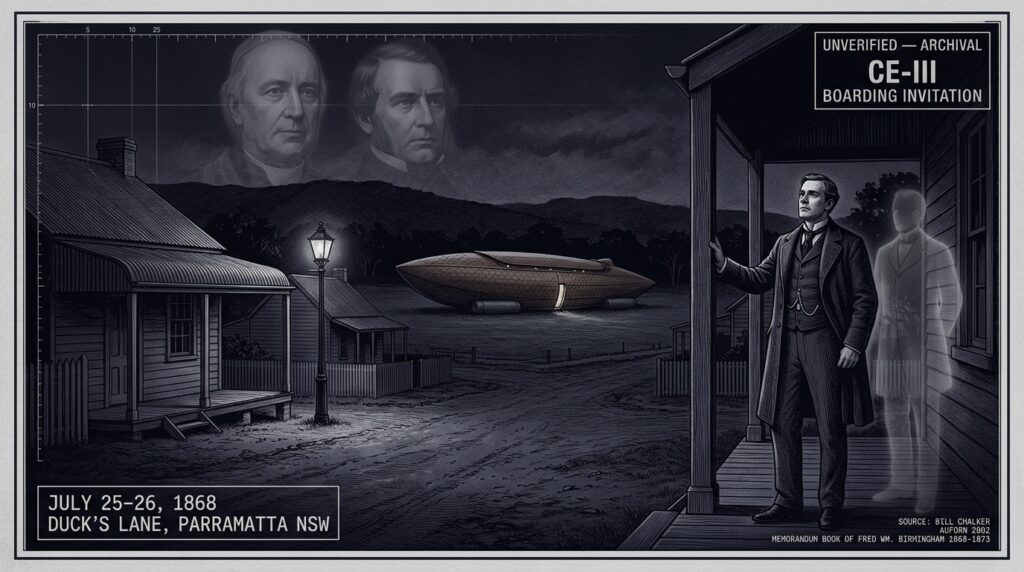
Duck's Lane, Parramatta, New South Wales — July 25–26, 1868. Surveyor Fred Birmingham observes a large ark-shaped aerial machine descend and land in Parramatta Park, accompanied by a spirit entity who invites him aboard. Engineering formulae shown to him in the craft's pilot room were found the following year on page 137 of Molesworth's Engineering Tables — a book he had not previously read. Forty-four years later, Australia's first licensed pilot landed at the same location.
THINK ABOUTIT UFO|UAP ENTITY ENCOUNTER REPORT
1868: Australia’s UFO Buzz
In the winter of 1868, a Parramatta surveyor named Fred Birmingham stood on the veranda of his rented cottage in Duck’s Lane and watched floating heads move across the New South Wales sky — the Lord Bishop of Sydney, the Premier, their faces drifting and fading like a telescope being racked in and out of focus. Then the heads were gone and in their place: an ark. A machine. Moving in a zigzag through the air before descending twenty feet as gently as a feather and coming to rest twenty yards from where he stood. A voice behind him — a spirit, neutral-tinted, man-shaped but not solid — said simply: “That’s a machine to go through the air.” Birmingham was invited aboard, levitated gently onto the upper deck, shown two cylinders at fore and aft, led down steep steps into a pilot’s room where a table covered in oilskin-like material held papers printed with engineering formulae and figures. He was told the information was absolutely necessary, that he should study it as he went on. Then he was alone in the ark. Then he was awake. The year 1868 was his most miserable year — fever, rheumatism, lumbago. In 1869, opening Molesworth’s Engineering Tables for the first time, he found the exact formulae on page 137, in connection with centrifugal pumps. He had never seen the book before.
Date: July 25–26, 1868
Sighting Time: Night — during sleep/hypnagogic state, transitioning to apparent waking observation
Day/Night: Night
Location: Duck’s Lane, Parramatta, New South Wales, Australia (close to what is now the geographical heart of Sydney)
Urban or Rural: Urban fringe — colonial township
No. of Entity(‘s): 1
Entity Type: Spirit / non-corporeal humanoid
Entity Description: Described as “a neutral tint shade and the shape of a man in his usual frock dress” — not solid, semi-transparent, humanoid form in period Victorian frock coat; voice clear and deliberate; capable of levitating witness; demonstrated craft functions by hand gesture; provided printed engineering documents; disappeared without explanation
Hynek Classification: CE-III (Close Encounter III) — close observation with animate being associated with the object; boarding and interior tour of craft
Duration: Extended — initial vision indeterminate duration; craft landing and boarding sequence estimated several minutes; follow-up experiences span 1868–1873
No. of Object(s): 1 (plus secondary cloud-based object observed March 9, 1873)
Description of the Object(s): Large ark-shaped aerial vessel; brown overall at distance with faint flitting shades of steel blue below; surface tremulous and scale-like resembling a large fish flying through the air; not the shape of anything living; divided into compartments; moved in zigzag pattern before descending; two cylinders fore and aft; pilot room approximately 3.5 feet below deck level; walls extremely thick — approximately 6 inches; table covered in oilskin or iron with rubber cloth; everything described as very strong; spartan interior with no additional furnishings
Shape of Object(s): Ark/vessel shape — elongated, described as resembling an ocean-going ship; not organic in form
Size of Object(s): Large — comparable to a vessel; pilot room approximately 5 x 3.5 feet interior; exact external dimensions not recorded
Color of Object(s): Brown overall at distance; faint steel blue shades below; surface texture described as magnified fish scales
Distance to Object(s): Approximately 20 yards (18 meters) at closest approach before boarding
Height & Speed: Moved at aerial altitude before zigzag descent; descended “as gently as a feather on the grass”; speed not quantified
Number of Witnesses: 1 (Fred William Birmingham, Engineer to the Council of Parramatta, C.E. & Licensed Surveyor)
Special Features/Characteristics: Witness levitated onto craft by entity; interior pilot room with engineering documents including formulae and figures; formulae later found to match page 137 of Molesworth’s Engineering Tables 1868 (centrifugal pumps) — a volume Birmingham had not seen prior to the vision; follow-up poltergeist phenomena (self-rising gate latch, March 27, 1871); auditory phenomena (voice in left ear, April 15, 1872); secondary cloud observation (March 9, 1873) showing turtle-shaped object with rotating screw appendages performing identical maneuver sequences twice; prophetic coda — 44 years later, June 29, 1912, Australia’s first licensed pilot William E. Hart landed at Parramatta Park — the exact landing location of Birmingham’s vision — after winning Australia’s first air race
Case Status: Insufficient Data — manuscript authenticated by researcher Bill Chalker; all verifiable biographical details confirmed; no anachronism found in the document; original memorandum book provenance traced; case classified as genuine historical document of uncertain phenomenological status
Source: Bill Chalker, AUFORN, September 2002; “A Machine to Go Through the Air: AD 1873” — Memorandum Book of Fred William Birmingham, copy made late 1950s by T.V. Homan
Summary/Description: Parramatta surveyor Fred Birmingham experiences a nocturnal vision on July 25–26, 1868 in which he observes floating apparitional heads followed by a large ark-shaped aerial machine descending to rest in Parramatta Park. Accompanied by a semi-transparent humanoid spirit, he is levitated aboard the craft, shown its mechanical features, and presented with engineering documents he is told are absolutely necessary to study. He wakes alone. The following year he discovers the exact formulae from his vision in a previously unseen engineering publication. Multiple follow-up experiences spanning 1868–1873 include poltergeist phenomena, auditory contacts, and a daylight cloud object displaying mechanical screw appendages. The manuscript was investigated and authenticated by Australian researcher Bill Chalker. In 1912, Australia’s first licensed pilot landed at the precise location of Birmingham’s 1868 vision.
Related Cases: 1893 Central Park NSW Australia CE-II (paralysis beam, Bill Chalker) | 1830 Paris Catherine Labouré contact | 1820 Joseph Smith First Vision | 1823 Moroni visitation — boarding invitation and engineering knowledge transfer pattern
DETAILED REPORT
Fred Birmingham was not an imaginative eccentric. He was the Engineer to the Council of Parramatta, a licensed surveyor who had served twice as alderman of the town — a man whose professional life was built on precise measurement and documented record. When something extraordinary happened to him in the winter of 1868, he wrote it down carefully and kept the document. It survived him by decades, passed through several hands, and eventually reached Australian UFO researcher Bill Chalker in 1975, who spent years verifying every checkable biographical detail before concluding that the manuscript was genuine and that no anachronism existed within it.
The vision began on the night of July 25–26, 1868. Birmingham was standing under the veranda of his cottage at Duck’s Lane, Parramatta — a location that now sits near the geographical heart of greater Sydney — when he observed the first apparition: the Lord Bishop of Sydney’s head, floating in the sky to the northeast, looking at him with a frowning half-laughing expression and traveling eastward before dimming like a telescope losing focus. The Premier’s head appeared twice in the same manner. The Bishop returned. Then they were gone.
Birmingham dropped his gaze and thought. When he looked up again the heads had been replaced by an ark — a large vessel shape moving through the air on the same track the heads had traveled. He said aloud: “Well that is a beautiful vessel.” A voice to his right, slightly behind him, replied: “That’s a machine to go through the air.” The voice belonged to what Birmingham described as a spirit — neutral-tinted, man-shaped, not solid, dressed in the form of a Victorian frock coat. It seemed to him that his viewpoint had shifted and that he and the spirit were now standing on elevated ground in Parramatta Park.
The machine had been moving in a zigzag flight path. Then it stopped, descended approximately twenty feet, and came to rest on the grass approximately twenty yards from where they stood — as gently, Birmingham wrote, as a feather. He described it in careful detail: brown all over at distance, with faint flitting shades of steel blue below, the surface tremulous and resembling magnified fish scales — but explicitly not the shape of anything living. It had the form of an ocean-going vessel.
The spirit asked if Birmingham would like to enter. He said he would. They were levitated gently off the ground and carried through the air onto the upper part of the craft. There the spirit indicated two cylinders — one at the fore, one at the aft — with a downward gesture of the hand, conveying their function without words. Birmingham was then led to the pilot house and invited to step in. He descended several steep steps into a room approximately 3.5 feet below deck level. The room contained a single table, approximately 5 by 3.5 feet, covered with a material like oilskin or iron sheeted in rubber cloth. The walls were thick — approximately six inches — and everything was built with what Birmingham described as extraordinary strength. He puzzled at why a flying machine would need to be so heavily constructed.
Standing alone at the rear of the table, Birmingham began to feel uneasy. He was then roused by the spirit’s voice, which directed his attention to a set of printed papers resting on the table beneath the spirit’s hand. The first paper was covered with figures and formulae. The spirit told him the information was absolutely necessary and that he should study it as he went on. Birmingham looked down between his hands at the table, considering this. When he looked up, he was alone in the ark. Then he was in his usual sleeping state. Then he was awake. The year 1868 was, in his own words, his most miserable year — low fever, rheumatism, lumbago and related ailments throughout.
Early in 1869, working on Parramatta’s new waterworks project, Birmingham obtained a copy of Molesworth’s Pocket-Book of Engineering Formulae for 1868 — a volume he states he had not previously seen. On page 137, he found the figures and formulae from his vision, presented in connection with centrifugal pumps. The technology was relatively new. The coincidence, if it was one, was precise.
The experiences did not end with the vision. On March 27, 1871, Birmingham watched the iron latch of his front gate rise and fall three times with no hand on it — challenging it aloud on the second occasion and watching it rise anyway. On April 15, 1872, he heard a voice in his left ear while calculating pressure figures at his table — the words “Are not the sides greater than a third?” — which he interpreted as the first practical clue to overcoming gravity in the construction of the aerial machine he had seen. He became increasingly obsessed with building such a device, conducting experiments that repeatedly failed.
On March 9, 1873, just after sunset, having risen after a period of discouragement, Birmingham watched a cloud in the southwest from which two screw-like appendages projected downward. Between them appeared a second shape resembling a turtle. The screws rotated approximately seven times, reversed, the turtle’s neck-like projections responding in coordination. The entire sequence repeated identically a second time. Then the turtle faded, the screws folded like a bear’s arms, and the cloud dissolved into the others and melted from the sky in a matter of minutes. Birmingham estimated the entire display lasted 20–25 minutes. The three clouds had been stationary throughout.
The manuscript ends there. But Bill Chalker, investigating the case in 1980, was able to stand on the veranda of Birmingham’s Duck’s Lane cottage — still standing — and look across toward Parramatta Park, the landing site. And he noted the epilogue the record provides: on June 29, 1912, forty-four years after Birmingham’s vision, Parramatta dentist William E. Hart — holder of Australia’s first aerial pilot’s license — won the country’s first air race and landed as planned in Parramatta Park. The same park. The same ground.
RESEARCHER’S NOTES:
The Surveyor’s Ark — Fred Birmingham’s 1868 Parramatta Contact and the 44-Year Prophecy
- Document Authentication: Researcher Bill Chalker investigated this case from 1975 onward and verified every checkable biographical fact in the manuscript — Birmingham’s employment by the Parramatta Council, his role as twice-elected alderman, his address in Duck’s Lane, his work on the Parramatta waterworks, his professional credentials as licensed surveyor. No anachronism was found in the document. The original memorandum book was traced through a documented provenance chain. Chalker’s conclusion, stated explicitly, was that the manuscript is what it purports to be.
- Hynek Reclassification Note: The existing page tag reads CE-III, which is correct given the boarding of the craft and interaction with an entity. However the case occupies a genuinely ambiguous phenomenological space — Birmingham himself frames the entire experience as a “wonderful dream” while simultaneously describing verifiable physical details, a cross-checkable engineering formula, and follow-up experiences spanning five years. The CE-III classification is retained on the strength of the contact and boarding elements, with the caveat that this is one of the archive’s most analytically complex cases.
- Engineering Formula Correlation: The centrifugal pump formulae appearing in Birmingham’s vision and subsequently found on page 137 of Molesworth’s Engineering Tables (1868) are the most empirically verifiable element of the case. Researchers Janet and Colin Bord located an earlier 1863 edition of the same tables with the formula on the same page, which reduces but does not eliminate the precognition hypothesis — Birmingham could have encountered the formula before 1868 in a volume he later forgot, or the 1868 vision could have been a hypnagogic surfacing of previously absorbed information.
- The 1912 Coda: The landing of Australia’s first licensed pilot in Parramatta Park on June 29, 1912 — the precise location of Birmingham’s 1868 vision of an aerial machine descending to that ground — is either one of the most extraordinary prophetic coincidences in the UFO archive or something more structurally significant. Chalker noted it explicitly. The archive records it without resolution.
Fred Birmingham spent the remaining years after his vision trying to build the machine he had been shown and failing every time. The spirit told him the information was absolutely necessary. The centrifugal pump formulae showed up in a book he had never read. The gate latch rose three times with no hand on it. A cloud demonstrated mechanical screw propulsion twice in identical sequence and then dissolved. Whatever was happening to the Parramatta surveyor between 1868 and 1873 was consistent, persistent, and entirely beyond the explanatory reach of his era — or, arguably, ours. Forty-four years later, a biplane landed exactly where the ark had landed, and Australia’s first air race was over. The record does not explain this. It only records it — and waits.
Source
By Bill Chalker
September 2002
A machine to go through the air: AD 1873. Such was the title of a very curious document that came to my attention in 1975. It was 15-pages long, dated from the 1950s and described itself as a “Copy from the Memorandum Book of Fred Wm. Birmingham, the Engineer to the Council of Parramatta”. Although somewhat skeptical of the account’s authenticity, I was intrigued enough to investigate whether there was anything of substance behind this potentially significant first-hand testimony of what could be one of the most significant early UFO sightings in Australia. Fred Birmingham was a surveyor.
His extraordinary series of experiences began with a strange vision of floating heads – or, as he put it “a wonderful dream” – on the night of the 25–26 July 1868. He was standing under the veranda of his rented cottage in Duck’s Lane, Parramatta, close to what is now the geographical heart of Sydney when he saw one, up in the sky to the north-east, a bizarre apparitional procession. Floating there was “the Lord Bishop of Sydney’s head in the air looking intently upon me in a frowning half laughing mood… I watched it intently and when it had traveled to the east it dimmed – just as one loses his focus by quickly drawing in or out the slide of a telescope.”
In the same manner, “the Premier’s head twice appeared… this dimmed and again the Lord Bishop’s head shone forth as it were looking intently and impeachingly upon me, and travelling southerly to about [south-south-east].”
Birmingham dropped his gaze to ponder the extraordinary display. “After some considerable time I determined to look at the head or heads again,” but they were gone. “I retraced the course the head had taken and, just in the spot where I first saw the head, I saw an ‘Ark’ and while looking at it – moving along the same track as the head had taken – I said to myself aloud, ‘Well that is a beautiful vessel.’ I had no sooner ended the sentence than I was made aware that I was not alone, for to my right hand and a little to the rear of my frontage a distinct voice said, slowly – ‘That’s a machine to go through the air.’”
Birmingham thought it looked more like an ocean-going ship and said so, adding: “but it’s the loveliest thing I ever saw.” The origin of the voice, slightly behind him, seemed to be what he describes as “a spirit”. It was part of his ‘dream’ – not solid but “like a neutral tint shade and the shape of a man in his usual frock dress.” It also seemed to him that his viewpoint had changed, “that somehow or another, the spirit and I were, as it may have been spiritually, on the highest part of the Parramatta Park.”
During this interchange, “the machine” had moved through the air in a zigzag fashion, “then quite, stopped, the forward motion and descended some twenty feet or so as gently as a feather on the grass.” It came to rest about 20 yards (18m) from Birmingham and the ‘spirit’. Birmingham described the ‘ark’ in the following way: “…though a brown colour all over at a distance… its peculiar shapings are well impressioned upon my mind and the colour seemed to blend with faint, flitting shades of steel blue below and appearing tremulous and like what one might term magnified scales on a large fish, the latter being as it were flying in the air, (the machine has not the shape of anything that has life).”
The ‘spirit’ asked Birmingham if he’d like “to enter upon it” and he replied that he would. “‘Then come’ – said the spirit, thereupon we were lifted off the grass and gently carried through the air and onto the upper part of the machine…”Onboard, the spirit showed Birmingham two cylinders, located at the front and back, indicating their purpose “by downward motion of hand.” The spirit then brought him to “the pilot house” inviting him to “step in.” Birmingham went down several steep steps into the pilot’s room, about three and a half feet lower than the deck. The only feature of the room was a table, about 5 by 3.5ft (1.5 by 1m), and 2.5ft (76cm) high, covered with material like oilskin, “or perhaps iron covered with rubber cloth tightly.”
About 2 feet (60cm) separated the table and the walls of the room. Birmingham referred to how, “everything appeared very strong; the sides, I noticed, were extremely thick, about six inches [15cm] – and I (then) wondered why they were so strong in ‘a machine to go through the air’.”Standing alone at the rear end of the table on which he rested one hand, Birmingham began to repent his curiosity about such a strange place. “I felt miserably queer… when I was aroused, as it were, from my reverie, by the voice of the spirit on my right hand, who said, ‘Here are some papers for your guidance’.” The hand of the spirit was resting on the table and, within it, were several printed papers. The first was covered with figures and formulæ.“
Thinking the formulæ and figures of other kinds might be too intricate for my comprehension I said to the spirit, ‘Oh! Will I want them?’ The spirit replied slowly, but with marked emphasis, ‘It is absolutely necessary that you should know these things, but, you can study them as you go on’.”“I again cast down my eyes between my hands, as it were, on the table, and considering silently the words of the holy spirit and, when I looked about, I found I was alone in the ark! So I fell, I suppose, into my usual sleeping state, and waking next morning deeply impressed with that vision of the night.”The rest of the year, 1868, was “a most miserable year” for Birmingham, who suffered from “low fever – rheumatism, lumbago and the like.”
Early in 1869, Birmingham – who was employed by the Parramatta council on a new waterworks project – was reading newly-acquired engineering literature, including a new copy of Molesworth’s Engineering Tables for 1868 (which he had not seen before). On page 137, much to his surprise, Birmingham found the figures and formulæ he had seen in his vision, presented in connection with centrifugal pumps.Birmingham often pondered his ‘vision’ but could only rationalise the first portion, believing that it reminded him to “serve God by conforming to the Christian doctrine and laws of his church. (Christ’s Bride).”
About the ‘ark’ he was mystified: “I could not conclude what it meant – at least in any satisfactory way (‘a machine to go through the air’ – or in other words, the ark mentioned in the Book of Revelation!)”Time passed, but more was in store for Fred William Birmingham. On 27 March 1871, opening the gate latch to his veranda, Birmingham spilt some water from a bucket he was carrying. He had shut the gate but then heard it opening again.“After depositing the water… I shut it again, carefully, looking at it as I retired into the room. But, to my great surprise the latch rose this second time! I thought it strange so I went out again and latched the gate, struck the posts, and the front of the gate, jumped on the veranda, watched it for some 15 seconds, went backward into the room and round the table, looked out the window and keeping my eyes fixed toward the latch said aloud in a triumphant voice – ‘Now you cannot rise’ – I had no sooner said the sentence than the same (iron) latch rose up!
And the gate opened!”Birmingham was astounded; he shut the gate again, “but, I did not repeat the challenge. The thing has sunk deeply into my mind even to my very soul, and I now know that the power of God never sleeps. (The latch for years before and years after this occurrence never did rise without hands to it or hand and cane).”The vision of the ‘ark’ continued to haunt him. “Day by day and at night in my wakeful moments I have often rehearsed the wonderful dreams I have had.” On 15 April 1872 – nearly four years after the vision – it occurred to him that the vision of the Lord Bishop’s head and the latch rising might be linked in some way.
“I came down from the hill in the Parramatta Park firmly convinced that the vision was gradually unfolding itself and ‘the machine to go through the air’ was a thing (through God’s mercy) to be accomplished.”“I sat down at the same end of the table where from I saw the latch rise, calculating pressures etc. and, taking a match box in my hand and letting it drop on the table, I said aloud ‘But, how in the name of goodness can I overcome ‘gravity’.’ I instantly felt in my left ear a sound like that produced by pressing a large seashell close to one’s ear, and the words ‘Are not the sides greater than a third’.”
“Becoming excited and in great joy I said aloud: ‘Yes, and the sides and bottom working together can overcome the top’. This was the first practical clue as to forming the interior parts of the machine I saw in the vision of the aforenamed night.”Obsessed by his flying machine, Birmingham spent increasing amounts of time and money on experiments, with little success.
On 9 March 1873, downhearted after a third failure, he had a long lie-down. Suddenly, he was overwhelmed by a renewed determination to complete the great work: “I said aloud to myself – ‘Well, I don’t care, I believe it firmly and try I will if I should fail a thousand times, to the day of my death I will believe in it’.” Enthused, he rose and ate his supper. “The sun was or had just set. My door was open and my eyes were toward the sky which was quite clear, excepting three small clouds of Van Dyke brown colour, in the south-west a little separate. The middle one being the largest, drew my attention and was without doubt, the most extraordinary cloud in its wonderful movements that I ever saw. I made a sketch of it which I keep because it is evidence that we are taught betimes by the great and good spirit.”
As he watched, two screw-like appendages (above) appeared out of the middle ‘cloud’, projecting downwards. Between these ‘screws’ appeared a “second shape with like two flat necks on a turtle shaped body”. The ‘necks’ bent up as the screws rotated about seven times. Birmingham was amazed. “As the screws reversed, the neck(s) came down gradually to the horizontal position and, after two or three minutes, the screw part rotated the second time and reversed as before. After this double operation the ‘turtle’ disappeared, I then knew not where to.”
“After a few minutes lapse of time I was astonished (and said aloud) ‘Well I declare! The turtle is forming again’, and sure enough, in the same shape and place it remained for a pause of a few minutes, and to my surprise the movements were exactly the same as the previous series, namely twice screwed and twice reversed all the same forms as before.After a couple of minutes the ‘turtle’ began to fade; his last view of it was “winding around and going upwards to the middle cloud, and to my surprise the two big three-threaded screws folded up, like the arms of a bear, and lost their shape in the middle cloud!”
The sight lasted for about 20–25 minutes, Birmingham estimated, and, until then, the three clouds had remained stationary in the sky. Now they merged into one cloud, and in about three minutes melted out of sight. “This going away of the clouds was so quickly done that I had to rise quickly and step out of doors to watch them!”Birmingham concluded “that the cloud material was worked upon by positive and negative electricity – for wind there was none, seemingly. After some lapse of time I said to myself ‘There may be a meaning in all this’ – doubled over and twice each time. I then thought of Pharaoh’s ‘dream’ of the fat and the lean kine – but said I (inwardly) ‘Pharaoh’s was a dream but this just now seen by me was in daylight!’
There the account finishes.
Was this a legitimate historical document from 1873? Or was it a literary hoax perpetrated more recently, like David Langford’s An Account of a Meeting with Denizens of Another World, 1871, ” attributed to one William Robert Loosley? [see FT86:47]
As far as it has been possible to determine, this copy of the Memorandum Book was made in the late 1950s by TV Homan, who was given the manuscript by a Mrs N de Launte. Mrs de Launte had, herself, obtained the original book from Mr Wallace Haywood, a teacher who lived near Parramatta Park Hill – the landing site in Birmingham’s vision.
The original had been in his family for quite some time.Did Fred Birmingham ever exist? Apparently so. In 1872, he describes himself as “The Engineer to the Council of Parramatta. C.E. & Lic. Surveyor, Parramatta.” From at least 1868 to 1873, he was living alone in a rented cottage in Duck’s Lane, Parramatta. Before 1868, he had been “twice elected alderman of Parramatta”. and by 1869 was working for the Parramatta Council on “the water works scheme for supplying Parramatta with water.”
Perhaps surprisingly, research confirmed all of these facts and a detailed chronology of Birmingham emerged. I was even able to determine that the cottage in which he experienced his “wonderful dream” of 1868 still existed in 1980, and I was able to stand on its veranda and contemplate the vision that had led me there.I found nothing in the ‘Memorandum Book’ which was inconsistent with information known at that time in the 19th century. No apparent anachronism exists in the manuscript. Birmingham’s surprise as to why the ark’s furnishings were “extremely thick” and “very strong” and the reference to rubber, steel, centrifugal pumps and “positive and negative electricity” are realistic for the period of the manuscript – 1868 to 1873.
I believe the manuscript is what it purports to be.
Many aspects of the Birmingham vision can be found in the rich harvest of contactee stories of the 1950s and the alien abductions of the 1990s. The invitation to board the craft is very common in contactee tales, though such freedom of choice has become rare in more contemporary abduction accounts. Levitation of the witnesses is, of course, likewise reported widely as is some explanation or demonstration of how the UFO operates and its Spartan furnishings. What is curious is how cursory the ‘spirit’s’ actions seem.
Alien tutelage – the imparting of ‘significant’ information to the contactee by an entity – is another common element. Usually it is the percipient who invests the information, with importance and not the entities; however, in Birmingham’s case, the ‘visionary’ information is deemed important by the spirit. (Just how important the centrifugal pump equation was to Birmingham when he came across it in reality while later working on the waterworks project is not at all clear. However, such pumps were relatively new at the time, and the information may have seemed striking.)
Birmingham implies a measure of precognition about the centrifugal pump equation in the ‘ark’ during July 1868, then professes that the first time he had seen the equation was in the following year (1869) when he opened Molesworth Engineering Tables for 1868. In seeking a copy of these tables, researchers Janet and Colin Bord managed to track down an earlier edition – for 1863 – in which, on the appropriate page (p137), we find the equation in question! So the possibility of precognition wanes somewhat.Birmingham describes his obsession with the aerial machine and how it was to be accomplished. Similar obsessions with extraordinary ‘inventions’ and ‘devices’ pervade modern contactee literature.
Remember George Van Tassel’s ‘Integraton’ and Howard Menger’s ‘free energy motor’?
UFO accounts often include weird ‘follow-up’ experiences, including poltergeist phenomena, voices, and more UFO sightings subsequently. However, it has to be said that contact percipients have been known to connect an array of questionable or unusual events together into a larger, complex but consistent ‘contact’ experience. All that one can say about Birmingham’s account, perhaps, is that it is on a par with its modern equivalents.The bizarre, dreamlike nature of Birmingham’s vision does not, to my mind, lessen its relevance to modern UFO accounts; quite the opposite, in fact. The impossible and the totally absurd are no longer strange bedfellows in today’s UFO accounts.
The bizarre fabric of UFO experiences shares themes and motifs with ancient accounts from shamanic cultures, tales of the ‘ærial people’ of the Middle Ages, and of fairylore the world over. The UFO experience is woven into our global culture, fantasy and imagination, and is evolving.Suppose, for a moment, that Birmingham describes a vivid hallucination, embroidered with remarkable imagery and possibly including both objective and subjective events.
Work by Dr Ronald K Siegel, Michael Persinger and others have shown that there are many ways to trigger hallucinatory sensory experiences, including falling asleep and waking up, insulin hypoglycæmia, the delirium of fever, epilepsy, psychotic episodes, advanced syphilis, sensory deprivation, photo stimulation, electrical stimulation, crystal gazing, migraine headaches, dizziness, a variety of drug intoxications, religious exaltations, and extreme hunger, cold or thirst. Recollect that 1868 was Birmingham’s “most miserable year”, filled with illness.In Siegel’s categorisation of hallucinatory experiences, second-stage situations lead to complex images – “an activation of images already recorded on the memory.”
2 Religious symbols, small animals and human beings seem to predominate at this level. Similar anthropomorphic visions figure largely in UFO entity reports. Creatures – whether ugly dwarves or angelic Venusians – are usually humanoid, while the truly monstrous is relatively rare, and when such entities do appear, they are often in forms familiar from science fiction or popular culture. The visual characteristics of the ubiquitous Greys can be seen as early as in 19th century illustrations of extraterrestrials, while you only have to remember the TV series V, or perhaps The Creature From the Black Lagoon to locate the increasingly ‘popular’ Reptilians.
As the depth of the hallucinatory events progresses, the complexity of the imagery increases. Tunnel-like perspectives and bright lights in the centre of the field of vision predominate, corresponding with out-of-body experiences, near-death experiences and UFO abductions. Siegel notes that common images also include childhood memories and scenes associated with strong emotional experiences undergone by the percipient: “These hallucinatory images were more than pictorial replicas; many of them were elaborated and embellished into fantastic scenes.”
Given sufficient depth, an hallucinatory experience can become quite ‘objectively real’ to the observer. Siegel notes: “The remarkable constancies of drug induced hallucinations lead naturally to an inquiry into how universal they may be. Some of them are strikingly similar to the primordial or archetypal forms (such as the mandala, the mystic symbol of the universe employed in Hinduism and Buddhism as an aid to meditation) that the psychoanalyst CG Jung described as part of man’s collective unconscious. Moreover, as many anthropologists have noted, the hallucinogen-inspired art of many primitive peoples often contain constants of form, colour and movement.”
Siegel’s cross-cultural studies of drug visions show that the constants of hallucinatory experiences transcend cultural boundaries, “…in patterns that are definable, predictable, and explainable in terms of where they came from and how they were produced.”
3 The universality of the world of exotic, hallucinatory imagery is startling. The specific content may differ, but the basic components of these visions will be the same, whether for shamans in antiquity, a Parramatta surveyor in 1868, or a 20th century UFO abductee.Contact and abduction experiences may be human responses to the more objective aspects of the UFO phenomenon. I have little doubt that there are objective phenomena involved in the UFO mystery but, as researchers, we must be very cautious in locating the border between objective, physical events and the realms of imagination and fantasy. Ultimately – whether it be fantasy, fiction, allegory or fact – the story attributed to Birmingham has, I hope, helped to cast some light on the human mind and the strange phenomena which sometimes engulf it.
Epilogue
On 29 June 1912, Parramatta dentist William E Hart, holder of Australia’s first ærial pilot’s license, won the country’s first air race. He challenged the visiting American flier, ‘Wizard’ Stone, to a 20-mile (32km) race for a stake of £250. Stone lost his way, landing at Lakemba, but Hart, a much less experienced pilot, finished the flight in 23 minutes and landed as planned in Parramatta Park… just over 44 years after Birmingham’s vision of a flying machine landing at that precise location.