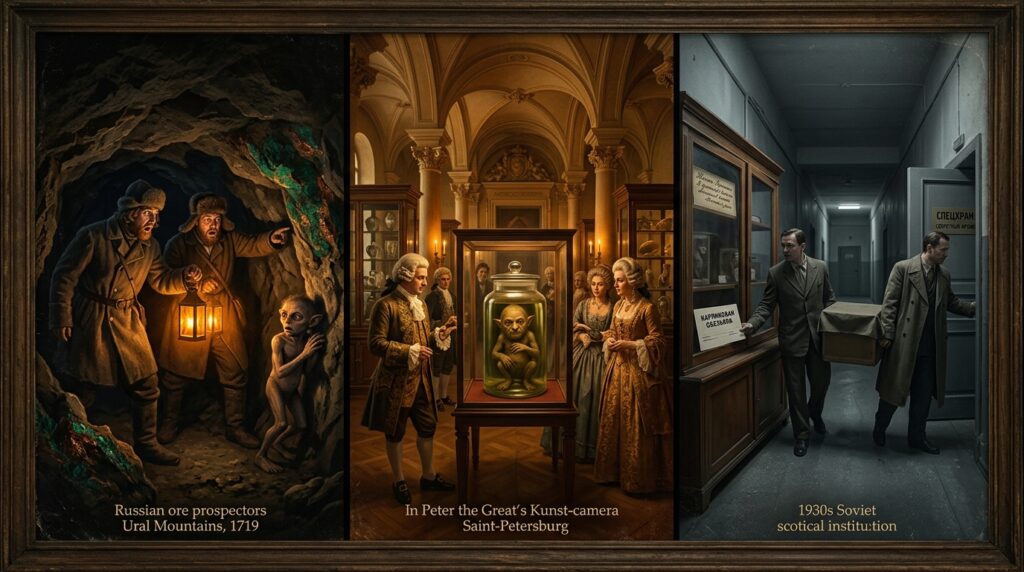
1719 CE — Ural Mountains, Russia. Ore prospectors working for industrialist Demidov captured a gnome-like entity alive in an underground cave. It died in a canary cage and was pickled and shipped to Peter the Great's Kunst-camera in Saint Petersburg where it was displayed for approximately two centuries. In 1936, Soviet researchers reclassified it as a dwarf monkey and transferred it to a hidden repository. Soviet anthropologist Dr. V.F. Porshnev found the reclassification impossible — no such monkey inhabits the Ural Mountains' cold pine forests.
THINK ABOUTIT ENTITY SIGHTING REPORT
1719: Ural, Russia Encounter
In 1719, in the Yekaterinburg region of the Ural Mountains, ore prospectors working for the famous Russian industrialist Akinfiy Demidov captured something living underground in a cave. It was gnome-like — small, non-human, clearly alive, and clearly not any animal the prospectors had a name for from their experience in the Ural forests and mines. They brought it back. It was kept alive in a canary cage for a time. Then it died — from inadequate shelter, or more likely inadequate nourishment. Knowing the fascination of Tsar Peter the Great with extraordinary specimens for his Kunst-camera — the Cabinet of Curiosities he established in Saint Petersburg as Russia’s first museum — Demidov ordered the body pickled and shipped by convoy to the capital. The pickled body arrived and was displayed in the Kunst-camera for generations. Then, in 1936, Soviet-era researchers reclassified it as an unusual dwarf monkey and transferred it to the Zoological Museum in a hidden repository. When Dr. V.F. Porshnev, one of the Soviet Union’s most respected anthropologists and researchers of relic hominids, investigated in the 1960s, he found the reclassification impossible to accept: no such monkey lives in the cold pine forests of the Ural Mountains. Whatever Demidov’s ore prospectors captured underground in a cave in 1719, it was real enough to be physically held, caged, preserved, shipped to the Tsar, displayed for two centuries, and then quietly reclassified by researchers who apparently found it inconvenient rather than impossible.
Date: 1719
Sighting Time: Not recorded
Day/Night: Not recorded
Location: Yekaterinburg region, Ural Mountains, Russia
Urban or Rural: Rural — underground cave, mining region
No. of Entity(s): 1
Entity Type: Gnome-like entity — small, non-human, living underground; described as a dwarf; classified as a relic hominid or unknown entity type
Entity Description: A strange gnome-like entity found living underground in a cave in the Ural Mountains. Small enough to be held in a canary cage. Survived for a period in captivity before dying from inadequate shelter or nourishment. Body was pickled and preserved for shipment to Saint Petersburg. Physical characteristics beyond small stature and underground habitation not detailed in surviving accounts — the body was apparently distinctive enough that Demidov believed it worthy of presentation to Peter the Great and that subsequent researchers in 1936 found it sufficiently inconvenient to reclassify and remove from public display.
Hynek Classification: CE-III — Close Encounter of the Third Kind; direct physical capture and extended close-proximity holding of a non-human animate being; physical specimen preserved
Duration: Extended — entity was held alive in a canary cage for days or weeks before dying
No. of Object(s): 1 — the entity’s preserved body constitutes the physical artifact
Description of Object(s): N/A
Shape of Object(s): N/A
Size of Object(s): Small — canary cage-sized; gnome-like proportions
Color of Object(s): Not recorded
Distance to Object(s): Direct capture and physical holding
Height & Speed: Ground level — found in an underground cave
Number of Witnesses: Multiple — Demidov’s ore prospecting crew; Demidov himself; Peter the Great’s Kunst-camera staff; all visitors to the museum over two centuries; Dr. Porshnev’s 1960s research team
Special Features / Characteristics: Physical capture and extended captivity — one of the only pre-modern cases in the archive where a non-human entity was physically held alive for days or weeks; physical body preserved and shipped — the pickled body traveled from the Urals to Saint Petersburg by convoy on the order of one of Russia’s most powerful industrialists; Kunst-camera display — the body was exhibited in Peter the Great’s Cabinet of Curiosities for approximately two centuries; the 1936 reclassification — Soviet-era researchers transferred the exhibit to the Zoological Museum as an unusual dwarf monkey, a classification Dr. Porshnev found impossible given that no such monkey inhabits the Ural Mountains’ cold pine forest environment; the reclassification suggests the exhibit was sufficiently anomalous to be considered scientifically inconvenient; the underground cave habitation connects this case directly to the Subterranean Bases archive and the Ural Mountains underground entity tradition including the 1700 Mistress of the Copper Mountain; Ural ancient legends describe underground cities, caves and tunnels beneath the mountains as the regular dwelling places of these entities; Peter the Great’s specific interest in extraordinary specimens makes the Demidov shipment a rational institutional response rather than individual eccentricity; the canary cage detail establishes the entity’s size precisely — small enough for a standard cage while alive
Case Status: Unexplained — physical specimen reported but now classified as unavailable or reclassified; 1936 reclassification disputed by Dr. Porshnev
Source: Tatyana Samoylova in NLO magazine, Saint Petersburg, No. 44, October 25, 2004
Summary/Description: In 1719, ore prospectors working for industrialist Demidov in the Ural Mountains captured a gnome-like entity living underground in a cave. It was held alive in a canary cage before dying. The pickled body was shipped by convoy to Saint Petersburg for Peter the Great’s Kunst-camera. Displayed for approximately two centuries, the exhibit was reclassified in 1936 as an unusual dwarf monkey and transferred to the Zoological Museum. Soviet anthropologist Dr. V.F. Porshnev, investigating in the 1960s, found the reclassification impossible — no such monkey inhabits the Ural Mountain forests.
Related Cases: 1700 CE Urals Russia Mistress of the Copper Mountain | 1138 CE German Monastery Dwarf | 1644 CE Chemnitz Germany Female Dwarf Capture | Subterranean Bases Archive — Underground Entity Access Points | Russian Underground Entity Archive
DETAILED REPORT:
The year is 1719. Peter the Great has been Tsar of Russia since 1682 and has transformed the country with the ferocity of a man who understands that power requires infrastructure. He founded Saint Petersburg in 1703 on the marshes of the Neva River delta. He established Russia’s first museum — the Kunst-camera, his Cabinet of Curiosities — where extraordinary specimens from across the Russian Empire were collected and displayed for the edification of the Russian public and the demonstration of imperial reach and intellectual ambition.
Akinfiy Demidov was one of the most powerful industrialists in early 18th century Russia — the Demidov family had built their fortune on the iron and copper works of the Ural Mountains, operating some of the largest industrial enterprises in Russia under imperial license. His ore prospectors were the frontier workers of Russian industrial expansion — men who went into the mountain terrain of the Urals to find the ore deposits that fed the empire’s foundries.
In 1719, one of Demidov’s prospecting teams found something underground in a cave.
A gnome-like entity. Small. Living underground. Alive.
The prospectors captured it. Whatever the circumstances of the capture — whether it was trapped, cornered, or approached — they brought it back. Someone procured a canary cage. The entity was placed inside and kept alive for what the account describes as days or weeks. This specific detail — the canary cage — establishes the entity’s size with precision: small enough to be housed in a standard bird cage, animate enough to require containment rather than simple preservation, alive long enough for the attempt at housing it to be sustained for a meaningful period.
Then it died.
The account attributes the death to inadequate shelter or, more likely, inadequate nourishment. This is an analytically significant detail — the entity had specific nutritional requirements that the prospectors did not know how to meet, which argues for a biology genuinely different from any animal they had previous experience with. If they could not determine what to feed it effectively enough to keep it alive, it was not a familiar animal in an unfamiliar guise.
Demidov made the decision that connects this case to the imperial record: he ordered the body pickled and shipped to Saint Petersburg. Peter the Great’s interest in extraordinary biological specimens for the Kunst-camera was well-known — the Tsar had personally acquired human and animal anomalies from across Europe and Russia for his museum and had publicly encouraged his subjects to bring him remarkable things. Demidov was sending the Tsar exactly what he had asked for.
The pickled body traveled from the Ural Mountains to Saint Petersburg by convoy — a significant logistical commitment that reflects Demidov’s confidence that what he was sending was genuinely extraordinary. It arrived. It entered the Kunst-camera. It was displayed there, presumably alongside the museum’s other extraordinary specimens, for approximately two centuries.
Then, in 1936, something changed.
Soviet-era researchers became interested in the exhibit. They apparently found it sufficiently unorthodox and scientifically inconvenient that they reclassified it — not as a gnome or an unknown entity, but as an unusual dwarf monkey — and transferred it from the Kunst-camera to the Zoological Museum, where it was placed in a hidden repository away from the public.
Dr. V.F. Porshnev — one of the Soviet Union’s most respected anthropologists, a specialist in relic hominids and Snowman research, not a researcher with any prior interest in dwarfs or gnomes — investigated the story in the 1960s. He made an inquiry to the museum. The response confirmed the reclassification.
He found it impossible.
There are no dwarf monkeys in the cold pine forests of the Ural Mountains. No such primate inhabits that environment. The reclassification of a museum exhibit as a species that does not and cannot live in the region where the specimen was collected is not a scientific determination. It is a removal from inconvenient consideration.
Porshnev’s assessment — that Demidov could not have deceived Peter the Great with a fraudulent specimen, and that the 1936 reclassification was an act of institutional convenience rather than scientific accuracy — represents the most credible analytical framework available for this case. Whatever Demidov’s prospectors captured in an Ural cave in 1719 was different enough from any known animal to be considered worth shipping to the Tsar, different enough from any known specimen to be kept in the Kunst-camera for two centuries, and different enough from anything scientifically comfortable to be quietly reclassified and removed from public display in 1936.
The Ural underground entity tradition — preserved in ancient legends of underground cities, caves, and tunnels beneath the mountains where alien entities dwell regularly — provides the broader context. The 1700 Mistress of the Copper Mountain. The 1566 South of Moscow tall hairy humanoid in the forested zone above. The broader Russian small entity tradition documented by Chernobrov and others. Whatever lives in the underground systems beneath the Ural Mountains, the 1719 Demidov capture is the only case in the archive where one of them was physically held, preserved, shipped to a tsar, displayed for two centuries, and then made to disappear.
RESEARCHER’S NOTES:
The Demidov Ural Gnome — Physical Capture, Institutional Trajectory, and the 1936 Reclassification
- The Canary Cage as Size Evidence: The specific detail of the canary cage as the holding vessel for a living entity establishes its size as precisely as any measurement could. A standard canary cage is approximately 12 to 18 inches in its largest dimension. Whatever was housed in it was smaller than that in its living state — a size consistent with the gnome-like small entity tradition across the Ural and broader Russian record, but inconsistent with any known primate from the Ural region.
- The Institutional Trajectory as Evidence: The trajectory of the specimen from capture to Demidov to Peter the Great to the Kunst-camera to the 1936 reclassification to the hidden repository is an institutional evidence chain that argues for a genuine physical specimen at every link. Each institutional decision — Demidov’s decision to ship, Peter’s decision to display, the 1936 researchers’ decision to reclassify and hide — reflects an assessment of the specimen’s reality. The 1936 reclassification is the most analytically significant decision in the chain because it suggests the specimen was inconvenient rather than fictitious.
- Dr. Porshnev’s Assessment: Dr. V.F. Porshnev’s specific point — that no such monkey inhabits the Ural Mountains’ cold pine forest environment — is the decisive analytical argument against the 1936 reclassification. A reclassification as a species physically incapable of existing in the region where the specimen was collected is not a scientific determination. It is an administrative act whose purpose was something other than taxonomic accuracy.
- Underground Entity Connection: The cave origin of the 1719 entity connects directly to the Subterranean Bases archive’s documentation of underground non-human entity access points in the Ural region. The Mistress of the Copper Mountain who commanded hundreds of lizards and maintained crystalline underground chambers near Ekaterinburg. The ancient legends of underground cities beneath the Ural Mountains. The 1719 Demidov entity is not a standalone anomaly in the Russian underground entity record — it is a captured physical specimen from a tradition that has been documented in the same geographic zone across centuries.
Demidov’s ore prospectors caught a gnome-like creature alive in an Ural cave in 1719 and kept it in a canary cage until it died of inadequate nourishment and then pickled it and shipped it to Peter the Great who put it in his museum where it stayed for two centuries until 1936 when Soviet researchers reclassified it as a dwarf monkey that doesn’t live in the Ural Mountains and put it in a hidden repository. Dr. Porshnev investigated in the 1960s and found the reclassification impossible. Tatyana Samoylova published the account in NLO magazine in 2004. The archive holds the full chain: capture, cage, death, pickle, convoy, Kunst-camera, two centuries, 1936, hidden repository, Porshnev, impossibility. Whatever was in that canary cage in 1719 was real enough to ship to a tsar. Whatever was in that museum case before 1936 was real enough to reclassify and hide. The cold pine forests of the Ural Mountains do not have dwarf monkeys. They do have caves. The caves apparently have things in them that are not monkeys.