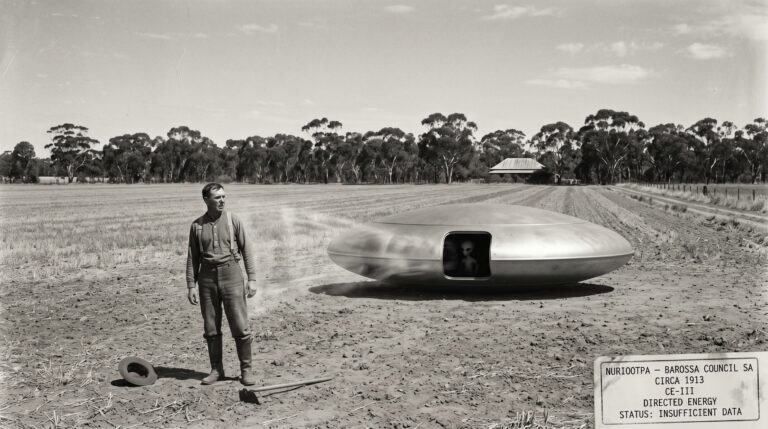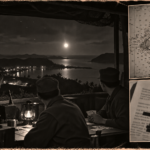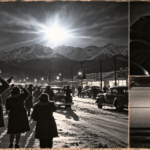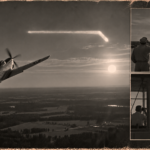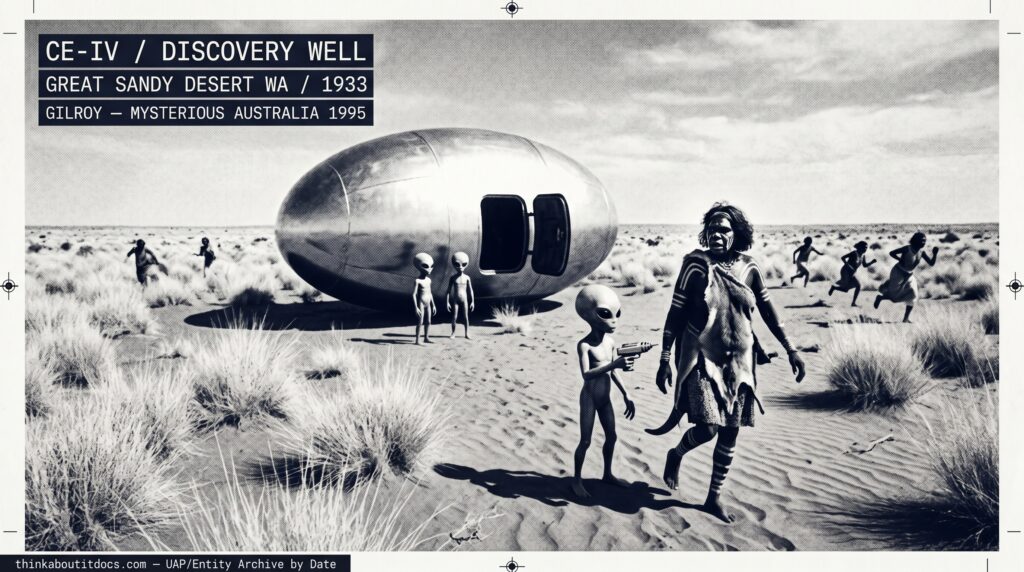
Discovery Well, Great Sandy Desert, Western Australia, 1933 — a large shining egg-shaped craft lands in the open desert in broad daylight, frightening an Aboriginal woman's tribe from the area. The woman is stunned by a device carried by one of several grey-skinned man-like beings and taken inside the craft, which is lit by a reddish interior glow. She is strapped to a shiny table and apparently experimented upon before being returned. Source: Rex Gilroy, Mysterious Australia, Nexus, 1995. Case Status: Insufficient Data. thinkaboutitdocs.com.
THINK ABOUTIT ABDUCTION REPORT
1933: Western Australia Abduction
In 1933, at the isolated locality of Discovery Well on the northern edge of the Great Sandy Desert in Western Australia, an Aboriginal woman said her tribe was frightened off their camp when a large shining egg-shaped object descended out of a clear daytime sky. Several strange, grey-skinned, man-like beings emerged; she was stunned by a device one of them carried, taken inside the object into a reddish glow, strapped to a shiny table, and — in her account — experimented on. The tale surfaces in ufological literature only through a single fringe compilation published sixty-two years after the alleged event, and this report treats the case’s narrative distinctiveness and its very thin sourcing as two separate facts that must both be stated plainly.
Date: 1933 (specific day undocumented)
Sighting Time: Daytime
Day/Night: Day
Location: Discovery Well, Great Sandy Desert, Western Australia
Urban or Rural: Isolated desert locality
No. of Entity(‘s): Several (exact count undocumented)
Entity Type: Man-like humanoids
Entity Description: Strange, grey-skinned, man-like in general form; no further physical detail (facial features, height, clothing) preserved in the available source
Hynek Classification: CE-IV (Close Encounter of the Fourth Kind — abduction)
Duration: Undocumented
No. of Object(s): 1
Description of the Object(s): A large, shining, egg-shaped object that descended rapidly and flew low over the tribe in broad daylight; interior described as bathed in a reddish glow, containing a shiny table to which the witness was strapped
Shape of Object(s): Egg-shaped
Size of Object(s): Large (no specific dimension given)
Color of Object(s): Shining/shiny
Distance to Object(s): Close range — object landed near the tribe’s location and the witness was taken inside
Height & Speed: Object was described as flying low over the group before landing; no numeric figures given
Number of Witnesses: A tribe (collective sighting of the object and its landing); the abduction itself was experienced by one named-unnamed adult Aboriginal woman, whose account is the sole source for the interior/abduction details
Special Features/Characteristics: Rapid low-altitude approach in broad daylight frightened the tribe off the immediate area; the witness was stunned by a hand-held device before being carried aboard; the craft’s interior is described with specific sensory detail (reddish glow, shiny table) consistent with, though not identical to, later post-1947 abduction-narrative conventions
Case Status: Insufficient Data. Single secondary source, published sixty-two years after the alleged event, from a compiler whose broader body of work includes material without independent scholarly corroboration.
Source: Rex Gilroy, Mysterious Australia, Nexus Publishing, 1995. Gilroy is a self-described Australian “mysteries” researcher known primarily for cryptozoological (Australian “Yowie”) and ancient-civilization claims; his work is treated by mainstream Australian ufology as a secondary, credibility-limited source rather than a primary investigative one. No named investigator, no date more specific than the year, and no independent corroborating account of this specific case have been located.
Summary/Description: In 1933 at Discovery Well, on the northern edge of the Great Sandy Desert in Western Australia, an Aboriginal woman reported that her tribe was frightened off the area when a large shining egg-shaped object descended rapidly and flew low over them in broad daylight. Several strange, grey-skinned, man-like beings emerged from the object. The woman said she was stunned by a device carried by one of the beings and carried inside the craft, where the interior was bathed in a reddish glow. She was strapped to a shiny table and, in her account, subjected to some form of examination or experimentation. No further detail on her release or return is preserved in the available source.
Related Cases: 1930 Central Desert, Western Australia — green-glowing figures observed by an Aboriginal tribe (Bill Chalker, The Oz Files) | 1931 Arnhem Land, Northern Territory — Aboriginal elder’s account of child abduction and telepathic contact attempt (Bill Chalker, The Oz Files)
Detailed Report
The Discovery Well case is, on its narrative content alone, one of the earliest fully-formed abduction accounts in this archive’s record — predating the Antonio Villas-Boas case (1957) by nearly a quarter-century and the Betty and Barney Hill case (1961) by nearly three decades, if the 1933 dating and the account’s substance are both accurate. The core sequence — a landed craft, a stunning device, transport inside, a reddish interior glow, restraint on a table, and apparent physical examination — anticipates the abduction-narrative template that would not become culturally widespread for another twenty to fifty years. That anticipatory quality is genuinely striking whether or not the case is ultimately judged credible, because it means the account either predates the cultural template it resembles, or the account’s telling (as recorded by Gilroy in 1995) was shaped by that template after the fact during the sixty-two-year gap between the alleged event and its publication.
The case also sits within a documented broader context: Aboriginal Australian oral tradition includes longstanding accounts of “sky gods” or culture-hero figures who abduct or initiate individuals — men and women alike — in Dreamtime narratives and in the initiation experiences described for Aboriginal “men of high degree,” or shamanic figures. This is not evidence that the 1933 Discovery Well account is either more or less credible as a discrete historical event, but it is relevant context: an account transmitted through or shaped by pre-existing tribal narrative frameworks of sky-being abduction may reflect a genuine, culturally specific way of processing an anomalous experience, a retelling of older traditional material recast in more recent vocabulary, or some combination of both. This archive does not resolve that question and flags it as a live interpretive issue rather than deciding it.
The source itself is the case’s central limitation. Rex Gilroy’s Mysterious Australia (Nexus Publishing, 1995) is the only located citation for this specific case, and Gilroy’s broader body of published work — centered on Australian cryptozoology (most notably the “Yowie,” an Australian counterpart to Bigfoot claims) and speculative ancient-civilization theories — is not treated by mainstream Australian ufological research (including Bill Chalker’s more rigorously sourced The Oz Files, cited elsewhere in this archive’s Australian entries) as a comparably reliable primary source. That does not mean the account is fabricated; it means this archive cannot independently verify it, cannot name the witness, cannot fix a specific date, and cannot trace the chain between the alleged 1933 event and Gilroy’s 1995 publication of it.
RESEARCHER’S NOTES
Discovery Well — 1933 and the Pre-Contactee Abduction Question
- Source Chain Assessment: The sole located source is Rex Gilroy’s 1995 Mysterious Australia. Gilroy is a controversial figure within Australian anomaly research, and this archive applies the same credibility discount to his work here that it applies elsewhere to comparably fringe-adjacent compilers. The case is retained because of its genuine narrative and historical interest, not because the sourcing meets this archive’s higher evidentiary bar.
- Classification Rationale: CE-IV is assigned because the account describes physical removal of the witness into the craft and apparent physical examination — meeting the abduction threshold regardless of the source’s reliability. The classification describes the narrative content, not a judgment on whether the event occurred as described.
- Pattern Context: If accurately dated to 1933, this account predates every widely recognized modern abduction case by decades, and its structural similarity to the post-1950s abduction template (stunning device, interior glow, restraint table, examination) is either a remarkable case of pattern anticipation or evidence that the account’s specific details were shaped by later cultural vocabulary during the six-decade gap before publication. Both readings are defensible from the available evidence, and this archive does not adjudicate between them.
- Evidentiary Weight: No named witness, no named investigator beyond the compiling author, no specific date, no independent corroboration, and a sixty-two-year gap between the alleged event and its only located publication. This is among the weakest-sourced entries in this archive’s 1930s record, retained for its narrative and historical significance rather than its evidentiary strength, and logged as Insufficient Data rather than Unexplained accordingly.
The Discovery Well account is worth preserving precisely because of what it claims to be — an abduction narrative predating the cultural genre by decades — while being equally worth treating with real skepticism, because a single fringe-adjacent 1995 compilation with no traceable primary chain is a thin foundation for a claim of that historical weight. Both things are true at once, and this archive holds them together rather than resolving one into the other.
“Several beings, described as strange gray skinned, and man-like came out. The woman said she was stunned, by an object carried by one of the beings, and carried by one of the beings inside the object. Inside, the object the interior was bathed in a reddish glow. She was then strapped to a shiny table and apparently ‘experimented with.'”
Case summary, Rex Gilroy, Mysterious Australia (1995), describing the 1933 Discovery Well, Western Australia account