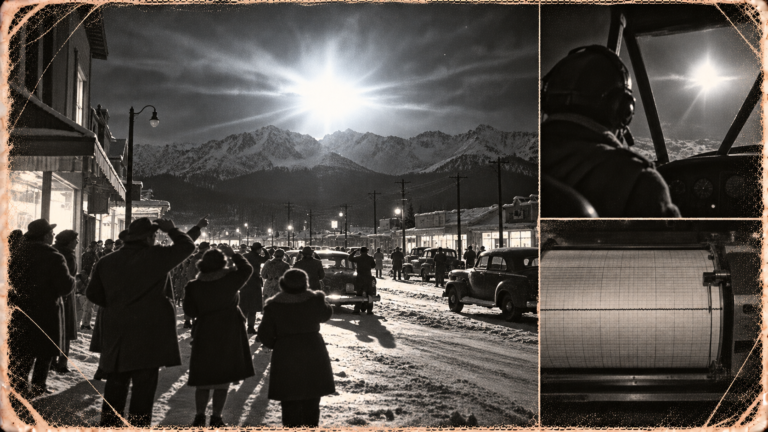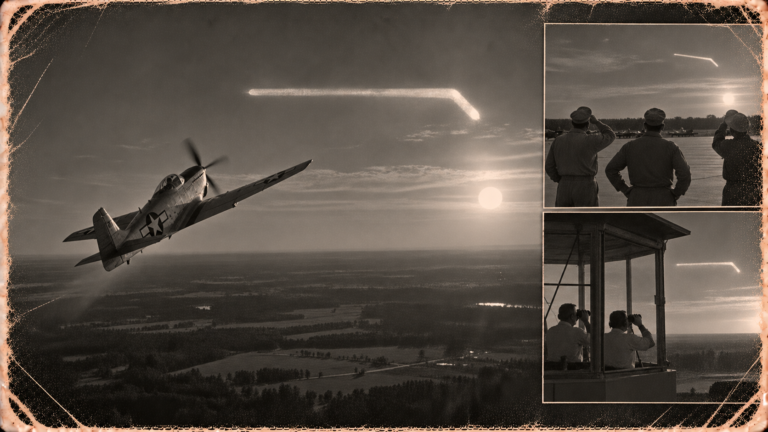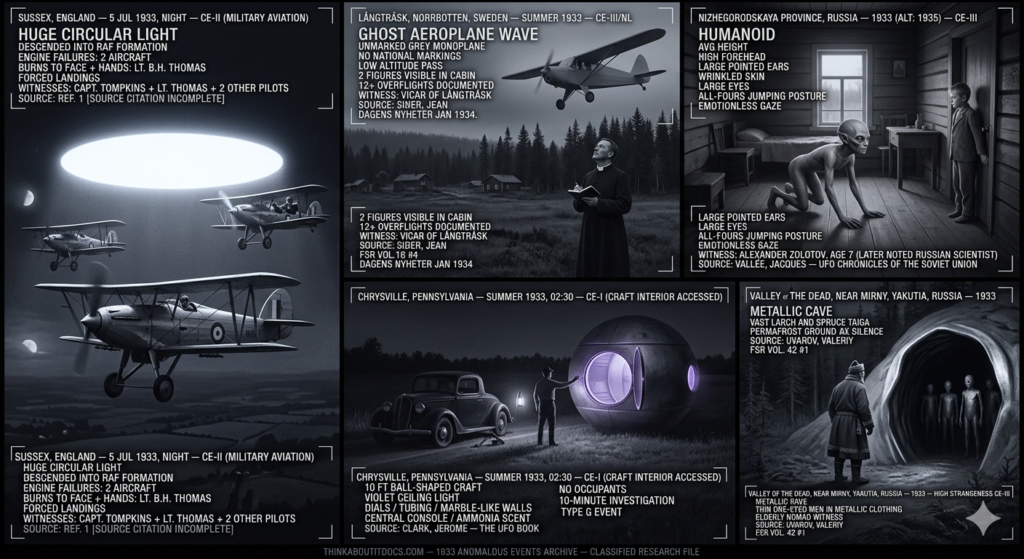
1933 anomalous events archive: Sussex England July 5 RAF Hawker Fury CE-II military formation broken up by huge circular light with engine failures and pilot burns, Langtrask Sweden Ghost Aeroplane wave unmarked monoplane with two cabin figures (Sider/FSR/Dagens Nyheter), Chrysville Pennsylvania Summer CE-I craft interior accessed alone at 2:30 AM with violet light dials and ammonia scent (Clark The UFO Book), Nizhegorodskaya Russia Zolotov age-7 frog-posture entity (Vallée UFO Chronicles of the Soviet Union), and Yakutia Valley of the Dead metallic cave one-eyed metallic-clothed inhabitants (Uvarov FSR Vol. 42).
1933: UFO|UAP & Entity Sightings Archive
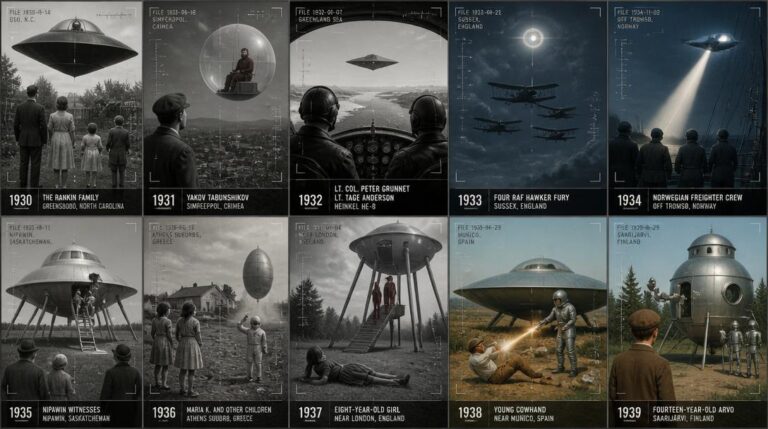
The year 1933 carries the pre-war archive’s most consequential military aviation incident: the night of July 5, when a flight of four Royal Air Force Hawker Fury I biplane fighters on a night cross-country training exercise over Sussex, England was broken up by a huge circular light that dropped from above their formation into its center. RAF Captain Nigel Tompkins was forced to land after his engine quit. Lieutenant Bruce H. Thomas suffered burns to his face and hands after passing too close to the light while attempting to land his own stricken aircraft. Two RAF pilots — their engines disabled by proximity to an unidentified circular light, one with documented physical burns — in a military training flight over southern England in 1933, fifteen years before the modern UFO era began. The year also sits at the peak of the Scandinavian Ghost Aeroplane wave, a phenomenon documented across Norwegian, Swedish, and Finnish airspace from 1932 to 1937 in which unidentified aircraft — behaving like the monoplanes and biplanes of the period but carrying no markings, no colors, no national insignia, and flying under impossible weather conditions — appeared repeatedly over military installations and remote regions. The Piiteå and Långträsk, Sweden cases in this record are part of that wave, documented in Jean Sider’s research via the Dagens Nyheter of January 1934 via FSR Vol. 16 #4.
The year’s CE-III content is anchored by the Chrysville, Pennsylvania summer case: a witness with a flat tire at 2:30 AM finds a 10-foot ball-shaped craft in a nearby field with a circular opening ajar, opens it, and observes dials, tubing, marble-like walls, and a central console — all in a violet light with an ammonia scent — for 10 minutes without seeing any occupant. The Near Cudworth, Saskatchewan case adds four-foot green-clad “little men” observed across a pond with missing time — the witness could not remember what happened next. The Nizhegorodskaya Province Russia case adds the account of Alexander Zolotov, who would later become a well-known Russian scientist, describing a humanoid of average height with a high forehead, large pointed ears, wrinkled skin, and large intelligent eyes that stood on all fours jumping like a frog when Zolotov was seven years old — sourced through Jacques Vallée’s UFO Chronicles of the Soviet Union. The Valley of Death Yakutia Russia case — a nomad entering a metallic cave containing thin one-eyed men in metallic clothing — extends the Soviet CE-III record into the Siberian interior. The Mirny Valley of the Dead and the Chrysville ammonia-cave together give 1933 two of the most unusual interior-of-craft descriptions in the pre-war archive. This page also carries full standalone reports, now reflected below, for the previously bare-linked Discovery Well, Western Australia abduction and the Nipawin, Saskatchewan landing case.
Date: 1933
Location: Ubatuba, Sao Paulo, Brazil
Time: Unknown
Summary: ⚠ CORRECTED — TWO DISTINCT NARRATIVES SEPARATED: This entry previously conflated two separate accounts under one date. (1) A named witness, Antonio de Oliveira, along with his dentist friend Dr. Benedito Sabastião Pires Nobre, independently reported witnessing a bright object over Ubatuba in 1933 or 1934: a sudden flash of light, a bright object brighter than Venus traveling north to south with a whistling sound, disappearing behind hills, followed 15–20 seconds later by an explosion strong enough to shake houses and wake residents. In 1984 correspondence with Harvard meteor expert Dr. Fred Whipple’s colleague Dr. Richard McCroskey, this event was assessed as consistent with a meteor — an atmospheric fireball and airburst, not a UFO — though the whistling sound noted by witnesses is not independently corroborated as a real meteor characteristic. (2) The famous “Ubatuba fragments” case — a flying disc reportedly exploding over Ubatuba’s Toninha Beach, with metal fragments recovered and sent anonymously to journalist Ibrahim Sued, subsequently analyzed by Dr. Olavo Fontes of APRO and found to be high-purity magnesium — is a separate, much better-documented event dated to September 1957, not 1933–34. Some researchers have speculated the 1933–34 de Oliveira explosion could be connected to the origin of the 1957 fragments story, but this remains an unconfirmed hypothesis discussed in specialist literature, not an established link. The “Explanation: Prank” note on this page’s original entry more properly applies to skepticism directed at the 1957 letter and fragments, not to the independently witnessed and named 1933–34 de Oliveira sighting.
Source: 1933–34 explosion: Antonio de Oliveira witness account, cited in “On Events Possibly Related to the ‘Brazil Magnesium’ Case,” Journal of Scientific Exploration; correspondence with Dr. Richard McCroskey (Harvard) via Dr. Fred Whipple, 1984. 1957 fragments case (separate event): APRO Bulletin; Dr. Olavo Fontes investigation; Ibrahim Sued, O Globo, September 14, 1957.Bulletin
Date: 1933
Location: Near Mirny, Yakutia, Russia
Time: Unknown
Summary: In an isolated area called “The Valley of the Dead” an elderly nomad reported entering “a metallic cave” where he encountered very thin, one-eyed men in metallic clothing. No other information. High strangeness CE-III. One-eyed humanoids in metallic clothing inside a metallic cave in Siberia is a morphologically unusual entity description.
Source: Valeriy Uvarov, FSR Vol. 42 # 1
Date: 1933
Location: Pitea, Sweden
Time: Unknown
Summary: The author indicates that in 1933, in the summer, in Pitea, Sweden, there was a close encounter of the third kind amidst a wave of unknown “aeroplanes” which broke on Scandinavia at the beginning of the 1930’s, that had the shape of propeller planes, but were never identified, which did not carry any mark, figures, letters, symbols, color of nationality, etc. Jean Sider indicates that their flight behaviour, sometimes under the most terrible weather conditions, strongly indicates that they were UFOs which had taken the shape of the modest monoplanes and biplanes of the time. He then quotes: “The vicar of Langtrask claimed to have seen mysterious airplanes in the area during the two last years. Last summer, these ghost planes flew over the area a dozen time. On four occurrences an apparatus appeared at very low altitude, but no sign of identification was observed on its fuselage. Once, the apparatus flew at only a few meters of the ground. During a few seconds two people were seen in the cabin. The machine was a monoplane of greyish color. The vicar did not report his observation earlier because he believed that these incidents had been reported by the coastal population.” Jean Sider indicates that this some from “FSR, vol. 16, #4, July/August, 1970, p. 17, according to the Dagens Nyheter for January 22, 1934, according to a compilation by Mr. Ake Franzen, of Stockholm, who browsed the Press of the time in his country.” The author, not noticing that it is the same case, indicates as a separate case that in 1933, in the summer, in Langtrask, Sweden, there was a close encounter of the third kind reported by a witness who noticed a strange object of the monoplane type going down on the area on several occasions. In one of these flights at very low altitude, two men are seen in the cockpit.
Source: FSR, vol. 16, #4, July/August, 1970, p. 17, | Source Status: VERIFIED
Date: 1933
Location: Discovery Well, Great Sandy Desert, Western Australia Abduction
Time: Daytime
Summary: An Aboriginal woman said her tribe was frightened off Discovery Well when a large, shining, egg-shaped object descended rapidly and flew low over them in broad daylight. Several strange, grey-skinned, man-like beings emerged. The woman said she was stunned by a device carried by one of the beings and taken inside the object, where the interior was bathed in a reddish glow. She was strapped to a shiny table and, in her account, subjected to some form of examination. The account, if accurately dated, predates the Villas-Boas (1957) and Betty and Barney Hill (1961) abduction cases by decades and echoes longstanding Aboriginal Dreamtime traditions of “sky gods” or culture-hero figures abducting or initiating individuals. CE-IV classification. Case Status: Insufficient Data — single, sixty-two-years-later secondary source with no named witness, no named investigator, and no independent corroboration located. Full standalone report available.
Source: Rex Gilroy, Mysterious Australia, Nexus, 1995 — Gilroy is a self-described “mysteries” researcher whose broader body of work centers on Australian cryptozoology and speculative ancient-history claims; treated by mainstream Australian ufology (including Bill Chalker’s more rigorously sourced work) as a credibility-limited secondary source. | Linked page.
Date: 1933
Location: Nizhegorodskaya Province Russia
Time: Unknown
Summary: Seven-year old Alexander V Zolotov (who later became a well known Russian scientist) was alone in his room when a being suddenly appeared. The being was described as humanoid of average height with a high forehead and large head with large pointed ears. Its skin was wrinkled and it had large intelligent eyes. The humanoid stood on all fours and was jumping around like a frog. He was about 7 meters away from Zolotov. The alien had a calm and penetrating gaze completely emotionless. The witness ran from the room and did not see how the being left. The second source indicates the year was 1935 in the Gorkovskaya region.. Named witness who became a documented public figure (Zolotov). DATE DISCREPANCY: two sources give 1933 and 1935 respectively. CE-III classification. The frog-like quadruped posture is an unusual entity movement pattern.
Source: Jacques Vallee, UFO Chronicles of The Soviet Union Alexander B Petukhov and Anton Anfalov | Source Status: VERIFIED
Date: March 1933
Location: Favorino Reggio Calabria Italy
Time: Unknown
Summary: A man that dragged him then slapped him took a peasant from his home. The witness then found himself on top of a tall tree, where the being was holding him by his hair. The witness crossed himself and the entity suddenly vanished. He was unable to speak for several hours afterward. HIGH STRANGENESS — this account has characteristics more consistent with demonic assault / folklore tradition than a standard CE-III. The sign-of-the-cross dismissal element is particularly notable.
Source: Paolo Fiorino, UFO Universe Oct/Nov 1991
Date: April 11, 1933
Location: Vergiate (near Varese), Lombardy, Italy
Time: Unknown
Summary: A disc-shaped craft reportedly crashed or landed near Vergiate, Lombardy. Italian government documents — if authentic — indicate Benito Mussolini created a secret investigation group designated Cabinet RS/33, headed by Nobel scientist Guglielmo Marconi, to examine the recovered object. Documents published by Italian ufologist Roberto Pinotti in 2000.
Source: Pinotti, Roberto, Italian Centre for UFO Studies (CUN), 2000; cited in multiple international references including ultimatepopculture.fandom.com UFO article
Date: May 1933
Location: unknown
Time: afternoon
Summary: A five and a half year old child, the daughter of a farmer, was playing alone on a steep hill not far from her house. As she wandered around a ravine in the bottom of a hill the child was confronted by what she describes as a “big round silver platform” with four people on it. They raised a ladder so the girl could board the craft, and then put her through some kind of physical examination. CE-IV pre-Hill abduction classification. Platform morphology with visible occupants and a ladder deployed for the witness is a specific pre-contamination detail.
Source: Whitley Strieber, The Communion Letters, and Chris Aubeck, Return to Magonia
Date: Summer 1933
Location: Chrysville, Pennsylvania
Time: 0230A
Summary: A witness, Y, who desired no publicity, claimed that as he was on his way to Nazareth, his car had a flat tire. As he was fixing it, he noticed a faint violet glow in a field to his right. Curious, he walked toward it and soon found himself facing a ball shaped craft 10 ft in diameter and six ft high. The light was coming from a slit in a circular opening that on close examination proved to be slightly ajar. With he a push, Y opened it and put his head through the one-foot circle to observe the inside. The violet light, emanating, he thought, from the ceiling, made it difficult for him to see, but as his eyes adjusted, he discerned dials, tubing, and walls seemingly of a marble-like material as well as a kind of “console” in the center. There were no windows. An ammonia scent permeated the room, which was notably chilly; Y then walked around the object and felt the outside surface, which was slick, metallic, and cold. At no time did y see the craft’s occupants. After 10 minutes he returned to his car, fixed the tire, and drove home. Technically a type G event. CE-I (interior examination without occupants) / Type G classification. Specific interior details — ammonia scent, marble-like walls, violet ceiling light, central console — are pre-contamination structural descriptions.
Source: Jerome Clark, The UFO Book, Encyclopedia of The extraterrestrial | Source Status: VERIFIED
Date: Summer 1933
Location: Tobin Lake, northwestern Saskatchewan, Canada
Time: Unknown
Summary: Two young men and a woman from the village of Nipawin investigated reports of strange lights in the sky and near the ground in the Tobin Lake area. Encountered an anomalous aerial object. Two of the witnesses were interviewed by Canadian ufologist John Brent Musgrave in 1976; account published in Flying Saucer Review.
Source: Musgrave, John Brent, Flying Saucer Review, 1976; HUMCAT, citing Vallée, Jacques, Magonia, p. 168
Date: 1933
Location: Nipawin, Tobin Lake area, Saskatchewan, Canada
Time: After midnight (observation); dawn, roughly two days later (trace investigation)
Summary: Two young men and a woman from Nipawin, following a week of local reports of strange lights, drove out after midnight and were stopped a quarter mile short by impassable muskeg — close enough to watch, for roughly thirty minutes, a large domed oval craft resting on legs in the marsh, lit by an orange glow the witnesses called “unearthly,” while approximately a dozen silver-suited, helmeted figures moved silently up and down a central ladder in what looked like repair activity. No sound was produced throughout. Two days later they returned to find the craft gone but discovered six square landing imprints (2–2½ feet square, 2–3 inches deep, 8–10 feet apart), a stairway base mark, and a 12-foot central burn circle. They photographed the traces with a Brownie box camera and attempted to publish the account with photos in Canadian newspapers and magazines; every outlet declined, and the photographs were lost over the following four decades. Two of the three witnesses were interviewed directly by Canadian researcher John Brent Musgrave in 1976. CE-III classification. Full standalone report available.
Source: Musgrave, John Brent, Flying Saucer Review, 1976; HUMCAT, citing Vallée, Jacques, Magonia, p. 168 | Linked page
Date: Summer 1933
Location: Near Cudworth Saskatchewan
Time: afternoon
Summary: The witness was alone in a field beside a pond that was located on the farm where she lived. Across the pond, she observe a number of “little green men” that were about 4 ft tall, and wearing silvery suits. The witness could not remember what happened next. CE-IV possible (missing time implied). Flag: SOURCE UNVERIFIED. The little green men with silvery suits and missing time is a specific and early pre-Hill encounter pattern.
Source: Unidentified in Saskatchewan
Date: June 1, 1933
Location: Mount Everest, China-Nepal border (high altitude)
Time: Unknown Daytime
Summary: British mountaineer Frank Smythe, during the 1933 British Mount Everest expedition, witnessed two unusual spots hovering at high altitude above the Himalayan peaks. The objects were described as having pulsating or moving qualities inconsistent with any known atmospheric phenomenon.
Source: Listed in Wikipedia List of Reported UFO Sightings; cross-reference Smythe’s published expedition accounts
Date: July 5, 1933
Location: Sussex, England
Time: Night
Summary: Gigantic light -On July 5th 1933, during a night cross country training flight over Sussex, England a flight of four Hawker Fury I biplane fighters was broken up by a “huge” circular light that “dropped down from above their formation, into its very centre.” RAF Capt. Nigel Tompkins was forced to land after his engine quit. Lt. Bruce H. Thomas suffered burns to his face and hands after passing close to the light while trying to land his aircraft after his engine quit… The RAF Hawker Fury I was in active service from 1931; the formation type and engine-failure pattern are consistent with EM effects. CE-II military aviation classification. Named witnesses, documented aircraft type.
Source: Gross, Loren E., UFOs: A History — The Early Years, pp. 6–7
Date: Aug.-Dec. 1933
Location: East Coast United States
Time: Unknown
Summary: mysterious aircraft
Source: Gross, Loren E., UFOs: A History — The Early Years, p. 7
Date: Dec. 24, 1933
Location: Kalix, Sweden
Time: Unknown
Summary: Beam of light coming from machine
Source: Gross, Loren E., UFOs: A History — The Early Years, p. 7
Date: Dec. 30, 1933
Location: Sweden
Time: Unknown
Summary: Low-flying airplane
Source: Gross, Loren E., UFOs: A History — The Early Years, p. 7
EXECUTIVE SUMMARY
The Sussex RAF Incident and the Ghost Aeroplane Wave — 1933’s Military Record
The year 1933 sits at the intersection of two distinct anomalous aviation phenomena that together give it a military record unmatched in the pre-war archive. The July 5 Sussex RAF incident is the strongest: a military training formation disrupted by a huge circular light with EM effects producing engine failures in two aircraft and physical burns on one pilot. The ghost aeroplane wave is the broader phenomenon: from 1932 through 1937, unidentified aircraft appearing in Scandinavian and North American airspace with the physical profile of period aircraft but no markings, no identification, and behavioral characteristics — flight in the worst weather, extreme low-altitude passes, vanishing without trace — that no known air force of the period could replicate. The Piiteå and Långträsk, Sweden cases document this specifically: the vicar’s account of a dozen overflights including one at a few meters altitude with two visible figures in the cabin, documented in the Swedish press and carried in FSR via Jean Sider’s research. The East Coast United States August–December entry and the Kalix and Sweden December entries are part of the same wave’s North American and Scandinavian extension. Together they make 1933 the year in which unidentified aviation activity — both obviously anomalous (the circular light) and disguised-conventional (the ghost aeroplanes) — reaches its pre-war peak density.
Against this aviation record, 1933’s CE-III content is concentrated in interior-access encounters. The Chrysville Pennsylvania witness who opened a landed craft’s hatch at 2:30 AM and spent ten minutes examining the violet-lit interior with its ammonia scent and marble-like walls without ever seeing an occupant is an analytically unusual account: no entity contact, no confrontation, just ten minutes of unsupervised investigation inside a landed structured craft at the side of a Pennsylvania road. The Valley of the Dead Yakutia Russia metallic cave with one-eyed men, the Zolotov frog-posture quadruped entity, the Cudworth Saskatchewan green-and-silver men with missing time, the 5½-year-old girl’s silver platform with four people and a deployed ladder, the Nipawin, Saskatchewan landing case, and the Discovery Well, Western Australia abduction account collectively give 1933 an unusually deep CE-III/CE-IV record spanning five countries.
From the July 5, 1933 Sussex, England entry:
“A flight of four Hawker Fury I biplane fighters was broken up by a ‘huge’ circular light that ‘dropped down from above their formation, into its very centre.’ RAF Capt. Nigel Tompkins was forced to land after his engine quit. Lt. Bruce H. Thomas suffered burns to his face and hands after passing close to the light while trying to land his aircraft after his engine quit.”
Case summary, describing the July 5, 1933 night formation incident over Sussex, England