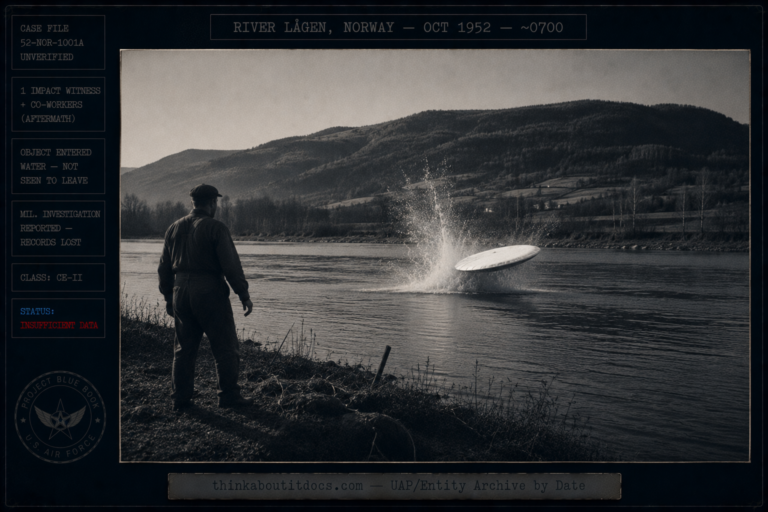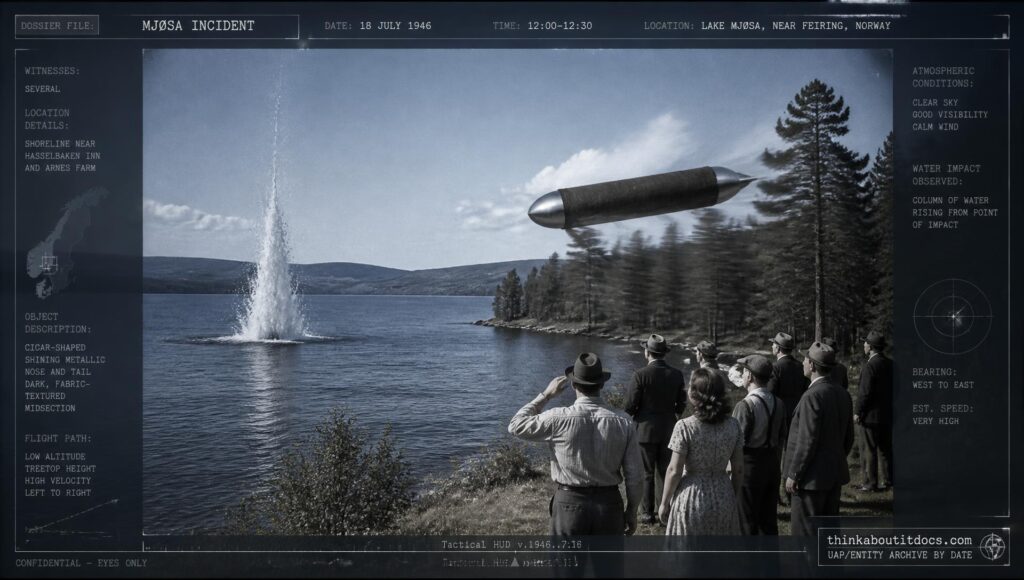
July 18, 1946 — Lake Mjøsa, Norway. A cigar-shaped, V-1-like object flew low enough to sway trees before plunging into 300 meters of water with no explosion — corroborated by a contemporaneous Aftenposten account two days later.
THINK ABOUTIT UFO SIGHTINGS REPORT
1946: The Lake Mjøsa Ghost Rocket — Norway
A small, V-1-shaped object skimmed so low over a Norwegian lakeshore that it left trees swaying in its wake, then plunged into water 300 meters deep without exploding, without leaving wreckage, and without ever being identified. A local sheriff called it in to Norway’s Defense High Command the same day. A national newspaper had the story within 48 hours, complete with named witness locations. It remains one of the best-documented single incidents of the entire 1946 Scandinavian ghost rocket wave — and the official investigation file, if it still exists, has never been found.
Date: July 18, 1946
Sighting Time: Between 12:00 and 12:30 (midday); some contemporaneous press accounts describe a second, related report placing similar objects over Feiring closer to midnight the same night
Day/Night: Day
Location: Lake Mjøsa, near Feiring, southeastern Norway — impact point approximately 2 kilometers from the western shore and 7 kilometers from Minnesund
Urban or Rural: Rural — lakeside farming community
No. of Entity(s): Not Applicable
Entity Type: Not Applicable
Entity Description: Not Applicable
Hynek Classification: CE-I — Close Encounter of the First Kind. The object passed low enough over witnesses to physically disturb trees, placing it well within close-range observation, though it produced no landing or occupant sighting.
Duration: Brief — witnesses heard the whistling sound, saw the object pass at low altitude, and observed the lake impact within what appears to have been well under a minute total
No. of Object(s): 1, though some witnesses believed a second object trailed close behind the first
Description of the Object(s): Cigar-shaped, resembling a small aircraft or a German V-1 flying bomb in general profile. The front and rear sections shone like polished metal, while the midsection, including the wings, appeared dark. The wings, roughly one meter long and positioned about a meter behind the nose, appeared to flap slightly, as though made of fabric rather than rigid material. No fire, exhaust trail, or light was observed at any point.
Shape of Object(s): Cigar/small-aircraft shaped, V-1-like
Size of Object(s): Approximately 2.5 meters long, with roughly 1-meter wings — smaller than a conventional light aircraft
Color of Object(s): Metallic shine on the nose and tail sections; dark midsection and wings
Distance to Object(s): Close enough to be heard clearly before being seen, and low enough to visibly disturb trees along its flight path
Height & Speed: Approximately 50 meters altitude; speed not numerically recorded but described as sudden — witnesses heard a loud whistle and the object was visible at close range almost immediately afterward, suggesting considerable velocity
Number of Witnesses: Multiple, including guests and staff at the Hasselbaken Inn and residents of the Arnes farm in Feiring; a local sheriff subsequently confirmed the sighting with what a contemporaneous press account described as “many reliable quarters” by telephone
Special Features/Characteristics: The object’s fabric-like flapping wings and lack of any visible fire, exhaust, or propulsion signature distinguish this case from a conventional aircraft or missile identification; the impact produced a large water splash but no explosion, no fire, and no debris field, despite the lake’s considerable depth at the impact point (300-400 meters); the sighting was reported to Norway’s Defense High Command the same day via the local sheriff, and a formal military investigation was reportedly opened, though no surviving investigation documents have been located by any source consulted for this report; some researchers have specifically raised the possibility that Norwegian ghost-rocket investigation files from 1946 were destroyed, which if true would leave period newspaper coverage as the primary surviving record for this and similar cases.
Case Status: Unexplained
Source: Aftenposten (Oslo), July 20, 1946, p. 1, “Foregar det forsok med Fly X over Norge? / To V-1-lignende gjenstander falt i Mjosa” (“Are experiments with Flier X underway over Norway? / Two V-1-like objects fell in Mjøsa”); contemporaneous witness accounts collected at the Hasselbaken Inn and Arnes farm, Feiring, as reproduced in Project 1947’s Scandinavian ghost rocket documentation
Related Cases: 1946: July UFO & Entity Sightings Archive (see also the July 19-20 entries at Lake Kölmjärv and Lake Mjøsa, same wave)
Detailed Report
Shortly after midday on Thursday, July 18, 1946, residents and guests near the Hasselbaken Inn and the Arnes farm in Feiring, on the shore of Norway’s Lake Mjøsa, heard an unusual, strong whistling sound unlike any aircraft they recognized. Looking up, they saw a small, cigar-shaped object coming in low from the west, at an altitude of roughly 50 meters — low enough that the object’s passage visibly made nearby trees sway.
The object was described in specific physical detail: about 2.5 meters long, with roughly one-meter-long wings positioned about a meter behind the nose. The front and rear sections had a metallic shine, while the midsection and wings appeared dark, and the wings themselves seemed to flap slightly, as though constructed of fabric rather than rigid material. No flame, exhaust trail, or light of any kind was observed — a detail that ruled out, for contemporary observers, an obvious identification as a rocket or missile under active propulsion in the conventional sense.
The object struck the surface of Lake Mjøsa approximately two kilometers from the western shore, and roughly seven kilometers from the town of Minnesund, at a point where the lake reaches depths of 300 to 400 meters. Witnesses reported that the impact threw a column of water several meters into the air — but with no accompanying explosion. The sky remained clear throughout, and the lake’s surface calmed quickly afterward. Notably, some witnesses believed they had seen not one but two objects, traveling one behind the other, though the primary press account treats this as an open question rather than a settled fact.
The event was reported locally the same day; a sheriff in the area telephoned contacts between Hurdal and Feiring and confirmed the sighting from what period press coverage described as “many reliable quarters,” before formally notifying Norway’s Defense High Command so that a military investigation could begin. Norway’s leading newspaper, Aftenposten, ran the story within 48 hours, on July 20, 1946, under the headline (translated) “Are experiments with Flier X underway over Norway? Two V-1-like objects fell in Mjøsa” — explicitly framing the incident within the period’s dominant hypothesis, that unidentified rocket-like objects over Scandinavia might represent secret weapons testing, most likely by the Soviet Union using captured German technology.
No official Norwegian investigation report on this incident has been located by any researcher whose work informs this account. Some historians of the 1946 ghost rocket wave have specifically noted the possibility that Scandinavian government documentation from this period was destroyed or lost, which — if accurate — would leave period newspaper accounts like the Aftenposten article as the closest surviving primary source for this case.
RESEARCHER’S NOTES
A Contemporaneous Press Account in a Field Full of Later Retellings
- On why this case’s sourcing is unusually strong for its era: Much of this archive’s 1946 record, and a great deal of the broader ghost rocket literature, relies on secondary compilations (AFU Sweden’s catalogue entries, Liljegren’s research, later retrospective histories) that don’t always specify a contemporaneous primary source. The Lake Mjøsa case is different: it is directly traceable to a named national newspaper, Aftenposten, publishing within 48 hours of the event, describing specific named witness locations (the Hasselbaken Inn, the Arnes farm) and the chain of official notification (local sheriff to Defense High Command) that followed. That’s a materially stronger evidentiary foundation than most entries in this month’s archive.
- On the “fabric wings” detail: The witnesses’ specific observation that the object’s wings appeared to flap slightly, as though made of fabric, is an unusual and quite precise detail for an object moving at speed and observed only briefly. This detail resists easy explanation by any conventional 1946-era aircraft or missile, which would not typically feature flexible fabric wing surfaces of this kind, and it’s one of the case’s more analytically interesting features precisely because it doesn’t fit neatly into either the “secret weapon” or “misidentified natural phenomenon” explanations most commonly offered for the broader ghost rocket wave.
- On the missing investigation file: The apparent loss of Norway’s official 1946 ghost rocket investigation documentation, if accurate, is a significant gap that this report treats honestly rather than filling with speculation. It means the case’s official military assessment — what conclusions, if any, the Defense High Command reached — is simply unknown, and this archive cannot represent that assessment as either confirming or debunking the sighting. What survives is witness testimony and press coverage, not the government’s own analysis.
- On the broader wave context: This incident did not occur in isolation. Just one day later, on July 19, a similarly detailed object crashed into Lake Kölmjärv in northern Sweden, witnessed by farmer Knut Lindbäck, with a subsequent military lakebed search that likewise recovered no debris. The pattern of unidentified objects impacting lakes without recoverable wreckage recurs repeatedly through this archive’s July 1946 entries, suggesting either a common, if unidentified, natural or technological cause behind multiple incidents, or a shared cultural and perceptual framework shaping how independent witnesses across Scandinavia interpreted what they saw during an anxious postwar summer already primed to expect exactly this kind of aerial threat.
A whistle, a low pass that bent the trees, a splash with no explosion, and a lake three hundred meters deep that gave nothing back. The Lake Mjøsa ghost rocket is as well documented as any single incident from Scandinavia’s extraordinary 1946 — and its case file, wherever it may have ended up, has never resurfaced to say what the Norwegian military actually concluded.