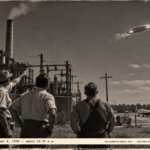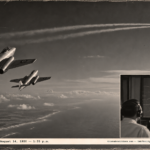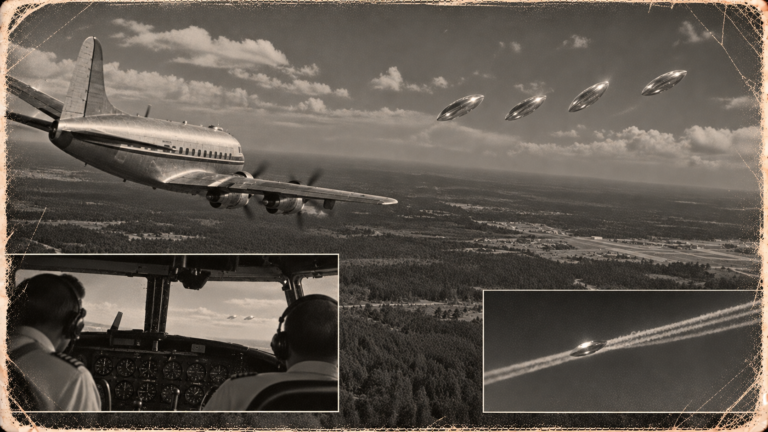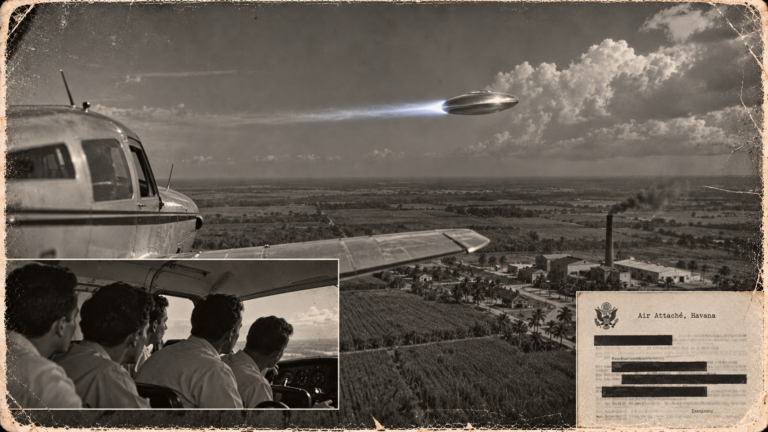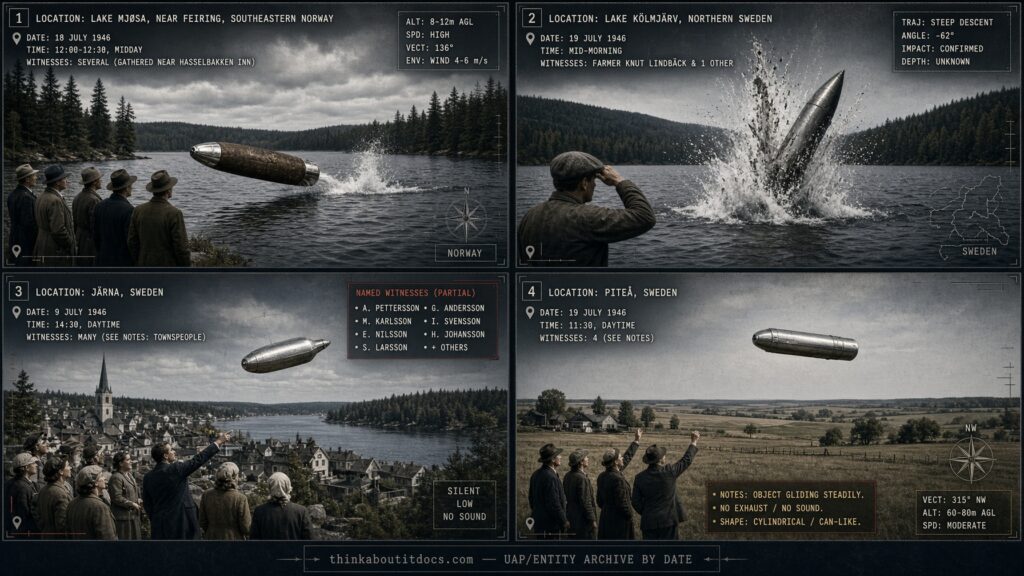
July 1946 — four anchor cases from the Scandinavian ghost rocket wave's most intense month: the Lake Mjøsa crash, the Lake Kölmjärv impact, the Järna thermos-shaped object, and the Piteå cylinder. thinkaboutitdocs.com.
1946: July UFO & Entity Sightings Archive
July 1946 is the month the Scandinavian “ghost rocket” wave became undeniable. Day after day across the month, Swedish witnesses reported cigar-shaped and rocket-like objects — over Borlänge, Mockfjärd, Järna, Piteå, and more than a dozen other towns — several diving into lakes and leaving no trace once search teams arrived. The month’s best-documented single event is the July 18 incident at Norway’s Lake Mjøsa, where a V-1-like object was watched by multiple named witnesses from a lakeside inn, tracked by local police, and formally investigated by the Norwegian Defense High Command — whose report, if it survives at all, has never been recovered. Only three weeks after Kenneth Arnold’s American sighting the following June would coin the term “flying saucer,” Scandinavia was already living through its own full-blown wave, largely unknown to the American public at the time.
Date: July 1946
Location: Muscatine, Iowa
Time: Unknown
Summary: Nocturnal lights were reported.
Source: George M. Eberhart, A Geo-Bibliography of Anomalies, Greenwood Press, Westport, 1980, ISBN 0-313-21337-2
Date: July, 1946 (exact date unknown)
Location: Indian River Inlet, Delaware
Time: Dusk
Summary: Two high school students (names not known) reported that a disc came up from the water, turned, and descended back into the ocean.
Source: Carl Feindt, referencing Irene McDonald, Delaware MUFON; UFOCAT PRN-123407
Date: July, 1946 (exact date unknown)
Location: San Antonio, Texas
Time: Unknown
Summary: An object was sighted with an appearance and performance beyond the capability of known earthly aircraft. An unidentifiable object was observed at close range.
Source: George M. Eberhart, A Geo-Bibliography of Anomalies, Greenwood Press, Westport, 1980, ISBN 0-313-21337-2
Date: July, 1946 (exact date unknown)
Location: Viskinge, Denmark
Time: 14:00
Summary: Three metallic discs passed overhead, with mirror-like reflective tops and dull gray bottoms, observed silently by several witnesses on a road (Sørensen). No sound was heard.
Source: Data-Net Report
Date: July 2, 1946
Location: Gävle, Sweden
Time: 20:00
Summary: An unidentified object was sighted, though with appearance and behavior most likely having a conventional explanation.
Source: Flying Saucer Review
Date: July 3, 1946
Location: Scotland
Time: Around 21:00
Summary: Nocturnal lights were reported.
Source: John A. Keel, UFOs: Operation Trojan Horse, G. P. Putnam’s Sons, New York, 1970
Date: Early July, 1946
Location: Lake Kölmjärv, Sweden
Time: Unknown
Summary: An object was observed moving with a falling-leaf motion, landing remotely, by two experienced witnesses at the lake (Lindbäck).
Source: Karl Gösta Rehn
Date: July 9, 1946
Location: Borlänge, Sweden
Time: 14:30
Summary: A cigar-shaped object was observed.
Source: AFU Sweden
Date: July 9, 1946
Location: Mockfjärd, Sweden
Time: 14:30
Summary: An object was sighted with an appearance and performance beyond the capability of known earthly aircraft, observed by one male witness. A noise was heard.
Source: AFU Sweden
Date: July 9, 1946
Location: Järna, Sweden
Time: 14:30
Summary: A UFO resembling a silvery thermos bottle flew over Järna. There were six further reports of cigar-shaped objects and eleven reports of fireballs rocketing over Sweden around this same time. One silver, cigar-shaped object, roughly 5 feet across, was observed by many witnesses at a lake (Andersson, Arvidsson, Eliasson, Fransson, Gustafsson, Jonsson, Karlsson, Nejstrom, Tomasson). A noise was heard.
Source: AFU Sweden
Date: July 10, 1946
Location: Färila, Sweden
Time: 10:30
Summary: A daytime object was reported.
Source: A. Liljegren
Date: July 10, 1946
Location: Skagen, Nordjylland, Denmark
Time: 11:10
Summary: A nautical UFO reportedly crashed or landed in water.
Source: AFU Sweden
Date: July 11, 1946
Location: Enköping, Sweden
Time: Unknown
Summary: An object was sighted with an appearance and performance beyond the capability of known earthly aircraft, observed by one experienced male witness (Larsson).
Source: AFU Sweden
Date: July 11, 1946
Location: Njurunda, Sweden
Time: 14:30
Summary: Multiple witnesses reported physiological effects, a 7-foot-wide crater, and liquid traces at the site. One sphere, about 10 feet across, was observed in overcast weather by three experienced male witnesses on the shore (Lindén).
Source: Flying Saucer Review; A. Liljegren
Date: July 12, 1946
Location: Kölmjärv, Sweden
Time: Unknown
Summary: An object was sighted with an appearance and performance beyond the capability of known earthly aircraft, observed by two witnesses.
Source: A. Liljegren
Date: July 13, 1946
Location: Näsviken, Sweden
Time: 10:30
Summary: One fireball, about 10 feet across, was observed by several male witnesses, one an experienced observer (Lyckefält). A noise was heard. The object had an appearance and performance beyond the capability of known earthly aircraft. Referred to as the “dockers incident.”
Source: A. Liljegren
Date: July 13, 1946
Location: Rogaland, Norway (see editorial note on location)
Time: 12:00
Summary: An unidentified object was sighted, though with appearance and behavior most likely having a conventional explanation, observed by a female witness. Referred to as the “builders incident.”
Source: A. Liljegren
Editorial note: Previously listed as “Rogaland, Sweden.” Rogaland is a county in Norway, not Sweden; corrected here.
Date: July 13, 1946
Location: Björklinge, Sweden
Time: 21:30
Summary: An object was sighted with an appearance and performance beyond the capability of known earthly aircraft, observed by more than two male witnesses (Nilsson). A noise was heard.
Source: A. Liljegren
Date: July 17, 1946
Location: Gråbo, Sweden
Time: 11:40
Summary: A cigar-shaped object was observed by one witness for 12 seconds.
Source: A. Liljegren
Date: July 18, 1946
Location: Lake Mjøsa, near Feiring, southeastern Norway
Time: Between 12:00 and 12:30
Case Status: Unexplained
Summary: A “ghost rocket” crashed into Lake Mjøsa. Several witnesses observed a V-1-like object coming in low from the west at roughly 50 meters’ height, first hearing a strong whistling sound unlike any known aircraft. The object flew low enough to make trees sway. It impacted the lake roughly two kilometers from the western shore and seven kilometers from Minnesund, where the water depth reaches 300-400 meters. It was cigar-shaped, about 2.5 meters long, with roughly one-meter wings placed a meter behind the nose; the front and back sections shone like metal while the midsection, including the wings, was dark, and the wings appeared to flap slightly as if made of fabric. No fire, exhaust, or light was observed. On impact, water splashed several meters into the air with no explosion; the sky was clear and the water calmed quickly. Some witnesses believed they saw two objects, one trailing the other. [Full Report]
Source: Aftenposten (Oslo), July 20, 1946, p. 1; witness accounts collected at Hasselbaken Inn and the Arnes farm, Feiring Source Status: VERIFIED — corroborated by a contemporaneous named newspaper account with multiple named witness locations, published two days after the event.
Date: July 18, 1946
Location: Frustuna, Gnesta, Sweden
Time: Unknown
Summary: An object was sighted with an appearance and performance beyond the capability of known earthly aircraft, observed by an experienced female witness (Andersson).
Source: AFU Sweden
Date: July 19, 1946
Location: Piteå, Sweden
Time: 11:30
Summary: A shiny cylinder, nicknamed a “flying milk can,” was observed by four witnesses for over 15 minutes, gliding to the northwest.
Source: AFU Sweden
Date: July 19, 1946
Location: Kattistjärn Lake, Sweden
Time: 11:40
Summary: A nautical UFO: a large roar with no wind, an unseen object dove into the lake making a big splash, observed by two witnesses for over one minute.
Source: AFU Sweden
Date: July 19, 1946
Location: Kölmjärv, Sweden
Time: 11:55
Summary: A two-meter-long, cone-shaped object fell into the lake, observed by two witnesses for over one minute, accompanied by a roaring sound. An underwater search was attempted but nothing was found. This is likely the same well-documented Kölmjärv incident described more fully elsewhere in secondary sources — farmer Knut Lindbäck watched a large rocket-shaped object crash into the lake with a deafening report and a column of water and debris; a subsequent Swedish military search of the lakebed recovered no debris.
Source: AFU Sweden
Date: July 20, 1946
Location: Åtvidaberg, Sweden
Time: 10:30
Summary: An object was sighted with an appearance and performance beyond the capability of known earthly aircraft, observed by several witnesses at a lake (Berthner). A noise was heard.
Source: AFU Sweden
Date: July 20, 1946
Location: Lake Mjøsa, Norway
Time: 12:00
Summary: Objects were sighted with an appearance and performance beyond the capability of known earthly aircraft. Two objects, about 10 feet across, were observed at the lake (Skaug). A noise was heard.
Source: Flying Saucer Review
Date: July 22, 1946
Location: Norrbotten, Sweden
Time: Unknown
Summary: A meteor-like object was observed. One cylinder was observed by four witnesses at a lake (Skaug). A noise was heard.
Source: Flying Saucer Review
Date: July 29, 1946
Location: Överkalix, Sweden
Time: Unknown
Summary: One object, about 10 feet across, was observed at a lake.
Source: Flying Saucer Review
Date: July-August, 1946
Location: Sweden
Time: Unknown
Summary: “Ghost rocket” sightings, part of the broader national wave.
Source: NICAP UFO Evidence, 1964, Hall, X
EXECUTIVE SUMMARY
July 1946 — The Ghost Rocket Wave in Full Force
This is the densest single month this archive has documented for 1946, and for good reason — July is when the Scandinavian ghost rocket wave moved from scattered spring reports into a sustained, near-daily pattern, with more than two dozen Swedish and Norwegian sightings logged across the month, several ending in unexplained lake impacts that Swedish and Norwegian military investigators searched without recovering debris. The month’s anchor case is the July 18 Lake Mjøsa incident, corroborated by a contemporaneous Aftenposten newspaper account — named witness locations, a local sheriff’s report to Norway’s Defense High Command, and a formal investigation whose documentation, if it survives, has never resurfaced. That gap in the paper trail is itself part of the story: multiple sources researching this era note the strong possibility that Scandinavian ghost rocket investigation files from 1946 were destroyed, leaving period newspaper coverage as the best surviving evidence for many cases, Lake Mjøsa included.
One location correction this revision: the July 13 “Rogaland” entry was previously listed under Sweden; Rogaland is a Norwegian county, and the entry has been corrected accordingly. Otherwise, this month’s dense list of thinly-detailed AFU Sweden and Liljegren-sourced entries are retained as originally recorded — verifying each individually was beyond this revision’s scope, though none showed internal red flags warranting a Disputed or Insufficient Data flag beyond what the sourcing already implies.
“They went so low that trees were left swaying after they passed. Nearly midway out in Mjøsa… the water took a big splash and the spray stood many meters high in the air where the objects disappeared.”
Aftenposten (Oslo), July 20, 1946, describing the July 18 Lake Mjøsa ghost rocket incident.