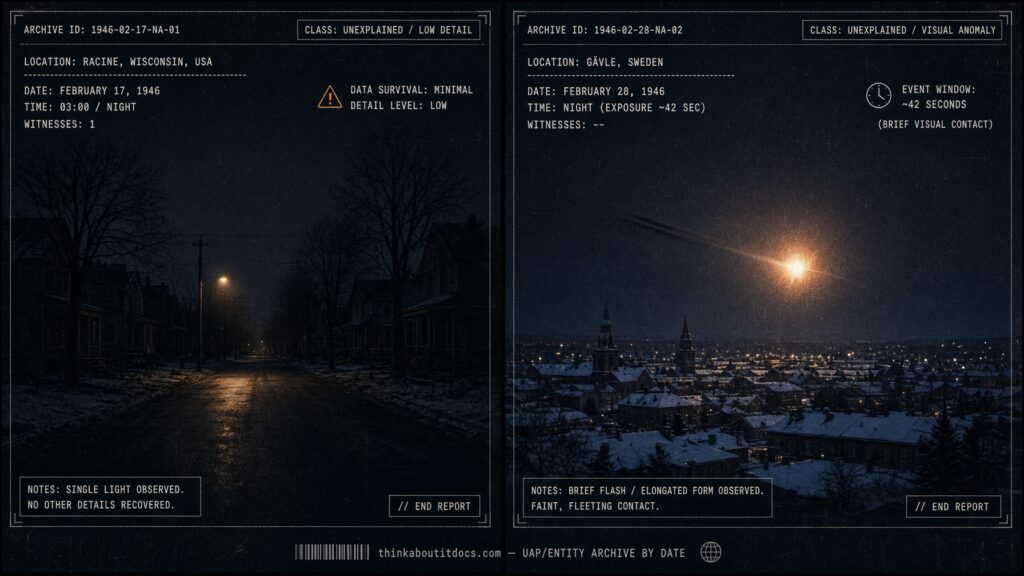
February 1946 — two thinly documented cases: a single-witness light over Racine, Wisconsin, and a 42-second explosion sighting over Gävle, Sweden, three months ahead of Sweden's main ghost rocket wave. thinkaboutitdocs.com.
1946: February UFO & Entity Sightings Archive
February 1946 is one of the thinnest months in this archive’s postwar record — two entries, both bare-bones, neither carrying a named witness. But the second, from Gävle, Sweden, is worth noting for its timing: it predates by roughly three months the main wave of Swedish “ghost rocket” reports that would begin that May and run through the rest of the year, eventually logging some 2,000 sightings nationwide. Whatever exploded over Gävle that February night, it was early.
Date: February 17, 1946
Location: Racine, Wisconsin
Time: 03:00
Summary: One object was observed by one witness.
Source: Condon Committee Source Status: INSUFFICIENT DATA — no further descriptive detail located; likely drawn from the Condon Report’s pre-1947 background case catalogue rather than an independently investigated report.
Date: February 28, 1946
Location: Gävle, Sweden
Time: Unknown
Summary: A mysterious explosion was reported. One object was observed for 42 seconds.
Source: Karl Gösta Rehn Source Status: INSUFFICIENT DATA — thin detail, but notable as one of the earliest 1946 Swedish reports, predating the main “ghost rocket” wave (May-December 1946) by roughly three months.
EXECUTIVE SUMMARY
February 1946 — A Quiet Month, and an Early Warning from Gävle
Neither entry this month carries enough detail to support a full report, and this revision doesn’t manufacture context that isn’t there. The Racine, Wisconsin case traces only to the Condon Committee’s later case catalogue, with no independent description beyond “one object was observed by one witness.” The Gävle, Sweden case is thin in the same way — an explosion, an object visible for 42 seconds, a single named compiler (Karl Gösta Rehn) — but its date matters more than its detail: it sits roughly three months ahead of the main 1946 Swedish “ghost rocket” wave that would begin that May and eventually generate some 2,000 reported sightings nationwide, 200 of them on radar. Whether Gävle was a genuine early instance of the same phenomenon or an unrelated event is not something this thin a record can settle, but the timing is worth flagging for anyone researching the wave’s actual origin point.
“A mysterious explosion was reported. One object was observed for 42 seconds.”
Karl Gösta Rehn, describing the February 28, 1946 Gävle, Sweden case — three months ahead of Sweden’s main “ghost rocket” wave.