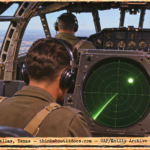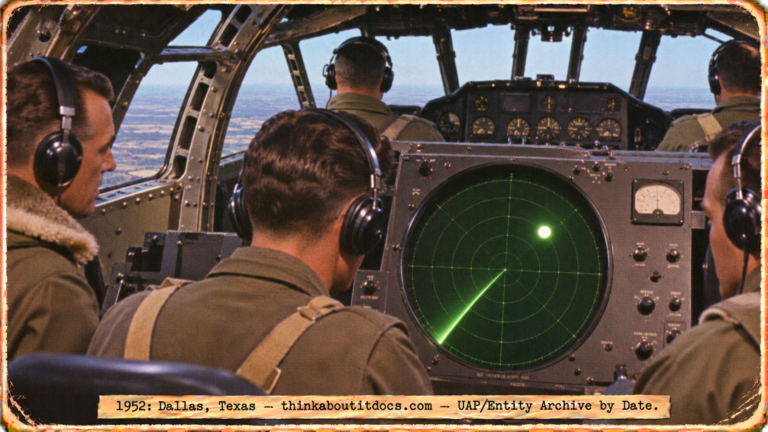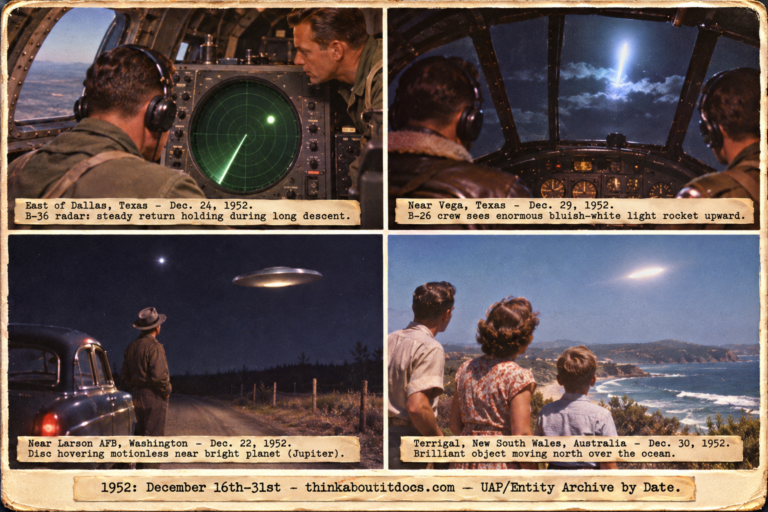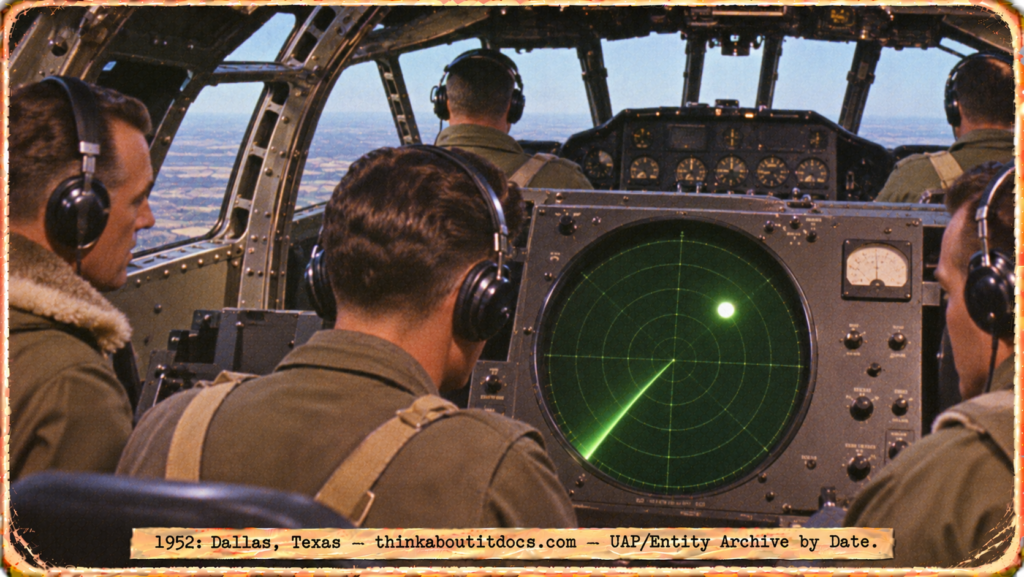
Near Dallas, Texas, December 24, 1952: the B-36 radar case.
THINK ABOUTIT UFO|UAP SIGHTINGS REPORT
1952: Near Dallas, Texas, the B-36 Radar Case
“Something Intelligent Was Guiding It”
On December 24, 1952, a USAF B-36 bomber descending from 40,000 to 15,000 feet east of Dallas, Texas, picked up an object on two separate onboard radar sets that held a near-constant position just ahead of the aircraft for thirty straight minutes. The crew’s own Air Intelligence Information Report did not hedge: the object’s behavior, it stated, “was unexplainable, and seemed to indicate that something intelligent was guiding it.” It stands as one of the best-instrumented radar cases of the entire 1952 wave — tracked on gun-camera film as well as navigation radar, through a long and otherwise unremarkable descent.
Date: December 24, 1952
Sighting Time: 12:15 p.m. CST
Day/Night: Day
Location: East to northeast of Dallas, Texas, roughly 40–80 miles out
Urban or Rural: Not applicable — airborne
No. of Entity(‘s): None
Entity Type: Not applicable
Entity Description: Not applicable
Hynek Classification: RV (Radar-Visual) — though in this case the “visual” element is the radarscope and gun-camera film rather than the naked eye; no eyewitness sighting of the object itself is recorded in the source material reviewed
Duration: About 30 minutes
No. of Object(s): 1
Description of the Object(s): An object detected independently by an AN/APG-41 gun-laying radar and an AN/APS-23 navigation radar, holding a position roughly ahead of the bomber at 2,000–4,000 yards distance throughout the aircraft’s descent
Shape of Object(s): Not resolved — known only as a radar return; the AN/APS-23 presentation was noted by the crew as similar to recent PPI photographs from the Washington, D.C. radar-visual sightings of July 1952
Size of Object(s): Not recorded
Color of Object(s): Not applicable
Distance to Object(s): 2,000–4,000 yards throughout the encounter
Height & Speed: The B-36 descended from 40,000 to 15,000 ft over the encounter; the object matched the bomber’s changing altitude and speed closely enough to hold a near-constant relative position the entire time
Number of Witnesses: The B-36 crew, including the gun-laying radar operator and the AN/APS-23 navigation radar operator
Special Features/Characteristics: Independent confirmation on two separate radar systems of different type; the gun-laying radar was instrumented with a camera, and the resulting film, though unclear, indicated the target’s presence and trackability; the AN/APS-23 operator noted the target returns were consistently sharp compared to other contacts made that day; the object’s station-keeping ahead of the bomber persisted through a 25,000-foot change in altitude
Case Status: Unexplained
Source: Dan Wilson; Project Blue Book files (Air Intelligence Information Report)
Summary/Description: On December 24, 1952, a USAF B-36 bomber descending from 40,000 to 15,000 feet east to northeast of Dallas, Texas, detected an object on both its AN/APG-41 gun-laying radar and its AN/APS-23 navigation radar, holding a position 2,000–4,000 yards ahead of the aircraft for roughly thirty minutes as it matched the bomber’s descent. The gun-laying radar was instrumented with a camera, producing unclear but confirmatory film of the contact. The Air Intelligence Information Report on the incident concluded that the object’s behavior “was unexplainable, and seemed to indicate that something intelligent was guiding it.” The case remains unexplained.
Related Cases: December 1952 archive | the Vega, Texas B-26 encounter, December 29, 1952 | the Washington, D.C. National Airport radar-visual sightings, July 1952
DETAILED REPORT
The encounter began during a routine descent. A USAF B-36 bomber was letting down from 40,000 to 15,000 feet somewhere east to northeast of Dallas, Texas, roughly 40 to 80 miles out, at about 12:15 p.m. on December 24, 1952, when its crew picked up an unidentified return on the aircraft’s AN/APG-41 gun-laying radar — the system normally used to aim the bomber’s defensive armament. The target held a position some 2,000 to 4,000 yards ahead of the aircraft and did not behave like ground clutter, weather return, or another aircraft crossing paths at altitude: it stayed roughly in place relative to the B-36 as the bomber continued its long descent.
What elevates this case above an ordinary unidentified blip is the redundancy of the detection. The crew’s AN/APS-23 navigation radar, an entirely separate system from the gun-laying set, independently picked up the same target at the same relative position. Two different radar systems, built for different purposes and operating on different principles, were tracking the same object in the same place at the same time — a far harder coincidence to explain away than a single set’s spurious return. The AN/APS-23 operator went further still in his own notes, remarking that the target’s returns were consistently sharper than other contacts the crew had made earlier that same day, and separately noting that the scope presentation reminded him of PPI photographs taken during the widely publicized Washington, D.C. National Airport radar-visual sightings five months earlier, in July 1952.
The gun-laying radar was equipped with a camera, standard practice for a system used in aiming defensive fire, and that camera was running during the contact. The resulting film survives in the case file. It is described as unclear — not a crisp photographic record of a craft — but it does corroborate that a persistent target was present and being tracked on the scope throughout the thirty-minute encounter, rather than existing only in a crew member’s verbal recollection after the fact.
The contact persisted through the entire 25,000-foot change in altitude as the B-36 completed its descent, with the object maintaining its 2,000-to-4,000-yard standoff distance the whole way. It was this station-keeping behavior, sustained across a long and otherwise routine maneuver, that prompted the Air Intelligence Information Report filed on the incident to state plainly that the object’s conduct “was unexplainable, and seemed to indicate that something intelligent was guiding it” — language unusually direct for an official Air Force document of the period, which more often reached for a mundane explanation even when one was not obviously available.
RESEARCHER’S NOTES
Two Radars, One Target, and an Official Report That Said So
- Classification, and an honest caveat about “visual”: RV captures the general shape of this case — radar contact with a secondary confirming channel, here the gun-camera film rather than a crew member’s naked eye. No eyewitness description of the object’s appearance survives in the material reviewed for this entry; the “visual” record is the film and the radarscope, not a human sighting, and that distinction is worth keeping clear rather than letting RV imply something it does not.
- Why dual-radar confirmation matters: A single radar operator misreading a spurious return, ground clutter, or an atmospheric anomaly is a known failure mode and a routine skeptical explanation for isolated contacts. Two independently operating radar systems of different design, tracking the same target at the same relative position through a long and varied flight profile, is a materially different and harder case to wave away — which is precisely why the Air Intelligence report’s language is as direct as it is.
- The film as corroboration, not proof: The gun-camera film is real documentary evidence that something was being tracked, but its own description as “unclear” means it does not resolve the object’s shape or nature. It corroborates the existence and persistence of the contact; it does not by itself explain what was producing it.
- The report’s own language deserves to be quoted exactly: Official Air Force intelligence reports of 1952 were not generally inclined toward language suggesting controlled, purposeful behavior by an unidentified object. That this report used the specific phrase “something intelligent was guiding it” is itself a documented fact about the case’s institutional record, independent of whether that conclusion was correct — and it is why the case has been quoted so often in the decades since.
This is not a single confused radar operator’s report. It is two separate onboard radar systems, independently confirming the same target over a sustained thirty-minute descent, backed by camera film of the contact and summarized in the crew’s own Air Intelligence report as unexplainable behavior suggesting intelligent control. What the object actually was remains unresolved. The case stands as Unexplained, on the strength of its instrumentation rather than any single witness’s impression.
“Its behavior… was unexplainable, and seemed to indicate that something intelligent was guiding it.”
— Air Intelligence Information Report, near Dallas, Texas, December 24, 1952