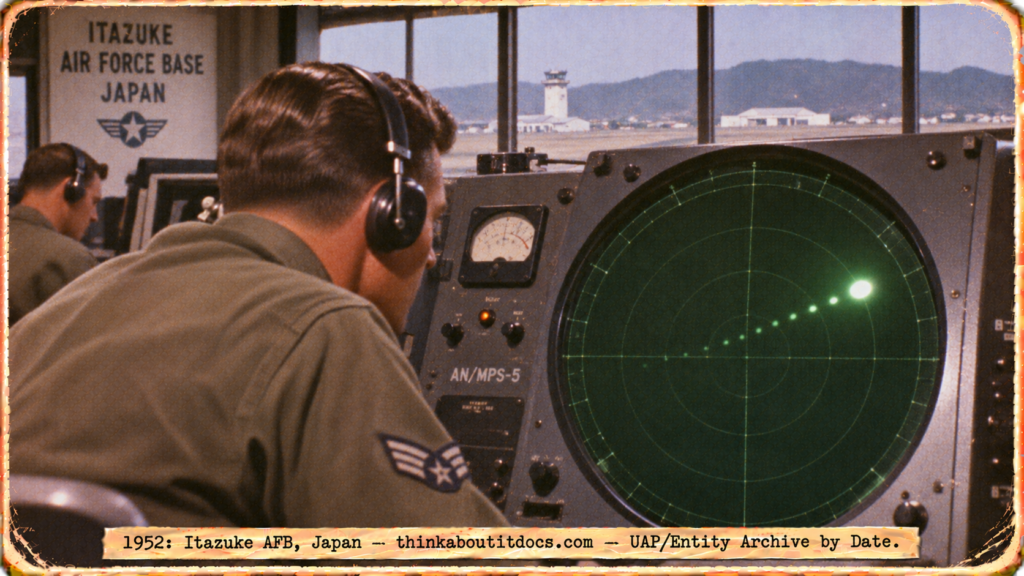
Itazuke AFB, Japan, December 18, 1952: the accelerating radar plots.
THINK ABOUTIT UFO|UAP SIGHTINGS REPORT
1952: Itazuke AFB, Japan, Radar Plots That Tripled Their Speed
On the morning of December 18, 1952, radar operators at Itazuke Air Force Base, Japan recorded five successive plots of a target matching the size of a B-29 bomber — but accelerating steadily across the encounter from roughly 300 knots at first pickup to an estimated 1,040 knots by the fourth, an acceleration curve no B-29, or any aircraft of the period, could sustain.
Date: December 18, 1952
Sighting Time: 8:28 a.m.
Day/Night: Day
Location: Itazuke Air Force Base, Japan
Urban or Rural: Not applicable — radar detection
No. of Entity(‘s): None
Entity Type: Not applicable
Entity Description: Not applicable
Hynek Classification: RV (Radar-Visual) in the broad sense of an instrumented radar case; no eyewitness visual sighting is recorded in the material reviewed
Duration: About 9 minutes
No. of Object(s): 1 (recorded as five successive plots of a single track)
Description of the Object(s): A radar target matching the physical size of a B-29-type aircraft on the AN/MPS-5 scope
Shape of Object(s): Not resolved; radar size-matching to a B-29 silhouette only
Size of Object(s): Matched a B-29-type aircraft, per the radar return
Color of Object(s): Not applicable
Distance to Object(s): Not recorded
Height & Speed: Averaged roughly 710 knots across five plots, on a course varying between 270° and 312°; speed increased from an estimated 300 knots at initial pickup to roughly 1,040 knots by the fourth pickup
Number of Witnesses: Radar operators at Itazuke AFB
Special Features/Characteristics: A radar target sized to match a B-29 bomber yet accelerating to more than three times a B-29’s maximum speed within the course of a single continuous track; a course shifting between 270° and 312° across five recorded plots; no corresponding aircraft reported in the area matching the described performance
Case Status: Unexplained
Source: Dan Wilson
Summary/Description: At 8:28 a.m. on December 18, 1952, radar operators at Itazuke Air Force Base, Japan recorded five successive plots of a target sized to match a B-29-type aircraft on an AN/MPS-5 scope, averaging roughly 710 knots on a course varying between 270° and 312°. The target’s speed increased steadily across the plots, from an estimated 300 knots at first pickup to roughly 1,040 knots by the fourth. The nine-minute encounter has no identified conventional aircraft or cause and remains unexplained.
Related Cases: December 1952 archive, 16th–31st | the Chitose/Misawa AFB, Japan three-beam light case, December 28–29, 1952
DETAILED REPORT
At 8:28 in the morning on December 18, 1952, the AN/MPS-5 radar at Itazuke Air Force Base in Japan picked up a target whose physical size, as rendered on the scope, matched that of a B-29 bomber — a large, familiar aircraft type that radar operators of the period would have had extensive experience recognizing by its characteristic return.
Over the course of five successive plots, recorded as the target moved on a course varying between 270 and 312 degrees, the operators tracked an average speed of roughly 710 knots. But the average obscures the more striking detail: the speed was not constant across the encounter. At the initial pickup, the target was moving at an estimated 300 knots, a speed well within range for a B-29 or similar large aircraft. By the fourth recorded plot, the same target’s speed had climbed to an estimated 1,040 knots — more than three times its own starting speed, and far beyond what any B-29, or indeed any aircraft flying in December 1952, was capable of sustaining.
The entire encounter, from first pickup to loss of contact, lasted about nine minutes. No conventional aircraft matching that performance profile — a B-29-sized radar return accelerating from 300 to over 1,000 knots within minutes — was identified as operating in the area at the time.
The case is documented through researcher Dan Wilson’s compilation of Blue Book and related Air Force radar records. No proposed conventional explanation for the acceleration curve, consistent with neither a malfunctioning radar set (which would more typically produce erratic or implausible readings rather than a smoothly accelerating, consistently sized track) nor any aircraft of the period, is recorded.
RESEARCHER’S NOTES
A Size-Matched Target With an Impossible Acceleration Curve
- Classification rationale: RV is used here in the broader sense common to Blue Book radar cases of a purely instrumented encounter; the source material reviewed contains no eyewitness visual report to pair with the radar data, and that gap is stated plainly rather than implied otherwise.
- Why the acceleration curve is the crux of the case: A single anomalously fast radar plot can often be explained as a momentary glitch, a double-bounce return, or an atmospheric effect. A smoothly progressing acceleration across five consecutive, individually plotted contacts — the same apparent target growing steadily faster rather than simply jumping once — is a harder pattern to dismiss as a single instrument artifact.
- The B-29 size-match is a double-edged detail: That the radar return matched a B-29’s physical size could suggest radar operators were tracking a real large aircraft whose speed readings were somehow corrupted; it could equally suggest an object of comparable radar cross-section to a B-29 that was not, in fact, a B-29 at all, given that no such aircraft’s performance could match the recorded acceleration. The source material does not resolve which reading is correct.
- No corroborating visual or ground-witness account: This case rests entirely on the radar record; without a paired eyewitness sighting, the archive cannot independently verify what radar operators perceived as height, course, or shape beyond what the AN/MPS-5 scope itself presented.
A radar target the size of a B-29 bomber more than tripled its own speed across five successive plots in under ten minutes, far outside the performance envelope of any aircraft flying in 1952. No conventional explanation accounts for the acceleration curve. It stands as Unexplained.
“Successive tracks showed the speed increasing from roughly 300 knots at initial pickup to an estimated 1,040 knots by the fourth pickup.”
— Dan Wilson, summarizing the Itazuke AFB radar case, December 18, 1952