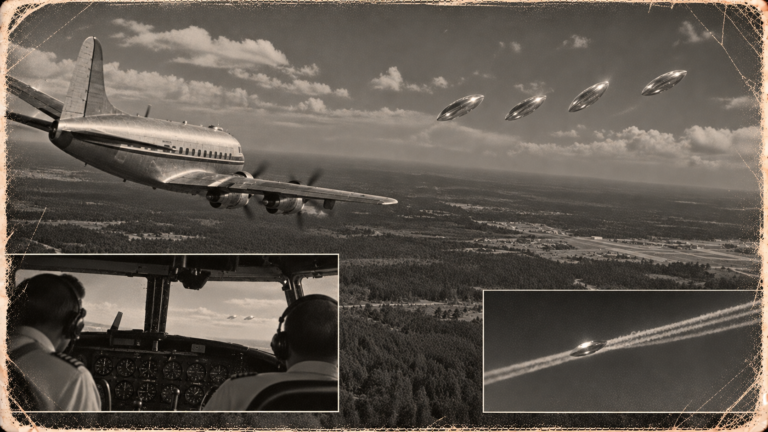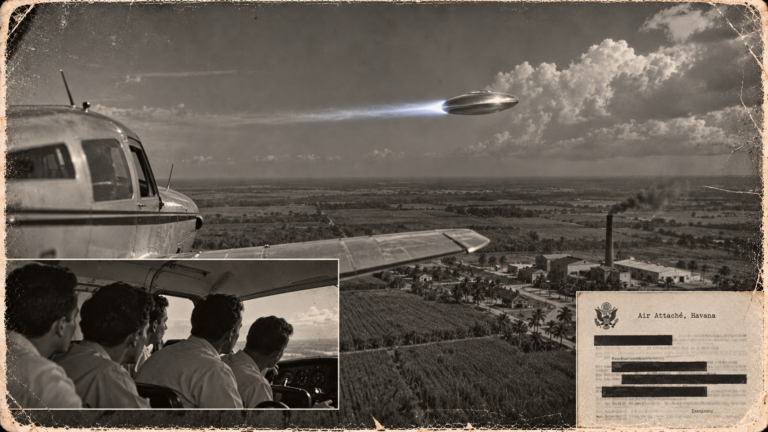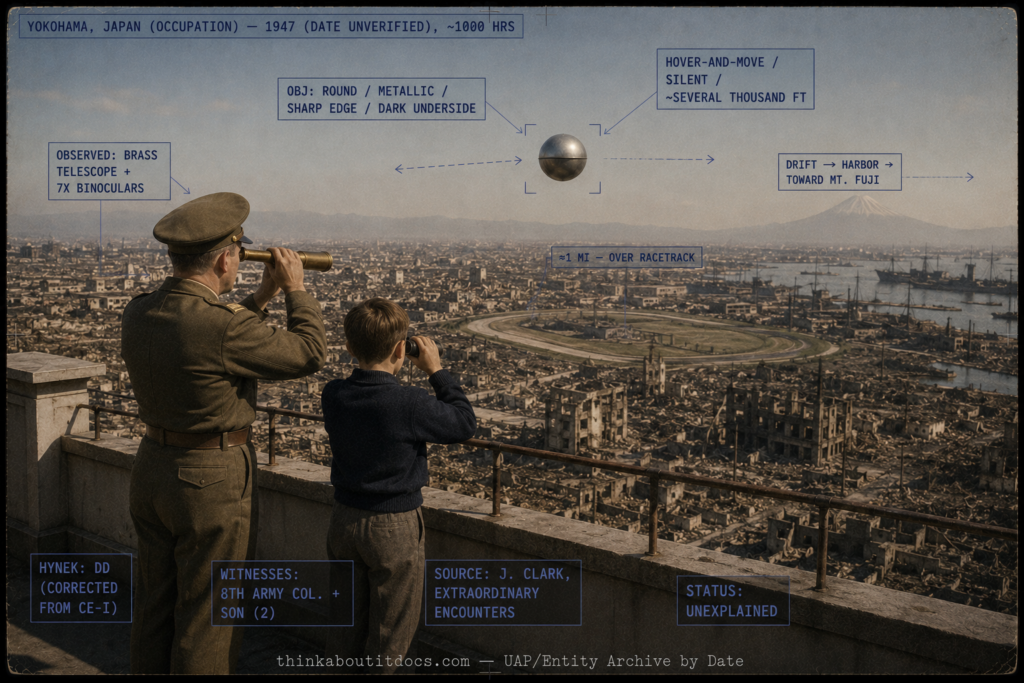
A colonel and his son track a silent metallic sphere through a telescope as it surveys the ruins of Yokohama, 1947 — a daylight case made hard to dismiss by the optics.
THINK ABOUTIT UFO | UAP SIGHTING REPORT
1947: Yokohama Japan Sighting
A colonel of the U.S. Eighth Army and his young son were taking turns with a Japanese brass telescope on the flat roof of their house on the Bluff above Yokohama, looking for something to focus on, when the father picked out a dark shape in the sky. He brought it up in the binoculars first, then captured it in the telescope — and what filled the eyepiece was not an aircraft. It was round, “soccer-shaped,” metal-like with a darker underside and a sharp, un-rounded edge, with no windows and no sound. For a long while the two watched it cross the ruins of a city that B-29s had left ninety percent burned, pausing and hovering over the spared racetrack a mile off, drifting toward the harbor full of sunken ships, then turning away toward Mount Fuji until even the telescope could no longer hold it. The colonel reported it through channels. Nothing ever came back. Decades later, a boy who had heard the story firsthand set it down so it would at least exist in the record.
Date: 1947 (reported as January 15, 1947; the witness states he learned of the event around June 1947, so the precise date is held with uncertainty)
Sighting Time: ~10:00 (morning)
Day/Night: Day (morning)
Location: Yokohama, Japan — observed from a rooftop in the Dependents’ compound on the Bluff, near the horse racing track and POW camp
Urban or Rural: Urban
No. of Entity(‘s): None reported
Entity Type: Not applicable — no occupants or entities observed
Entity Description: Not applicable
Hynek Classification: DD (Daylight Disc) — a structured, metallic object observed in daytime at distance
Duration: A long time (extended observation across the city until the object passed out of telescopic view)
No. of Object(s): 1
Description of the Object(s): A round, “soccer-shaped” object — metal-like in appearance with a somewhat darker underside, a sharp (not rounded) edge, and no windows or other features. It moved, paused, and hovered repeatedly, drifting silently across the city. Observed clearly by naked eye, 7× binoculars, and a brass telescope.
Shape of Object(s): Round / spherical (“soccer-shaped”)
Size of Object(s): Not specified
Color of Object(s): Metallic (“metal-like”), with a darker underside
Distance to Object(s): About 1 mile (when it paused over the racetrack)
Height & Speed: Estimated several thousand feet altitude (below any cloud cover); slow movement with repeated hovering; no estimate of speed
Number of Witnesses: 2 — a Colonel (8th U.S. Army, Occupation forces) and his son; the report relayed by a third party (a young dependent who heard it firsthand)
Special Features/Characteristics: Observed through quality optics (brass telescope + 7× binoculars) over an extended period; metallic appearance with sharp edge and dark underside; silent; repeated hover-and-move behavior; appeared to be slowly surveying the bomb-destroyed city; reported up the Army chain of command with no response received
Case Status: Unexplained
Source: Jerome Clark, “Extraordinary Encounters” (witness report submitted for the record; names redacted in the published account)
Summary/Description: A witness who was a young dependent of U.S. Occupation forces in Yokohama submitted, for the record, an account told to him firsthand around June 1947 by a friend — the son of an 8th Army Colonel. The colonel and his son, experimenting on their rooftop with a brass telescope and 7× binoculars, spotted a dark shape that, in the optics, proved to be a round, “soccer-shaped,” metallic object with a sharp edge, darker underside, and no windows. It traveled silently toward them, paused and hovered over the racetrack about a mile away at several thousand feet, then moved across the destroyed city toward the harbor, appearing to inspect the damage, before turning toward Mount Fuji and slowly receding from view. The colonel reported it through military channels; no feedback was ever received.
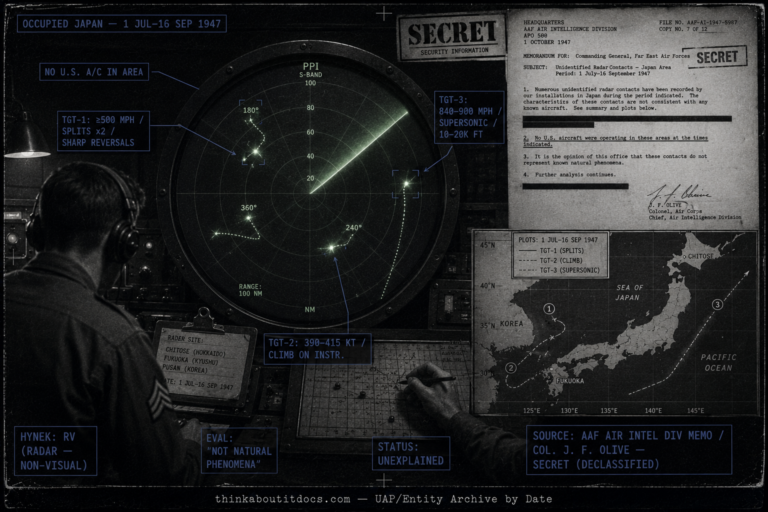
Related Cases: 1947 Radar Pick-ups of High Speed Targets in the Far East (same theater, same year) | 1947 Kenneth Arnold sighting (wave context) | broader Occupation-era Japan sightings
DETAILED REPORT
This account comes to the record at one remove but with notably strong observational credentials. The submitting witness was a young American boy, a dependent of U.S. Occupation forces living in a compound on the Bluff at the edge of Yokohama — near the horse racing track that doubled as a POW camp. He explains that around June 1947 his friend, the son of an 8th Army Colonel, described to him an event the friend had witnessed alongside his father. The submitter sets the account down years later expressly “to make sure it is recorded,” deferring to the original witnesses should they ever report it themselves — a modest and careful framing.
The observation itself is the kind that resists easy dismissal because of the optics involved. The colonel and his son were on the flat, deck-like roof of their two-story house, taking turns with a Japanese brass telescope the colonel had brought home, along with a pair of 7× binoculars. Looking for a target to practice on, the father noticed a dark shape in the sky. He examined it first through the binoculars, then brought it into focus in the telescope. It proved to be round — the boy repeatedly called it “soccer-shaped” — metal-like in appearance, with an underside somewhat darker than the rest, a sharp rather than rounded edge, and no windows or visible features. It made no sound.
Its behavior was the most striking element. The object traveled toward the witnesses, then paused and hovered over the racetrack about a mile away, at what the witness judged to be several thousand feet — low enough to be beneath any cloud cover. It would move to a position, stop and hover, then move again, working its way slowly across a cityscape that the 1945 B-29 raids had left roughly ninety percent burned out: block after block of destruction, canals choked with sunken wooden junks, large ships sunk in the harbor, ruined docks. To the witnesses it looked as though the craft was surveying or inspecting the damage. It drifted toward the harbor, then turned off to the left toward Mount Fuji and slowly receded until it could no longer be seen even through the telescope. Both witnesses were certain it was not an aircraft — it had no wings, no engines, made no noise, and hovered, none of which fit any flying machine the boy knew. The colonel agreed it was no airplane, said he did not know what it was, but stressed that it was unmistakably real and well-seen in the optics. He reported it through military channels; as of the submitter’s departure from Japan in August 1947, no response had come back.
As evidence, the case is secondhand in transmission — the submitter heard it from one of the two primary witnesses — and the primaries are anonymized in the published version, with no recovered military report to corroborate the claimed up-channel filing. The precise date is also uncertain, the witness’s narrative establishing only that the account was circulating by the middle of 1947. But the countervailing strengths are real for an entry of this period: two witnesses, one a senior military officer; an extended daylight observation; the use of both binoculars and a telescope, which largely rules out the misperception of a mundane distant object; and a coherent, unembellished account free of exotic claims. The published source is Jerome Clark, one of the field’s most disciplined chroniclers, which lends the entry credibility as a faithfully recorded report.
RESEARCHER’S NOTES
The Surveyor Over the Ruins — Yokohama 1947 and the Telescope That Made It Hard to Dismiss
- Classification Basis: DD (Daylight Disc) is the correct category: a structured object observed in daylight at roughly a mile’s distance and several thousand feet of altitude. The object being “round” or “soccer-shaped” rather than a classic disc does not affect the classification, which covers daytime structured craft generally. No Close Encounter category applies, as there is no proximity within the close-encounter threshold, no physical trace, and no occupant.
- Source Chain Assessment: The provenance is mixed but respectable. The case is published by Jerome Clark in “Extraordinary Encounters,” a credible secondary source that places it well above anonymous web submissions. The observational chain, however, is secondhand: the submitting witness heard the account directly from one of the two primary observers (the colonel’s son) around June 1947 and set it down later for the record. The primaries are anonymized, and the claimed report “through channels” to the 8th Army has no recovered corroborating document. The submitter’s own candor — explicitly flagging that he is relaying a friend’s account and deferring to the principals — reads as a credibility marker rather than a warning sign.
- Date and Theater Context: The account is firmly anchored to occupied Yokohama in 1947, with the witness establishing that the story was in circulation by the middle of that year. If the January 15 date holds, the sighting predates Kenneth Arnold’s June 24 sighting by five months, which would make it a noteworthy early daylight disc case from the Occupation theater. Either way it sits in the same time and place as the 1947 Far East radar pickups documented elsewhere in this archive, in which trained military operators tracked unidentified high-speed targets over Japan that same year — a theater-level consistency worth noting.
- Pattern Context and Evidentiary Weight: The “metallic, sharp-edged, silent, hovering” morphology and the apparent survey behavior over a devastated cityscape recur in credible daylight reports of the period. There is no physical evidence — no photograph, no recovered report — so the weight rests entirely on the quality of the testimony: two witnesses, senior-officer involvement, extended duration, and, crucially, the use of a telescope and binoculars, which together make a mundane misidentification (balloon, aircraft, bird, optical artifact) considerably harder to sustain than in a naked-eye account. With no conventional explanation fitting the deliberate hover-and-survey behavior seen clearly in good optics, Unexplained is the defensible standing.
The Yokohama sighting is a modest entry with an outsized credibility for its era: a metallic, sharp-edged, silent object that hovered and moved in deliberate stages across a ruined city, watched at length by an Army colonel and his son through a brass telescope and binoculars, and reported up the chain to silence. It is secondhand in transmission and its exact date is uncertain, but the use of quality optics over an extended daylight observation, the senior-officer witness, and the disciplined publication by Jerome Clark lift it well above the anonymous reports of 1947. The record’s standing is DD (Daylight Disc), Case Status Unexplained — a craft that seemed, to the two who watched it, to be quietly surveying what the war had left behind.
I am making this report to make sure it is recorded. I learned of this event around June of 1947. The person who told me was my good friend ((name deleted)). As a background, understand that after WWII, many American Officers brought their families to Europe and Japan as a part of the Dependents of the Occupation Forces. I was one of these dependents, my age was 10 years old. We lived in the ((deleted)) Compound on the Bluff, by the horse racing track and POW camp, at the edge of Yokohama, Japan. We, the ((family name deleted)) lived in House ((deleted)) and the ((family name #2 deleted)) lived in House ((deleted)) Compound. The houses were two story with flat roofs. The roofs were made to use, much like a top deck. ((name deleted)), son of Colonel ((name deleted)), 8th Army in Occupation, was with his father one morning. They had a Japanese brass telescope Colonel ((name deleted)) brought home for his son. They also had a 7X binocular.
They were experimenting with the telescope, at the time this occurred. I will paraphrase what ((name deleted)) told me, for it is worth being recorded. They were taking turns looking through the telescope and binocular when ((name deleted)) father noticed a dark shape in the sky. A perfect target on which to experiment with. Colonel ((name deleted)) first looked at it through the binoculars, then took the telescope and brought the object into its field of view and focus. I was soccer shaped. (( ((name deleted)) said he and his dad took turns watching this object through both the binocular and the telescope. It was traveling toward them. It traveled over to and above the race track and paused. That was about one mile away. It paused. ((name deleted)) said it was not high, probably several thousand feet in the air. This would put it under any cloud cover.
I asked what did it look like?
It looked like a soccer, it was “metal-like, but the underside was somewhat darker. The edge of the soccer was sharp, not rounded. It had no windows or such. I asked what did it do? It move around and then stopped in the sky and just hovered. Then it would move to another location and again hover. For the record, at the time (1947) Yokohama showed the full brunt of many B-29 strikes. The city was 90% burned out with an occasional structure standing amidst a totally destroyed area, block after block. Down toward the harbor, the canals were chocked with sunken wooden junks. Out in the harbor several large ships were sunken in the harbor. The dock facilities were equally damaged. The city was totally destroyed. Many of the people who lived in the hills surrounding Yokohama were really the only houses spared by the bombing strikes. The race track wa also spared, probably because it was a POW camp. ((name deleted)) said this “craft” was slowly crossing across the destroyed city. It looked like it was inspecting the damage. Where did it go? I asked. It went across us and slowly made it way across the city heading toward the harbor. Did you see it by eye and in the binocular and telescope? Oh sure, it was easy to follow. I was in good view, especially in the telescope. What did it look like? Like a soccer. It was round, it was soccer shaped. Did it make a noise? No, not at all. I was totally perplexed. This was the first time I ever heard of a flying machine shaped like a soccer. All flying machines had wings and big motors and they dropped bombs and shot machine guns and made lots of noise. None hovered! How long did you watch it? I asked in perplexed wonder.
A long time, we watched it go out toward the harbor. It moved around, paused and then turned off toward the left(toward Mount Fujiyama) It slowly moved off. we watched it until we could not see it any more, even in the telescope. What was it? I don’t know. It wasn’t an airplane. What did your dad say? He said it wasn’t an airplane. He didn’t know what it was, but it was real, we could see it. The binocular and telescope gave us real good views. With that, we went on to other things that 10 year boys do. We probably went over to the open field where we played baseball with the Japanese children. I played right field. I seem to remember ((name deleted)) was a baseman. Anyway that was the end of our conversation about the unidentified flying object. I left Japan in August of 1947. I believe ((name deleted)) was still living in House # ((deleted)). I do remember asking him about this strange soccer. I asked what his father did. He reported it. I asked, what happened? He said, “Nothing. We never heard another thing.” As far as I know, that is where it ended. His father being a full bird colonel in the 8th US Army, like mine were pretty VIP. He reported it through channels and that was that. They did not receive any feed-back, as of August 1947. However make no mistake, the US Army was duly notified of the sighting. That’s as much as I know. I hope ((name deleted)) or his father have already made this report. In this case, I prefer to defer to that that said. At any rate, this is as much as I know, as close to the actual conversations as I can remember.
((name deleted)) Dependent, Army of Occupation Yokohama, Japan 1947.