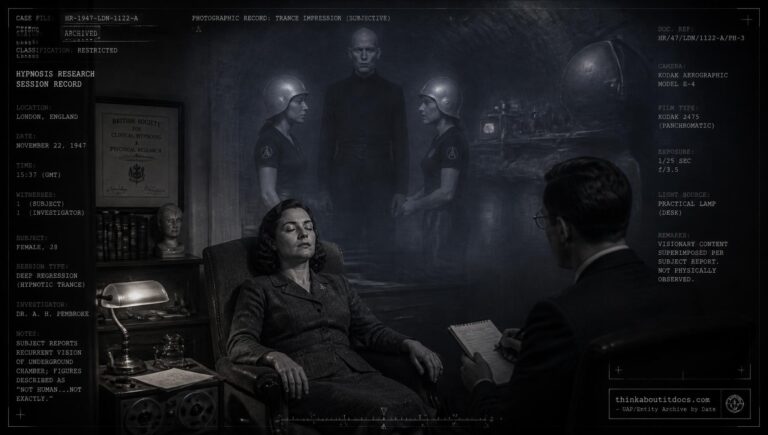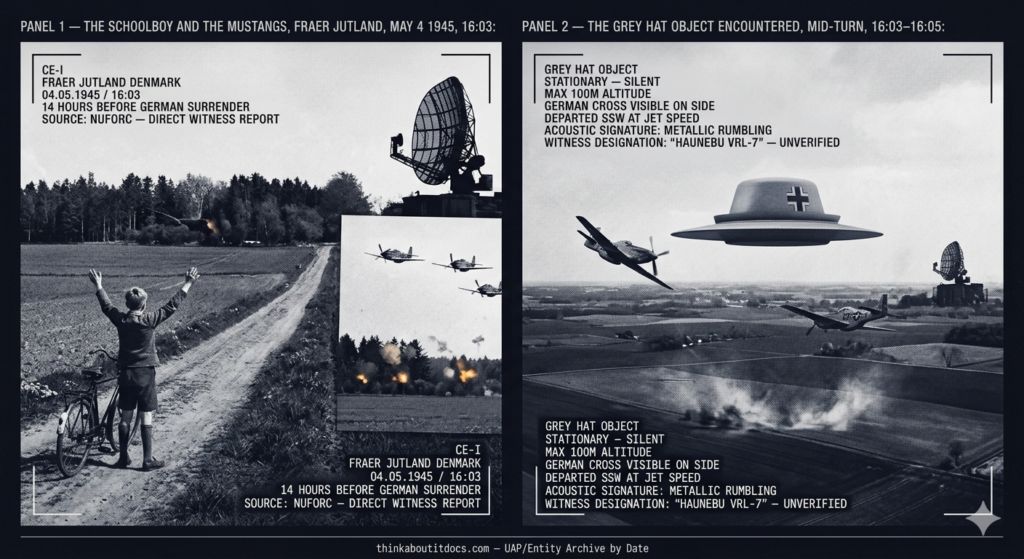
Fraer, Jutland, Denmark, May 4, 1945 at 16:03 — 14 hours before Germany's surrender in Denmark. A 13-year-old Danish schoolboy near German radar station Camp Lindwurm watches three RAF Banff Strike Wing P-51 Mustangs draw German flak and turn to strafe. During their 360-degree turn all three aircraft encounter a grey hat-shaped object hovering silently at maximum 100 metres altitude. When the Mustangs approach close, the object departs at very high speed SSW with a metallic rumbling sound; a German military cross is visible on its side. One Mustang pilot is shot down and hospitalised at Løgstør; he recovers and returns to Britain. The witness filed a direct report with NUFORC in 1997 with Peter Davenport correspondence on record. Source: NUFORC. Case Status: Unexplained. thinkaboutitdocs.com.
THINK ABOUTIT UFO | UAP SIGHTING REPORT
1945: Fraer Jutland Denmark Sighting
At 16:03 on May 4, 1945 — fourteen hours before Germany’s formal surrender in Denmark — a 13-year-old Danish schoolboy was cycling home from school along a road near the German Würzburg Reise radar station at Camp Lindwurm near Fraer, Jutland, when he heard the unmistakable sound of Allied aircraft. He stopped. Three P-51 Mustangs from the Banff Strike Wing were crossing Jutland on course 280 degrees, returning from a strike in the Kattegat. The boy dropped his bicycle and waved with both arms. The lead pilot saw him and tipped his wings. Then German flak opened up from a small forest nearby. All three Mustangs turned 360 degrees and came back to fire on the flak position. The pilot in the lead aircraft — name redacted in the NUFORC report — was hit in the arm and his aircraft holed. He crash-landed in an open field approximately one kilometer east of Hornum village and was taken to Løgstør Hospital, where German soldiers attempted to take him prisoner and the hospital chief refused. The pilot recovered and was back in Britain within two weeks. He was later killed in Kenya by the Mau Mau movement between 1952 and 1956. But that is not the centre of this account. During that 360-degree turn, approximately 90 degrees into the manoeuvre, all three Mustangs encountered a grey hat-shaped object hanging silently in the air at no more than 100 metres above the ground. No sound. Just hovering. When the Mustangs came close, the object began to move — accelerating in the direction of SSW at a speed the witness compared to a modern jet fighter, preceded by a short heavy noise he described as sounding like many metal dustbins rumbling together. The boy watched it go. On its side he could see a German cross.
Date: May 4, 1945
Sighting Time: 16:03 (precise time per witness)
Day/Night: Day
Location: Near Fraer (Skørping area), Jutland, Denmark — in the vicinity of German radar station Camp Lindwurm; crash landing near Hornum village, approximately 1 km east
Urban or Rural: Rural — open Jutland countryside, German radar installation area
No. of Entity(s): None reported
Entity Type: N/A
Entity Description: N/A
Hynek Classification: CE-I — Close Encounter of the First Kind (object observed in close proximity to witnesses within 500 feet — the object was at maximum 100 metres altitude when the P-51s encountered it, which puts it well within CE-I range; the schoolboy on the ground also observed it at close range)
Duration: Not precisely recorded — object was stationary until P-51s closed on it, then accelerated away rapidly
No. of Object(s): 1
Description of the Object(s): A collared grey hat-shaped object hanging silently in the air at maximum 100 metres above the ground. No sound during hover. When the P-51s approached at close range, it began to move in the direction of SSW at very high speed. Departure preceded by a short heavy noise described as resembling many metal dustbins rumbling together. A German military cross (Balkenkreuz) was visible on its side when it banked. No other markings or structural details recorded.
Shape of Object(s): Grey hat-shaped — collared, like a wide-brimmed hat or disc with a collar rim
Size of Object(s): Not precisely recorded; scale suggested by proximity to the P-51s during the encounter
Color of Object(s): Grey
Distance to Object(s): Maximum 100 metres altitude (ground level distance not recorded); P-51s in very close contact when object departed
Height & Speed: Hovering — maximum 100 metres altitude; departed at very high speed in SSW direction (witness compared it to a modern jet fighter)
Number of Witnesses: The 13-year-old Danish schoolboy (primary ground witness — filed the NUFORC report as an adult); three P-51 Mustang pilots (aerial witnesses — not independently interviewed; names redacted in NUFORC report)
Special Features/Characteristics: Most precisely dated and timed wartime WWII disc encounter in the archive — 16:03, May 4, 1945, 14 hours before Germany’s surrender in Denmark; witnessed simultaneously from the ground (schoolboy) and from the air (three P-51 pilots); object was initially stationary and silent, departed only when P-51s approached at close range; departure preceded by specific acoustic signature (metal dustbin rumbling); German Balkenkreuz (military cross) visible on the object’s side on departure; witness’s own identification of the object as a German “Haunebu Vril-7” is an interpretation, not a confirmed fact; the P-51 crash, the pilot’s hospitalisation, and the German attempt to take him prisoner are independently verifiable historical elements of the account; NUFORC correspondence with witness on record (Peter Davenport)
Case Status: Unexplained — object not identified; witness’s Haunebu designation is an interpretation
Source: National UFO Reporting Center (NUFORC) — direct witness report filed by the Danish schoolboy (adult, name redacted), with NUFORC correspondence from Peter Davenport on record
Summary/Description: On May 4, 1945 at 16:03, fourteen hours before Germany’s surrender in Denmark, a 13-year-old Danish boy near a German radar station watched three P-51 Mustangs draw German flak and turn to strafe the position. During their 360-degree turn the Mustangs encountered a grey hat-shaped object hovering silently at maximum 100 metres altitude. When the aircraft approached it, the object departed at very high speed in the SSW direction with a specific metallic rumbling sound. A German cross was visible on its side. One P-51 pilot was shot down and hospitalised; he later recovered. The event occurred 14 hours before the German surrender in Denmark.
Related Cases: 1942 Battle of Los Angeles — unidentified object impervious to military engagement | 1944 WWII Foo Fighters — German-marked aerial anomalies over European theatre | 1936 Black Forest crash claim (same Haunebu mythology — contrast case) | 1937 Czernica crash claim (same mythology — contrast case)
DETAILED REPORT
The May 4, 1945 Fraer Jutland case is the most precisely timed and historically anchored wartime disc encounter in the European WWII record. Its specific details — 16:03, May 4, 1945, 14 hours before Germany’s surrender in Denmark, near an identifiable German radar installation at a specific map location — are not the features of a fabricated or embellished account. They are the features of a man who remembered exactly where he was and what he saw on one of the most significant days of his life.
The historical scaffolding of the account is independently verifiable to a substantial degree. The Banff Strike Wing was an active RAF strike formation operating over Danish waters in the final days of the war. P-51 Mustangs of Madras Presidency Squadron (the squadron designation is redacted in the NUFORC filing but referenced in the operational description) were conducting strikes in the Kattegat in May 1945. German flak positions in Jutland were still active on May 4 — the surrender did not take effect until 08:00 on May 5. The Würzburg Reise radar system was standard German defensive radar equipment deployed throughout occupied Denmark. A pilot being crash-landed near Løgstør and hospitalised, followed by a German attempt to take him prisoner rebuffed by the hospital chief, is consistent with the documented chaos of the last days of the German occupation of Denmark. The witness notes that the pilot was later killed in Kenya by the Mau Mau movement between 1952 and 1956 — a specific biographical detail that would be verifiable through RAF personnel records.
The UAP element enters the account at a very specific moment: approximately 90 degrees into the Mustangs’ 360-degree retaliatory turn against the flak position. At that point all three aircraft encounter a grey hat-shaped object hovering silently at maximum 100 metres altitude. This is not a distant light. This is a structured, stationary object in the direct flight path of three combat aircraft at an altitude below 100 metres. The three pilots could not have missed it. The witness on the ground, who was already watching the aircraft’s manoeuvre, observes the encounter and the departure simultaneously.
The object’s behaviour on the P-51s’ approach is operationally significant. It was stationary and completely silent during its hover — undetected by the witness until the aircraft drew close to it. When the P-51s closed to very close range, it departed immediately in the SSW direction at a speed the witness compared to a modern jet fighter — a comparison he makes from the perspective of a man filing in 1997, comparing what he saw in 1945 to technology he knew in 1997. The departure was preceded by a distinctive sound: a short heavy metallic rumbling described as similar to many metal dustbins. This specific acoustic signature is the most distinctive physical evidence detail in the account.
The German cross visible on the object’s side during its departure is the element that leads the witness to identify it as a “Haunebu Vril-7.” This identification must be treated with the same caution applied to the Black Forest and Czernica claims in this archive. The Haunebu designation originates in post-war German fringe literature with no verified primary documentation. However, the German cross sighting itself is a separate datum from the Haunebu interpretation — a visible German military marking on an unidentified flying object in German-occupied Danish airspace in May 1945 is factually significant regardless of what kind of object carried it. It could indicate: (1) a genuine German experimental disc aircraft; (2) a known German aircraft type misidentified by the witness; (3) a marking the witness interpreted as a German cross that was something else. The archive records the marking as reported without endorsing the Haunebu identification.
RESEARCHER’S NOTES
14 Hours Before Surrender — Fraer Jutland 1945 and the Last-Day Anomaly
- Source Chain Assessment: NUFORC is a self-reporting database — its cases are not field-investigated. However, the Fraer Jutland case carries exceptional internal credibility for a NUFORC report: named location, precise time, independently verifiable historical context (Banff Strike Wing operations, Würzburg radar stations, German occupation of Denmark in May 1945), NUFORC director Peter Davenport’s direct correspondence with the witness on record, and a witness who signed his statement by hand and invited contact from the surviving P-51 pilots. The witness’s English is noticeably non-native and untranslated — a credibility marker for an authentic foreign national report rather than a constructed English-language narrative. The case sits at PLAUSIBLE — above Insufficient Data for a NUFORC self-report — because of the density of verifiable historical anchors.
- The Haunebu Identification — Witness Interpretation vs. Archive Standard: The witness designates the object as a “german rfz” and specifically “Haunebu Vril-7.” The archive’s standard treatment of Haunebu claims — established in the Black Forest and Czernica report pages — is PROBLEMATIC / Insufficient Data due to the absence of primary documentary evidence for the Haunebu programme. However, the Fraer Jutland case occupies a different evidentiary position from those claims: the witness directly observed a structured object with a German military cross in German-occupied airspace in the last hours of the war. Whether that object was a Haunebu or a known German experimental aircraft or something else entirely cannot be established from the account. The Haunebu designation should remain in the report as the witness’s own interpretation while the CE-I classification reflects the observational evidence.
- The Timing — 14 Hours Before Surrender: Germany’s unconditional surrender in Denmark, the Netherlands, and Northwest Germany took effect at 08:00 on May 5, 1945. The Fraer encounter occurred at 16:03 on May 4 — 15 hours and 57 minutes before the surrender came into force. If the object was a German experimental aircraft of any kind, its operational use 14 hours before surrender raises the question of what operational purpose it served at that moment. The German military in Denmark on May 4 was in administrative surrender — Field Marshal Montgomery’s ceasefire had been agreed the previous day at Lüneburg Heath. An experimental aircraft hovering near a radar station at 100 metres altitude as P-51s overflew the position is an anomaly within the anomaly.
- The Pilot’s Fate: The witness notes that the downed P-51 pilot (name redacted) was later killed in Kenya by the Mau Mau movement between 1952 and 1956. This specific biographical detail post-dates the war and could be verified through RAF personnel and casualty records. If confirmed, it would establish the pilot’s identity and make the aerial witness component of this case potentially traceable through formal RAF archival research — the most significant open research lead available for this case.
At 16:03 on May 4, 1945, fourteen hours before the war in Denmark ended, a Danish boy on a bicycle watched three P-51 Mustangs turn to fight German flak and instead encounter something that hovered silently at 100 metres altitude near a German radar station. When the aircraft got close it left — fast, loud in departure, with a German cross on its side. One pilot was shot down and hospitalised. The others went back to Banff. The grey hat object went SSW. The surrender came at 08:00 the next morning. The witness filed his account with NUFORC in 1997 by hand, in his own English, and invited anyone who knew the pilots to contact him. Case Status: Unexplained. The German cross on the object’s side remains the most specific and least resolved detail in the record.
Young Danish boy witnesses UFO in dogfight with three U.S. P-51’s.
Subject: german rfz (ufo) 4th may 1945.
A special event took place on 4th may 1945 at 16.03 when 3 Mustang flying over a very important german radar station area Camp “Lindwurm” near Fraer, Jutland Denmark as this event took place: All three pilots mentioned above were on their way back to their base in England from a raid in Danish water “Kattegat” – but they were on their course crossing a big and very important german military Radar- and listening Camp- codename “Lindwurm” – with 6 spec. Radar/listening devices/system were placed among other equipments etc. – I think they all three pilots got very surprised on this spot which looks peacefully – here is the event as I remember it:
On that this very last day 4th may 1945, just 14 hours before the second World War (the german surrender) ended both in Denmark and Germany was on a Friday 4th May 1945 and precisely at 16,03 hours did 3 Mustang Jagerfly IV pass by on crossing Jutland and they were passing by on course 280o. – A schoolboy (witness name deleted – 13 year) has stopped on the road, when he heard this special airplane noise which only could come from the allied flights. The boy stopped on the road, on his way home from school, just outside one of the german Würzbug Reise radar-station – close to the road (30 m) and when he discovered three Mustangs – he signaled to all 3 pilots by waving his arms. The pilot in front tipped with his wings from side to side back to the boy. On the precisely the same time a german flak open fire on these 3 Mustang IV from (Squadron # deleted) Sqdn. (Madras Presidency). All 3 Mustang-flight´s now turned 360o around and back again to fire on this creasy german flak, hiding in on a very small forest area – Pilot P/O (pilot name deleted) here was hit in his arm, and the aircraft was holed. The P/O (name deleted) crash landed few minutes later on an open field, approx 1 Km east of the city Hornum village, where he was taken care of and brought to Løgstør Hospital by civilians (local doctor), just before the German army enters the crashing plane. – The German army now went to Løgstør Hospital to capture (name deleted) as prisoner, but the hospital chief/doctor refuse to do it, as he said: “this patient was in treatment.” – P/O (pilot name deleted) soon recovered and was back in Great Britain within 2 weeks time.
The schoolboy shortly after that got in serious trouble from two germans soldiers, who was stationed at this Würzburg radar, nearby him – they shout, threaten and running after the boy, they want to give him a beating. The boy jump on his bicycle as fast as he could away home. A very special event toke place as those 3 Mustang turning 360o around to fire back on the flak. Than they approx. after 90o all meet a collared “grey hat formed object” hanging in the air – max. 100 m of the ground, without no sound! When this “grey hat-formed object” realize that it now could get in trouble, it started at ones away from those Mustangs in direction SSW. When “the grey hat object” (a german “Haunebu” Vril-7) was on its side marked with a german cross. This object did started with a short heavy noise, a sound as you may imagine coming from many metal dustbins, like rumbling and away was this “grey hat-object” as fast as a now a day Jet-fighter.
This report on this document I hereby sign, testifying as the witness, to that the above report, confirming that this incident did take place as described here. in June 1999. Please contact: (name deleted) email: (e-address deleted).tele.dk November 1997 – Signed by my own hand.
Note: The special event on 4th may 1945 at 16.13: I would like to get in contact to one or all 3 RAF-pilot who was stationed on Banff Air Base in northern England in may 1945:
Mustang Jagerfly (a/c # and pilot #2 name deleted)
Mustang Jagerfly (a/c # and pilot #3 name deleted)
Mustang Jagerfly (a/c # and pilot #1 name and birthdate deleted)
All three Mustang on crossing out over Jutland, some flak positions by Mariager (correct pos. was Fraer near Skorping) opened up fire. Mustang Jagerfly (pilot #1) was hit in his arm and the aircraft was holed. He crash landed near Løgstør (Aars) and he was taken to Løgstør Hospital. He soon recovered. – Some sources also state that the Banff Strike Wing was “escorted” by their Air Sea Rescue Warwicks as well on 4 may 1945. It has later been confirmed that P/O (pilot #1) has been killed in Kenya by the “Mau-Mau movement” in Kenya sometime between 1952-56. I´m willing to answer any questions and to your first question I can replay: I did not see this rfz object before the incident tool place because my interest was the well knowing noise from this P-51 a noise which we during the 2. WW have heard many time but only at nights and never have seen, now was possible to see in full daylight and this was a exciting moment for me. after following the P-51 around in the air I here for the first time got the view of this rfz object there was hanging quit was just after the germans try to shoot the P-51 down and they now turning around very fast- here I got the first look at the rfz -object.
Second question: the rfz did take off from its hanging position after the P-51 was in very close contact to this rfz object and the rfz fly of in the direction SSW south/south/west in high speed possible and my only guess is that it did try to avoid any further contact. i do hope that my response to your questions be content sincerely (witness name deleted)
P.S.–My english is not the best but I hope we understand each other.
(NUFORC CORRESPONDENCE WITH WITNESS)
Dear Mr. (name deleted),
Thank you very much for the most interesting letter!! The report is remarkably well detailed, and it certainly has the sound of authority to it. There is little doubt in my mind but what the incident occurred precisely as you have described below. I have many questions about the gray object, and would like to correspond with you about it. Would you be willing to answer a few questions, please? Most of all, I would like to know whether you witnessed the object ahead of time, before the P-51’s arrived. Also, I would like to know what happened to it, in the final analysis. Did it fly off, in order to escape from the P-51’s, or did it stay in the same place? I will enter your description of the incident as a report, and post it to our website in the near future. Thank you, again, for sharing the information with our Center!!
Cordially, Peter Davenport
(END NUFORC LETTER)
(WITNESS RESPONSE)
i´m willing to answer any questions and to your first question I can replay: I did not see this rfz object before the incident tool place because my interest was the well knowing noise from this P-51 a noise which we during the 2. WW have heard many time but only at nights and never have seen, now was possible to see in full daylight and this was a exciting moment for me. after following the P-51 around in the air I here for the first time got the view of this rfz object there was hanging quit was just after the germans try to shoot the P-51 down and they now turning around very fast- here I got the first look at the rfz -object. second question: the rfz did take of from its hanging position after the P-51 was in very close contact to this rfz object and the rfz fly of in the direction SSW south/south/west in high speed possible and my only guess is that it did try to avoid any further contact. i do hope that my response to your questions be content
sincerely (witness name deleted)
ps. my english is not the best but I hope we understand each other.
(END RESPONSE)