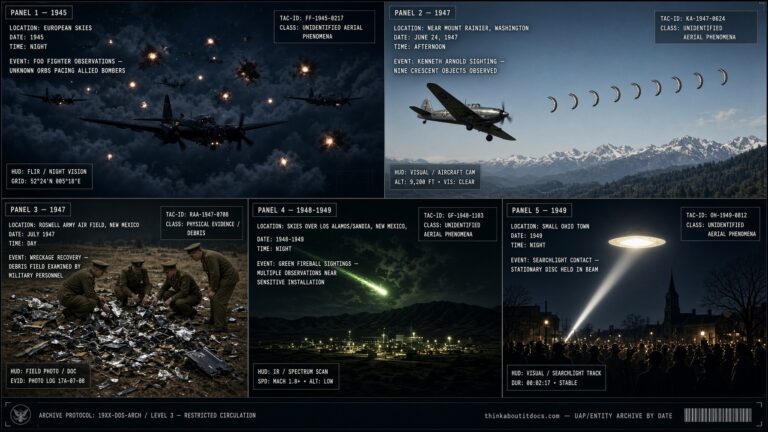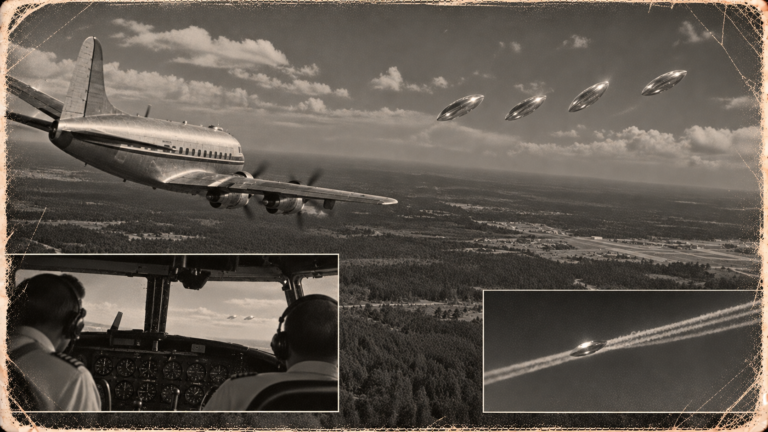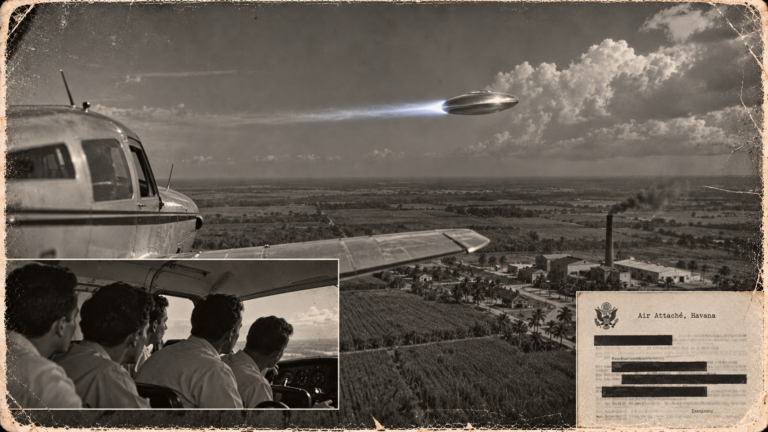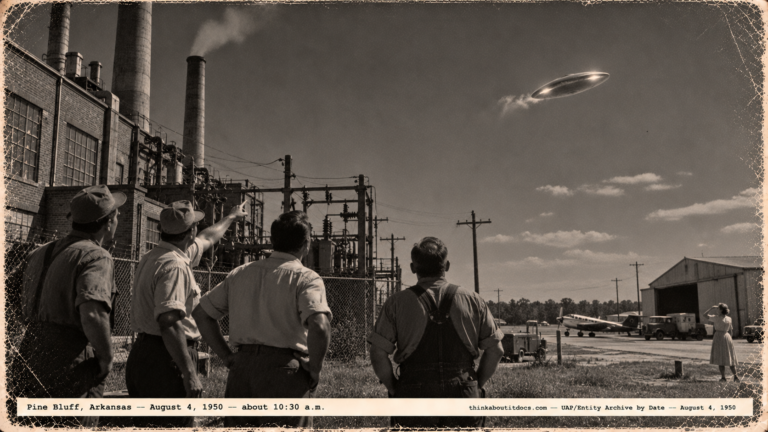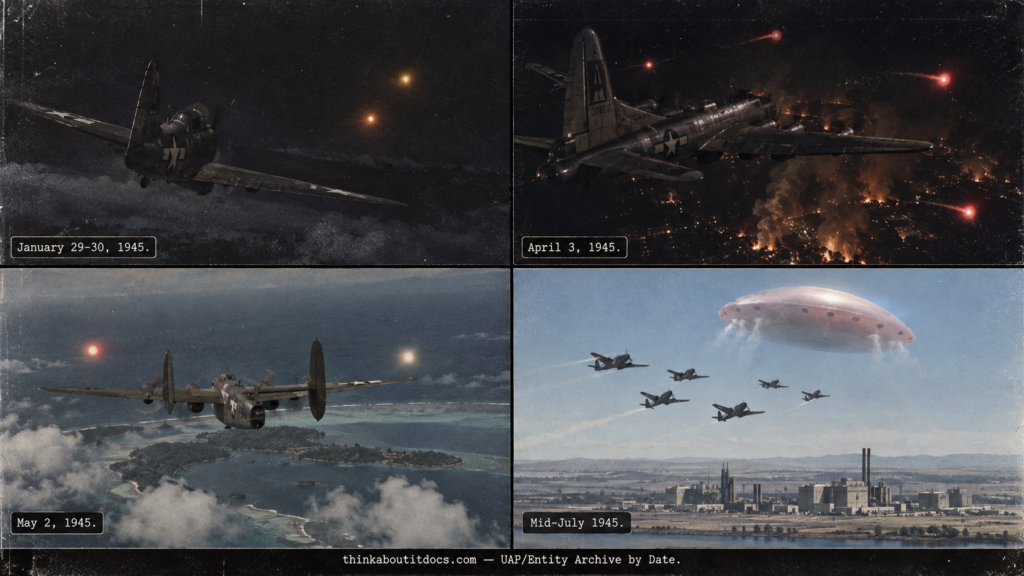
1945 — Four anchor cases from the year the Foo Fighter entered the official record: Wissembourg-Landau (January), Kawasaki and Tokyo (April), Fala Island (May) and Hanford (July). thinkaboutitdocs.com.
1945: UFO | UAP & Entity Sightings by Date Hub
In 1945, the strangest lights of the Second World War stopped being pilots’ slang and started showing up in official paperwork. On the night of January 29-30, a 415th Night Fighter Squadron crew flying as “Travel 34” logged a “Foofighter” over Germany, and their intelligence officer put the word in a report the very next day. By April, B-29 crews were reporting basketball-sized “balls of fire” over Kawasaki and Tokyo that matched every evasive maneuver, and a Pentagon memo noted that infrared viewers could be shipped to XXI Bomber Command for trial. On May 2, a VII Bomber Command mission report recorded two color-changing objects pacing a B-24 over Fala Island, Truk Atoll, for more than an hour.
The rest of the year widened the record. Named witnesses described a pink, egg-shaped object hovering over the Hanford plutonium works while six F6F Hellcats strained to reach it, a cigar-shaped craft that followed the Okinawa coastline at eye level, and three teardrop objects that paced a C-46 near Iwo Jima just after Japan’s surrender. Then the reports thin out: one thinly sourced light in September, no UFO cases located for October or December, and a lone November entry that is a disappearance rather than a sighting. This is the complete 1945 UFO sightings archive: twelve monthly indexes and an Unknown Date page, each with its anchor cases and its honest source flags.
1945: January UFO & Entity Sightings Archive
The month “Foofighter” entered official paperwork: Travel 34’s encounter between Wissembourg and Landau, a VII Bomber Command crew’s amber-light escort off Iwo Jima, and a submerged disc off the Solomon Islands, recounted 31 years later.
1945: February UFO & Entity Sightings Archive
Nine Italian-front Foo Fighter reports, alongside LCDR Norman Stark’s Ulithi intercept, where four F6F Hellcats at full power couldn’t close on a radar contact, and a 415th Night Fighter Squadron report from Rastatt. The Prague “German saucer” claim is retained and labeled disputed.
1945: March UFO & Entity Sightings Archive
A Maine hunter’s account of a craft landing near Belfast, USS New York’s gunners unable to reach a hovering object over the Admiralty Islands, and a report of 100 orange fireballs over Bologna.
1945: April UFO & Entity Sightings Archive
RAF-corroborated “balls of fire” over Kawasaki and Tokyo, a Pentagon memo on shipping infrared viewers to XXI Bomber Command for trial, and a 549th Night Fighter Squadron radar chase near Iwo Jima.
1945: May UFO & Entity Sightings Archive
The best-documented Pacific “balls of fire” case in the archive: two objects pacing a B-24 for over an hour at Fala Island, Truk Atoll, per an official mission report. Also a fireball that followed a battle-damaged B-29 for 50 miles.
1945: June UFO & Entity Sightings Archive
A nine-year-old’s encounter at Taganrog Bay with a silver-suited occupant who invited him aboard (carried as Insufficient Data on thin sourcing), the Delarof sphere’s third and best-dated appearance, a naval radar officer’s 1,000-mph contact south of Okinawa, and a 9th Bomb Group veteran who asked General LeMay about the balls of fire and received no explanation.
1945: July UFO & Entity Sightings Archive
Six F6F Hellcats couldn’t reach an egg-shaped object hovering over the Hanford plutonium works, per pilot Roland D. Powell, whose size and altitude estimates have no independent military corroboration. B-29 commander Charles Chauncey also watched two formations of fireballs pass off Yokohama.
1945: August UFO & Entity Sightings Archive
William Mandel’s cigar-shaped craft over Okinawa, Leonard Stringfield’s three teardrops pacing a C-46 near Iwo Jima, and a USS Bradford officer’s star-like object that three radars did not register.
1945: September UFO & Entity Sightings Archive
The month of Japan’s formal surrender aboard USS Missouri leaves a single entry: a stationary bluish-white light at Buckner Bay, Okinawa, with no named witness.
1945: October UFO & Entity Sightings Archive
No UFO or entity cases located. The United Nations Charter taking effect on October 24 is noted as context, and the archive treats the silence as a genuine lull rather than a sourcing gap.
1945: November UFO & Entity Sightings Archive
One entry, and not a sighting: the November 12 disappearance of 74-year-old hunting guide Middie Rivers on Glastenbury Mountain, Vermont, the first case in what became known as the Bennington Triangle.
1945: December UFO & Entity Sightings Archive
No UFO or entity cases located, with the Middie Rivers entry corrected out of this month and into November.
1945: Unknown Date UFO & Entity Sightings Archive
Five cases with no month: the Delarof sphere with its named-witness source chain, a disputed Bulgaria wreckage claim tied to the Zhitkur legend, an unverified Wonsan dogfight claim, an undetailed radar contact near Guam, and an undated landed-craft account from occupied Germany.
THE 1945 PAPER TRAIL
Where the Foo Fighter Record Comes From
415th Night Fighter Squadron reports (January-April): Capt. F.B. Ringwald’s January 30 intelligence report used the squadron’s own term, “Foofighter.” The squadron’s mission reports, fifteen of them recovered from NARA by researcher Barry Greenwood in 1992 and covering September 1944 to April 1945, document the Rastatt-Bischwiller (February) and Rhine River (April) encounters.
VII Bomber Command (January and May): Mission Report No. 11-140 documents the January 10 amber light off Iwo Jima, and Mission Report No. 11-327 documents the May 2 Fala Island encounter.
Army Air Forces and RAF Fighter Command (April-May): Maj. Gen. James P. Hodges’s April 17 memo to Gen. H.H. Arnold on infrared viewers for XXI Bomber Command, and RAF Fighter Command Intelligence and Operational Summary No. 30 of May 15, which quotes a U.S. Army Air Forces Pacific G-2 report, document the Kawasaki and Tokyo balls of fire and the response to them.
The press (January and December): The New York Times carried an AP dispatch on foo-fighter sightings on January 2, Time magazine ran “Foo-Fighter” on January 15, and Jo Chamberlin’s “The Foo-Fighter Mystery” appeared in American Legion Magazine in December.
Later witness accounts (July-August and beyond): Hanford (Roland Powell), Okinawa (William Mandel, whose 1952 letter first put his account on record), Iwo Jima (Leonard Stringfield) and Ulithi (Norman Stark’s 2000 memoir) rest on witness testimony recorded after the fact, and this archive labels each one’s source status accordingly.
Read in order, 1945 traces a phenomenon’s paper trail rather than a wave of public excitement. “Foofighter” moves from squadron slang to intelligence reports in January, spreads across the German, Italian and Pacific fronts in February and March, draws Pentagon attention as “balls of fire” over Japan in April, produces its best-documented mission report at Fala Island in May, and reaches the Hanford plutonium works in July, a case that rests on a pilot’s own account rather than a military document. After Japan’s surrender, the record thins to one weakly sourced September light, two months with no cases located, and a November disappearance that isn’t a sighting at all. Two years before Kenneth Arnold’s 1947 sighting gave the phenomenon the name “flying saucer,” crews had already put these lights in writing, and several of the cases remain listed as Unexplained in this archive.
“No amount of evasion of the most violent nature succeeded in shaking the balls.”
Headquarters, U.S.A.F.P.O.A. G-2 Periodic Report No. 67, quoted in RAF Fighter Command Intelligence and Operational Summary No. 30, May 15, 1945, describing the April 3 Kawasaki and Tokyo balls of fire.