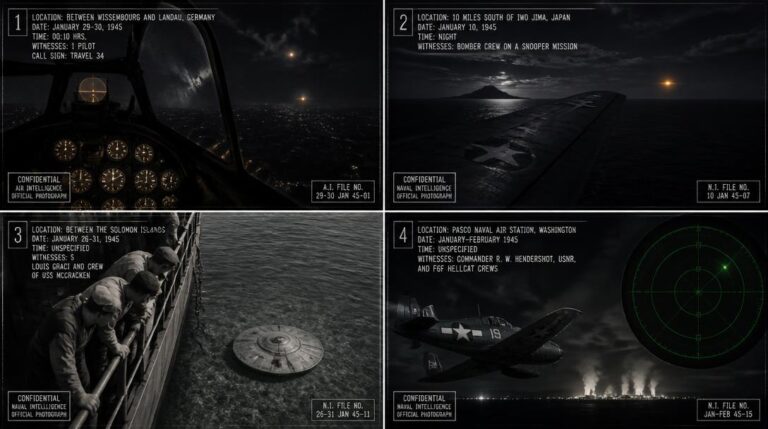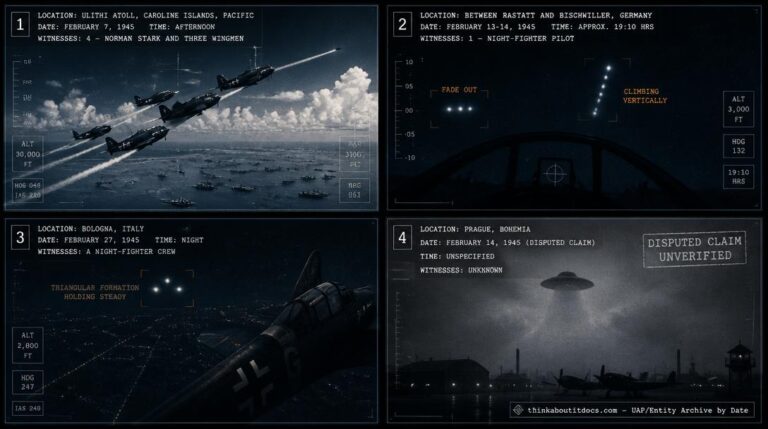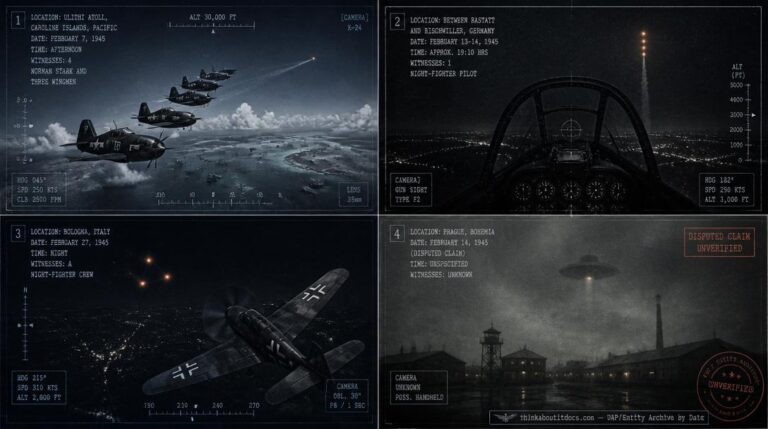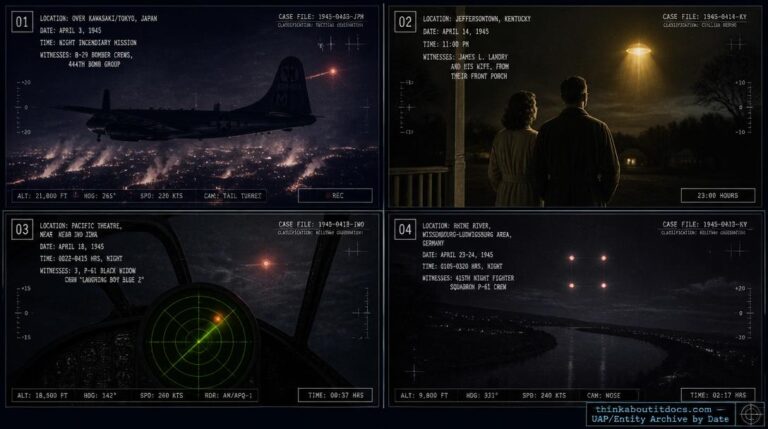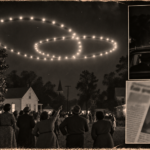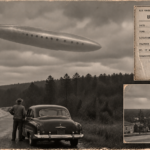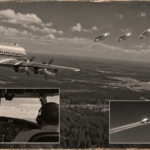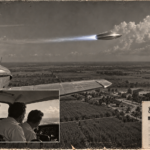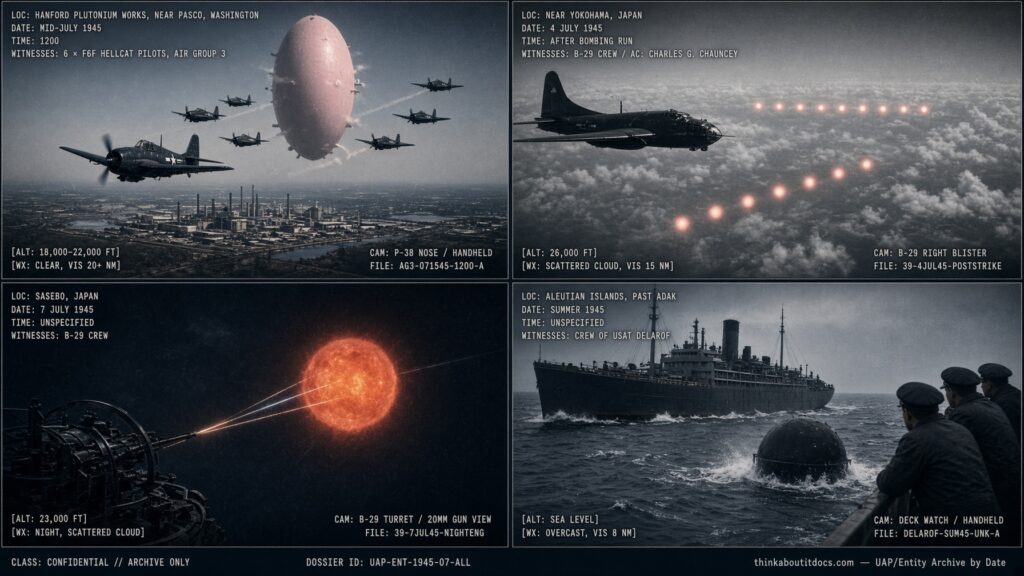
July 1945 — Four anchor cases: six Hellcats' failed intercept over the Hanford plutonium works, Charles Chauncey's Yokohama fireball formations, a Sasebo foo fighter that shrugged off gunfire, and the recurring Delarof sphere. thinkaboutitdocs.com.
1945: July UFO & Entity Sightings Archive
Six weeks before the atomic bombs fell, an egg-shaped, pinkish object the estimated size of three aircraft carriers side by side hovered for twenty minutes directly over the Hanford plutonium works — the facility that had produced the fissile material for the Nagasaki bomb then being finished. Six F6F Hellcats, pushed 5,000 feet past their rated ceiling, couldn’t get near it. The witness who eventually put his name to the story, Roland D. Powell, was a combat veteran of Air Group 3 off the USS Yorktown — not a man with an obvious reason to invent a UFO story decades later. Over Japan that same month, B-29 crews kept logging the now-familiar balls of fire — one pilot watched two full formations of them pass his aircraft in single file without incident, “they did not bother us and we did not bother them” — while, once again, the Aleutian Delarof sphere makes its now-familiar appearance, in what is at least its fourth telling across this archive’s 1945 pages.
Date: July 2, 1945
Location: Japan
Time:
Summary: Several balls of fire, much larger than a supercharger glow but of somewhat the same color.
Source: Undocumented
Date: July 4, 1945
Location: Near Yokohama, Japan
Time:
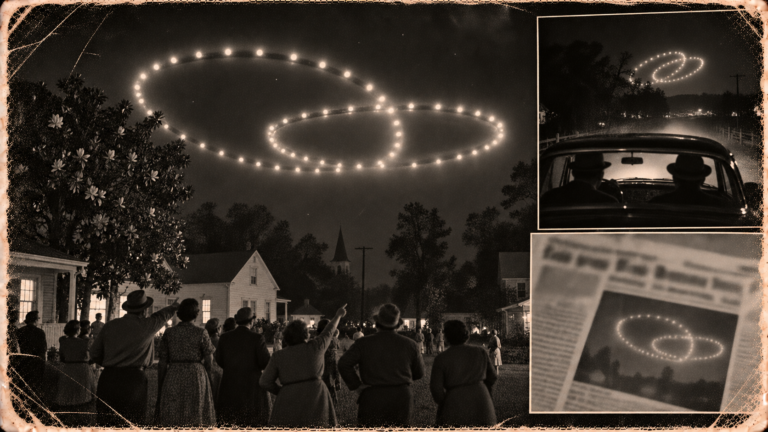
Summary: Aircraft commander Charles G. Chauncey was flying a B-29 on a mission with Kawasaki as the planned target; after evasive action left the radar operator confused, the bombs were dropped on Yokohama instead. Chauncey’s own account of what followed: “After coming away from our bomb drop, we saw the UFO’s. I especially recall seeing two groups of them in single file. One group of six were lower than we were and coming towards us from the front, their heading taking them off to our left. The other group was more distant and headed in the opposite direction, but were at about our level. They each looked and appeared like a great ball of fire, but there was no fire trail. Their color was very subdued, not blazing like a torch. They did not bother us and we did not bother them.”
Source: Charles G. Chauncey, aircraft commander, named eyewitness account
Date: July 7, 1945
Location: Sasebo, Japan
Time:
Summary: Foo fighter: a big ball of fuzzy orange-red light. A B-29 fired on the object; it appeared to be hit, with no apparent effect.
Source: Undocumented
Date: July 12, 1945
Location: Honshu, Japan
Time:
Summary: A light phenomenon spotted by an aircrew appeared to trail an enemy aircraft as a large orange light, traveling with it at the same speed.
Source: Undocumented
Date: Mid-July, 1945
Location: Hanford Plutonium Production Works, near Pasco, Washington
Time: Noon
Case Status: Unexplained
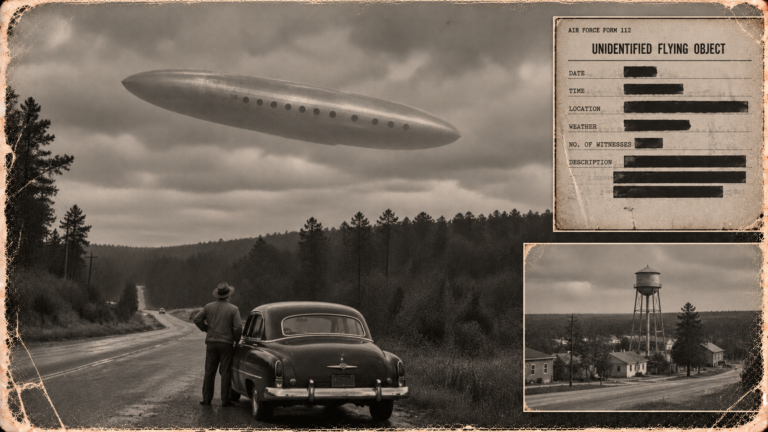
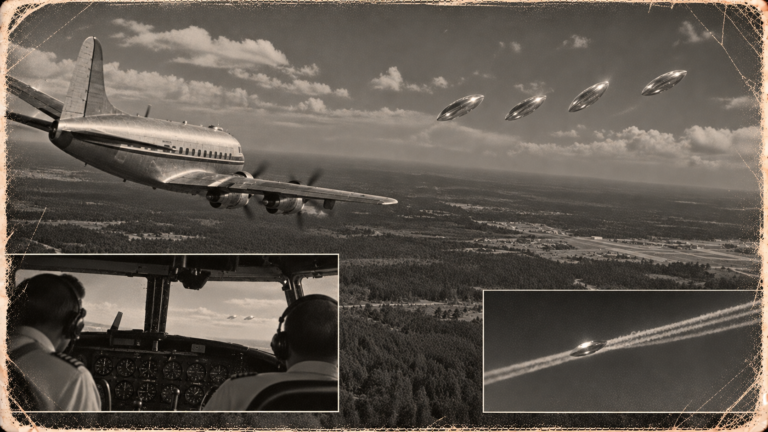
Summary: Radar at Pasco Naval Air Station detected a fast-moving object holding position directly above the Hanford plutonium production site. Roland D. Powell and five other F6F Hellcat pilots of Air Group 3 (based aboard USS Yorktown, CV-10) were scrambled to intercept. The object was initially too high to see; as the pilots climbed, they spotted it nearly simultaneously and closed on its position, pushing their aircraft to roughly 42,000 feet — well past the F6F’s rated 37,000-foot ceiling — without closing the distance to an estimated altitude of 65,000 feet. The object was oval, “very streamlined like a stretched-out egg,” pinkish in color, and roughly the size of three aircraft carriers side by side. Vapor was observed venting from what appeared to be portholes or vents around its edges. It made no aggressive moves and gave no signal, holding position as if observing, for roughly twenty minutes total. As engines began to strain and fuel ran low, the Hellcats broke off one by one and returned to Pasco NAS; the object departed straight up and was gone as quickly as it had appeared. [Full Report]
Source: Roland D. Powell, witness account as investigated by Walt Andrus (former MUFON International Director) and Robert Hastings; case report, NICAP files Source Status: VERIFIED (witness) — a named, identified combat veteran with a traceable service record gave this account directly to established UFO researchers, though the specific performance figures (altitude, size) have no independent military-document corroboration located by this archive.
Editorial note: Previously appeared twice on this archive — a brief stub (“Location: WA”) and this full account, immediately following it. Consolidated into a single entry. Related but distinct: this archive’s January page separately documents a January-February 1945 Pasco NAS radar case involving Commander R.W. Hendershot, and other researchers (Robert Hastings) have documented a separate January 1945 Hanford overflight witnessed by Lt. j.g. Clarence “Bud” Clem — three apparently distinct incidents at the same facility across six months, not the same event repeated.
Date: Summer 1945
Location: Aleutian Islands, past Adak
Time:
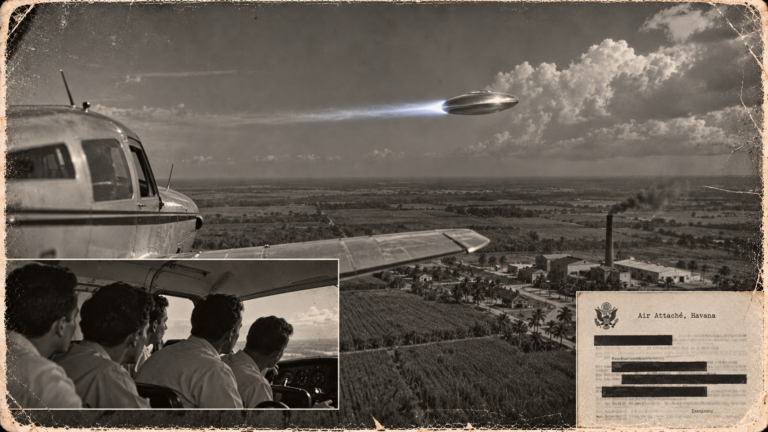
Summary: Crew saw a large round object emerging from the sea, estimated at 150-200 feet in diameter; the object circled the ship, and three white flashes were observed in the direction it departed.
Source: Page 188-189 Ref.1 (NICAP)
Editorial note: This is at least the fourth appearance of the USAT Delarof case across this archive’s 1945 pages (see also January, March, and June). Full Report: The USAT Delarof Sphere.
EXECUTIVE SUMMARY
July 1945 — A Very Large Object Over a Very Secret Place
The Hanford case is the month’s anchor, and one of the most consequential entries in this archive’s entire 1945 run: a UFO holding station directly over America’s plutonium production facility, six weeks before that plutonium ended the war. This revision names the primary witness — Roland D. Powell, an Air Group 3 combat veteran — and traces the investigation chain through MUFON’s Walt Andrus and nuclear-sites researcher Robert Hastings, while being direct that the specific numbers (65,000 feet, three-carrier-lengths) rest on the pilots’ own visual estimation rather than independent instrument confirmation. It is also, notably, one of at least three distinct UFO incidents documented at Hanford within a roughly six-month window in 1945 (January’s Hendershot radar case, a separate January overflight witnessed by Bud Clem, and this one) — a pattern of repeated attention to a single top-secret site that is worth noting on its own.
Elsewhere, the Pacific “balls of fire” record continues in its now-familiar register: named B-29 commander Charles Chauncey watched two full formations pass his aircraft off Yokohama with a calm that had become almost routine by this point in the war — “they did not bother us and we did not bother them.” And the Aleutian Delarof sphere makes yet another appearance on this archive, its fourth across the year’s monthly pages; this revision simply cross-references the full report rather than repeating the case a fifth time.
“It didn’t make any overt moves, gave no signals, just hovered there as if observing, staying well enough out of reach.”
Roland D. Powell, describing the object over the Hanford plutonium works, mid-July 1945.