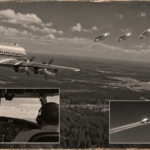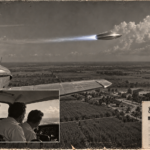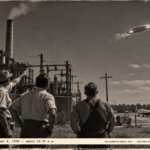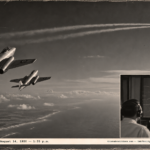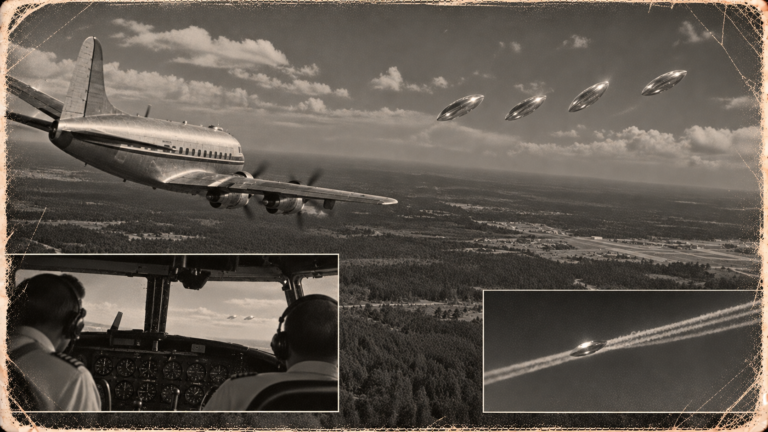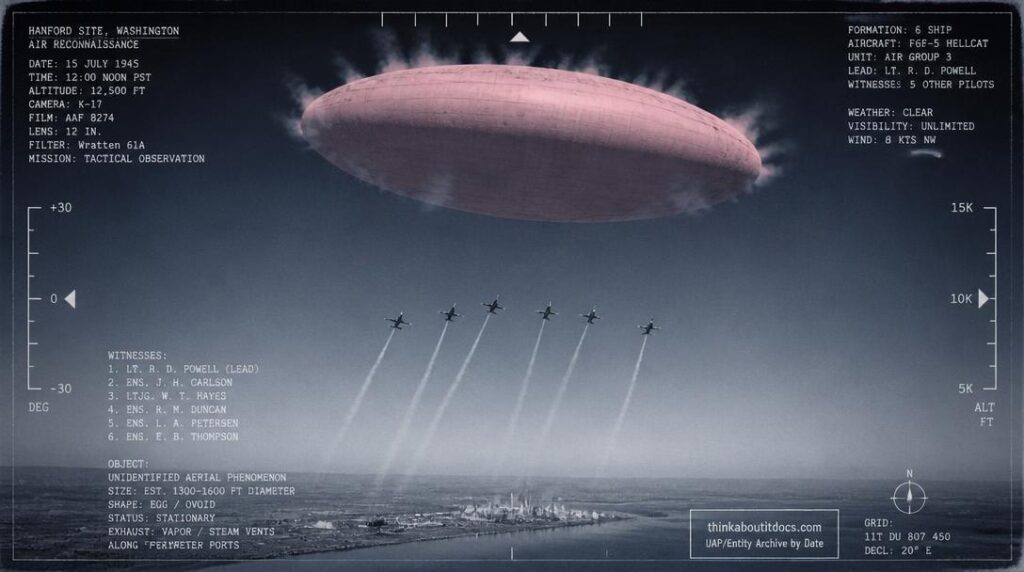
Mid-July 1945 — Hanford, Washington. Named witness Roland D. Powell and five other F6F Hellcat pilots pushed past their aircraft's rated ceiling and still couldn't reach a huge pink object hovering over the plant that made the Nagasaki bomb's plutonium.
THINK ABOUTIT UFO SIGHTINGS REPORT
1945: The Hanford Intercept — Roland D. Powell
Six weeks before Fat Man fell on Nagasaki, six Navy fighter pilots pushed their Hellcats thousands of feet past their rated ceiling trying to reach an object the size of three aircraft carriers hovering silently over the plant that made the bomb’s plutonium. They never got close. Decades later, one of them — Roland D. Powell, a combat veteran of Air Group 3 aboard USS Yorktown — put his name to the story when MUFON’s Walt Andrus tracked him down. This report lays out what Powell said, and what can and can’t be independently confirmed about it.
Date: Mid-July 1945 — Powell estimated the event occurred roughly six weeks before the Japanese surrender (September 2, 1945), placing it in mid-July
Sighting Time: Noon
Day/Night: Day, clear sky
Location: Directly over the Hanford Engineer Works (plutonium production facility) near Richland, Washington; pilots launched from and returned to Pasco Naval Air Station, roughly 60 miles from the plant
Urban or Rural: Rural — a then-remote, top-secret industrial site along the Columbia River
No. of Entity(s): Not Applicable
Entity Type: Not Applicable
Entity Description: Not Applicable
Hynek Classification: RV — Radar-Visual. The object was tracked on radar from Pasco NAS and separately confirmed by direct visual observation from six intercepting pilots, meeting the standard definition of a radar/visual corroborated case, though the aircraft never closed the distance to the object.
Duration: Approximately 20 minutes of stationary hovering observed, not counting the time required for the intercepting aircraft to climb to altitude
No. of Object(s): 1
Description of the Object(s): Oval-shaped, “very streamlined like a stretched-out egg,” pinkish in color, with what appeared to be portholes or vents around its outer edge, from which vapor was observed venting. Powell speculated the vapor may have been discharged deliberately to obscure the object. It made no aggressive or evasive maneuvers, holding a fixed hovering position throughout the encounter.
Shape of Object(s): Oval/egg-shaped
Size of Object(s): Estimated by the pilots at the size of three aircraft carriers positioned side by side — a rough visual estimate made at extreme distance and altitude, not an instrument-measured figure
Color of Object(s): Pinkish
Distance to Object(s): The Hellcats climbed to approximately 42,000 feet — roughly 5,000 feet past the F6F’s rated 37,000-foot service ceiling — and still could not close the distance to the object
Height & Speed: Estimated altitude of approximately 65,000 feet, again a visual estimate rather than an instrument reading, since the pursuing aircraft never came close enough to triangulate the distance precisely; the object was also reported as extremely fast on initial radar detection before settling into its stationary hover
Number of Witnesses: 6 — Roland D. Powell and five other F6F Hellcat pilots of Air Group 3, plus Pasco NAS radar and ground personnel who first detected the contact
Special Features/Characteristics: The object’s position directly over one of the most secret and strategically vital industrial sites in the United States, weeks before that site’s product was used in combat, gives this case a significance beyond the sighting details alone; the object gave no indication of hostile intent and made no attempt to evade or engage the intercepting aircraft, simply outclimbing them and holding position; this is one of at least three separate documented UFO incidents at or near the Hanford site within roughly a six-month span in 1945, alongside a January-February radar case involving Commander R.W. Hendershot and a separate January overflight described by Lt. j.g. Clarence “Bud” Clem.
Case Status: Unexplained
Source: Roland D. Powell, witness account as investigated by Walt Andrus, former International Director of the Mutual UFO Network (MUFON), and separately researched by Robert Hastings; NICAP case files, “UFO Sighting Over Hanford Nuclear Reactor”
Related Cases: 1945: July UFO & Entity Sightings Archive | 1945: January UFO & Entity Sightings Archive (the Hendershot Pasco NAS radar case, same general location, five months earlier)
Detailed Report
By mid-July 1945, the Hanford Engineer Works, sited along the Columbia River in south-central Washington State, had already produced the plutonium for the Trinity test and was continuing production toward the material that would arm the Nagasaki bomb three weeks later. The facility was among the most closely guarded secrets of the entire war, and Navy fighter squadrons training at nearby Pasco Naval Air Station were tasked, among other duties, with providing air coverage in the area.
At noon on a clear day, radar at Pasco detected a fast-moving object that settled into a holding pattern directly above the Hanford plant. Roland D. Powell, a combat veteran who had survived Pacific action as a member of Air Group 3 aboard USS Yorktown (CV-10), was one of six F6F Hellcat pilots scrambled to investigate. The object was initially too high for the pilots to see; as they climbed, all six spotted it at roughly the same moment and turned directly toward its position.
None of the pilots could identify what they were looking at, though they could see it clearly from their vantage point: an oval, streamlined, pinkish object, described by Powell as looking like “a stretched-out egg,” with vapor venting from what appeared to be portholes or vents along its edges. Powell later speculated that the vapor might have been deliberately discharged to obscure the craft. The F6F Hellcat’s rated service ceiling was 37,000 feet; on this mission, the pilots pushed their aircraft to roughly 42,000 feet — a significant overexertion of aircraft rated for combat, not extreme-altitude interception — and still could not close the gap to an object estimated at roughly 65,000 feet.
The object gave no indication of aggression, made no evasive maneuvers, and simply held its position “as if observing” for approximately twenty minutes. As engine strain and fuel consumption became critical, the six Hellcats broke off the intercept one by one and returned to Pasco. The object departed straight up and was gone as quickly as it had appeared.
The case did not surface publicly until decades later, when Walt Andrus — then International Director of MUFON — located and interviewed Powell. Powell told Andrus he could not recall the full names of the other five pilots involved, though he identified the squadron as part of Air Group 3, a unit of combat veterans who had survived Pacific fighting before the Hanford assignment. Researcher Robert Hastings, who has spent decades investigating reported connections between UFO activity and nuclear weapons sites, subsequently profiled Powell’s account alongside a separate, earlier Hanford-area sighting reported by Lt. j.g. Clarence “Bud” Clem, who described a January 1945 overflight witnessed from the Pasco control tower and corroborated in part by documents Hastings located at the National Archives.
RESEARCHER’S NOTES
What a Named Witness Can and Can’t Establish, Decades Later
- On why the named witness matters: Powell’s account is not an anonymous internet report or an unverifiable secondhand rumor. He is identified by name, unit, and ship assignment, and was directly located and interviewed by Walt Andrus, a serious and long-tenured figure in UFO research with decades of institutional credibility at MUFON. That doesn’t make every detail of his account independently verified, but it does place this case well above the evidentiary floor of an anonymous claim.
- On the gap between witness testimony and instrument confirmation: The specific numbers that make this case so dramatic — 65,000 feet, three-carrier-lengths in size — are visual estimates made by pilots who never got close enough to the object to measure it directly. Unlike the January-February 1945 Hendershot case at the same general location, which this archive documents separately with a corroborating National Archives paper trail (4th Air Force intelligence summaries referencing Hanford overflights), this July case currently rests on witness recollection alone, filtered through a decades-later interview. This archive treats the sighting itself as credible and significant while being explicit that the specific performance figures are pilot estimation, not measurement.
- On the pattern of repeated Hanford incidents: This is not an isolated report at this location. Within roughly six months of 1945, this archive and adjacent research (Hastings) document at least three separate incidents in the immediate Hanford/Pasco area: the January-February Hendershot radar case, a separate January overflight reported by Bud Clem, and this July visual intercept. Three independently reported incidents at the same top-secret nuclear facility within half a year is a pattern worth noting on its own, regardless of what any single account ultimately proves.
- On the timing relative to the atomic bomb program: The sighting occurred roughly three weeks before the Trinity test (July 16, 1945) and the Hiroshima and Nagasaki bombings (August 6 and 9). Hanford’s plutonium production was, at this exact moment, the most strategically significant industrial output in the United States. Whether or not any connection exists between the object’s presence and the facility’s function, the timing places this case at one of the most consequential moments and locations in 20th-century military history.
Six Hellcats, pushed past their limits, couldn’t close the distance on an object holding silent watch over the plant that made the bomb. Roland Powell carried that memory for decades before anyone thought to ask him about it directly. What hovered over Hanford that July noon remains, by every account located, unidentified.