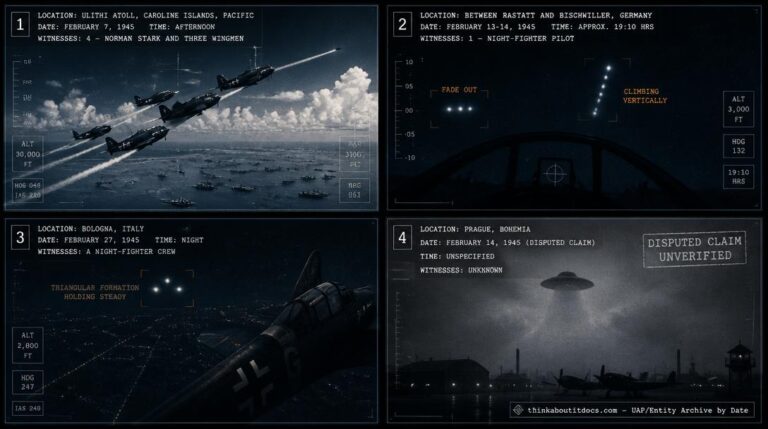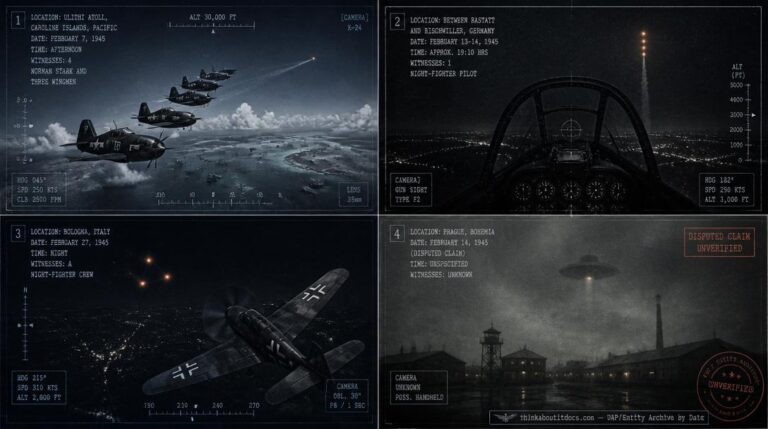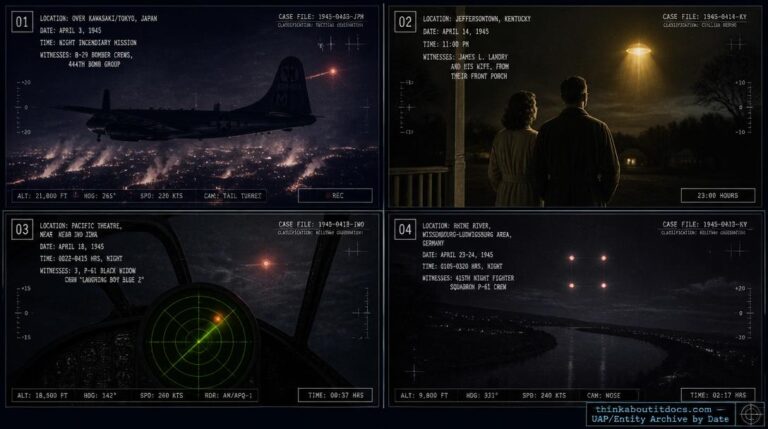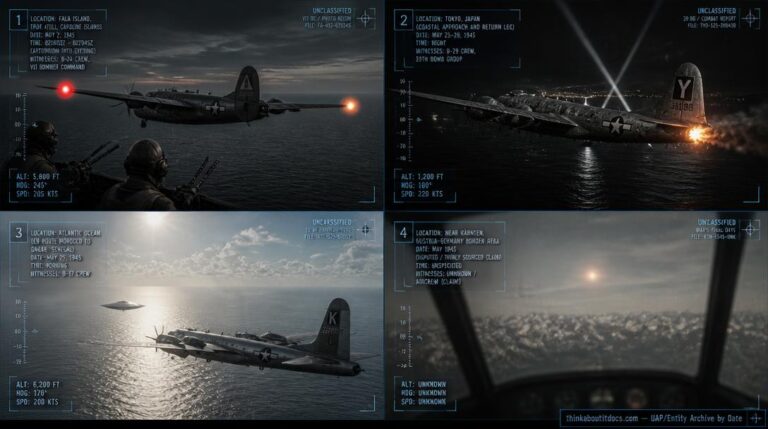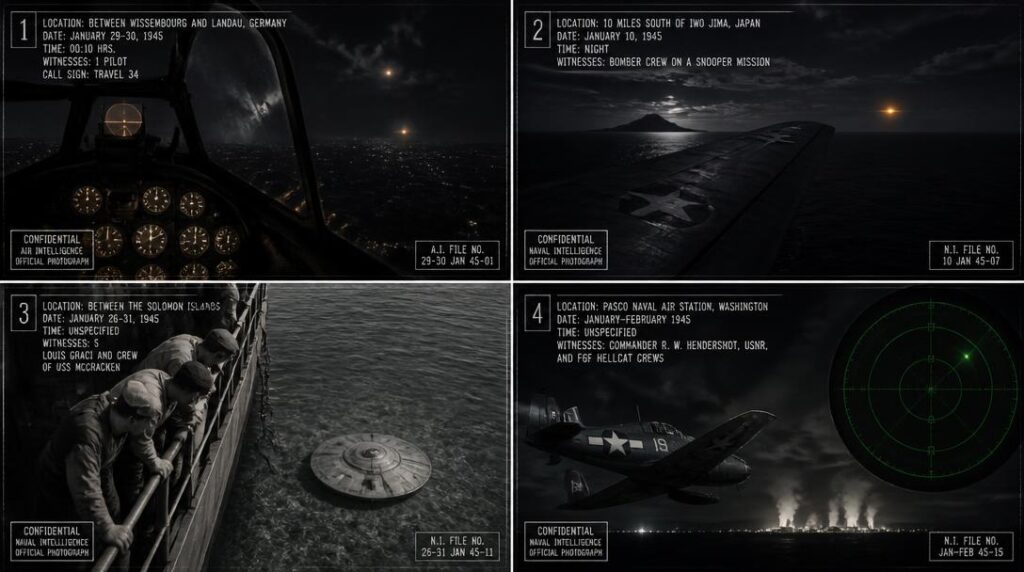
January 1945 — Four anchor cases from the month "Foofighter" entered official U.S. military paperwork: Travel 34's Wissembourg-Landau encounter, a bomber's amber-light escort near Iwo Jima, a submerged disc between the Solomon Islands, and failed Navy radar intercepts at Pasco NAS, Washington. thinkaboutitdocs.com.
1945: January UFO & Entity Sightings Archive
By January 1945 the word “Foofighter” had stopped being pilots’ slang and started showing up in official paperwork. On the night of January 29-30, a 415th Night Fighter Squadron crew flying as “Travel 34” between Wissembourg and Landau logged amber lights pacing their aircraft at 1,000 feet — and their squadron intelligence officer wrote the encounter up, by name, in a report sent to XII Tactical Air Command two days later. Ten miles south of Iwo Jima on January 10, a snooper-mission bomber crew watched an amber light hold formation off their wing, precise enough to make it into a First Lieutenant’s mission report to VII Bomber Command headquarters a week later. Between the Solomon Islands, five sailors aboard USS McCracken watched their troop transport pass directly over a motionless, dull-silver disc lying just beneath the surface — and said nothing about it for thirty-one years. From North Korea to the Aleutians, the pattern holds: the closing weeks of the war produced sightings that were stranger, better documented, and more officially acknowledged than almost anything that came before them.
Date: Jan. 1945
Location: Germany
Time: Unknown
Summary: Another 415th Night Fighter Squadron pilot was followed by three red and white lighted objects over Germany.
Source: NICAP UFO Evidence, 1964, Hall, III
Date: Jan. 1, 1945
Location: Ardennes, Belgium
Time: Unknown
Summary: Pair of fog lights; bright yellowish orange; flying in tandem; three feet in diameter.
Source: Undocumented
Date: Jan. 1/2, 1945
Location: North of Strasbourg, France
Time: Unknown
Summary: Foo fighters.
Source: Undocumented
Date: Jan. 2, 1945
Location: Undisclosed (national press coverage)
Time: Unknown
Summary: The New York Times carried an AP dispatch from France about several recent “foo-fighter” sightings. Lt. Donald Meiers said he had twice been followed by UFOs. Time magazine would run its own “Foo-Fighter” story on the phenomenon two weeks later, on January 15, 1945, reporting that the lights had been following USAAF night fighters for more than a month.
Source: NICAP UFO Evidence, 1964, Hall, III; Time, “Foo-Fighter,” January 15, 1945
Date: Jan. 10, 1945
Location: 10 miles south of Iwo Jima, Japan
Time: Unknown
Summary: A VII Bomber Command crew on a “snooper mission” targeting Iwo Jima observed an amber light that passed parallel to their aircraft and held the same altitude off their wing.
Source: Mission Report No. 11-140, First Lt. Kinsey Jones, Assistant A-2, VII Bomber Command, to Headquarters VII Bomber Command, January 17, 1945; Keith Chester, Strange Company (2007) Source Status: VERIFIED — corroborated by a dated, named, primary intelligence document filed one week after the sighting.
Date: Jan. 14/15, 1945
Location: Ingweiller, Germany
Time: Unknown
Summary: A large orange glow in the sky, approximately 5 ft. in diameter.
Source: Undocumented
Date: Jan. 18, 1945
Location: Oyster River, near Vancouver Island, Canada
Time: Unknown
Summary: Large silvery cylinder or balloon that appeared to discharge another balloon or object, each traveling in separate directions.
Source: Undocumented
Date: Jan. 26-31, 1945
Location: Between the Solomon Islands
Time: Unknown
Summary: Louis Graci and four other sailors aboard USS McCracken (APA 198, Troop Transport) observed a submerged round object about the size of a gun turret, roughly 20 feet across, with a dull finish, sharply outlined, and no sound. The ship passed directly over it as it lay still in the water. Not reported at the time, as the sailor initially thought it was a sea turtle.
Source: International UFO Bureau report form, dated September 25, 1976
Editorial note: This account rests entirely on a witness statement recorded 31 years after the fact, with no contemporaneous corroboration located. Retained as a well-described sighting; Case Status treated as Insufficient Data for verification purposes, not Unexplained.
Date: Jan. 29/30, 1945
Location: Between Wissembourg and Landau, Germany
Time: 00:10 hrs
Case Status: Unexplained
Summary: 415th Night Fighter Squadron pilot “Travel 34” logged a “Foofighter” — the squadron’s own term, used in its own official paperwork — off the starboard rear of the aircraft at 2,000 feet. Two amber lights, one 20-50 feet above the other, held position roughly 1,000 feet away and followed the aircraft for about 30 seconds before vanishing the moment the pilot turned into them. Ground control intercept, contacted per standard procedure, confirmed no friendly or hostile aircraft in the area. [Full Report]
Source: USAAF, Report from Capt. F.B. Ringwald, Intelligence Officer, 415th Night Fighter Squadron, to AC of S, A-2, XII Tactical Air Command, January 30, 1945, NARA; Keith Chester, Strange Company (2007) Source Status: VERIFIED — a dated, named official squadron intelligence report filed the day after the sighting, held at NARA.
Date: Jan.-Feb. 1945
Location: Pasco Naval Air Station, Washington
Time: Unknown
Summary: Commander R. W. Hendershot, USNR, reported that radar targets were detected and interception was attempted at least twice by F6F Hellcats, with negative results. Flying an SJS, Hendershot personally attempted an interception of high-altitude, slow-moving blips, also with negative results. 4th Air Force intelligence summaries reportedly indicate overflight of the Hanford Site and possible Navy countermeasures staged from Pasco NAS.
Source: Keith Chester, Strange Company, p. 142; Hendershot letter to APRO in NICAP files; NARA
EXECUTIVE SUMMARY
January 1945 — The Month “Foofighter” Entered the Official Record
January 1945 is the month the Foo Fighter phenomenon stopped being pilots’ after-hours slang and became documented military language. On January 29-30, a 415th Night Fighter Squadron crew flying under the call sign “Travel 34” reported amber lights pacing their aircraft between Wissembourg and Landau — and their intelligence officer, Capt. F.B. Ringwald, used the squadron’s own coined term, “Foofighter,” in an official report filed the very next day to XII Tactical Air Command. That document survives at NARA. Two weeks earlier, on January 10, a VII Bomber Command crew on a night mission near Iwo Jima watched an amber light hold formation off their wing — precise enough to be written up by name in a First Lieutenant’s mission report to bomber command headquarters within the week. And on January 15, Time magazine ran the story nationally, reporting that “balls of fire” had been trailing USAAF night fighters for over a month, cementing the term in American public consciousness for the first time.
The month’s other cases are more thinly documented but geographically striking: a submerged, sharply outlined disc that a U.S. troop transport passed directly over between the Solomon Islands (recounted three decades later by the sailors who saw it); a rising sphere off the Aleutians witnessed by fourteen men; attempted, failed Navy radar intercepts near the Hanford atomic site at Pasco, Washington; and an unresolved claim of a Japanese-versus-disc dogfight over Wonsan, Korea. Taken together, January 1945 shows a phenomenon that, by the final winter of the war, had become routine enough to generate its own paperwork trail — official intelligence reports, named officers, dated documents — rather than surviving only as postwar recollection.
“Foofighter was about 1000 ft. away and following. The lights were about a foot in diameter. Lights disappeared when Travel 34 turned into them.”
USAAF 415th Night Fighter Squadron intelligence report, January 30, 1945, describing the night of January 29-30 between Wissembourg and Landau, Germany.