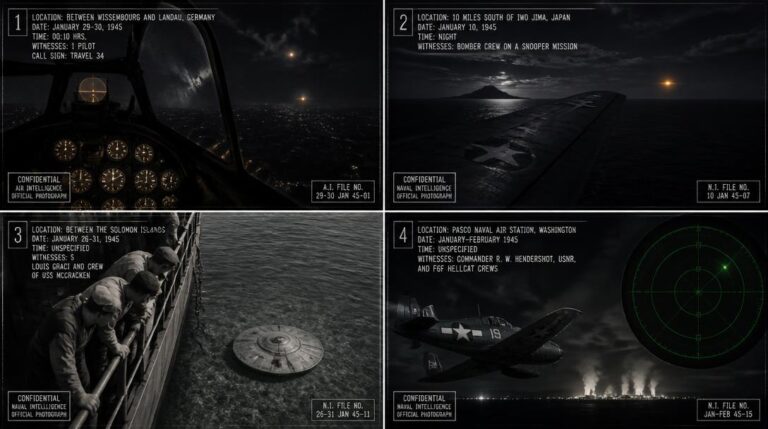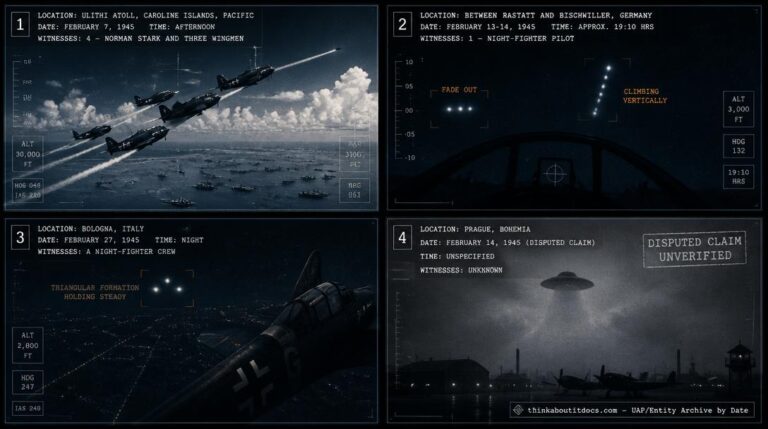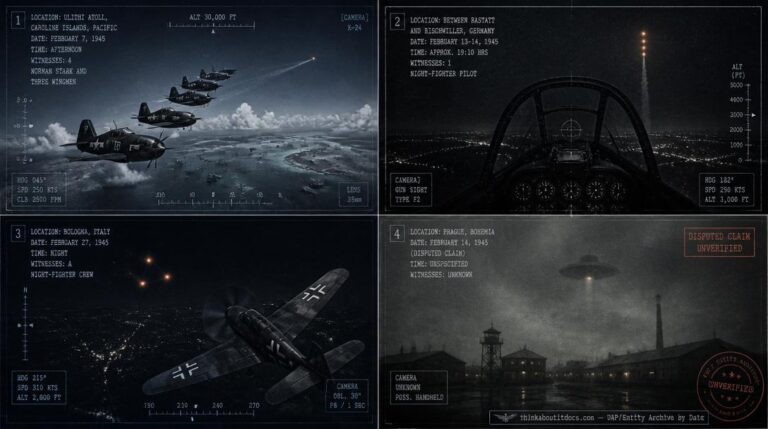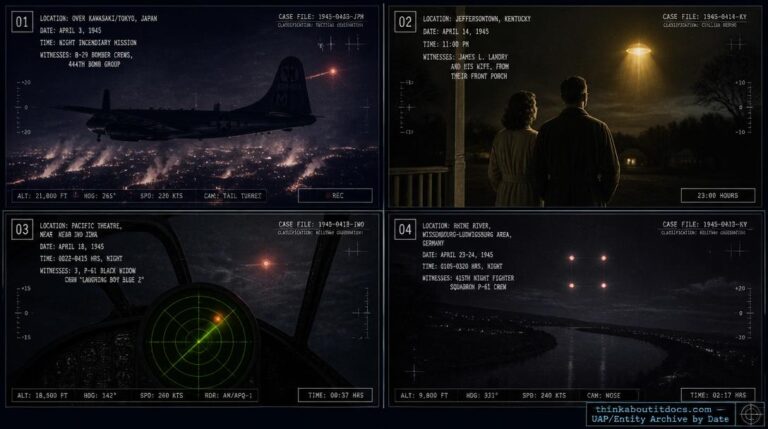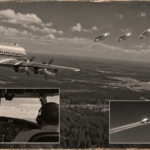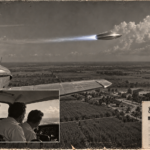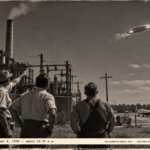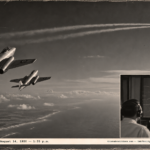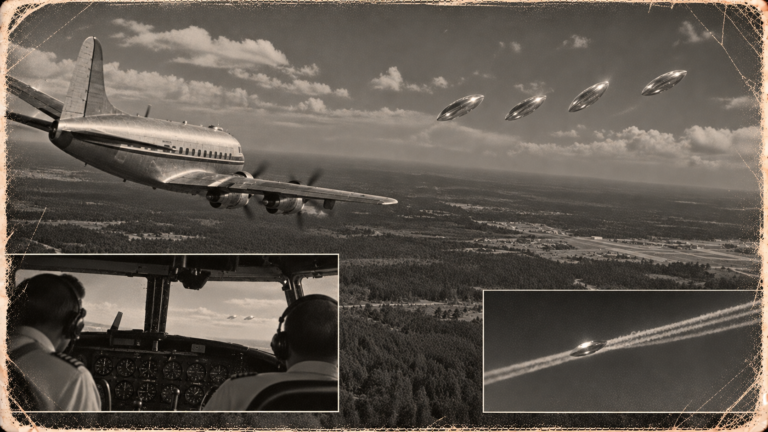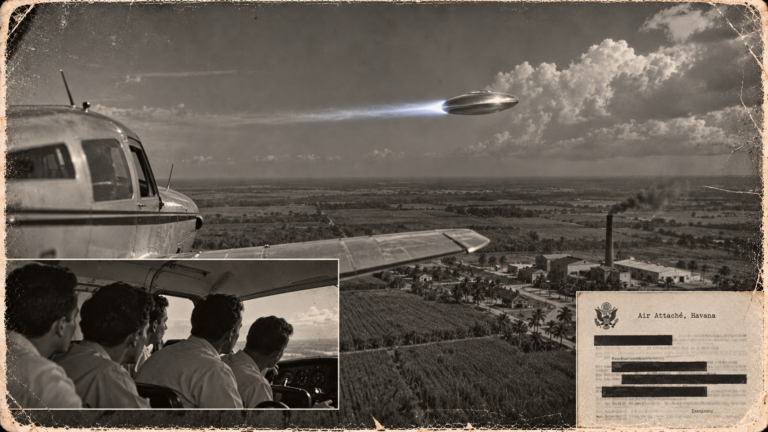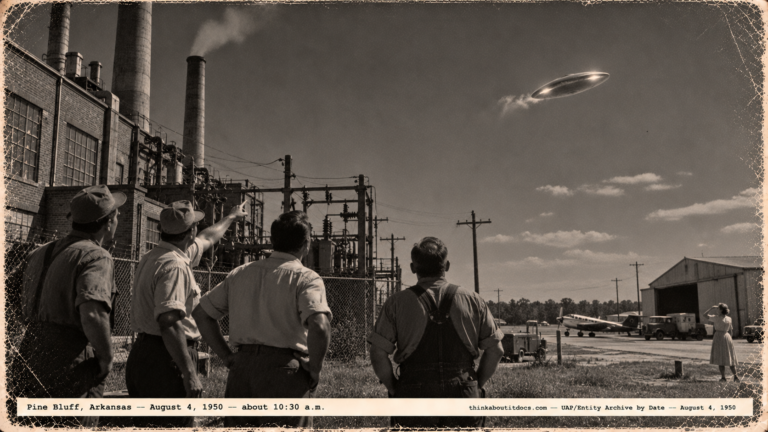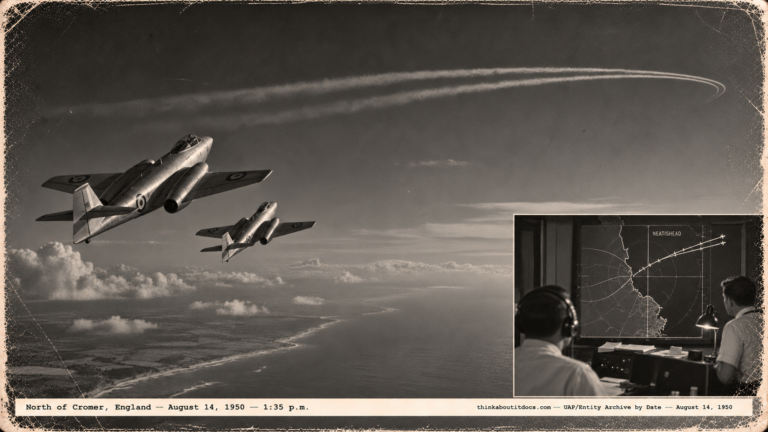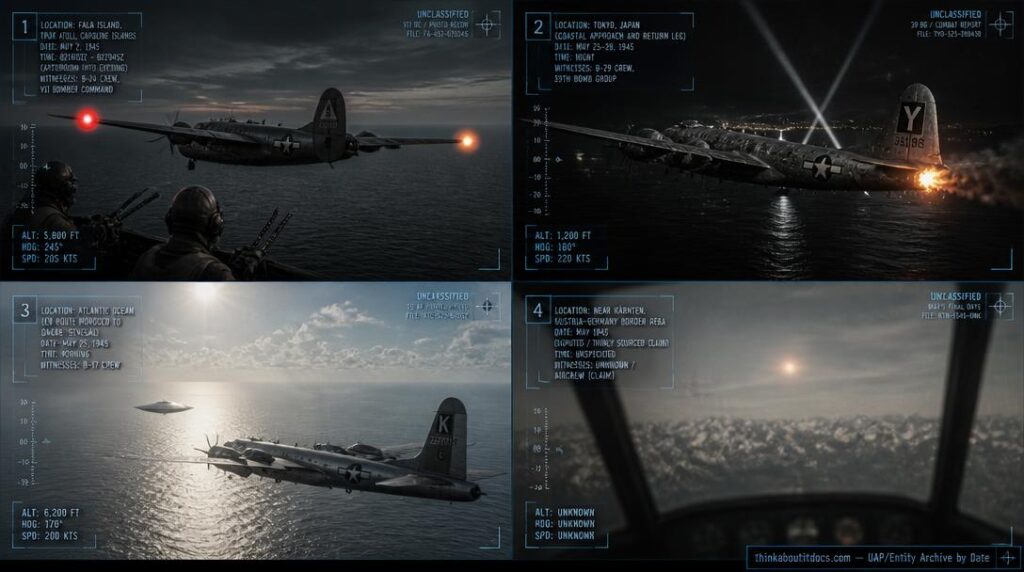
May 1945 — Four anchor cases: the officially documented Fala Island Truk Atoll encounter, a Tokyo fireball riding alongside a battle-damaged B-29, a silvery disc over the Atlantic, and a thinly sourced Karnten photograph from the war's final days. thinkaboutitdocs.com.
1945: May UFO & Entity Sightings Archive
May 1945 opens with the best-documented Pacific “balls of fire” case in this entire archive: over Fala Island, Truk Atoll, a B-24 crew was paced for more than an hour by two objects that cycled through cherry-red, orange, and white, one of which followed the aircraft through every evasive maneuver before finally breaking off near Guam — an encounter preserved in a full official VII Bomber Command mission report and independently retold two months later in Jo Chamberlin’s American Legion Magazine account. The same week, a battle-damaged B-29 crew over Tokyo picked up a fireball at the coast that rode with them for fifty miles while their tail gunner lay wounded and their aircraft limped home on failing controls. Off West Africa, a B-17 was paced by a silvery disc for the length of a transatlantic ferry leg. And as V-E Day arrived in Europe, the war that had produced the Foo Fighter phenomenon five months earlier was ending — with the mystery, as one witness later put it, no closer to solved than the night it started.
Date: May 2, 1945
Location: Fala Island, Truk Atoll, Caroline Islands
Time: 021802Z through approximately 022130Z (over five hours, per the mission report timestamps)
Case Status: Unexplained
Summary: The crew of a VII Bomber Command B-24, plane #616, over Fala Island at 11,000 feet observed two airborne objects cycling from cherry-red to orange to white and back to cherry-red, one out on each wing, out of range of the aircraft’s .50 caliber guns. Both followed the B-24 through every evasive maneuver attempted. One dropped off after roughly an hour, as the aircraft set course for Guam; the other continued following, never closing closer than 1,000 yards, speeding up to reappear ahead of the aircraft after it passed through cloud cover, and was seen in daylight to be bright silver in color. It finally departed on a course of 330 degrees, climbing to 15,000-20,000 feet, as the B-24 let down at Guam. Separately, another B-24 in the area encountered eight intense light-green flames, one of which burst and hung stationary at 5,000 feet with no warning trail, and a third B-24 reported 9 to 10 red tracer-type fire trails, one pair passing within 50-100 yards of the tail. Island radar stations confirmed no enemy aircraft were in the area at the time. [Full Report]
Source: Headquarters VII Bomber Command, Mission Report No. 11-327, 2 May 1945 (GCT); Jo Chamberlin, “The Foo-Fighter Mystery,” American Legion Magazine, December 1945 Source Status: VERIFIED — primary official military mission report, independently retold in a contemporaneous magazine account based on direct interviews.
Editorial note: This case previously appeared twice on this archive — once as a brief one-line entry, and again in full detail buried under an entry primarily describing the 509th Composite Group’s May 1945 movement to Tinian. Consolidated here into a single entry; the 509th’s unrelated travel history is preserved separately below.
Date: May 4, 1945: Fraser, Jutland, Denmark Sighting
Date: May 14, 1945
Location: Nagoya, Japan
Time: Unknown
Summary: Red or flame-colored light, holding a constant position, the same apparent size as a B-29 landing light.
Source: Undocumented
Date: May 1945
Location: Near Kärnten (Carinthia), Austria-Germany border area
Time: Unknown
Summary: A widely circulated photograph, credited to a German pilot, is captioned as showing a “foo-fighter” observed near Kärnten in May 1945, in the war’s final days on the European front.
Source: Photo credit Chronicle/Alamy, as reproduced by History.com, “Mysterious UFOs Seen by WWII Airmen Still Unexplained,” August 2018
Source Status: INSUFFICIENT DATA — this archive has located only a photo caption with no underlying named witness, unit, or primary document. Retained as a documented claim of the era, not as a verified sighting.
Date: May 25-26, 1945
Location: Tokyo, Japan
Time: Night incendiary mission (Mission 11)
Summary: During a night incendiary raid on downtown Tokyo and the nearby waterfront, a B-29 of Crew 44, 62nd Squadron, 39th Bomb Group, made its visual bomb run at 9,100 feet in clear weather. Searchlights held the aircraft for nine minutes; a fighter made a pass over the target and several others were seen; roughly 50 flares, many carrying explosives, were observed. “A ‘fireball’ picked us up at the coast and followed us for 50 miles before falling off toward the sea.” The aircraft was hit repeatedly by flak — the nose, left wing, bomb bay, center wing tank, top blister, and tail compartment all took hits. Tail gunner Henry Matthaus was severely wounded when ammunition exploded near his position; Charles Smith broke open the jammed tail compartment door, and radio operator Lloyd Volkmar moved Matthaus to the radar compartment to render first aid. With Iwo Jima weathered in, the damaged aircraft flew on to its home base, manually ejecting six hung bombs and landing with inoperative co-pilot controls and damaged trim tabs. The crew also witnessed a separate B-29 go down in a flat spin with wing fire. Total mission time: 15 hours, 20 minutes.
Source: VH (veteran history account, Crew 44, 62nd Squadron, 39th Bombardment Group)
Date: May 25, 1945
Location: Atlantic Ocean, en route Morocco to Dakar, Senegal
Time: Morning
Summary: In early morning on a sunny day with intermittent clouds, a B-17 bomber en route from Morocco to Dakar, Senegal observed a silvery disc or ellipse positioned opposite the sun, estimated at 5 to 10 miles distant. The object paced the aircraft, hovering at times.
Source: Ref. 3; Harley D. Rutledge, Project Identification, 1981, p. 251
Date: Late May 1945
Location: Route from the continental United States via Hickam Field, Hawaii, Johnston Island, and Kwajalein to Tinian Island, Mariana Islands
Time: Unknown
Summary: The greater part of the 509th Composite Group arrived on Tinian Island during this period, traveling via C-54 and B-29 aircraft. The first C-54 of the Advance Air Echelon, number 9009, flew from Kwajalein to Tinian on May 22, 1945; this final leg of the route crosses just north of the Caroline Islands, where Truk Atoll — site of this month’s Fala Island encounter — is located.
Source: Undocumented
Editorial note: Not a UFO sighting; retained as historical context connecting the atomic-bomb delivery unit’s arrival in theater to the same general Pacific airspace as the Fala Island encounter three weeks earlier, consistent with this archive’s practice of including directly adjacent atomic-program milestones (see also the September 1944 Oak Ridge entry, 1944 archive, and the April 23, 1945 Groves memo, April 1945 archive).
EXECUTIVE SUMMARY
May 1945 — The War Ends, the Mystery Doesn’t
The Fala Island, Truk Atoll case on May 2 is the strongest entry in this month’s record and one of the best-documented Pacific “balls of fire” cases in the entire archive: a full official VII Bomber Command mission report, cross-referenced against an independent magazine account published seven months later. Two objects paced a B-24 for over an hour, cycling through cherry-red, orange, and white, matching every evasive maneuver, and never once giving island radar a contact to confirm. This revision consolidates what had become two separate, overlapping entries for the same case into one properly sourced record.
The rest of the month carries the war’s momentum toward its close. A battle-damaged B-29 over Tokyo brought its wounded tail gunner home with a fireball riding alongside for fifty miles of the return leg — a sighting almost incidental to the survival story surrounding it. A silvery disc paced a B-17 across a routine Atlantic ferry run to Senegal. And as the last of Europe’s Foo Fighter reports faded with V-E Day, a photograph — thinly sourced but persistently circulated — purports to show one final German pilot’s encounter near Kärnten before the guns went silent. None of it resolved. The war ended; the balls of fire didn’t get explained.
“The other continued to follow, never approaching closer than 1000 yards and speeding up when the B-24 went thru the clouds to emerge on the other side ahead of the B-24.”
Headquarters VII Bomber Command, Mission Report No. 11-327, describing the May 2, 1945 Fala Island, Truk Atoll encounter.