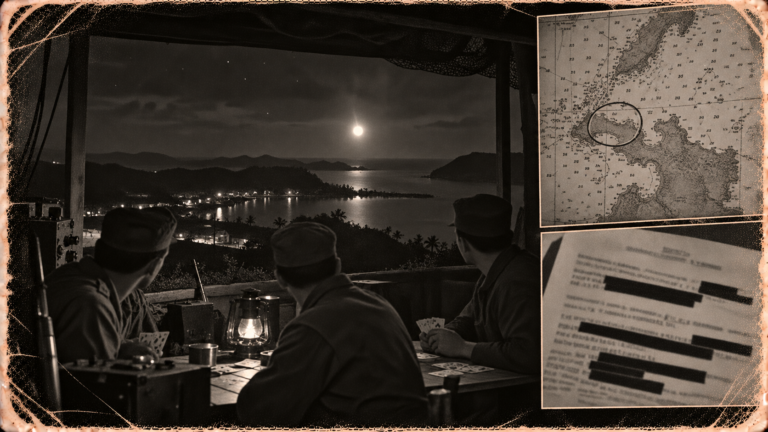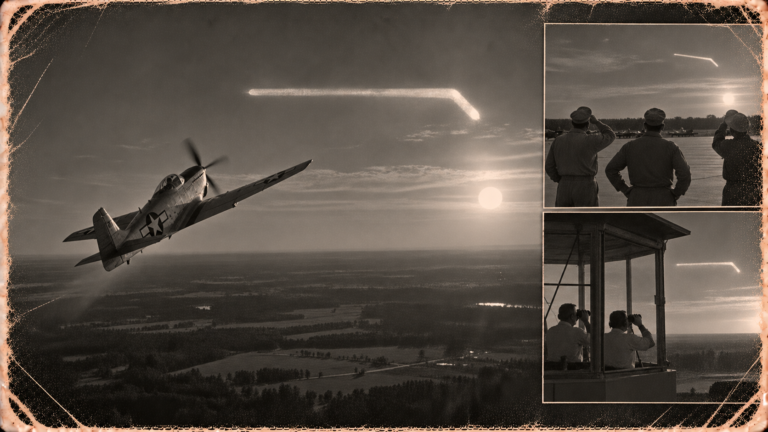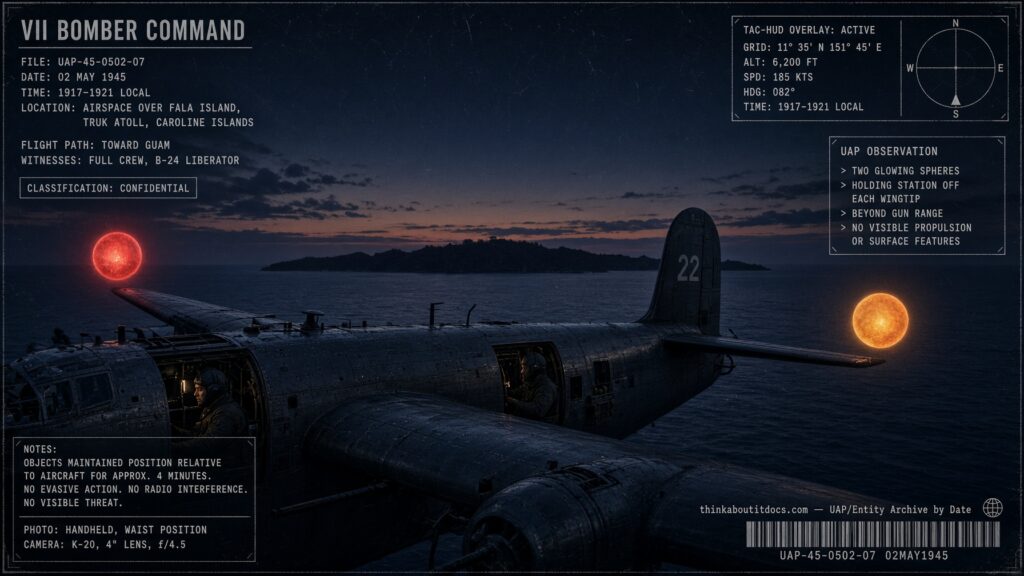
May 2, 1945 — Fala Island, Truk Atoll. A VII Bomber Command mission report and an independent magazine investigation both document two color-cycling objects that paced a B-24 for hours, matching every evasive turn.
THINK ABOUTIT UFO SIGHTINGS REPORT
1945: The Fala Island Mission Report — Truk Atoll
For over an hour, two objects that shifted between cherry-red, orange, and white held position off each wing of a B-24 Liberator flying between Truk Atoll and Guam, matching the aircraft’s every evasive turn and staying just out of gun range. The encounter survives in an official VII Bomber Command mission report filed the same day, and again seven months later in a national magazine’s account built from direct interviews. Few WWII “balls of fire” cases carry this much independent documentation.
Date: May 2, 1945
Sighting Time: 021802Z (approximately 6:02 PM GCT) through approximately 022130Z (9:30 PM GCT), per mission report timestamps — objects observed continuously for over three hours, with the encounter as a whole (from initial sighting to final departure) spanning roughly the ship’s transit time from Truk to Guam
Day/Night: Spanning dusk into night, continuing until daybreak per the secondary account
Location: Airspace over Fala Island, Truk Atoll, Caroline Islands, on a flight path between Truk and Guam, Mariana Islands
Urban or Rural: Not applicable — open ocean and island airspace during an active combat mission
No. of Entity(s): Not Applicable
Entity Type: Not Applicable
Entity Description: Not Applicable
Hynek Classification: NL — Nocturnal Light, transitioning to daylight disc observation. The objects were tracked visually only, with no radar corroboration despite island radar stations being queried directly; no landing, physical trace, or structural detail beyond color and daylight silver appearance was recorded.
Duration: The primary pursuing object remained with the aircraft for roughly an hour before one of the two objects broke off; the second continued following through the night and into daylight before departing near Guam — a total encounter window of several hours
No. of Object(s): 2 primary objects on this aircraft; additional separate objects (light-green flames, red tracer-type trails) reported by other B-24s in the same general mission area
Description of the Object(s): Two airborne objects, one positioned off each wing, cycling in color from cherry-red to orange to white before returning to cherry-red. In daylight, the remaining object was seen to be bright silver. No wing, fuselage, or other structural feature was observed on either object at any point during the encounter.
Shape of Object(s): Described as circular/spherical (“red circles of light”); approximately the size of a basketball per the secondary magazine account
Size of Object(s): Approximately basketball-sized, per Chamberlin’s account
Color of Object(s): Cycling cherry-red, orange, white, back to cherry-red at night; bright silver in daylight
Distance to Object(s): Positioned out on either wing, beyond the effective range of the aircraft’s .50 caliber machine guns; the remaining object never approached closer than 1,000 yards throughout the encounter
Height & Speed: Initial altitude 11,000 feet, matching the B-24; final observed altitude 15,000-20,000 feet on a departure course of 330 degrees; speed sufficient to match all evasive maneuvers and to reappear ahead of the aircraft after passing through cloud cover, indicating the object took a faster path around or through the same weather
Number of Witnesses: Full crew of B-24 plane #616; additional independent witness crews aboard at least two other B-24s in the same mission reported separate light phenomena in the same general area and timeframe
Special Features/Characteristics: The objects matched every evasive maneuver the B-24 attempted; one object specifically demonstrated the ability to take a shortcut through or around cloud cover to reappear ahead of the aircraft on the other side, implying either superior speed or foreknowledge of the aircraft’s course; island radar stations were directly queried by radio during the encounter and confirmed no enemy aircraft were present in the area; two additional, separate light phenomena (green flame bursts and red tracer-type fire trails) were reported by other B-24 crews in the same operational area during the same mission, suggesting a broader pattern rather than an isolated single-aircraft event.
Case Status: Unexplained
Source: Headquarters VII Bomber Command, Mission Report No. 11-327, dated 2 May 1945 (GCT), APO #244 — primary official military document; Jo Chamberlin, “The Foo-Fighter Mystery,” American Legion Magazine, December 1945, which independently retells the same encounter based on direct research and interviews conducted in 1945
Related Cases: 1945: May UFO & Entity Sightings Archive | 1945: April UFO & Entity Sightings Archive (the Kawasaki-Tokyo balls of fire, same general pattern, one month earlier)
Detailed Report
On May 2, 1945, a VII Bomber Command B-24, aircraft #616, was operating in the vicinity of Fala Island, part of the Truk Atoll complex in the Caroline Islands — a former major Japanese naval base that Allied forces had been systematically neutralizing through air power rather than direct invasion since early 1944. At 11,000 feet, the crew observed two airborne objects, one positioned off each wing, cycling in color from cherry-red to orange to a white light that would die out and then return to cherry-red. Both objects remained out of range of the aircraft’s .50 caliber machine guns and followed the B-24 through every type of evasive action the crew attempted.
As the B-24 set course for Guam, one of the two objects broke off after having accompanied the aircraft for approximately an hour. The second continued following, maintaining a minimum distance of 1,000 yards throughout, and demonstrated a striking capability when the aircraft passed through cloud cover: rather than simply following through the clouds, the object appeared to take a different path and was waiting on the other side, ahead of the B-24, when it emerged. In daylight, this remaining object was clearly visible as bright silver in color. As the B-24 began its descent into Guam, the object took a departure course of 330 degrees, climbing from 15,000 to 20,000 feet before disappearing from view.
The mission report indicates this was not an isolated single-aircraft experience. A separate B-24 operating in the same general area encountered eight intense flames of light-green color, one of which burst and hung stationary at 5,000 feet with no warning trail before the actual burst. A third B-24 reported 9 to 10 red tracer-type fire trails appearing in pairs, with one pair passing within 50 to 100 yards of the aircraft’s tail. Throughout the encounter, crews queried island radar stations directly and received consistent confirmation that no enemy aircraft were present in the area.
The case reached a wider audience seven months later when Lt. Col. Jo Chamberlin, an aide to General Hap Arnold who had traveled to both the European and Pacific theatres specifically to investigate Foo Fighter reports, included it in his December 1945 American Legion Magazine article “The Foo-Fighter Mystery.” Chamberlin’s account, built on direct research rather than secondhand rumor, independently confirms the core details: two red lights rising rapidly from below, one turning back after an hour, the other maintaining a shifting position — sometimes behind, sometimes alongside, sometimes ahead — until it climbed to 15,000 feet and held position in the sun at daybreak, “like a Jap fighter seeking game, but never came down.” Chamberlin’s version adds that the object appeared to be roughly the size of a basketball and that island radar confirmed no enemy aircraft were present — matching the primary mission report closely enough to confirm this is the same documented event, described independently by someone who had done his own research rather than simply copying the military paperwork.
RESEARCHER’S NOTES
A Mission Report and a Magazine Article Telling the Same Story, Independently
- On why the dual-source corroboration matters: This archive documents many cases that rest on a single source — a squadron report with no secondary confirmation, or a postwar interview with no contemporaneous document behind it. This case has both: an official military mission report filed the same day as the event, and an independent magazine investigation published seven months later by a researcher with direct access to Army Air Forces personnel and General Arnold’s own interest in the phenomenon. The two accounts agree on every major detail — duration, color cycling, radar confirmation, the object holding position in the sun at daybreak — while each adds details the other lacks (the mission report’s precise timestamps and headings; Chamberlin’s basketball-size estimate and behavioral color of “like a Jap fighter seeking game”). Independent corroboration of this kind, from two source types with different institutional pressures and different authors, is relatively rare in this archive.
- On the cloud-cover detail specifically: The object’s apparent ability to reappear ahead of the B-24 after the aircraft passed through clouds is one of the more specific performance claims in the WWII UFO record. This requires either that the object took a genuinely faster path around the weather system, or that its course was not a simple pursuit but something closer to anticipation of the bomber’s heading — a detail the primary source states plainly without embellishment or speculation about its implications.
- On the broader mission context: That two additional B-24 crews in the same operational area reported separate, distinct light phenomena during the same mission (green flame bursts; red tracer trails) suggests this wasn’t an isolated perceptual event experienced by one crew, but part of a broader pattern affecting multiple aircraft over Truk Atoll that night — consistent with other multi-crew “balls of fire” waves documented elsewhere in this archive’s 1945 entries, including the Kawasaki-Tokyo case one month earlier.
- On what remains unexplained: Neither the mission report nor Chamberlin’s independent investigation offers a resolution. Radar confirmation of no enemy presence rules out the simplest conventional explanation (Japanese aircraft); the objects’ failure to attack or cause any harm across a multi-hour encounter argues against a deliberate weapon; and the specific, consistent color-cycling and positional behavior described by multiple crew members across a sustained period is difficult to attribute to a simple optical or atmospheric phenomenon. The case remains, in the words of Chamberlin’s own 1945 assessment, one for which “many solutions have been advanced… None of them stand up.”
Two objects, three-plus hours, a full official mission report, and an independent magazine investigation that reached the same conclusions from a different angle seven months later. Whatever paced that B-24 between Truk Atoll and Guam on the second of May, 1945, it left behind one of the better-documented mysteries of the entire Pacific “balls of fire” record — and, per every source that touched it, no resolution at all.