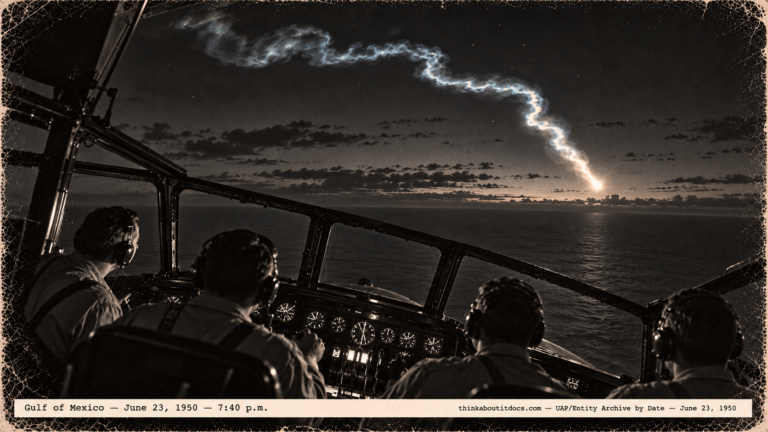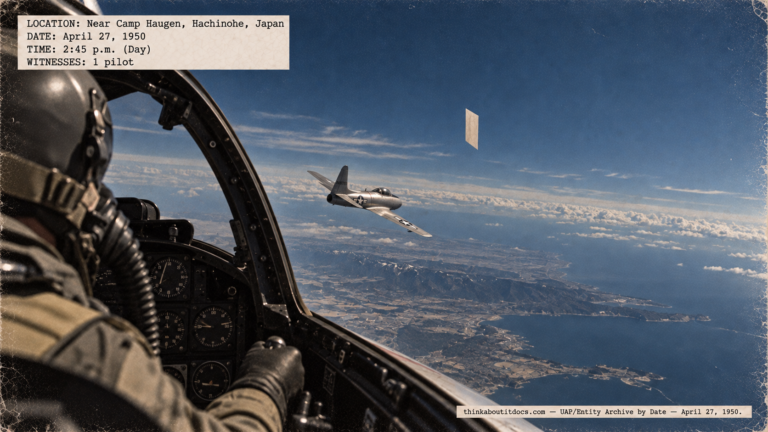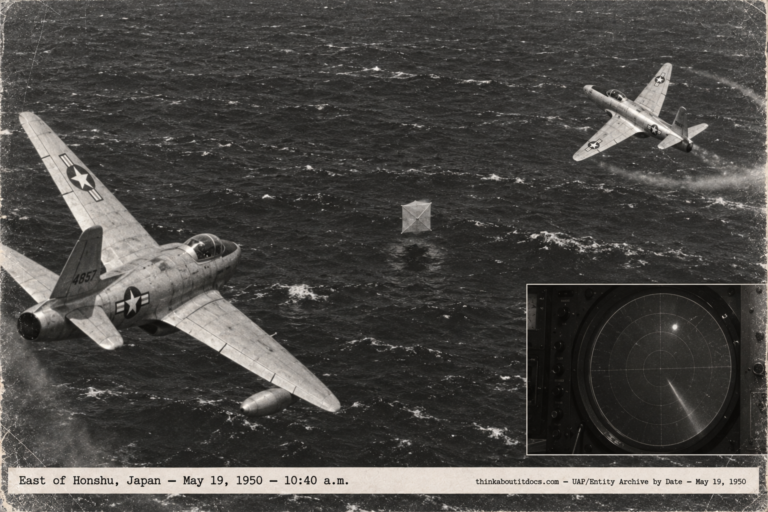
April 3, 1945 — Kawasaki and Tokyo, Japan. B-29 crews reported basketball-sized balls of fire that matched every evasive maneuver, an encounter later confirmed in both U.S. and RAF intelligence documents.
THINK ABOUTIT UFO SIGHTINGS REPORT
1945: The Kawasaki-Tokyo Balls of Fire
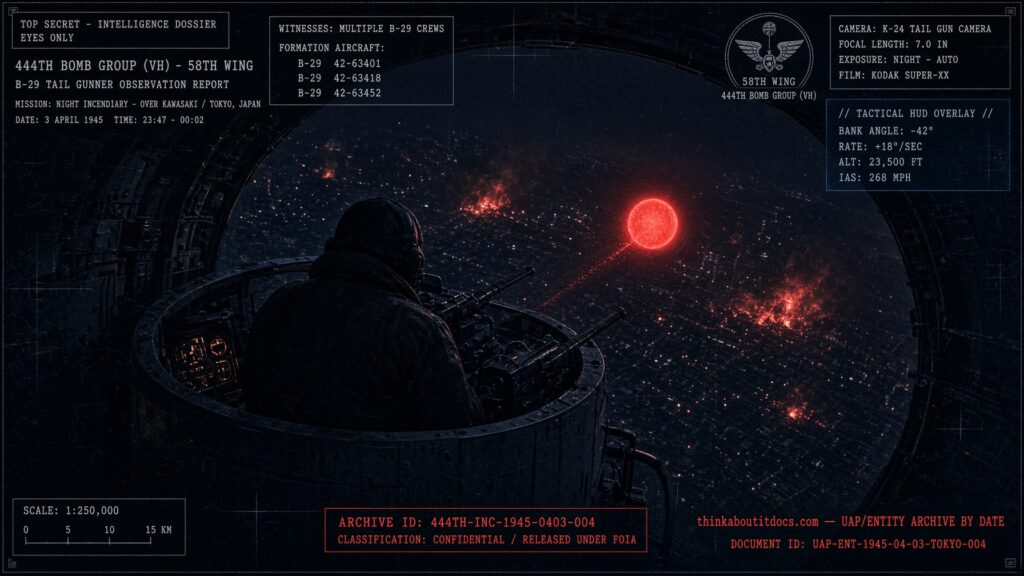
B-29 crews returning from the Kawasaki and Tokyo raids in early April 1945 brought back a story intelligence officers had already started hearing from other Pacific bomb groups: basketball-sized balls of fire that matched their every move. What makes this case unusual isn’t the phenomenon itself — by this point in the war, “balls of fire” had a name and a track record — it’s that the account survives in two independent forms: a named veteran’s personal recollection, and an official Allied intelligence document quoting a formal U.S. Army Air Forces Pacific intelligence report on the very same pattern.
Date: April 3, 1945, with a second wave noted roughly two weeks later after a Tokyo raid
Sighting Time: Night incendiary mission
Day/Night: Night
Location: Kawasaki and Tokyo, Japan — over the Tachikawa aircraft plant and the Kawasaki industrial area, with B-29s flying from bases in the Mariana Islands
Urban or Rural: Not applicable — high-altitude airborne encounter during active bombing missions
No. of Entity(s): Not Applicable
Entity Type: Not Applicable
Entity Description: Not Applicable
Hynek Classification: NL — Nocturnal Light. Multiple point-source lights observed at night, matching evasive maneuvers with no structural detail resolved beyond the light source itself; no landing, physical trace, or occupant sighting.
Duration: Individual pursuits lasting as long as six minutes, per the official intelligence summary; one object followed a B-29 for roughly thirty miles out to sea
No. of Object(s): Multiple, across multiple aircraft and missions; individual encounters typically involved one object per bomber
Description of the Object(s): Balls of fire approximately the size of a basketball, with a phosphorescent glow; some reported with tails of blinking light. The objects generally appeared to materialize from nowhere rather than being tracked on approach, with only one instance noted of an object ascending from a relatively low altitude to the rear of a B-29. No wing, fuselage, or other structural feature was observed on any of them.
Shape of Object(s): Spherical
Size of Object(s): Approximately the size of a basketball
Color of Object(s): Red, with a phosphorescent glow
Distance to Object(s): No accurate estimate could be established between the objects and the pursued B-29s, per the official report
Height & Speed: The objects matched B-29 altitude, speed, and course changes precisely, including through rapid altitude changes, sharp turns, and cloud cover; one bomber only broke contact by accelerating to 295 mph, at which point the pursuing object reversed course and headed back toward land
Number of Witnesses: Multiple B-29 crews across several missions; named account from Richard M. Keenan, 444th Bomb Group, 58th Wing, West Field, Tinian
Special Features/Characteristics: The objects held formation through violent evasive maneuvers that would defeat any conventional pursuit aircraft of the period; the pattern was significant enough to generate a formal Army Air Forces Pacific intelligence report (G-2 Periodic Report No. 67), which was in turn quoted by RAF Fighter Command’s own intelligence summary — a rare instance of one Allied service’s intelligence apparatus formally documenting and forwarding another service’s UFO-adjacent report; the stated apparent objective, per the official assessment, was “destruction of the Super-Fortresses by contact,” though no B-29 was ever damaged by one of the objects; both aerial interception and anti-aircraft fire proved entirely ineffective against them.
Case Status: Unexplained
Source: Sky Giants Over Japan: A Diary of a B-29 Combat Crew In WWII, Chester Marshall, pages 184-185 (article: “A Flashback — Great Balls of Fire”), relating the account of Richard M. Keenan; Headquarters, U.S.A.F.P.O.A. G-2 Periodic Report No. 67, quoted in full in RAF Fighter Command Intelligence and Operational Summary No. 30, dated 15 May 1945
Related Cases: 1945: April UFO & Entity Sightings Archive | 1945: January UFO & Entity Sightings Archive (the Iwo Jima amber-light case, same “balls of fire” pattern, three months earlier)
Detailed Report
By early April 1945, the 20th Air Force’s B-29 campaign against the Japanese home islands was in full swing, flying from bases across the Mariana Islands to strike industrial and urban targets across Honshu. On April 3, during a night incendiary mission, crews reported that “balls of fire followed our aircraft.” The pattern repeated less than two weeks later, following an early-morning strike on Tokyo, when an intelligence resume noted simply: “Several balls of fire observed.” The account survives in personal form through Richard M. Keenan of the 444th Bomb Group, 58th Wing, stationed at West Field on Tinian, as related in Chester Marshall’s B-29 crew memoir Sky Giants Over Japan.
What elevates this case above a single veteran’s recollection is independent corroboration from an entirely different Allied intelligence chain. Headquarters, U.S. Army Air Forces Pacific Ocean Areas (USAFPOA) issued G-2 Periodic Report No. 67, describing a raid on the Tachikawa aircraft plant and the industrial area of Kawasaki, both in the Tokyo area, during which “a number of Super-Fortresses reported having been followed or pursued by ‘red balls of fire’ described as being approximately the size of a basketball with a phosphorescent glow. Some were reported to have tails of blinking light.” The report goes on to describe the objects’ behavior in specific, falsifiable terms: they appeared generally out of nowhere; no accurate distance estimate could be made; no amount of evasive maneuvering — however violent — succeeded in shaking them; they matched altitude and speed changes and held course through cloud cover; one B-29 only outran its pursuer by accelerating to 295 mph, at which point the object reversed and headed back toward land; individual pursuits ran as long as six minutes; and one object followed a bomber thirty miles out to sea before breaking off.
This USAFPOA report did not stay within American channels. It was quoted in full by RAF Fighter Command’s own Intelligence and Operational Summary No. 30, dated May 15, 1945 — more than a month after the original encounters — under a section explicitly connecting it to previously documented German airborne controlled missiles (the Hs.298, Hs.293, X4, and Hs.117) and noting that “it is known that the Germans kept their Japanese Allies informed of technical developments,” implying British intelligence’s working theory was that Japan might be deploying German-derived guided weapon technology. The RAF’s own preliminary evaluation concluded that “the range and length of light greatly exceed the known capabilities of friendly or enemy jet aircraft,” and explicitly stated “there is great need for intelligence on all air phenomena” of this kind.
RESEARCHER’S NOTES
When One Ally’s Intelligence Report Becomes Another Ally’s Intelligence Report
- On why the cross-service corroboration matters: Most WWII “balls of fire” cases in this archive rest on a single squadron’s own paperwork, or a postwar veteran interview, or a wire-service press story. This case is different: an American Pacific theatre intelligence assessment was formally quoted by British Fighter Command over a month later, on the other side of the world, in the context of an active technical intelligence investigation into possible enemy guided-weapon technology. That’s not one witness telling one story — it’s two allied intelligence services independently treating the same body of reports as significant enough to formally document, forward, and analyze.
- On the “guided weapon” hypothesis, weighed honestly: The RAF’s working theory — that Japan might be using German-derived remote-controlled or homing munitions — was a reasonable wartime hypothesis given known German programs like the Hs.293 glide bomb. But the behavior described doesn’t cleanly fit a guided weapon: the objects never damaged a single B-29 despite repeated close pursuit over many missions, several were reported to reverse course and return to land rather than continuing an attack run, and the report itself concedes “the range and length of light greatly exceed the known capabilities of friendly or enemy jet aircraft.” A weapon designed to destroy aircraft “by contact,” in the report’s own words, that never once made contact across dozens of documented encounters, is a weapon that isn’t working as a weapon — which is itself worth noting.
- On the “295 mph” detail specifically: This is one of the more precise performance data points in the WWII UFO record. A B-29 at 295 mph was operating close to its maximum straight-and-level speed; for an object to match a B-29 through violent evasive maneuvering and then be outrun only at that speed, and only briefly, describes something with performance in the same general range as late-war piston aircraft — impressive but not necessarily beyond period technology, unlike some of the more extreme speed claims elsewhere in this archive (compare the September 1943 Guadalcanal-adjacent cases or the February 1945 Ulithi intercept, where objects simply could not be caught at all).
- On what remains unresolved: Neither the USAFPOA report nor the RAF summary offers a confirmed explanation. Both explicitly flag the case as unresolved and call for further intelligence gathering — the RAF summary’s own words, “there is great need for intelligence on all air phenomena,” reads less like a dismissal and more like an institutional acknowledgment that the existing catalogue of explanations (secret weapon, natural phenomenon, aircrew error) didn’t yet account for what multiple independent crews were reporting.
The Kawasaki-Tokyo balls of fire never damaged a single aircraft, were tracked by two separate Allied intelligence services, and were formally acknowledged by both as unexplained. Whatever pursued those B-29 crews through the night skies over Japan in April 1945 remains, by the explicit admission of the military organizations that investigated it at the time, unidentified.