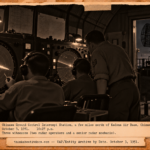
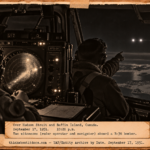
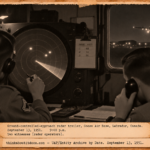
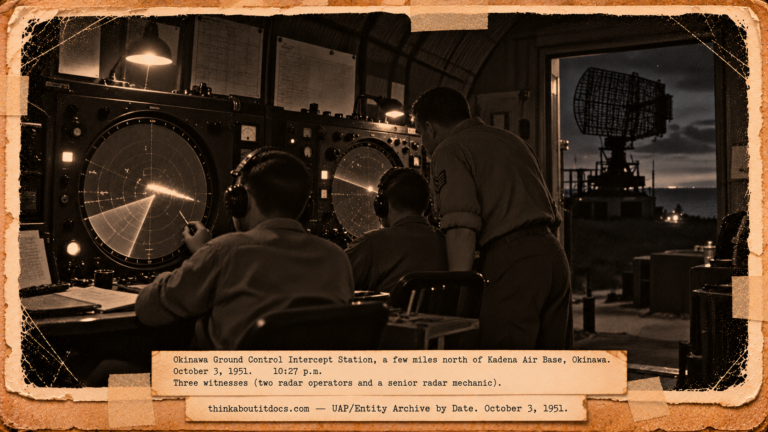
Okinawa, October 3, 1951: radar operators track an unidentified sausage-shaped echo north of Kadena Air Base.
THINK ABOUTIT UFO|UAP SIGHTINGS REPORT
1951: Okinawa Radar Station Tracks a Huge Sausage-Shaped Echo at an Estimated 4,800 mph North of Kadena Air Base
At 10:27 p.m. on October 3, 1951, a radar operator at the Okinawa Ground Control Intercept Station, a few miles north of Kadena Air Base, saw an unidentified echo appear on the high-beam scope of his AN/CPS-1 search radar, 90 miles out. The blip was sausage-shaped, about three times the size of the echo from a B-29, and it held its long axis at right angles to its direction of travel the whole time. It changed course between two sweeps of the antenna, within 15 seconds, and by the operator’s grease-pencil marks it covered the first stretch at an estimated 4,800 miles per hour.
A second operator picked up the same kind of echo on a different scope and followed it out past 240 miles, and a senior radar mechanic watching both scopes confirmed what they saw. No one saw anything in the sky. Project Blue Book rated this radar UFO case Unidentified, and the Air Technical Intelligence Center later declined to theorize about it, noting that two radar experts had offered conflicting explanations.
Date: October 3, 1951
Sighting Time: 10:27 p.m. Item time (2227 local; 1327Z)
Day/Night: Night
Location: Okinawa Ground Control Intercept Station, Site 51 “A,” 529th Aircraft Control and Warning Group, a few miles north of Kadena Air Base, Okinawa (26°24′55″ N, 127°47′49″ E in the report); the target was tracked over the sea north and north-northwest of the station
Urban or Rural: Rural (military radar station)
No. of Entity(‘s): Not Applicable
Entity Type: Not Applicable
Entity Description: Not Applicable
Hynek Classification: Radar only (no visual observation); a radar-only event falls outside the six Hynek categories
Duration: Not recorded; the high-beam operator saw six echoes and the low-beam operator four, and the speed estimate rests on the first minute of tracking
No. of Object(s): 1
Description of the Object(s): A solid, well-defined, sausage-shaped radar echo that was easily seen on the scope but not brilliant. The long axis stayed at 90 degrees to the direction of movement, and the operators saw no change in shape, size or rate of movement apart from one course change between sweeps. The report form lists the object as “extremely maneuverable” with type and markings unknown.
Shape/Size/Color of Object(s): Sausage-shaped echo. High-beam scope: about 2 miles wide by 4 miles long, roughly three times a B-29 echo. Low-beam scope: 2.5 to 3 miles wide by 6 to 8 miles long, 2.5 to 3 times a B-29 echo. These are the dimensions of the echo on the scope, not a measured size for the object. No visual sighting.
Distance to Object(s): High beam: first detected at 90 statute miles on a bearing of 014 degrees; last echo at 152 miles on a bearing of 340 degrees. Low beam: echoes at 200, 210 and 225 miles, and a last echo at 247 miles, all on a bearing of 355 degrees
Height & Speed: Altitude unknown. Ground speed estimated at 4,800 mph during the first minute of detection, from five consecutive echoes the operator marked on his scope in grease pencil; no times were written down. Track heading west.
Number of Witnesses: 3 (two radar operators and a senior radar mechanic; names redacted in the file)
Special Features/Characteristics: Long axis always at right angles to the direction of travel; direction changed between sweeps within 15 seconds; the high-beam operator saw no echoes between 112 and 152 miles, possibly because he was changing scope range; the mechanic said fixed echoes from the islands of Yoron Jima and Okino Erabu Shima brightened around the time of the detection; the object never appeared on the low-beam short-range scope; the station could not relay the report to the air defense control center at Itazuke because of heavy continuous-wave interference
Case Status: Unidentified (Project Blue Book record card: Other, “Unidentified”). The Air Technical Intelligence Center electronics branch declined to theorize in 1952, citing conflicting explanations from two radar experts.
Source: Project Blue Book record card; Far East Air Forces Air Intelligence Information Report IR-25-52 (October 8, 1951, with inclosures); Air Technical Intelligence Center disposition forms (September and October 1952); Berliner (BBU #984, per NICAP); Brad Sparks, Blue Book Unknowns Catalogue; Jerome Clark, The UFO Encyclopedia
Summary/Description: Two radar operators on Okinawa tracked a large sausage-shaped echo at an estimated 4,800 mph that turned between sweeps and ran out past 240 miles; with no visual sighting and two conflicting expert opinions, the Air Force left it Unidentified.
Related Cases: The North Truro, Massachusetts radar track of October 22, 1951 (a fast, sausage-shaped target), and the Goose Bay, Labrador GCA radar targets of September 1951
Detailed Report
The Detection
The Far East Air Forces intelligence report, dated October 8, 1951, was built from the station’s own paperwork and statements. At 1327Z on October 3 (10:27 p.m. on Okinawa), the senior air control and warning operator on the high-beam plan position indicator saw an unidentified echo 90 statute miles from the station on a bearing of 014 degrees. The scope was set to a range of zero to 120 miles, with the trace brilliance turned down to a barely discernible level and the focus sharp.
He described the blip as easily seen but not brilliant, and said that had it been brilliant it would have looked about three times the size of the echo a B-29 returns. It was sausage-shaped and straight, its length twice its width, which he put at 2 miles by 4 miles. Its long axis always lay at 90 degrees to the direction of movement. At one point the object changed direction, but the turn itself was not seen because it happened between two sweeps of the antenna, within 15 seconds. The last of the six echoes he saw, at 340 degrees and 152 miles, was the brightest. No weather echoes and no other targets appeared on his scope.
The Second Scope
After the object left the high-beam scope, an apprentice operator on the long-range low-beam scope of the same radar picked up an echo on a bearing of 355 degrees at 200 miles. He saw it four times at 200, 210, 225 and 247 miles. He described it as solid, well defined and sausage-shaped, brighter than the average echo and 2.5 to 3 times a B-29 blip, 2.5 to 3 miles wide and 6 to 8 miles long, with its long axis again at 90 degrees to its movement. The last echo was as large and bright as the first. At 247 miles it disappeared into the second transmitted pulse. That scope was running at a range of 110 to 230 miles, and no interference, weather or sea clutter was present.
A senior radar mechanic was watching the same scopes and agreed with both operators. He added that around the time of the detection, permanent echoes from nearby islands, Yoron Jima and Okino Erabu Shima, grew brighter. The object itself was never seen on the low-beam short-range scope. The mechanic had checked and synchronized both scopes to true north earlier that evening.
Speed and Maneuverability
The report puts the object’s ground speed at about 4,800 miles per hour during the first minute. That estimate comes from the high-beam operator’s five consecutive echoes, whose range and azimuth he marked on the face of the scope in grease pencil. No one wrote down when each plot was made, so the speed depends on his recollection of the sweep timing. The form lists the object as extremely maneuverable and moving west, with a first position near 27°42′ N, 128°10′ E and a last position near 29° N, 127°25′ E.
The high-beam operator did not see any echoes between 112 and 152 miles, though the beam swept the area; he thought he might have been re-setting his scope range at that moment. The low-beam operator saw nothing between 225 and 247 miles and also changed his range while the object was within it.
Reporting and Evaluation
The station notified its duty officer at 1335Z and tried to pass the data to the air defense control center at Itazuke, but heavy continuous-wave interference blocked the transmission. A priority secret radio message went to Air Force intelligence in Washington on October 4. No interception was attempted. Weather at Kadena at 1300Z showed 3/10 alto-cumulus at 10,000 feet, 15 miles of visibility and a temperature of 73 degrees F, with very few clouds to the north.
The Blue Book record card lists the case as Unidentified. In September 1952 an Air Technical Intelligence Center branch asked its electronics branch to review the report, calling it extremely detailed and “interesting as a possible unidentified aerial object.” On October 1, 1952, the electronics branch replied that, given the available information and the fact that “two radar experts have advanced conflicting explanations of the phenomena,” further theorizing “would be pure conjecture.”
RESEARCHER’S NOTES
Why the Kadena Radar Case Still Matters
- Three observers, two scopes: Two operators on two different scopes of one radar saw the same kind of echo, and a mechanic who knew the equipment agreed. That rules out a single misread blip, though it does not rule out a fault in the radar itself.
- The echo shape: The sausage shape with its long axis across the line of travel was seen on both scopes, which is what makes the report read as one consistent description rather than two separate blips.
- The island echoes: The mechanic’s remark that fixed island echoes brightened at the time is the kind of detail radar analysts associate with anomalous propagation. The file records that two radar experts disagreed but does not say what either one argued.
- The speed figure: About 4,800 mph rests on five grease-pencil marks and no timings. Treat it as the operator’s estimate, not a measurement.
- Figures that differ: The echo dimensions differ between the scopes (2 by 4 miles on high beam, 2.5 to 3 by 6 to 8 miles on low beam), and the high-beam operator saw six echoes against the low-beam operator’s four. The speed figure comes only from the high-beam plots.
What the file establishes is that trained operators saw a large, fast, maneuvering radar target that no one could explain, and that the Air Force’s own electronics experts could not agree on a cause. It does not establish that the target was a craft. It also does not show that the target was a radar artifact, because the one clue pointing that way, the brightening island echoes, was never resolved. The case stays Unidentified.
“Further theorizing by ATIAE would be pure conjecture.”
— Chief, Electronics Branch, Air Technical Intelligence Center, October 1, 1952