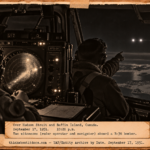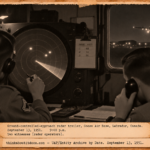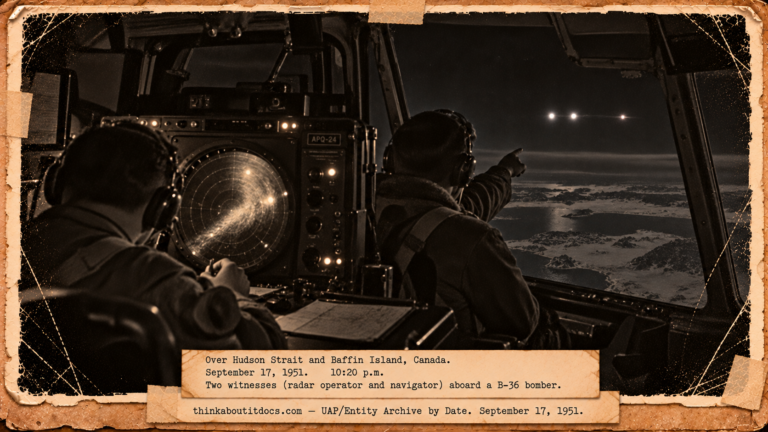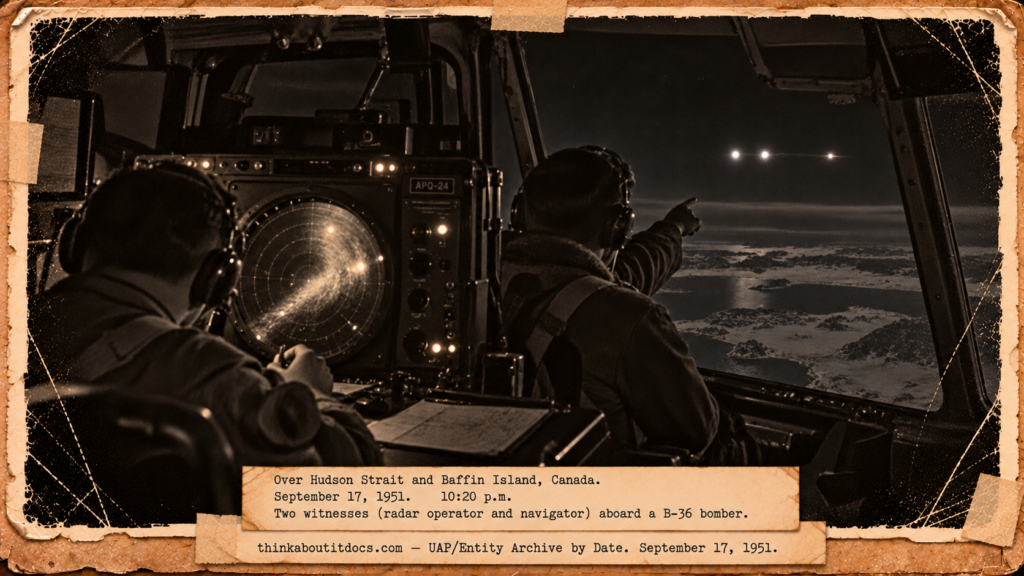
Hudson Strait, September 17, 1951: a B-36 crew tracks an unidentified aircraft on radar and sees white lights cross its nose.
THINK ABOUTIT UFO|UAP SIGHTINGS REPORT
1951: A B-36 Crew Tracks a White-Lighted Aircraft Over Hudson Strait, Canada
At 10:20 p.m. on September 17, 1951, a B-36 bomber flying a long training mission from Goose Air Base, Labrador, toward Resolute in the Canadian Arctic picked up a patch of radar interference that its radar operator slowly worked out was another aircraft, 28 miles off the right side and 130 degrees from the nose. Over the next 75 minutes the interference grew until it covered 120 degrees of the scope, jammed the plane’s radar, and finally resolved into something the crew could see: an aircraft with white running lights where red and green should have been. It crossed from the right side to the left at 18,000 feet, about 30 knots faster than the bomber, and stayed in view for 20 minutes.
The Hudson Strait B-36 UFO encounter was reported through Northeast Air Command, which ruled out ships, friendly aircraft and any known radar station. Blue Book’s record card calls it a report of an unidentified aircraft, “not a UFO report,” and checks Was Aircraft. The aircraft that the crew saw was never identified in the file.
Date: September 17, 1951 (0320Z, September 18)
Sighting Time: 10:20 p.m. to about 11:55 p.m. EST (0320Z to 0450Z)
Day/Night: Night
Location: Over Hudson Strait and Baffin Island, Canada, from about 61 degrees 30 minutes north, 68 degrees 50 minutes west, northward to about 65 degrees 40 minutes north, 71 degrees 40 minutes west (B-36 en route from Goose Air Base, Labrador, to Resolute, Northwest Territories)
Urban or Rural: Rural (Arctic wilderness and open water)
No. of Entity(‘s): Not Applicable
Entity Type: Not Applicable
Entity Description: Not Applicable
Hynek Classification: Radar-Visual (RV); airborne radar and visual observation of the same unidentified aircraft
Duration: About 75 minutes of radar tracking; visible for about 20 minutes
No. of Object(s): 1
Description of the Object(s): An unidentified aircraft detected by the B-36’s APQ-24 radar and then seen visually. It carried white running lights instead of the standard red and green, and a flashing white light at the tail, and was not identified by the crew.
Shape/Size/Color of Object(s): Not determined; only lights were seen (white running lights and a flashing white tail light)
Distance to Object(s): First detected at 28 nautical miles on a relative bearing of 130 degrees; later flew alongside the B-36 and crossed over its nose
Height & Speed: About 18,000 feet; estimated about 30 knots faster than the B-36, whose ground speed was 208 knots; heading approximately 046 degrees on the grid (334 degrees true)
Number of Witnesses: 2 on the lead B-36 (Major Paul E. Gerhart, radar operator, and Major Charles J. Cheever, navigator); 2 electronic-countermeasures operators on other B-36s reported signals the following days
Special Features/Characteristics: Heavy radar interference that the anti-jam device could not clear; autopilot and APQ-24 radar failed at about 11:50 p.m. and the radar returned a few minutes later; unexplained carrier-wave and radar-type signals on 790-800 and 900 megacycles recorded the next day
Case Status: Explained per Project Blue Book (record card: “Was Aircraft”; comment: “Report of unidentified a/c (Not a UFO report)”), though the aircraft was never identified
Source: Project Blue Book record card; Air Intelligence Information Report (Headquarters, Northeast Air Command, October 4, 1951); Air Force incoming message; Jan Aldrich; cf. Hynek, The UFO Experience, ch. 7
Summary/Description: A B-36 crew flying over Hudson Strait tracked radar interference that became an aircraft with white lights, crossing the bomber at 18,000 feet; Northeast Air Command could find no friendly or known aircraft, ship or radar to account for it.
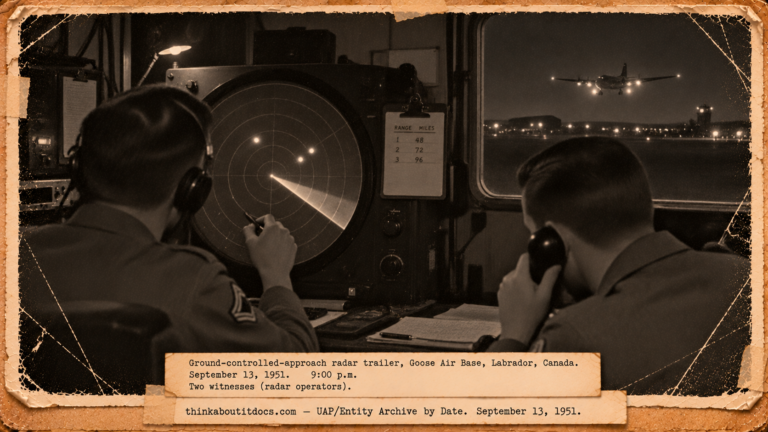
Related Cases: The September 13, 1951 Goose Bay GCA radar targets; the September 18, 1951 Michigan-Wisconsin radar tracks
Detailed Report
The Flight
The Northeast Air Command intelligence report says three B-36 aircraft flew a training mission from Goose Air Base, Labrador, to Resolute, Northwest Territories, and Thule, Greenland, and back between September 18 and 20 Greenwich time. Major Paul E. Gerhart was the radar operator and Major Charles J. Cheever the navigator aboard the first bomber; two staff sergeants, ECM operators, flew in the others. The first sighting happened on the first leg.
At 0320Z, which is 10:20 p.m. EST on September 17, Gerhart noticed radar interference on the APQ-24 scope that turned out to be an unidentified aircraft on a relative bearing of 130 degrees, 28 nautical miles away, near 61 degrees 30 minutes north and 68 degrees 50 minutes west. The scope later showed very noticeable jamming. The crew turned on the set’s anti-jam device, without effect. By 0435Z, interference was coming from the right side of the aircraft and covered 120 degrees of the scope.
At about that time the unidentified aircraft crossed over from the right side of the B-36 to the left at 18,000 feet and at a speed Gerhart estimated at 30 knots faster than the B-36, which the navigator’s log put at 208 knots. Cheever saw the aircraft fly alongside on the right, then cross over the bomber’s nose, at about 65 degrees 40 minutes north and 71 degrees 40 minutes west, and kept it in view for about 20 minutes. All its running lights were white. It passed the B-36 on a heading of about 046 on the grid, or 334 degrees true. At 0450Z the autopilot and the APQ-24 radar went out. The radar came back after a few minutes.
The Signals and the Air Force Analysis
The ECM operators aboard the other B-36s reported that on September 19 and 20 they picked up shifting, carrier-wave type signals and radar-like signals on frequencies in the 790-800 megacycle and 900 megacycle groups, and the report notes that 243 megacycles is the national emergency frequency. Northeast Air Command’s intelligence division wrote that a naval vessel with radar in Hudson Strait was ruled out because a ship would have presented an identifiable return on the APQ-24 radar set, that the frequencies were unexplainable because no U.S. or Canadian radar stations are known to exist in the area within range of the bombers, and that no aircraft assigned to the command carries night lights as described or flies at that altitude and airspeed in the area. It also judged it not feasible for an enemy aircraft to make reconnaissance flights in the command’s area, and said two RB-36 aircraft were being sent to Goose Air Base to investigate further.
Blue Book’s record card for the case lists the position as 61 degrees 30 minutes north, 68 degrees 50 minutes west (Atlantic), checks ground radar and air-intercept radar, checks “Was Aircraft,” and says: “Unidentified a/c at 18,000 ft. No red and green lights. Sighted visually and picked up on Air Radar. Also being picked up by ground radar.” The comment reads: “Report of unidentified a/c (Not a UFO report).”
RESEARCHER’S NOTES
What Makes the Hudson Strait Report Unusual
- Two sensors, one object: The B-36 radar and two airmen’s eyes followed the same aircraft, and the file says it was also picked up by ground radar, so the case is a radar-visual report rather than a lone light.
- Ruled-out explanations: Northeast Air Command checked ships, its own aircraft, nearby radar stations and the chance of enemy reconnaissance, and none fit the evidence in the file.
- A “not a UFO report”: Blue Book filed it as an unidentified aircraft, not a UFO, and the card’s “Was Aircraft” box means the Air Force considered it a conventional aircraft, though the file never names one.
- Equipment effects: The radar interference, the autopilot loss and the later signals suggest electronic effects, and the report does not say whether they came from the other aircraft or from something else.
- Date and time conventions: The reports mix Greenwich dates (September 18) and local dates (September 17), and the card reads 18/0420Z; the crew’s 0320Z and 0435Z times are consistent with the 10:20 p.m. start used here.
The file leaves a real gap between the Air Force’s label and its own investigation. Blue Book called it an aircraft, yet the command that investigated could not find one. The case is best described as an unidentified aircraft, with radar and visual evidence from experienced crew members, that was assessed as conventional without ever being matched to a conventional aircraft.
“A ship would have presented an identifiable return on the APQ-24 radar set.”
— Northeast Air Command intelligence report, October 4, 1951