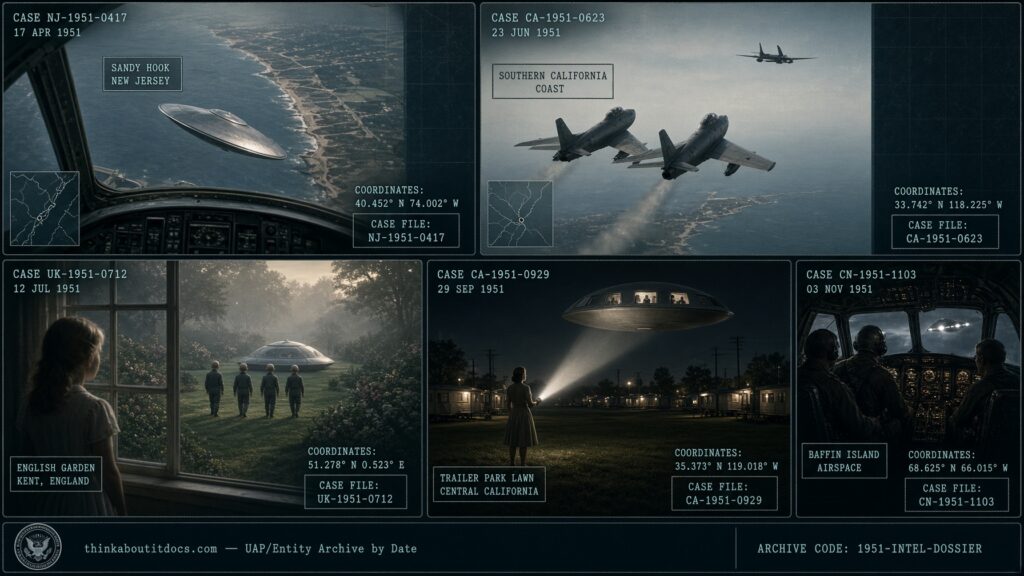
Five cases from September 1951, headlined by the Fort Monmouth UFO case and the March Field, California intercept.
1951: September
UFO|UAP & Entity Sightings Archive
September 1951 is one of this archive’s most consequential months, anchored by two cases now documented in full via standalone reports: the Withdean, Sussex, England encounter, in which a teenage girl watched three identical, perfectly synchronized entities exit a landed craft and retrace their steps “like a film played backwards,” and the March Field, California intercept, a two-hour, three-flight failed pursuit that stands alongside the Fort Monmouth case (also documented via its own standalone, restored below) as one of the year’s most institutionally significant sightings — indeed, the Fort Monmouth case is credited with helping transform the Air Force’s dismissive Project Grudge into the more methodical Project Blue Book. The month also brought a striking multi-witness saucer sighting in Bloomington, California and a detailed, hypnosis-recovered abduction account from Illinois.
Date: Fall 1951
Location: Dugny-sur-Meuse, France
Time: Night
Summary: A group of workers trying to recharge their stalled truck’s battery were suddenly bathed in orange light and saw a luminous orange globe nearby on the ground. A tall, beautiful, Nordic-looking woman with long blond hair stepped out, wearing a belted blue robe, smiling and cradling what appeared to be an infant in her arms. The figure abruptly vanished; the globe then brightened and took on the appearance of a “jellyfish.” The witnesses felt a sudden, intense cold, as if inside an icebox, before the light blinked out. They left convinced they had encountered the Virgin Mary.
Source: Raoul Robe, Regional Catalogue
Date: Fall 1951
Location: Manila, Philippines
Time: Afternoon
Summary: Sixth-grader Cornelio Closa, of Zamora Elementary School, met a beautiful, barefoot girl about his own age in a nearby field, with long blond hair reaching her waist, who appeared to float rather than walk beside him. Though her lips never moved, he could hear and understand what she said; when she touched his hand, he felt suddenly light and lost awareness of his surroundings, with no memory of the rest of the encounter. He reported meeting her many times afterward, during which he was able to float and travel to various places in the city, and apparently gained the ability to disappear at will — an ability he lost as he grew older.
Source: Brad Steiger, Strange Disappearances
Date: September 1951
Location: Bloomington, California
Time: 21:00 and 21:15
Summary: Sitting on the lawn outside their trailer park home, Mrs. Louise McDougall felt she was being watched and looked up to see a lenticular flying saucer, roughly 100 feet across and gunmetal silver, hovering less than 20 feet overhead. Tall rectangular windows in its lower half revealed, against an amber glow, four men in one-piece jumpsuits with shoulder-length hair. She turned a spotlight on the object, which shot off silently at incredible speed; about 15 minutes later it returned to the same spot, the figures still visible, before departing again to the southeast after 6-7 minutes. Her husband and three others also witnessed the sighting.
Source: NICAP; Lucius Farish
Date: September 4 or 5, 1951
Location: Withdean, Sussex, England
Time: Approximately 06:30
Summary: Teenager Sheila Burton watched a dome-shaped, fluorescent silvery-green craft descend at incredible speed onto her family’s garden. Three identical, bald, “Kojak”-style entities in dark green suits emerged in perfect synchronization, each carrying a gun-like device, walked about 30 feet, then stopped and walked backward to the craft in reverse, re-entering and departing vertically. The entire silent episode lasted 40-50 seconds. See the Full Report.
Source: Norman Oliver, Quest UFO Magazine; BUFORA Journal Vol. 8 #1, Jan/Feb 1979
Date: September 6, 1951 (BBU 964)
Location: Claremont, California
Time: 7:20 p.m.
Summary: S/Sgt. W. T. Smith and M/Sgt. L. L. Deuel saw six orange lights in an irregular formation, flying straight and level into a coastal fog bank.
Source: Berliner; FUFOR Index
Date: September 9, 1951 (BBU)
Location: Off the North Korean coast, aboard USS Cony (DDE 508), Task Force 77
Time: 6:50 p.m. local time
Summary: A high-speed target, or targets, was tracked on the USS Cony’s AN/SPS-6B air search radar, functioning normally before and after the incident, roughly 50 miles off the North Korean coast. The target held a course of 225° true at approximately 900 knots for about one minute; the operator’s interpretation was “many bogies” on a line of bearing perpendicular to the target’s course.
Source: Jan Aldrich
Date: September 10, 1951
Location: Fort Monmouth, New Jersey, and 3 miles NE of Asbury (Sandy Hook), New Jersey
Time: 11:18 a.m. (radar detection at Fort Monmouth); 11:35-11:37 a.m. EDT (T-33 pilot sighting)
Summary: A watershed case in UFO investigation history. USAF pilots Lt. Wilbert S. Rogers and Major Ezra S. Ballard, flying a T-33 from Dover AFB to Mitchel AFB, spotted a silvery, discus-shaped object roughly 30-50 feet across, silhouetted below them near Sandy Hook. Rogers turned to intercept; the object banked, revealing a flat, appendage-free profile, and outmaneuvered the jet, covering an estimated 30-50 miles in two minutes (roughly 1,000-1,500 mph) before heading out to sea near Point Pleasant. This pilot sighting is the same case as the Fort Monmouth radar incident that morning — together, the case is credited with helping transform the Air Force’s dismissive Project Grudge into the more rigorous Project Blue Book. See the Full Report.
Source: Sparks; Wendy Connors & Mike Hall, UFO Casebook Files
Date: September 13, 1951 (BBU 969)
Location: Goose Bay, Labrador
Time: Approximately 9:30 or 10:00 p.m. AST
Summary: GCA operators Warner B. Maupin and Cpl. John W. Green, of the 1932nd AACS Squadron, were called to the local GCA trailer at the request of an inbound C-54’s pilot and observed what appeared to be three targets on the radar’s Plan Position Indicator scope. The surviving source breaks off before describing the sequence’s resolution.
Source: Berliner; McDonald files; Jan Aldrich
Date: September 16 or 17, 1951 (BBU)
Location: 3 miles NE of Marion, Ohio
Time: 12:17 p.m.
Summary: Cessna pilot Grover saw a black, swept-wing object at 2,800 feet in a near collision with his aircraft.
Source: Project 1947; FUFOR Index
Date: September 17, 1951 (BBU)
Location: Over Hudson Strait, between Goose Bay, Labrador and Baffin Island, Canada
Time: 10:20-11:55 p.m. EST
Summary: USAF B-36 radar operator Major Paul E. Gerhart and navigator Major Charles J. Cheever, en route from Goose Bay to Resolute, Northwest Territories, detected radar interference from an unidentified aircraft. An anti-jamming device failed to resolve the interference, which spread to cover 120° of the scope by 11:35 p.m., at which point an object with unusual all-white running lights and twin flashing white tail lights was seen visually, traveling roughly 30 knots faster than the B-36, crossing from right to left over Baffin Island and remaining visible for about 20 minutes. At 11:50 p.m., the B-36’s autopilot and radar set failed, the radar returning a few minutes later as the object disappeared. The following day, over Labrador, separate ECM operators detected further unexplained carrier wave and radar-like signals on two more B-36 flights along the same route.
Source: Jan Aldrich; cf. Hynek, The UFO Experience, ch. 7, case RV-11
Date: September 18, 1951 (BBU)
Location: Empire AFS, Michigan; Elkhorn AFS, Wisconsin; Finland AFS, Minnesota
Time: 4:35-5:31 a.m. and 7:10 a.m.
Summary: Air Defense Command radar sites P-34, P-31, and P-69 recorded intermittent CPS-6B and CPS-5 radar tracks of targets at an estimated 6,000 mph.
Source: McDonald files; Jan Aldrich; Grudge Report 1; FUFOR Index
Date: September 23, 1951 (BBU)
Location: Off Long Beach Airport to Camp Pendleton and March AFB, California
Time: Approximately 7:55-9:25 a.m. PDT
Summary: Three separate flights of F-86 jet interceptors, scrambled from George AFB and vectored by GCI radar, made repeated attempts to intercept a bright, silvery, swept-wing object holding a controlled orbit at roughly 50,000-55,000 feet over the Southern California coastal and inland corridor. The object climbed or accelerated away each time a fighter attempted to close the distance; all three intercept attempts failed as the jets ran low on fuel. This is the case incorrectly dated to July 23 elsewhere in this archive’s records. See the Full Report.
Source: Project Grudge Reports 1 and 2; Ruppelt, pp. 94-95
Date: September 24, 1951
Location: Near Orland Park, Illinois
Time: 23:00
Summary: Walking through a wooded area, the witness felt a burning sensation in his neck and saw a silvery-gray, oval object ahead, becoming paralyzed as two beings appeared at a window and appeared to question him. Under hypnosis he later recalled a dozen 18-inch-tall, frog-like beings with large slanted eyes, slit mouths, and brown striped skin approaching and jumping against his body making high-pitched noises, along with smaller bug-like beings present; he fled but felt heaviness and passed out, later resuming his walk and again encountering the object. Under deeper hypnosis he recalled waking inside the craft on a soft bed under a shining light, approached by two five-foot humanoid beings with flat faces behind transparent shields, wearing one-piece suits and helmets. He reportedly suffered chronic ill health following the incident.
Source: Thomas E. Bullard, UFO Abductions: The Measure of a Mystery
EXECUTIVE SUMMARY
The Month That Changed How the Air Force Investigated UFOs
September 1951 is arguably this archive’s single most institutionally consequential month. The Fort Monmouth case — a radar detection and a pilot’s near-collision sighting that turned out to be the same event — is widely credited with catalyzing the Air Force’s shift from the dismissive, understaffed Project Grudge to the more rigorous Project Blue Book. Just thirteen days later, the March Field intercept demonstrated exactly the kind of sustained, multi-witness, radar-corroborated case that new methodology was built to properly investigate. Away from these institutional landmarks, the month’s most striking entity case, Withdean, Sussex, stands out for the sheer strangeness of its occupants’ synchronized, purposeless behavior — a useful reminder that not every close encounter this archive documents fits a single behavioral pattern.
“Like a film played backwards.”
— Sheila Burton, on the September 1951 Withdean, Sussex, England encounter