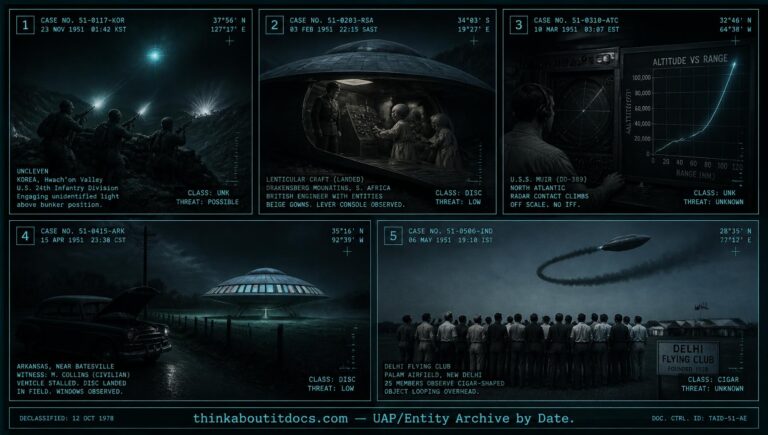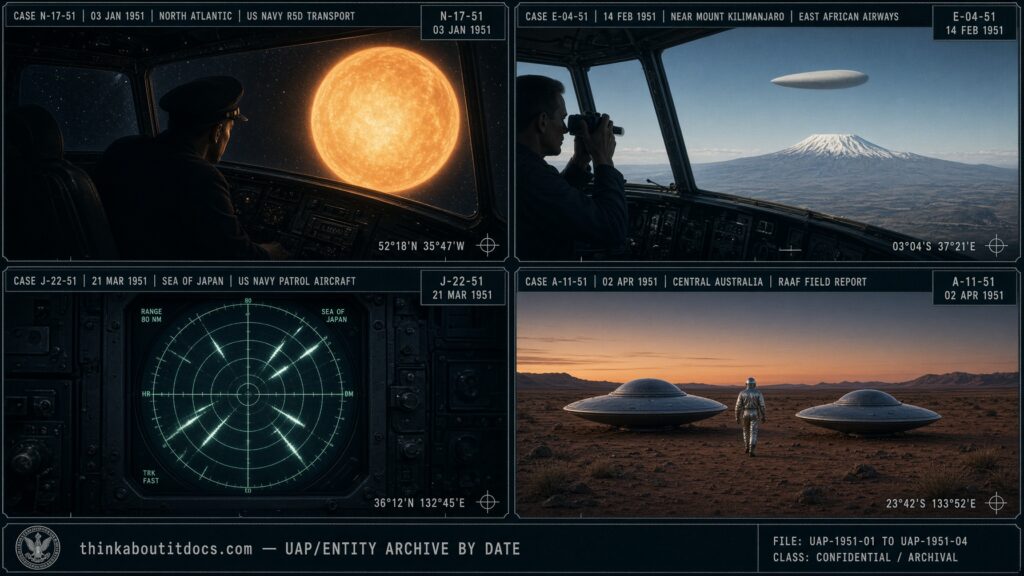
Four cases from February 1951, headlined by the Bethune Incident over the North Atlantic and the Mount Kilimanjaro cigar-shaped UFO photograph.
1951: February UFO|UAP & Entity Sightings Archive
February 1951 opens with a mysterious light that an F-82 night fighter crew could not shake over Japan and closes with an object that hovered over the Ladd Air Force Base runway in Alaska before leaving a puff of white smoke. Between them, this February 1951 UFO sightings archive follows the Bethune encounter, a Navy transport’s near-collision with a glowing object over the North Atlantic; a bullet-shaped, finned object watched for 17 minutes by an airliner’s passengers over Mount Kilimanjaro; a torpedo-shaped light over Durban; eight V-2-shaped objects over Queensland; and a 300-foot “telephone pole” over Galena, Illinois.
Date: February 1951
Location: Unmatjera, central Australia
Time: Unknown
Summary: A group of Aboriginal witnesses observed a shiny, circular object land near a similar craft, about 12 meters in diameter. Several minutes later, a dwarf-sized figure dressed in a shiny suit with a “round shiny head” emerged from one craft and entered the other; both then took off with a buzzing sound.
Source: Frank Edwards
Source Status: Single-source account with no day of the month, no named witnesses and no contemporary record. Filed as a folklore-grade claim.
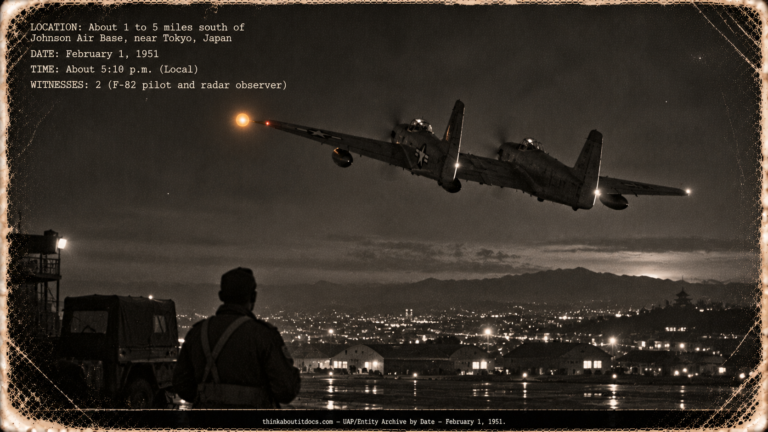
Date: February 1, 1951
Location: Johnson Air Base, Japan (near Tokyo)
Time: About 5:10 p.m. local (1710)
Summary: The pilot and radar observer of an F-82 night fighter on airborne alert saw an amber light, larger than a wing-tip light, hold station off the left wing tip through three or four 360-degree left turns, then jump to the two o’clock high position, drop back to twelve o’clock, reverse toward the aircraft and climb out of sight. Both said the light appeared to have complete control of its movement. See the Detailed Report.
Source: BBU; Berliner; Project Blue Book record card; Air Intelligence Information Report INT-OI-U/AO-1-51 (314th Air Division)
Source Status: Blue Book evaluation is split: the rising portion is Probably Balloon (a weather balloon was released at 6:15 p.m., about an hour after the sighting), and the remainder is Other (Unidentified). The report fixes the date at February 1.
Date: February 2, 1951
Location: Dobbins Air Force Base, Marietta, Georgia
Time: About 10:00-11:00 p.m. EST (0300Z on February 3)
Summary: A number of people at Dobbins AFB, among them the town operator and other airmen, watched a red-green-blue-white light located south of the base at an estimated altitude of 1,000 to 2,000 feet. Accounts differed on whether it moved; some said it stayed stationary, others that it drifted slowly. An attempted radar pickup was negative.
Source: Project Blue Book record card; Dobbins AFB report to Fourteenth Air Force, February 5, 1951
Source Status: Blue Book evaluation: Was Astronomical (the star Sirius, at about 45 degrees elevation). Included as a documented, explained case.
Date: February 2, 1951
Location: Cape Wales, Alaska
Time: About 0500 GMT on February 3 (evening of February 2 local)
Summary: The Weather Bureau officer in charge at Wales reported alternating green and red lights on a bearing of 242 degrees, with the green light seen directly above a red one and a faint glow below them suggesting a ship, although no superstructure was visible. The lights vanished at 0515Z, returned about half an hour later and stayed in the same position until about 0700Z, when fog obscured them. Alaskan Command asked for the position of Burton Island and whether a barrage balloon was flying.
Source: Project Blue Book record card; Alaskan Command message
Source Status: Blue Book evaluation: Other (lights from a ship off Nome).
Date: February 2, 1951
Location: Woodlands Station, 20 miles southwest of Condamine, Queensland, Australia
Time: About 3:00 p.m. (one witness gave 4:00 p.m.)
Summary: While repairing a belt on a pumping plant, a man from Toowoomba heard a high-pitched swishing noise and saw eight polished-metal objects pass overhead in formation at an estimated 10,000 feet, each about 40 feet long and shaped like a V-2 rocket, with a straight exhaust trail extending about 40 feet behind. His wife saw the same group glitter as it flew away. The couple reported it to the Army; the Royal Australian Air Force interviewed both and the U.S. Air Attache forwarded the file to Air Technical Intelligence Center in 1953. See the Detailed Report.
Source: Air Attache, Australia, report TR-202-53 (July 17, 1953), forwarding RAAF Intelligence interviews; Project Blue Book file
Source Status: The record card’s conclusion box is illegible in the released copy, so no Blue Book evaluation is shown here.
Date: February 3, 1951
Location: Galena, Illinois
Time: Night (Saturday evening)
Summary: Galena’s mayor said he was flooded with calls about a brilliant red object, about 300 feet long and shaped like a telephone pole or baseball bat, that glided noiselessly and not very high or fast over the town. Police said about six motorists reported nearly having accidents as it passed overhead. Later reports described it as green as it moved north and blue over Wisconsin, where a bright blue flash believed to be a meteor was seen the same night.
Source: Project Blue Book record card; UP wire story, Journal Herald, February 5, 1951
Source Status: Blue Book evaluation: Was Astronomical (meteor). The card notes the object appeared blue over Wisconsin. Included as a documented, explained case.
Date: February 4, 1951
Location: Sussex, England
Time: Evening
Summary: A young girl playing in her garden saw a hovering, disc-shaped object with a transparent cupola on top. Inside, she could see three figures wearing shiny, silvery outfits, apparently looking down at her. No other information survives.
Source: GEPUC
Source Status: Single-source catalogue entry with no named witness or location and no contemporary record.
Date: February 6, 1951
Location: Lucerne Valley, California
Time: About 3:00 p.m. PST (2300Z)
Summary: A structural draftsman and his wife, both described by Naval Intelligence as sincere and not seeking publicity, saw three silvery, pencil- or cigar-shaped objects, about twenty times as long as wide, with rounded fronts and feathered rear ends. They estimated the objects at least 14 miles away by comparing them against local mountains, and judged them stationary at high altitude, with no sound. They reported to the Atomic Energy Commission in Los Angeles, which referred them to Naval Intelligence.
Source: Project Blue Book record card; Office of Naval Intelligence report of February 13, 1951
Source Status: The investigating officer believed the witnesses saw Muroc Air Force Base tow targets, and the Blue Book card records that conclusion (Other: tow targets). Witness names are redacted in the released file.
Date: February 8, 1951
Location: Between Iceland and Newfoundland, over the North Atlantic
Time: Pre-dawn
Summary: The crew of a four-engine Navy R5D transport reportedly saw an object ascend from the surface of the Atlantic Ocean, moving at about 1,500 mph with a white glow and a reddish-purple fiery ring around its rim. Gander radar is said to have tracked it at more than 1,800 mph.
Source: NICAP UFO Investigator, September-October 1970; Weinstein, Aircraft UFO Encounters, p. 13; UNICAT case 691 (as cited in the Johnson UFO catalogue)
Source Status: Probable misdated duplicate of the Bethune encounter of February 10 (below): aircraft type, route, ascent from the surface, and the Gander radar speed over 1,800 mph all match accounts of that case. No separate Blue Book or Air Force message for February 8 is in the files reviewed. Kept as a cross-reference.
Date: February 10, 1951
Location: 49°50’N, 50°03’W, over the North Atlantic, roughly 200 miles east of Gander, Newfoundland
Time: About 0055 GMT (about 9:25 p.m. Newfoundland time on February 9)
Summary: Navy transport 6501 of Transport Squadron VR-1, on course 225 true at 10,000 feet from Keflavik, Iceland toward Argentia, Newfoundland, was approached by a red and yellow light first seen near the surface. Lt. Graham Bethune, the co-pilot, wrote that it closed so fast “the first feeling was we would collide in midair,” appeared circular and reddish orange on its perimeter, then reversed course at tripled speed and vanished over the horizon. Five officers watched for seven to eight minutes. Bethune estimated it at least 300 feet across. Gander air traffic control reported the Navy plane as the only aircraft in the area, and an Air Materiel Command astronomer concluded the crew most likely saw an unusual aurora. See the Full Report.
Source: NEAC Pepperrell AFB messages EN 0212 and EN 0215; AMC message of February 20, 1951; Lt. Graham Bethune’s Navy report; NICAP; Project Blue Book file
Source Status: The Air Force cable gives 49°50’N, 50°03’W, which is east of Newfoundland, on a flight inbound from Iceland. Blue Book evaluation: Was Astronomical (aurora), on the opinion of a consulting astronomer, who allowed a meteor or fireball as a possibility.
Date: February 14, 1951 (press date; sighting January 22, 1951)
Location: Alamogordo, New Mexico (Holloman AFB area)
Time: Unknown
Summary: Cross-reference. Press accounts in mid-February 1951 described two Air Force pilots, watching a large research balloon, who saw a flat, round, white object hovering at high altitude. The sighting itself took place on January 22, 1951, and is documented on the January 1951 page. See the Holloman AFB report, January 22, 1951.
Source: Dayton Daily News, February 9 and 15, 1951; Project Blue Book file
Source Status: Misdated: the event belongs to January 22, 1951. Kept as a cross-reference to the correct archive page.
Date: February 15, 1951
Location: Los Angeles, California
Time: 11:00 a.m.
Summary: The witness, eight years old at the time, was at her grandmother’s house when her mother sent her to fetch an item from the car. Opening the trunk, she felt she was being watched; seeing no one, she retrieved the sweater and looked up to see a round object hovering at roughly 1,500 feet, with a cone-shaped bottom and what looked like six rings around the cone, with visible movement at the outer edge of the airframe. The craft then shot upward at extremely high speed and vanished. The witness reported losing 55 minutes of time.
Source: NUFORC
Source Status: Retrospective witness report to NUFORC with no contemporary record; the missing-time element cannot be checked.
Date: February 15, 1951
Location: Sea of Japan, off the coast of South Korea
Time: Early afternoon
Summary: A Navy patrol plane using AN/APS-15B radar made five separate contacts with high-speed objects, tracked at estimated speeds ranging from 12,600 to 14,400 mph. The radar equipment was reported to be functioning normally throughout. It is the third Korea-theater radar case on this archive in about two months, after the December 1950 USS Gardiners Bay near-miss and the January 26, 1951 USS Passumpsic escort case.
Source: Jan Aldrich; Dan Wilson
Date: February 18, 1951
Location: Holloman AFB to Oscura, New Mexico
Time: About 5:10 a.m. MST (1210Z)
Summary: An officer and airmen traveling from Holloman AFB to Oscura watched a white and orange object that looked round and then conical, about the size of a coffee cup held at arm’s length. It hovered near the horizon, then rose to about 45 degrees elevation and faded as the sky brightened.
Source: Project Blue Book record card
Source Status: Blue Book evaluation: Was Astronomical (star or planet, “definitely”). The case file was not with the card. Included as a documented, explained case.
Date: February 19, 1951
Location: Over Mount Kilimanjaro, Tanganyika (now Tanzania)
Time: About 7:20 a.m.
Summary: Capt. J. Bicknell, the radio officer and nine passengers aboard an East African Airways Lodestar saw a metallic, bullet-shaped object with a square-cut vertical fin, apparently stationary about 10,000 feet above Kilimanjaro. Passengers watched it through binoculars for about 17 minutes before it climbed rapidly and moved east toward the coast. The U.S. Consulate reported that two American passengers took still and color motion pictures; the only known still shows a blurred spot, and the man holding the film reportedly vanished. See the Full Report.
Source: U.S. Consulate Nairobi despatch to the State Department; Nairobi Sunday Post, February 25, 1951, as summarized by the Australian Flying Saucer Bureau; Project Blue Book record card
Source Status: The consulate says passengers took the pictures, and the press account describes a bullet shape with a fin. The consulate gives the destination as Dar es Salaam and the press account as Mombasa. Blue Book evaluation: Other (Insufficient Data).
Date: February 19, 1951
Location: Rodeo, New Mexico
Time: Unknown
Summary: A USAF C-54 pilot saw a green flare or fireball pass his plane.
Source: BBU; Project 1947; FUFOR Index
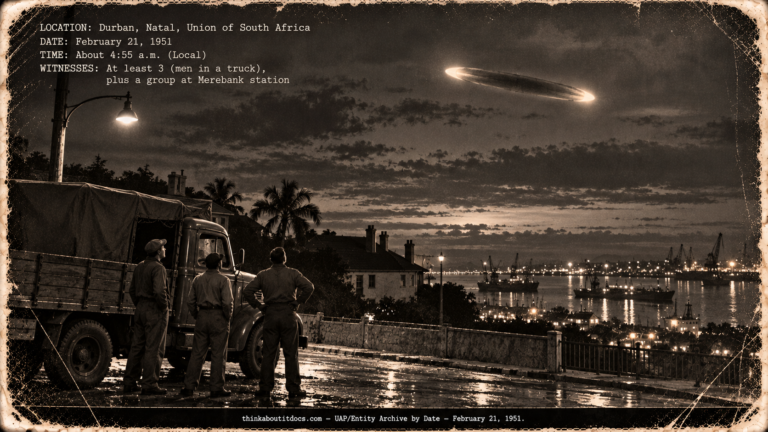
Date: February 21, 1951
Location: Durban, South Africa
Time: About 4:55 a.m. local
Summary: Three men in a truck, along with other unnamed persons, saw a bright, torpedo-shaped object with a red nose, dark red center and bright red tail glide silently and level for about a minute, then pass out of sight toward the Bluff. Passengers waiting for the 5 a.m. train at Merebank station watched the same object over the sea, saw it change from a ball to a torpedo shape, and lost it near Reunion Rocks. A Durban astronomer ruled out a comet. The U.S. Consul forwarded both clippings to Washington. See the Detailed Report.
Source: BBU; Berliner; Natal Daily News, February 21 and 22, 1951; U.S. Consulate Durban despatch 282; Project Blue Book record card
Source Status: Some listings give February 21 or 26; the newspaper is dated February 21 and the consulate despatch February 26. Blue Book evaluation: Other (Unidentified).
Date: February 21, 1951
Location: Between Newfoundland and Iceland, over the North Atlantic
Time: 3:00 a.m.
Summary: Lt. George Williams was piloting a Navy Fleet Logistics aircraft at 10,000 feet when he first took the object for a ship and called his co-pilot forward. Nine witnesses watched it approach rapidly, veer to the port side, hover briefly, then rise away at extreme speed. Its size was estimated at about 200 feet, flat and elliptical or cigar-shaped in profile, with a ring of red-orange exhaust along its edge. The nearly full moon was visible throughout.
Source: Jan Aldrich; Project Interloper report
Source Status: Cited to Aldrich and Project Interloper as a case separate from the Bethune encounter of February 10; no Blue Book card or Air Force message for it is in the files reviewed. The “Incident #26” numbering and the Benton connection stated on the earlier page are not repeated here because they could not be verified.
Date: February 26, 1951
Location: Ladd Air Force Base, Fairbanks, Alaska
Time: About 7:10 a.m. local (1710Z)
Summary: USAF Sgt. John B. Sells, on interior guard duty, saw a dull grey, metallic object about 120 feet across and 10 to 12 feet thick, shaped like a flattened football, hover over the runway for about 45 seconds. It emitted a single puff or ring of white smoke and sped away without sound or exhaust. No other person reported it. See the Detailed Report.
Source: BBU; Berliner; Project Blue Book record card; AFOSI report on Sgt. Sells; Alaskan Air Command message
Source Status: Blue Book evaluation: Other (Unidentified), with a card comment raising the possibility of a weather balloon bursting or entering overcast; the OSI report found no balloons or aircraft in the area. The card says the object went south and the OSI report says north.
EXECUTIVE SUMMARY
Explained Lights, Unexplained Reports, and One Crowded Ocean Route
February 1951 is a month in which the official evaluations pull in different directions. Project Blue Book attributed Galena to a meteor, Dobbins to the star Sirius, Holloman to a star or planet, Lucerne Valley to Muroc tow targets and Cape Wales to a ship, and an Air Materiel Command astronomer concluded that Bethune’s crew saw an unusual aurora. Yet three February cases carry an Unidentified evaluation from Blue Book itself (Johnson Air Base, Durban and Ladd Air Force Base), and the Kilimanjaro sighting was left as Insufficient Data.
The month’s strongest documentation belongs to Ladd Air Force Base, where an Air Force Office of Special Investigations report found no balloons, aircraft, test firings or project work that could account for the guard’s sighting, and to the Bethune file, which preserves the original cables, the Gander air-traffic statement and the astronomer’s opinion. The Durban, Johnson Air Base and Kilimanjaro cases each rest on a diplomatic or military report, and Condamine reached Air Technical Intelligence Center through the Air Attache two years later. A pattern also shows in the timing: three North Atlantic reports, two of them (February 8 and February 10) probably describing the same event, cluster along the Iceland-to-Newfoundland ferry route, and Blue Book’s own list of unknowns includes the Johnson, Durban, Ladd and Rodeo cases.
“I observed a glow of light below the horizon about 1,000 to 1,500 feet above the water.”
— Lt. Graham Bethune, co-pilot of Navy transport 6501, on the February 10, 1951 encounter over the North Atlantic