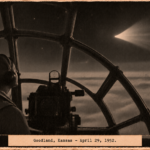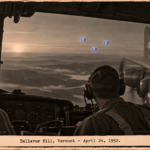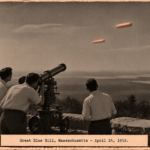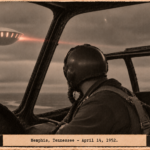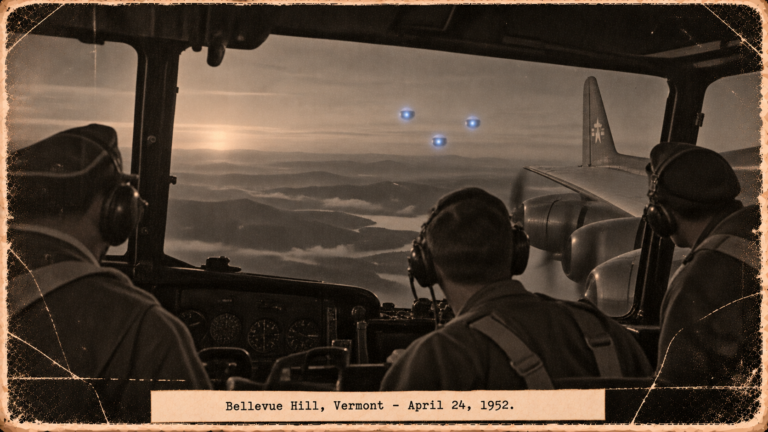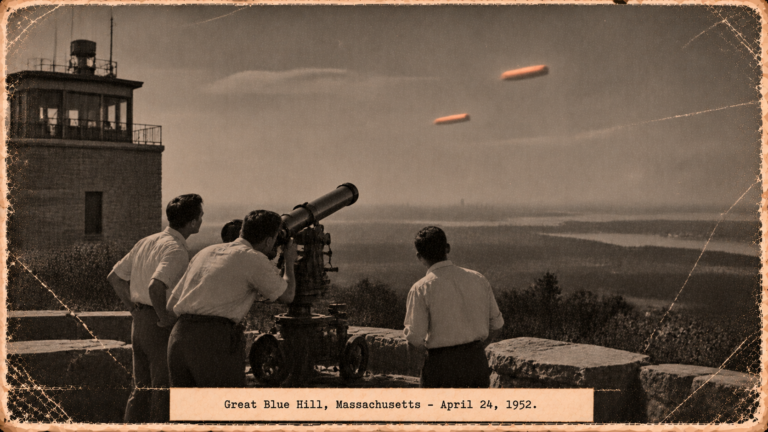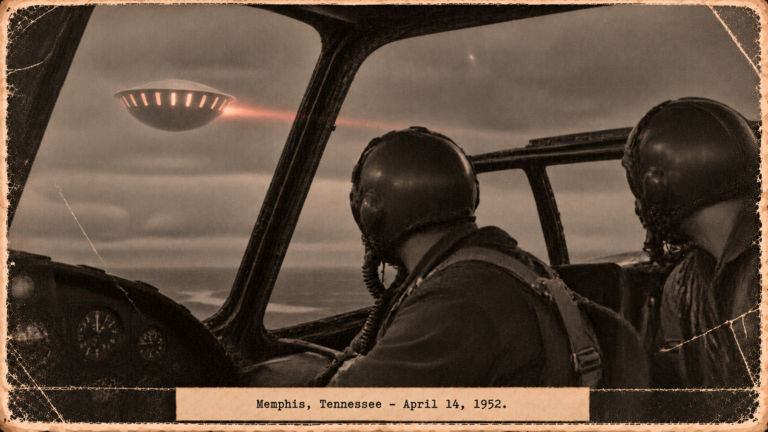
A C-47 crew tracking a Project Gopher balloon near Holloman AFB, New Mexico, reported a round object that left the balloon on January 22, 1951.
THINK ABOUTIT UFO|UAP SIGHTINGS REPORT
1951: Round object separates from Project Gopher balloon near Holloman AFB
On the morning of January 22, 1951, a C-47 carrying two Air Materiel Command captains, a General Mills engineer, and an airman was following a Project Gopher research balloon across the New Mexico desert when a bright, star-like point appeared beside it. As the crew flew beneath the balloon, the point seemed to descend to the balloon’s level and swell into a round, flat, milky-white object clear enough to look like a dime.
For about three minutes it held its place next to the pear-shaped balloon. Then it separated, streaked west at high speed, and after about a minute flashed three times like photo flashes and disappeared. The pilots filed a report at Holloman AFB, the story reached the Dayton Daily News weeks later, and Project Blue Book’s card explained it as gas leaking from the balloon. This Holloman AFB UFO case, set inside a known research program, shows how an unknown object and a known balloon ended up in the same patch of sky.
Date: January 22, 1951
Sighting Time: Approximately 10:00-11:00 a.m. (the Blue Book card logs 1800Z; the C-47 took off at about 9:00 a.m.)
Day/Night: Day
Location: Approximately 50 miles southeast of Holloman AFB, New Mexico, United States (roughly halfway between Holloman and Salt Flat, Texas)
Urban or Rural: Rural (high desert)
No. of Entity(‘s): 0
Entity Type: None observed
Entity Description: Not Applicable
Hynek Classification: DD (Daylight Disc)
Duration: About 3 minutes (Spradley and the Blue Book card); Cocker told the Dayton Daily News he watched about five minutes
No. of Object(s): 1
Description of the Object(s): A bright, star-like point beside a Project Gopher balloon that resolved into a round, flat object with a clear outline, then separated from the balloon, moved off horizontally at high speed, and disappeared after three bright flashes.
Shape of Object(s): Round, flat, like a dime (Spradley)
Size of Object(s): Roughly one quarter to one half the size of the balloon (witness estimate); the balloon is given as about 70 feet in Aldrich’s summary
Color of Object(s): Milky white or silvery; clear silver with no twinkle (Cocker). The card also notes orange sparks as it departed.
Distance to Object(s): Not measured. The object and balloon were estimated at 50,000-70,000 feet while the C-47 flew at about 11,000 feet.
Height & Speed: Estimated 50,000-70,000 feet (object and balloon); hover, then very high speed in level flight toward the west
Number of Witnesses: 4: Capt. Ernest W. Spradley, Capt. James E. Cocker, a General Mills project engineer (Mr. McAleese), and an airman
Special Features/Characteristics: Object appeared to descend to the balloon and grow larger; separated and left westward at high speed; three flashes at one-second intervals; the balloon began to descend soon afterward
Case Status: Evaluated by Project Blue Book as Other (gas leaking from the balloon); the witnesses’ description of a solid round object that flew off is unresolved
Source: Project Blue Book record card; Spradley statement and Holloman incident report of January 1951; Jan Aldrich; FUFOR Index; Dayton Daily News, Feb. 9 and Feb. 15, 1951
Summary/Description: While tracking a Project Gopher plastic balloon at 50,000-70,000 feet from a C-47 at about 11,000 feet, the crew saw a star-like object next to the balloon. It appeared to descend to the balloon’s level and grow larger, round and dime-like. Cocker and the engineer watched it from the astrodome. After about three minutes it separated from the balloon and headed west at high speed. About a minute later it emitted three bright flashes at one-second intervals and disappeared. The balloon descended shortly afterward and landed near Salt Flat, Texas.
Related Cases: January 1951 UFO sightings archive | Sioux City, Iowa, January 20, 1951 | Westover AFB, January 24, 1951
Detailed Report
This report concerns a daylight sighting on January 22, 1951, during a Project Gopher balloon-tracking flight out of Holloman Air Force Base, New Mexico. Two Air Materiel Command officers from Wright-Patterson Air Force Base were aboard a C-47: Capt. Ernest W. Spradley of the Aerial Photographic Laboratory and Capt. James E. Cocker of the All-Weather Flying Division. With them were a General Mills Aeronautical Laboratory project engineer and an airman. The balloon being tracked was set to hold about 100,000 feet for roughly four hours.
The C-47 took off from Holloman at about 9:00 a.m. and climbed to roughly 10,000 to 11,000 feet. The crew picked up the balloon shortly afterward and tracked it on an easterly course. After about an hour, about 50 miles southeast of Holloman and about halfway between the base and Salt Flat, Texas, the crew noticed a tiny, star-like object next to the balloon, and Spradley and the engineer were notified. The balloon was at 70,000 feet or more and looked pear-shaped. The C-47 was far below it.
Spradley’s written statement says the object was above and to the side of the balloon, though there was no reference to say how far, and that it was flat and round and milky in color, while the balloon was pear-shaped. He watched it for about three minutes. The object held its position relative to the balloon, and as the C-47 flew beneath the balloon he lost sight of it. Cocker and the engineer then went back to the astrodome to watch. In the incident report, the object appeared to descend to the balloon’s level and grow in size until its round shape and clear outline were visible, one quarter to one half the size of the balloon.
The object then separated from the balloon and moved west in level flight at very high speed, emitting orange sparks according to the Blue Book card. After about a minute it gave off a series of brilliant flashes at one-second intervals, which Cocker later described as three flashes like photo flashes, and disappeared. The crew called Holloman Tower to ask whether other aircraft were in the area; the report says that when the tower was told of the object there was no reply. Soon afterward the balloon began to descend and landed near Salt Flat, Texas. The crew made a verbal report at Holloman, the incident was reported to the project chief, and an officer of the Electronics Sub-Division was contacted.
The case reached the press weeks later. On February 9, 1951, the Dayton Daily News ran “Saucer Visiting Balloon? 2 Field Pilots Not Sure,” and on February 15 it followed with “A.F. Officers Report Seeing Flying Saucer.” Spradley told the paper the object was flat, looked like a dime and was milky in color, just hovering near the balloon. Cocker said he had never seen anything like it, that it was perfectly round, and that he did not know what it was. In the paper’s account Wright Field had no official comment, and Air Materiel Command officials said they had received no official reports from the two officers and did “not take it too seriously.” A spokesman said that observers in such cases were usually too far away to identify what they saw, and asked how much the average person can see at a distance of more than ten miles. The paper noted that the balloon was similar to the type used in Project Skyhook, which the Navy had disclosed that week.
Project Blue Book’s record card lists the case as Other, with the comment that the object was observed in conjunction with the balloon, that the balloon descended shortly after the observation, and that the most probable cause was gas leaking from the balloon. It attributes the flash to the leaking gas disappearing or exploding, and the color to the altitude and temperature of the escaping gas. The card also summarizes the witnesses’ description: a round object holding next to the balloon, then detaching and traveling in level flight at high speed, emitting orange sparks.
The Hynek classification is DD (Daylight Disc). A round, flat object was seen in full daylight at a long range, roughly ten miles or more from the aircraft. No entity, trace, or physical effect is reported.
Researcher’s Notes
A Balloon Case Within a Balloon Program: Holloman, Project Gopher, and the Escaping-Gas Explanation
- Classification and Range: The object was far outside the 500-foot range of a Close Encounter, since it was near a balloon at 50,000-70,000 feet while the aircraft flew at about 11,000 feet. DD applies because a defined round shape was seen in daylight, and no traces or effects were documented.
- The Explanation and the Account: The card’s explanation is that gas leaked from the balloon and produced the object, its color and the flash. The witnesses describe something different in behavior: a distinct round object with a clear outline that grew, separated, flew horizontally away at high speed and then flashed. The card itself repeats that description. Whether escaping gas could produce an object a quarter to half the balloon’s size with a clear outline is not addressed in the file.
- Witness Quality and Familiarity: The observers were two Air Materiel Command captains, a balloon engineer and an airman on a mission that required watching the balloon closely. That makes them well placed to notice anything unusual beside it, and also means they knew what the balloon normally looked like. The statements by Spradley and Cocker agree on the main sequence but differ on duration (three minutes versus about five) and on how much each saw from the cockpit versus the astrodome.
- Balloons in 1951: Plastic research balloons were new and little known to the public, and the Navy’s disclosure of Skyhook came the same week the story ran. Reflections off a high-altitude polyethylene balloon and debris from its release are reasonable candidates to consider. The file contains no instrument data to test them.
- Documentation Gaps: No photograph, theodolite track, radar record or independent ground observer is on file. The balloon’s altitude is given as 70,000 feet or more by the crew but its programmed altitude was 100,000 feet. Distances come from the crew’s estimates, and the apparent size of the object is relative to a balloon whose own size and range were uncertain.
- Official Handling: Air Materiel Command officials told the Dayton Daily News they had no official reports from the officers, while the file contains the officers’ written report and a Blue Book card. The two statements are recorded as they were reported and are not reconciled in the available record.
The Holloman Project Gopher sighting is a case in which the observers, the setting and the official explanation are all unusually well documented, and in which the explanation and the witnesses’ description still do not line up cleanly. A balloon engineer and two Air Materiel Command pilots watched a round object sit beside a balloon, leave it and flash away. Blue Book called it escaping balloon gas. With no instrument data, the honest position is that the case is unresolved: not proven to be anything exotic, but not convincingly explained by the explanation the Air Force gave.
“I saw something I never saw before. It was perfectly round. But I don’t know what it was.”
— Capt. James E. Cocker, All-Weather Flying Division, on the January 22, 1951 Holloman sighting (Dayton Daily News, February 1951)